As runners, we often chase the clearly rewarding aspects of our sport — faster times, longer distances, and that exhilarating sense of flow on the trail. Yet, there is another potentially more critical pursuit: maintaining the efficiency of our bodies to sustain performance and avoid disruption.
But for many runners, staying healthy feels like a game of chance, with periods of blissful, pain-free running suddenly disrupted by pain and injury without warning.
In reality, healthy running and injury are far from binary. Rather, they are at two ends of a continuum. Approaching the injury end of the spectrum often begins with subtle signs that get progressively more noticeable. The closer attention we pay to those small issues, the better we are able to avoid the injury end of the continuum altogether.

Paying attention to subtle signs can help keep biomechanical dysfunction from turning into an injury. Photo: iRunFar/Eszter Horanyi
Biomechanical Dysfunction as an Iceberg
Most running injuries are not random. Instead, many stem from deep-seated biomechanical dysfunctions. These are situations where key body parts and systems fail to function correctly over time, whether due to insufficient motion, force, or coordination. This can occur at a micro level, such as restricted mobility in specific joints or tissues, or at a macro level, involving whole-scale inefficiencies in stride mechanics, including posture and propulsion.
Impaired running performance — a loss of top speed and endurance — is often the first sign that something is amiss. If untreated, dysfunctions can then manifest as stiffness, soreness, and pain before ultimately developing into a full-blown injury. As such, injury rarely strikes without warning. In fact, it serves as a lagging indicator of diminished system efficiency.
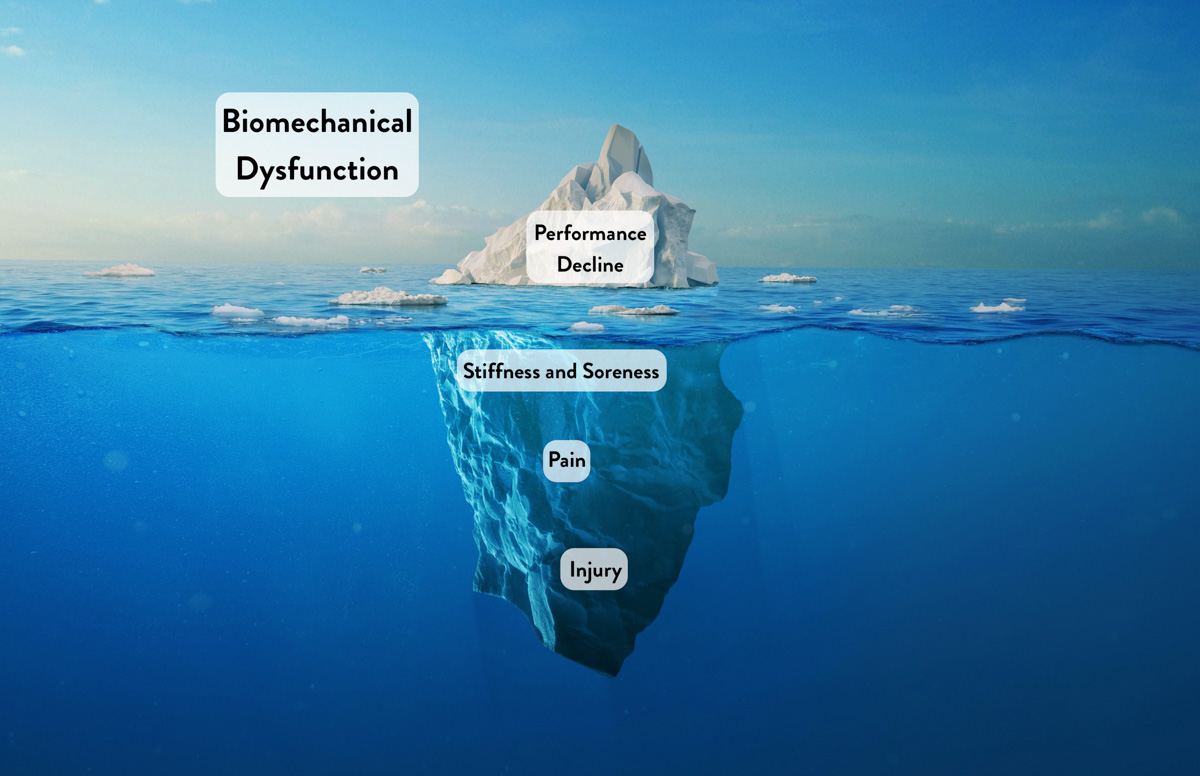
The biomechanical dysfunction iceberg. Image is modified from Shutterstock.
Think of an emerging dysfunction as an iceberg: the bulk lies hidden below the waterline, with only the tip readily visible from afar. In this metaphor, the visible tip of the iceberg represents performance decrease, while below the water are the larger and more insidious issues of stiffness, soreness, pain, and, eventually, injury.
In a previous article, we outlined the value of routine orthopedic maintenance, ideally guided by a trusted professional — your “family practice orthopedist” — to assess, restore, and preserve biomechanical efficiency. However, not every runner has immediate access to such care. The challenge, then, is to proactively monitor your own system’s health by tracking mobility, strength, efficiency, and performance across several metrics to detect — and quickly and effectively reverse — dysfunctions as soon as possible.
If we can learn to recognize an emerging dysfunction in that monitoring process by its early warning sign of a decrease in performance as the tip of an iceberg, then we can steer our ship well clear of the big chunk of ice and avoid serious damage.
So, in this article, we’ll help you to understand our body systems as an iceberg, as well as the corrective action you can take to make sure your ship stays in ice-free waters. This strategy not only prevents season-ruining injuries, but it is also the key to more effective training with quicker recovery, minimal aches and pains, faster performance, and ultimately more enjoyable running.
Physiological Factors Can Also Be Icebergs
Before we, ahem, dive in, we want to mention that not all performance declines, aches, pains, and injuries arise strictly from inefficient movement. Other physiological factors can also be icebergs leading to performance impairment, aches and pains, and injury, including:
- sleep (quantity and quality)
- nutrition (quantity and quality)
- non-running activity load (work, family)
- non-physical (emotional and/or psychological) stressors
All of these factors can profoundly impair our running and lead to injury, even with pristine biomechanics. Key big-picture metrics to monitor holistic health may include sleep measures, as well as resting heart rate and heart rate variability.

Even with perfect biomechanics, physiological factors can lead to issues. Photo: iRunFar/Eszter Horanyi
Layers of the Iceberg
The following are four progressive signs of biomechanical inefficiency, in order of first appearance and increasing severity, from the tip of the iceberg on down. When ignored, subtle signs of biomechanical dysfunction, like elevated heart rate or decreased mobility, can result in the escalation of an issue that leads to injury.
Declining Performance Metrics
The first visible layer of an issue often appears in performance data. You might notice reduced top-end speed during short sprints or intervals, slower times on familiar runs, loops, or short races, or elevated heart rate and perceived effort for standard paces and distances. This tip of the iceberg can be remarkably subtle, particularly if you are not closely attuned to your body’s feedback or do not maintain consistent training logs. Many runners overlook these shifts, attributing them to external factors or simply an off day.
Increased Stiffness and Soreness
The next progressive clues of system inefficiency are increased stiffness, decreased mobility, and tissue soreness. Stiffness manifests when dynamic stretching feels more resistant, yoga or mobility routines become challenging, or daily transitions — rising from bed, standing after prolonged sitting, or the initial miles of a run — require extended time to feel fluid and normal. Soreness, meanwhile, reflects greater muscle sensitivity during stretching, active use, or impact loading.
When these intensify despite consistent volume, intensity, or familiar training progressions, they indicate the equivalent of rising friction in a system. This layer is more noticeable than declining performance metrics, yet still tempts dismissal as temporary or acceptable, especially if occurring during high-volume, A-race preparation.

Small signs can indicate issues long before they turn into a full injury. Photo: iRunFar/Eszter Horanyi
Increased Pain
This next layer down in the iceberg is discomfort beyond typical soreness that persists during or after runs. As it worsens, pain may begin to limit running duration or intensity and eventually prompt compensation, like limping. Pain generally precedes tissue damage, signaling overload without necessarily indicating breakdown. Yet.
For most runners, this is often the point at which they finally realize a problem exists. Yet they may still fail to recognize running inefficiency as the cause, often blaming other external factors such as cold weather, poor footing, or faulty or different footwear.
Injury
At the frozen bottom of the iceberg lies injury, when real tissue damage occurs. This can be a sprain, strain, or fracture, and is often accompanied by swelling, bruising, moderate to severe pain, weakness, and reduced load-bearing capacity.
Not due to bad luck or training faults, tissues fail under the relentless strain of an inefficient system over many miles, months, and even years. For example, an acute hamstring strain may feel random or because of running fast, yet the true cause may be a chronically anteriorly tilted pelvis that is placing excessive tension on one hamstring. Over time, especially during long or fast efforts, this can lead to micro or macro muscle tears.

Fast efforts can cause injuries if there are underlying mechanical inefficiencies. Photo: iRunFar/Eszter Horanyi
Strategies to Monitor the Ship and Change Course in Icy Waters
To avoid ramming headlong into a season-wrecking iceberg — as well as finding the calmest waters for smooth, easy sailing — prioritize self-assessment and early action:
- Know Your Optimal Stride. Familiarize yourself with your most efficient running form, ideally using video analysis with your family practice orthopedist. Know what your “best” looks and feels like, and check in routinely.
- Understand Your Baseline Mobility. Regularly check your range of motion in key areas, like the hips, ankles, and thoracic spine.
- Maintain Reliable Running Data. Track heart rate, typical paces adjusted for seasonal fitness, and performance on standard routes. It’s best to pair these with effort metrics.
- Heed Stiffness, Soreness, and Pain. Have a daily mobility routine and recognize sustained flexibility losses, as well as increased soreness and pain, as signals of increased stress from reduced efficiency, rather than bad luck or random chance.
- Restore What You Can. Self-massage and stretch relevant areas; perform routine core and hip strength exercises; do mobility work on restricted areas; activate core and hip stability; and self-optimize your stride as best you can, until…
- Seek Professional Help Early. Consult your trusted family practice orthopedist at the first substantive signs of an iceberg. Early intervention minimizes downtime, accelerates recovery, supports progressive training, and ultimately enhances performance.
Peak running health exists on a continuum — from maximal efficiency with minimal strain to inefficiency that strains tissues and invites injury. By deeply knowing your body, training history, and typical responses to load, you position yourself for sustained, strong, fast, and joyful running. Monitor the iceberg closely, intervene early and wisely, and steer your ship to its best course!

Listening to your body closely can result in many long and happy running miles. Photo: iRunFar/Eszter Horanyi
Call for Comments
- Have you ignored the early signs of biomechanical dysfunction, only to end up with an injury?
- What other signs do you heed to stave off an injury?