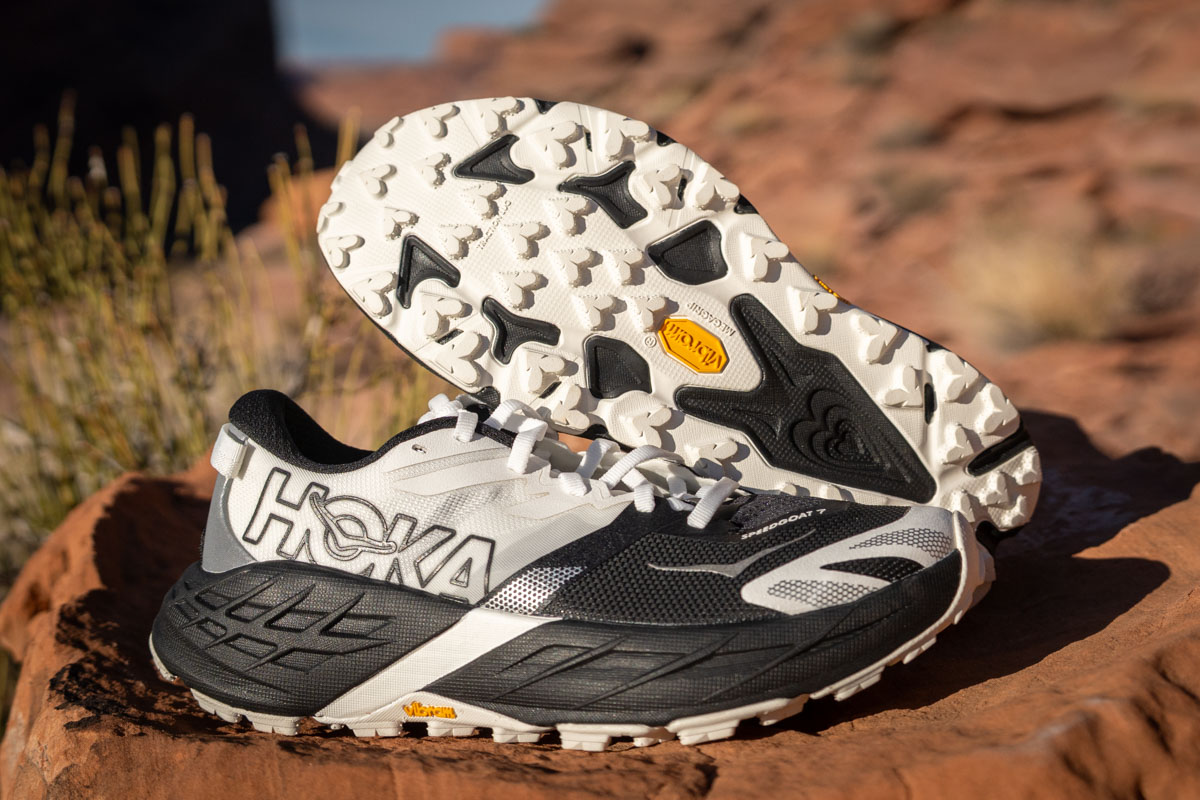
The Hoka Speedgoat 7. All photos: iRunFar/Eszter Horanyi
Coming to market a few months earlier than expected, the Hoka Speedgoat 7 ($165) has arrived with a new upper, a more lively midsole, and an updated lug pattern on a Vibram Megagrip outsole. In many ways, this beloved trail running shoe has returned to the characteristics that first made it so popular.
At its inception, the Speedgoat model was meant to be the Hoka shoe that could go any distance and over any kind of terrain. With solid upper lockdown, a protective but responsive midsole, and enough traction for most scenarios, the Speedgoat became the most popular shoe on the starting lines of the world’s top ultras. Speedgoat aficionados, however, thought the Hoka Speedgoat 6 deviated too far from its legacy. It had a looser upper and a firmer midsole, making it unwieldy for bigger days or on technical terrain.
This version has an actual weight of 9.1 ounces (257 grams) in a U.S. men’s 9, a 5-millimeter drop, and a 37-millimeter stack height in the heel. The redesigned upper locks down well on gnarly terrain; supercritical foam in the midsole offers both protection and comfort; and the outsole provides plenty of grip and traction.
The Speedgaot 7 remains a staple in our rotation and is currently featured as a top pick in our comprehensive guide to the best trail running shoes of 2026.
In the video below, iRunFar’s Travis Liles takes a look at the new Hoka Speedgoat 7 and explains how it has taken steps toward returning to its roots.
Shop the Men's Hoka Speedgoat 7Shop Women's Hoka Speedgoat 7
[Editor’s Note: Click here to watch the review on YouTube.]
Hoka Speedgoat 7 Review Transcript
Hey, and welcome to Trail Trials, a video review section of iRunFar. My name is Travis Liles. In this video, we’re looking at the Hoka Speedgoat 7.
Let’s start with the basics. This is the seventh iteration of the Speedgoat from Hoka, so it’s a tried-and-true shoe in the trail running and ultrarunning community, especially for technical terrain, thanks to its max-cushion balance. This shoe weighs 9.7 ounces in a U.S. men’s size 9, just under 10 ounces. You have a 5-millimeter drop from heel to toe, with about 37 millimeters of stack height in the heel and 32 in the forefoot. We have a redesigned tread pattern on the bottom, but most importantly, the new supercritical foam in the midsole is a lot squishier. We’ll get into those details, but let’s get up close and personal to see what this shoe is all about.
A quick disclaimer: generally, in my reviews, we show B-roll, and there’s dirt and stuff all over the shoes, and more broken-in-looking shoes. I spent almost 100 miles in a Speedgoat 7 over the last month, but not in the Speedgoat 7 I’m showing in this video review. I ran in a shoe with an unreleased colorway, so we can’t show it. This is the official colorway launched now, but I’m basing my opinions and thoughts on testing a shoe in another colorway. With that in mind, let’s check this thing out.
Hoka Speedgoat 7 Outsole
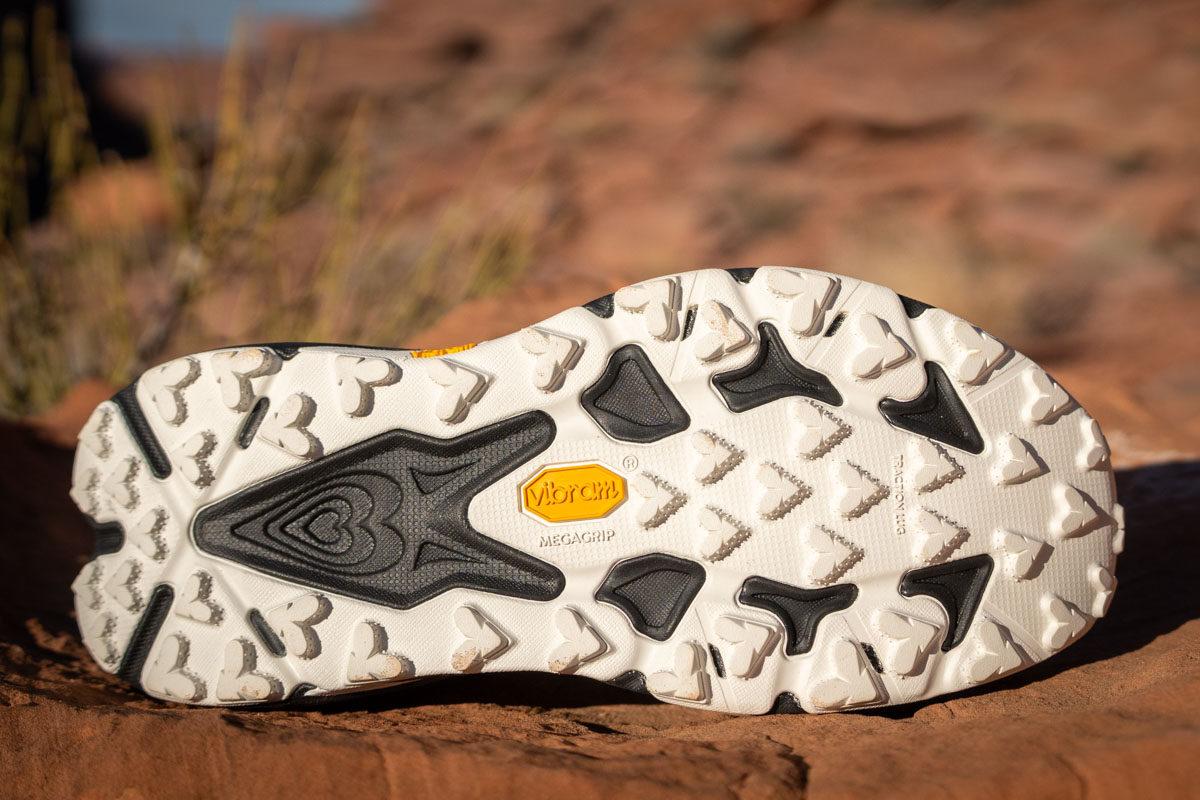
The outsole of the Hoka Speedgoat 7.
Let’s start by talking about the Hoka Speedgoat 7 outsole. If you’ve worn Speedgoats in the past, it’s Vibram Megagrip, and there are no changes to the compound. What changes is the patterning. That’s really the main part, so we still have 5-millimeter lugs that bite in and do a good job of getting some depth and grip into the ground. You have the Traction Lug technology, which are these little dots all the way around the outside of the lug that add more surface area. That’s supposed to add more grip. You have forward-facing lugs in the front for going uphill. You have rear-facing lugs at the back, and they sort of transition back and forth in the middle part of the shoe for that kind of transitional movement.
Overall, if you like what Vibram Megagrip is, this shoe fits right in. If you like existing Speedgoat outsole patterns, whether that’s really anything from the sixth version down to, probably, the second, I don’t think you’re going to notice much of a performance difference. I train in the U.S. Pacific Northwest. It’s wet. It’s muddy. It’s slick. Things have moss on them. The bridges get slimy. These perform exactly as I would expect, which is very good.
Hoka Speedgoat 7 Midsole
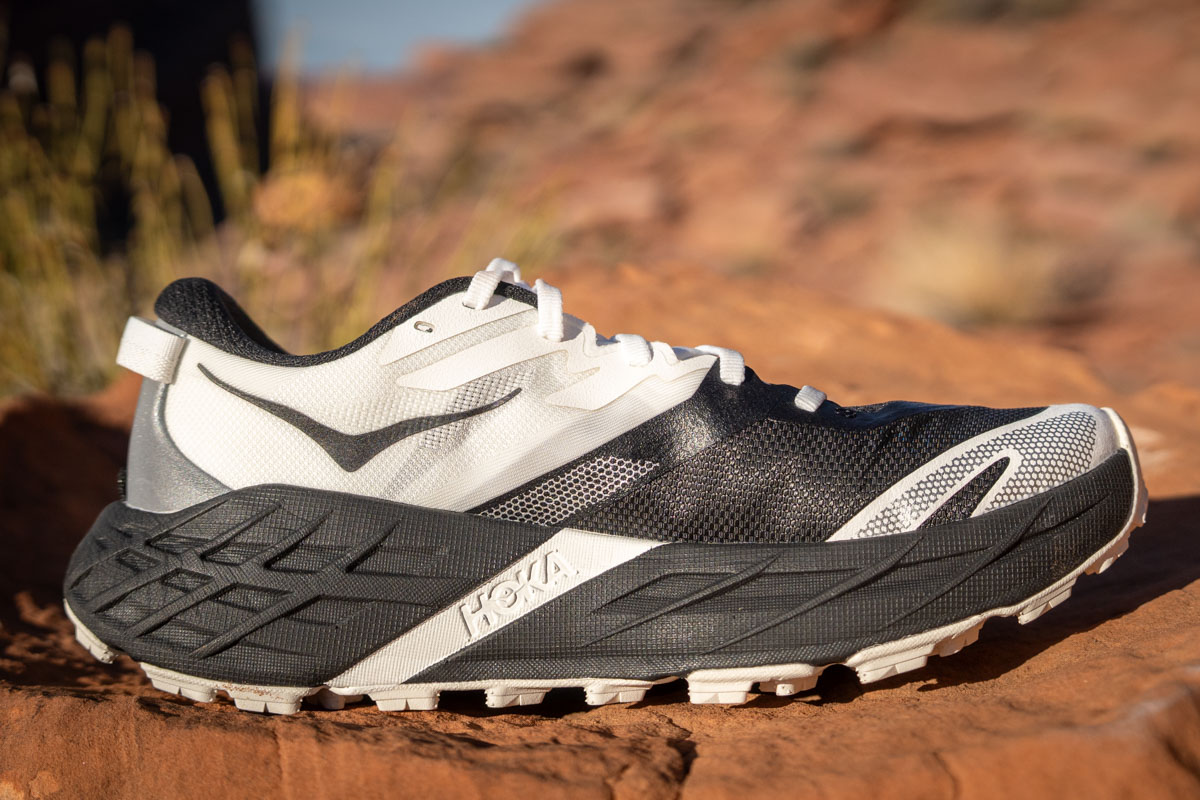
A medial view of the Hoka Speedgoat 7.
Moving into the Hoka Speedgoat 7 midsole, this is probably what I think is most significant about this shoe. They’re using supercritical foam in the midsole. I want to call out a couple of things before I dig into that too far. You’re going to notice this line, and you’re going to see it in press shots as well. This is not a piece of plastic. This is not really anything other than something visual. You can see where that white stripe just sort of turns into the midsole, so it’s really just a way to visually style it and break up the midsole a little bit in how it looks. But it is just foam, so I want to call that out.
What is supercritical foam? Well, this is a much springier, livelier-feeling version of the Speedgoat. Arguably, as someone who’s worn this shoe from the beginning, I’d say that this is probably the most lively and active feel of a Speedgoat. The last version was very firm. This sort of sits in the middle between what I think is the original Speedgoat foam and then the last version that we just had.
This foam rides really nicely. It absorbs impact from obstructions and obstacles on the trail. Things are poking up on the trail, and the pressure from those things seems to disperse well. It also has a lively type of feel. What I mean by that is there’s no rock plate or carbon-fiber plating or anything like that. But this, to me, feels like the most active and modern foam that’s been in this shoe.
In fact, if you have an older Speedgoat and you hit the heel down on the ground, it’s got almost a hollow, puffy sound and feel to it. This has a much stronger rebound, but it doesn’t add any weight. It still comes in at sub-10 ounces, so it’s just a bouncier feel while maintaining the older Speedgoats’ softness, which means less foot fatigue and less firmness. I feel like the shoe deforms and melds to the terrain beneath it better than the last version, which I felt was too stiff for what the Speedgoat was originally.
Hoka Speedgoat 7 Upper
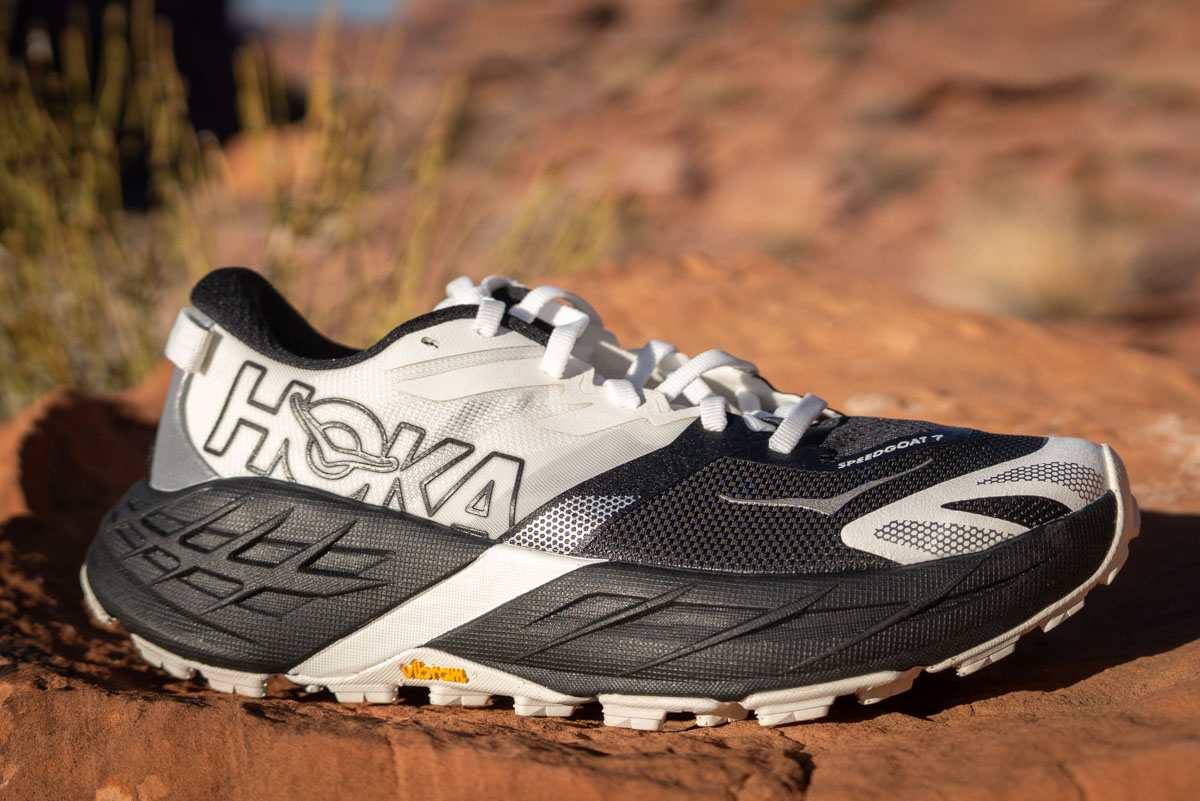
A lateral view of the Hoka Speedgoat 7.
Let’s talk about the other significant update in the Hoka Speedgoat 7: the upper. If you look at this upper visually, you’ll note that, from the fifth and sixth versions to now, they’ve gone back to a more traditional upper patterning. What I mean by that is, if you look at some of these spots, there’s a little bit of a darker white and a little bit darker black. You’re going to see the same type of patterning on the outside, and a little bit up here as well.
Gone is the kind of booty, sock-like stretch-mesh upper we’ve seen in the last couple of iterations. We’re back to an upper that is a little tighter. That seems to come from some of the fabric, which is less stretchy, and also from an upper that incorporates a cage-like structure, which I showed with these lines going through. To look in here, there is a tiny bit of a gusseted tongue, just barely though. It’s really mostly just to keep the tongue in place. But right behind where this gusset, this stretchy mesh — it’s tough to see because it’s black — there’s a cage-like feel. That cage-like feel is attached to the laces and goes all the way down to the midsole. It fits very much between these middle eyelets of the shoe on both sides.
It really locks down the top of the foot, keeping your foot connected inside the shoe rather than sliding back and forth or having some stretch and give. The benefit to me is that you have a more locked-down shoe, so when you’re on technical or off-camber terrain, your foot slides less, and it definitely feels more locked down, which I enjoy.
Up to the tongue, to expand on that a little bit more, it’s been lengthened, so it covers more space. It comes up pretty far above the top eyelet. I generally lace at this top eyelet, and some of the previous Speedgoats, the laces, when I tied them, were above the tongue. That has been eliminated, so this covers more of your foot and reduces irritation between the top of your foot and the shoe.
Let’s slide down into the bottom of the shoe itself. You’ve got some stretch and breathability in this upper part of the shoe. For an upper, in general, it’s a little bit more scratchy — I’m going to use the word dry-feeling — upper. Instead of having a soft, clothy feel, it has a slightly more rugged feel. You can hear that in my scratching. But, again, with 100 miles in the pair I tested, I’ve not noticed anything like tearing early. It’s been holding up as expected for the life of any general shoe. So, 100 miles, it’s going to look a little bit worn in, but you shouldn’t have any holes or things like that. I can report back that, compared to the others, that is the case.
Very similar stuff with the toebox, some overlays in the front, and a toe cap that brings it up. That’s pretty rugged and sturdy on the front. If you’re even taking them through water, there are enough spots where the water can escape. Even doing some creek crossings and things like that, I felt like they dried out fairly well.
Lastly, let’s talk about the heel cup. It’s a very standard, structured one. You can see it breaks down a little bit where the heel cup comes in. You’ve got a big tag on the back to pull this up on your heel. There is a gaiter attachment at the back if you’re into gaiters, and a big reflective hit on the back, which is good for wintertime running and just being seen. Overall, if you are an old Speedgoat fan, and by “old” I mean versions 2 through 4. And if versions 5 and 6 weren’t doing it for you, I think you’re going to be pretty happy about what’s going on here.
Hoka Speedgoat 7 Overall Impressions
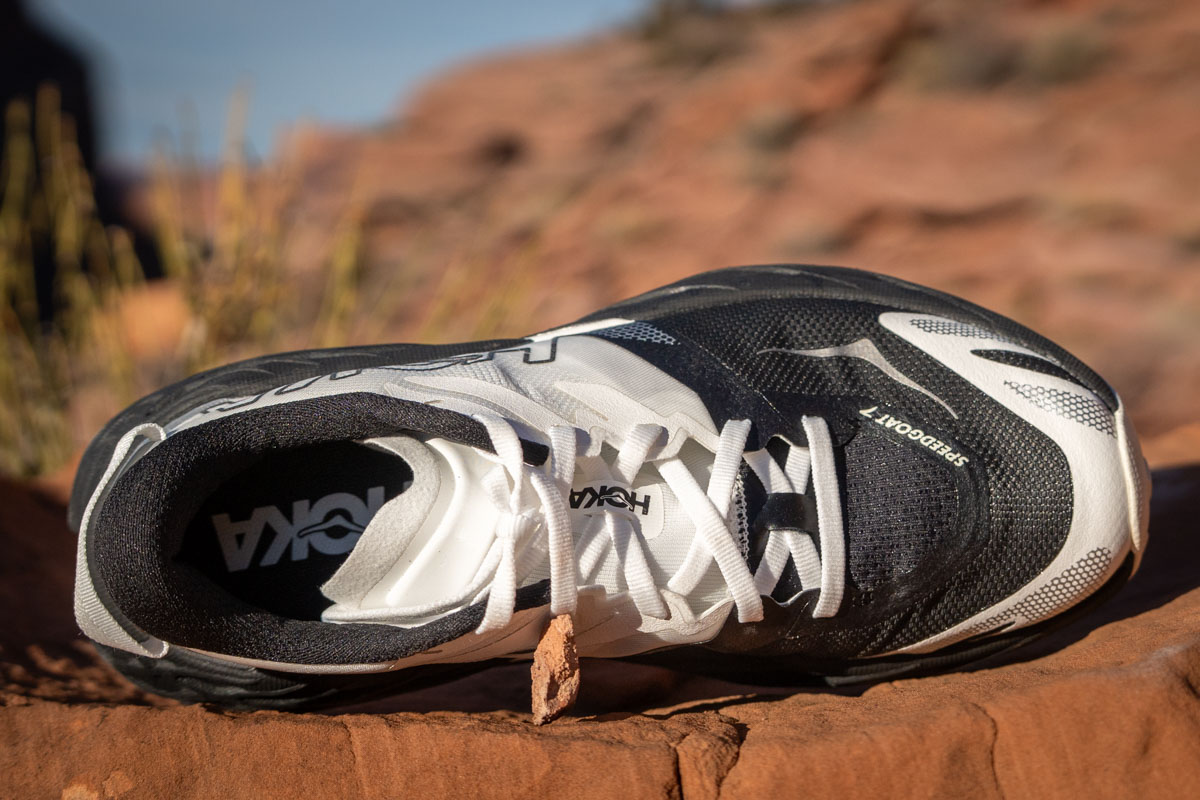
A top view of the Hoka Speedgoat 7.
In closing, I’m excited about the Hoka Speedgoat 7. I’ve been wearing Speedgoats for, basically, their entirety, with the exception of the first version. The last couple of versions, quite frankly, were not what I felt were true to the model. They were pretty firm. The upper didn’t lock down very well, so it sort of ended up in this spot of not something I could wear for really technical stuff. I felt like it was very much more tuned for the fire road, wide, not a lot of movement, less technical terrain. This, to me, gets back to what the Speedgoat 2, 3, and 4 were: a really locked-down upper, a good grip on the bottom, and foam that feels both protective and enough cushion, yet springy enough to feel fast when it needs to feel fast. But, for long-distance trail running, for general everyday trail running, there’s a lot to like.
If I were to really think back about the last couple of iterations, really, it was the Hoka Mafate Speed 4 that, for me, took the place of the Speedgoat. That was because it felt more locked down. It had a softer midsole. It felt like it worked better on technical terrain than the last couple of Speedgoat iterations. Then we moved into the newest Hoka Mafate 5, which had a higher heel drop and just didn’t feel as secure, and so I was, as an individual trail runner, left kind of wanting, “What am I going to wear right now?” Until the Speedgoat 7 came out, I didn’t have a good answer.
I was toying with a lot of different stuff, but I can say that, while this may not be the only shoe I wear, it is a shoe back to what the Speedgoat was for me: something I can just wear a lot and in a lot of different situations. I’ll feel good about really long-distance stuff. I’m going to feel good about fire roads. I’m going to feel good about technical terrain. I can wear it on the roads a little bit as well. It’s got all that stuff that was endearing to me about this shoe when it really hit its stride.
I’m very excited about this. Well, the only asterisk is that this version probably fits smaller than any other Speedgoat I’ve worn. This is a men’s 9. I wear a 9, but in terms of previous Speedgoat sizing, it feels about a quarter of a size smaller. I know that’s hard to quantify. Before, the Speedgoat was a touch big for me, and now this one almost fits just right. I bring that up because, if you’re somebody who was close in sizing before, you might want to size up. But outside of that, if you liked the heritage of the Speedgoat, you’re going to like what’s going on in the Speedgoat 7.
Any questions, comments, or feedback? If you’ve had a chance to wear these, leave them in the comments below. We’ll catch you next time.
Shop the Men's Hoka Speedgoat 7Shop Women's Hoka Speedgoat 7
Call for Comments
- Have you run in the Hoka Speedgoat 7? What do you think?
- What do you think of the midsole and upper on version 7, the parts of the shoe that received the most significant updates?
- How does this version compare to prior ones for you?
Our Favorite Trail Running Shoes
Check out our Best Trail Running Shoes article to learn about our current favorite trail running shoes!