As I write this, it is the second week in January. By now, many people have reneged on their New Year’s resolutions. If not yet, they may do so soon, as 23% of people quit their resolutions by the end of the first week of January, and only 9% of resolution-makers complete them by the end of the year (1).
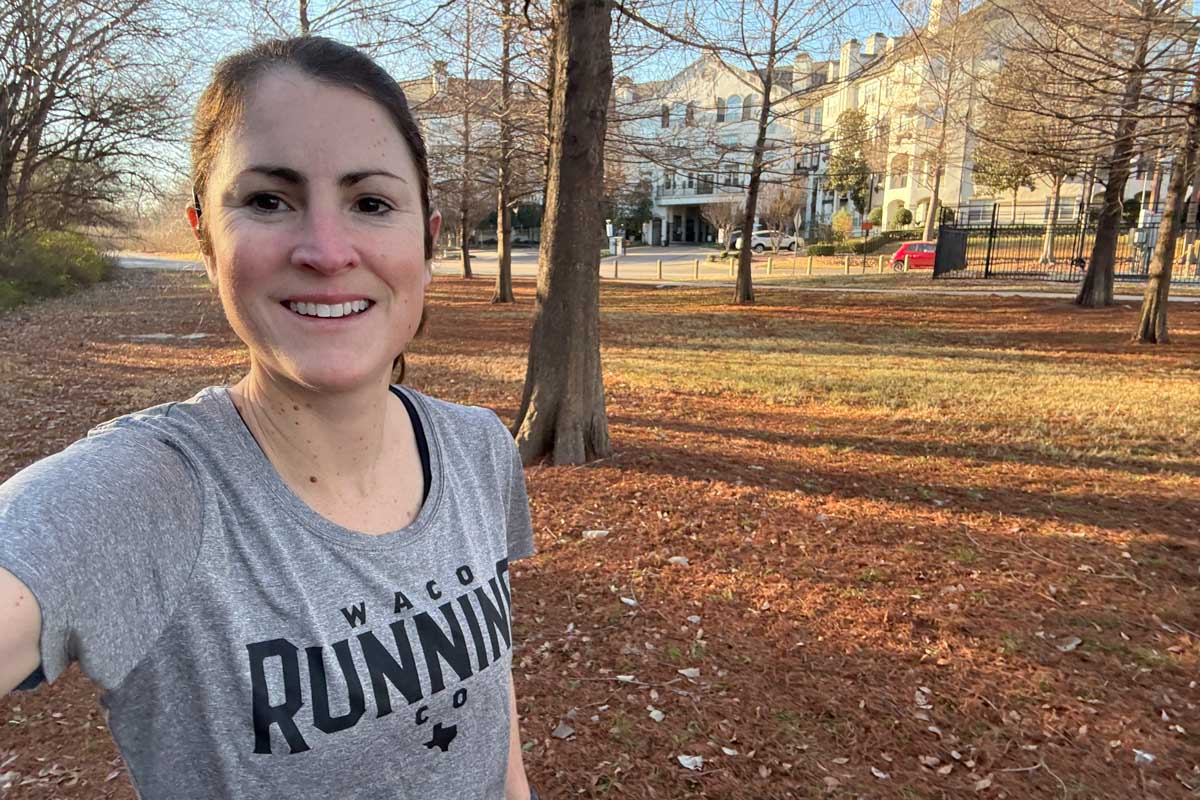
Sabrina learning how to be human through running. Photo: Sabrina Little
Even so, the turn of the new year occasions self-reflection. This is valuable, especially when accompanied by the intention to improve. And if, or when, we quit our resolutions, we learn something important about ourselves — that we are not excellent and we failed to become excellent when we tried.
Excellence is difficult. For example, it is easier to be impatient than patient. It is easier to be unjust than just when justice means advocating for others or challenging systems. It is easier to retreat from arduous goals — like giant race objectives or complex work projects — than to see them through to completion. It is easier to be lazy than diligent, irresolute than perseverant, fickle than stalwart. Virtue is hard.
Edifying Books
Like many runners, I am a book person. Like many book people, I am a runner. Both running and reading have been significant sources of edification in my life. Both serve as laboratories for moral cultivation and help me to see myself and others more honestly.
Last month, I provided a list of my favorite sports books from the past year. I promised to provide an additional list of classical texts I recommend for runners — and for people in general. These are not recent books — unless you consider 375 BCE recent. They are also not sports books. They are books from the Great Texts tradition that have enduring significance because they ask perennial questions about what it means to be human.
In the spirit of the new year — and in recognition of waning resolutions to be better — here are four books that I recommend. They have meant a great deal to me as a human and a runner.
“The Republic” by Plato
Imagine this. You are deep inside a cave, dwelling in the shadows and listening to echoes. Suddenly, you are drawn out of the cave. You are forced to ascend the steep upward way, which is painful and tiring, and when you emerge from the cave, you are confused and blinded by the sunshine (2).
No, this is not a trail race description — although, if it were, I would register immediately. It is the myth of the cave found in Book VII of Plato’s “The Republic.” Socrates provides this image in the context of a discussion on the nature of education (3).

Running toward the light. Photo: iRunFar/Eszter Horanyi
Plato wrote “The Republic” around 375 BCE. It is a Socratic dialogue, meaning it is a conversation that features Socrates and several interlocutors. It reads like a play or the transcript of an extended, amusing conversation. As you read, a character will say something incorrect that sounds reasonable enough. Then Socrates challenges the idea, and you are chastised alongside the character who said something you initially found sensible. In a dialogue, philosophy is preserved in a living form; you can participate in the inquiry as you read.
This book has perennial relevance across many topics — justice, the condition of the soul, truth, happiness, politics, aging, lying, love, and virtue. Runners will enjoy the section on the education of the guardians. A group of men is tasked to preserve justice in the city. They are prescribed physical training, a meal plan, and poetry to prepare them for that task. Every time I read “The Republic,” I think about my own physical training — running — and wonder how it shapes me. What does it mean for sports to educate someone to be more just? This is a line of inquiry we receive from Plato, and it seems particularly germane for our current moment of social unrest and political strife.
“Nicomachean Ethics” by Aristotle
If I ask you why you ran today, you might tell me about weekly mileage. If I ask you why you aim to meet that weekly mileage, you might say something about a racing goal. If I ask you why you selected that racing goal, this chain of questioning would not proceed indefinitely. Eventually, your “why” would be connected to your vision of a good life, or of happiness.
Aristotle’s “Nicomachean Ethics” starts with a memorable assertion — that everything aims at some good. He investigates the greatest good for a human. This is a valuable exercise for anyone; to ask the big question — “what are people for?” — or to investigate the ends at which our lives ostensibly aim. This is an exercise we undergo as runners when we speak about the “why” that sustains us through difficult miles or arduous terrain. Knowing our “why” matters because being firmly rooted in a purpose helps us to resist despair in hard moments. It also provides coherence across many seasons of life — seasons which may or may not involve running.

Understanding our “why” can keep us moving when things get hard. Photo: iRunFar/Eszter Horanyi
The “Nicomachean Ethics” is my favorite book. It investigates virtue, vice, freedom, emotions, the political, the contemplative, friendship, happiness, and character development. Of interest for a runner is the process by which we develop virtues — excellences — by repeated practice. This structure has a kinship with athletics. In running, we have a daily practice in excellence, trying to improve through repetition. We practice excellent habits of thinking and feeling when we train, and we try to become better. Developing virtues happens in a similar fashion.
“The Consolation of Philosophy” by Boethius
Have you ever been on the brink of despair in a race, and then you convince yourself that you are actually fine? I have. So has Boethius.
Book I of “The Consolation of Philosophy” is entitled “Boethius bewails his miserable state.” He feels bad, and he feels bad for himself — a perilous combination. Trust me, I have been there. In long races, “gloomy songs make no feigned tears bedew my face (4).” However, my tears are due to my own imprudence in undertaking an unreasonable hobby. Also, my imprisonment is figurative. Boethius’ imprisonment is both literal and unjust. He wrote this text in prison while awaiting execution by the Ostrogothic king, Theodoric the Great.
Boethius begins the book by bemoaning his lost fortune. Then he is visited by Lady Philosophy. This is akin to a race hallucination. For example, during a 48-hour run, I once thought I was surrounded by cats. Lady Philosophy helps Boethius to reconceive his situation. She points out that, while he lost lesser goods, he retains virtue, which is of greater value. Also, Boethius is more powerful than his captors because their power is misdirected. They are wrong about what will truly make them happy, so their power is for naught (5).
Friends, I hope that when you are stumbling through the wilderness in the final miles of an extended race, Lady Philosophy talks some sense into you. Though your condition may look bleak, you have only lost some ornamental goods of fortune. Virtue matters more.

When stumbling, listen to Lady Philosophy. Photo: Sabrina Little
“The Odyssey” by Homer
This would not be a serious list of classical text recommendations for runners if I did not include one of the greatest adventure tales in history. Read it. Your own misadventures may seem trivial once you read about Odysseus’ 10-year trek home, full of unanticipated obstacles. These include a cave nap with a Cyclops and a steep, mid-race descent into actual hell. Then, instead of being greeted happily at the finish, he has to demonstrate archery skills to win back his wife.
This trek sounds brutal, and Odysseus does not have the luxury of moisture-wicking clothes, a GPS watch, or carbon-plated racing shoes. Also, people often joke that ultrarunning is an “eating competition with some running along the way.” Odysseus’ adventure is the same. Food is a refrain throughout “The Odyssey” — bread, wine, cheese, lotus, and the Cattle of Helios. If Yelp food reviews existed back then, Odysseus would have an account. He would caution against eating the lotus, which generates apathy. He would give the Island of the Lotus Eaters a one-star review.
Final Thoughts
Alongside running, classical texts have been a critical source of edification in my life. These four books, in particular, have shaped me a great deal. They teach me about what it means to be human, and they have special relevance for runners. I challenge you to read one — or all — of them this upcoming year.
Do you have any books to share that have shaped you and your running?

Sabrina Little with her daughters, passing on lessons of excellence. Photo courtesy of Sabrina Little.
Notes/References
- Batts, R. 2023. Why Most New Year’s Resolutions Fail. Lead Read Today. Ohio State University. Web <https://fisher.osu.edu/blogs/leadreadtoday/why-most-new-years-resolutions-fail> Accessed 11 January 2026.
- Plato. The Republic. 514a-516a
- Plato. The Republic. 511a-514a
- Boethius, A.M.S. 2009. The Consolation of Philosophy. Transl. by W.V. Cooper. Ex-Classics Project. Web <https://www.exclassics.com/consol/consol.pdf> Accessed 13 January 2026.
- It is difficult to communicate the force and breadth of a powerful piece of writing in four paragraphs. There is a lot more worth saying here. My apologies to Boethius.