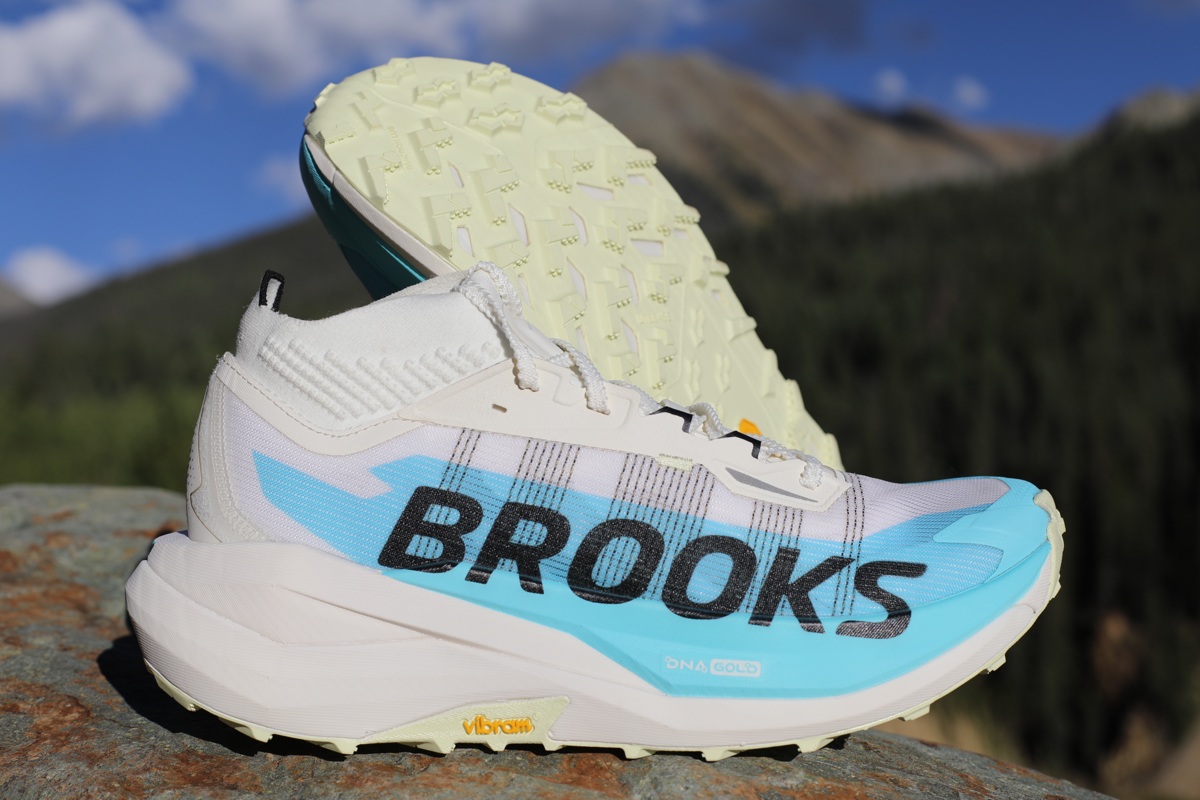
The Brooks Cascadia Elite. All photos: iRunFar/Bryon Powell
The Brooks Cascadia Elite ($275) feels like a clear statement from Brooks that they are serious about trail super shoes. The Brooks Cascadia line has long been known as dependable, protective workhorse shoes, and even the Brooks Caldera leaned more toward comfort than speed. The Brooks Catamount took a bigger step towards speed, and the Brooks Catamount Agil took that focus to a specialized extreme. The Cascadia Elite is something entirely different. In comparison to the Cascadia and Caldera, it’s a lighter, more responsive, more precise-fitting, and unapologetically race-focused trail running shoe. After roughly 150 miles of running in everything from dry singletrack to cold, snowmelt-soaked trails, it has proven to be one of the most complete trail race shoes I’ve worn.
At $275, it sits firmly in the premium category, and it runs like it belongs there. It has an actual weight of 9.8 ounces (278 grams) for a U.S. men’s 9 and features DNA GOLD 100% PEBA cushioning with a stack height of 40 millimeters in the heel and 34 millimeters in the forefoot for a 6-millimeter drop. That foam sandwiches a carbon-infused Pebax SpeedVault+ trail plate and is paired with a Vibram Megagrip Elite outsole.
On paper, the Cascadia Elite reads like a modern trail super shoe. On trail, it delivers performance without feeling twitchy, unstable, or overly aggressive. Some trail super shoes, like the adidas Terrex Agravic Speed Ultra (review), have a pronounced rocker geometry and rigid plated construction that allow them to excel on smoother, less technical terrain but can make them feel unstable on uneven trails. For me, some highly cushioned shoes like the Hoka Speedgoat 5 (review) and Hoka Speedgoat 6 (review) have felt somewhat tippy in comparison to the Cascadia Elite, which maintains its composure on technical terrain without sacrificing responsiveness.
From the first run, the fit felt dialed. The upper hugged my foot securely, the integrated collar sat comfortably around my ankle, and the foam felt soft and energetic without being unpredictable. It wants to move quickly, but it never feels like it was forcing me forward. More importantly, it is genuinely fun to run in. Over long efforts through the forest, splashing across cold streams and tracing rocky ridgelines, the shoe faded into the background and let the run take center stage. That balance of performance and ease is rare.
Shop the Unisex Brooks Cascadia EliteWhile the Brooks Cascadia Elite offers a unique ride, you can see which models currently lead the pack in our best trail running shoes buyer’s guide.
Brooks Cascadia Elite Upper
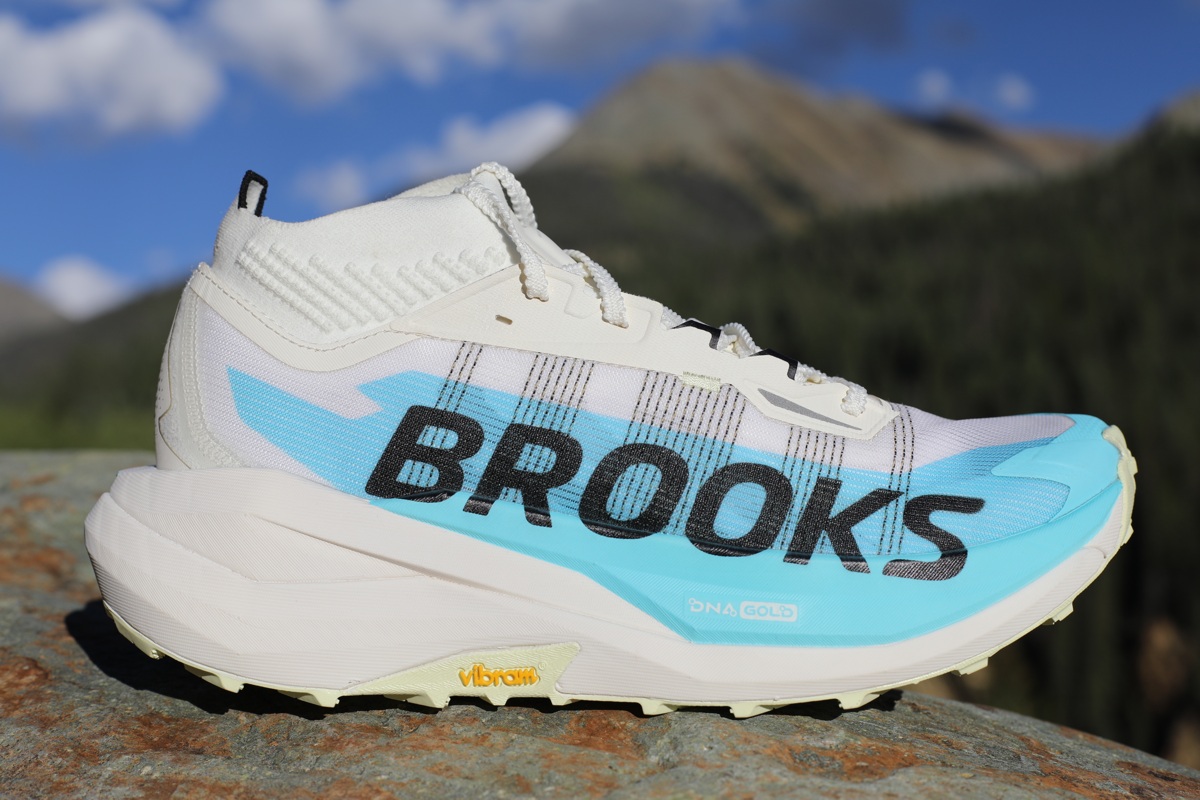
The Matryx upper of the Brooks Cascadia Elite offers support, durability, and breathability.
The upper of the Brooks Cascadia Elite uses a Matryx engineered woven material reinforced with Kevlar fibers. It balances durability, breathability, and structure extremely well. Even after repeated exposure to wet conditions and abrasive terrain, the material has held up impressively.
The fit is true to size. I have a wider foot, and the shoe felt comfortable from the start. The toebox provides enough room for natural toe splay without feeling sloppy or allowing the foot to slide around on technical terrain. The upper wraps the midfoot securely and integrates cleanly with the lacing system to create consistent lockdown, and a structured heel counter adds rearfoot stability without feeling harsh. The ribbed, textured laces are a small but meaningful detail. They hold tension extremely well and rarely require adjustment during longer efforts.
Instead of a traditional tongue, the shoe uses a sock-like design with a built-in mini-gaiter around the ankle. Unlike the higher-collared design of the Hoka Tecton X 3 (review), the collar here is noticeable but not excessive. Some shoes with built-in gaiters can feel like wearing two pairs of socks, especially when paired with mid- or crew-length socks that they often necessitate. This can create extra warmth or bunching around the ankle. That never happened here. The collar height feels like a thoughtful middle ground, working well regardless of sock height. It keeps debris out while hugging the ankle comfortably without adding bulk or making the shoe feel overly warm.
Brooks Cascadia Elite Midsole and Plate
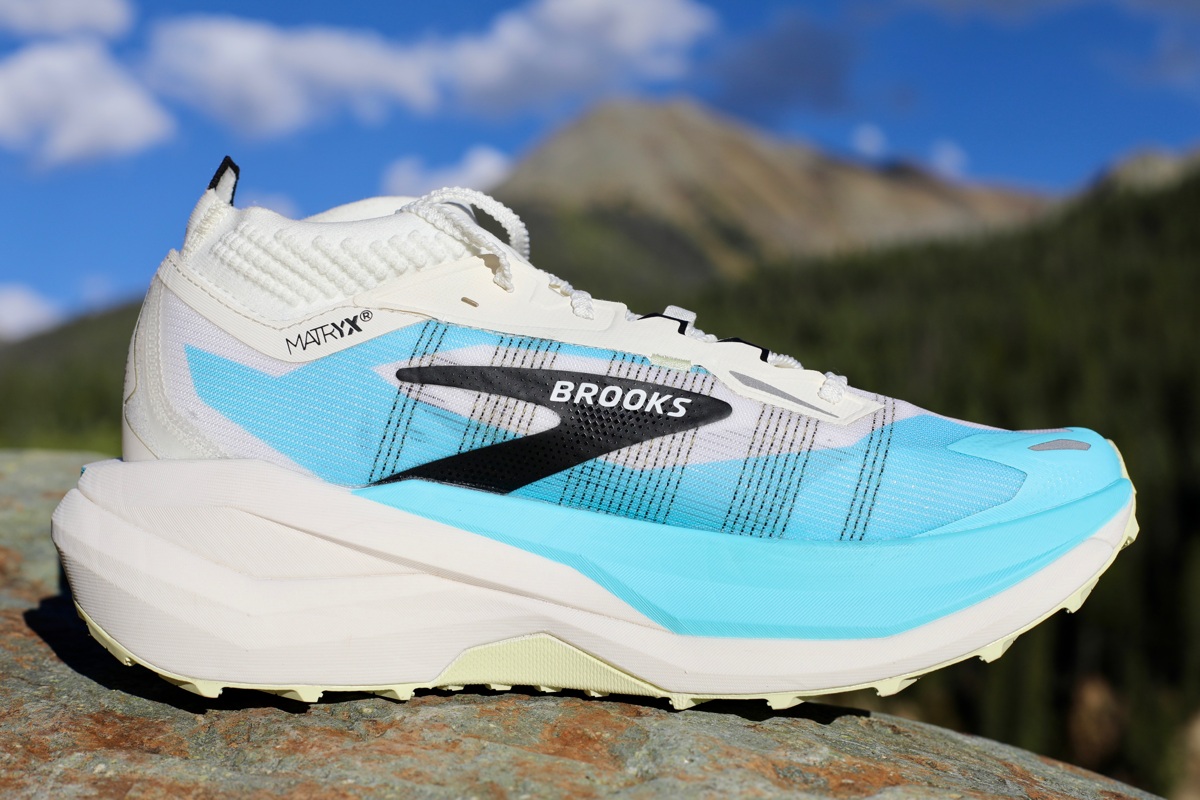
A medial view of the Brooks Cascadia Elite highlighting its generous PEBA cushioning.
The Brooks Cascadia Elite midsole is made of DNA GOLD 100% PEBA cushioning. With a stack height of 40 millimeters at the heel, it reads tall on paper, yet it doesn’t feel overly high or unstable on trail. A slightly wider platform through the midfoot and forefoot adds grounded stability that many plated trail shoes lack.
Underfoot, the foam feels soft, bouncy, and responsive. It absorbs impact well during longer efforts while still providing energy return when the pace increases. Even after more than 150 miles, there is no sense of premature compression or flattening, and the ride remains lively and consistent.
The carbon-infused Pebax SpeedVault+ Trail Plate is a defining element. Rather than having a full carbon plate — like that found in road super shoes — it uses a horseshoe-shaped plate instead. This structure reinforces the midsole, allows for lateral and medial stability, and offers some protection against rocks.
On trail, the plate feels nearly invisible in the best way possible. It never felt like it was fighting my stride or forcing me into a specific gait pattern. Instead, it provided subtle pop and structural support — especially at speed — without sacrificing adaptability over uneven terrain. That invisibility is part of what makes the shoe so enjoyable. I felt supported and efficient, but never distracted.
Compared to the On Cloudultra Pro (review), the Cascadia Elite feels more cushioned, stable, and responsive underfoot. It also fits more securely without creating hot spots. Against the adidas Terrex Agravic Speed Ultra, the Brooks feels noticeably more stable through the platform while maintaining similar speed potential, and the rocker profile is also far less dramatic. Where the Agravic Speed Ultra uses an aggressive rocker that may not work for all runners, Brooks employs a smoother, more restrained geometry that encourages forward motion without feeling forced. To me, the Cascadia Elite feels like the more complete and refined option.
Brooks Cascadia Elite Outsole
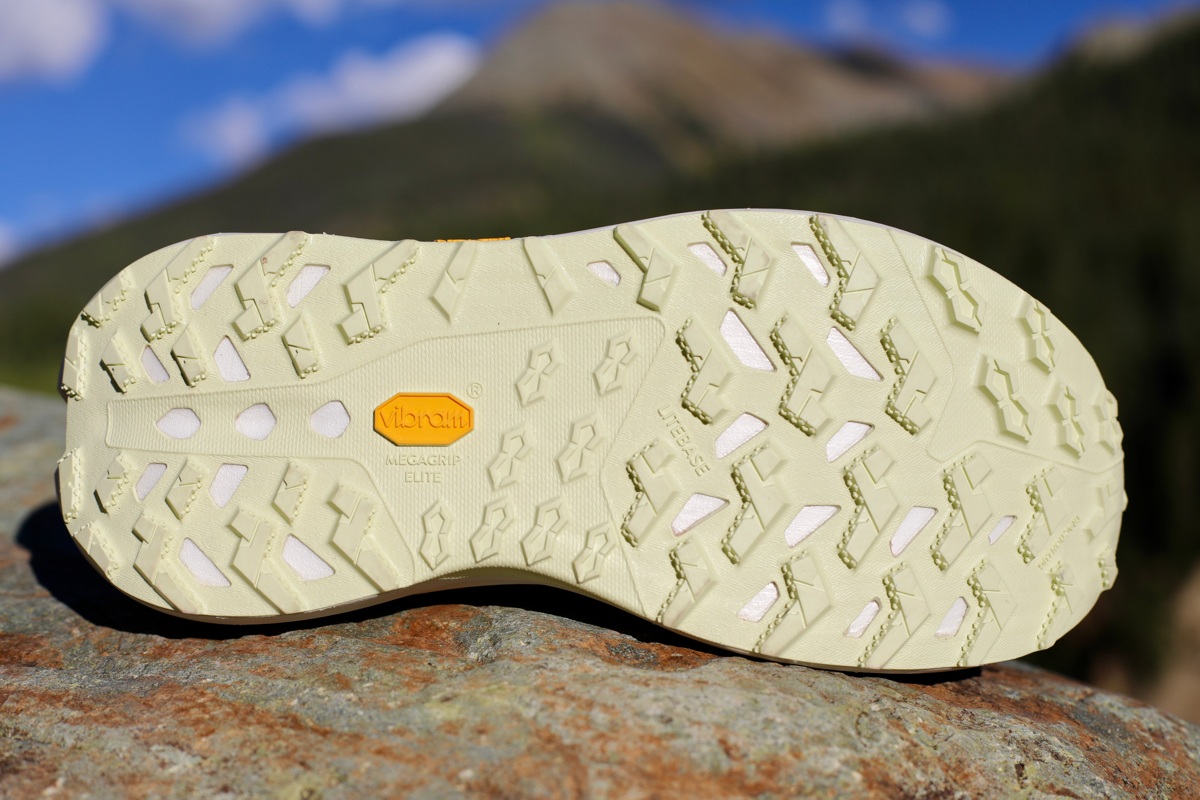
The outsole of the Brooks Cascadia Elite has 3.5-millimeter Z-shaped lugs.
The Brooks Cascadia Elite uses a Vibram Megagrip Elite outsole with Z-shaped lugs that are approximately 3.5 millimeters deep. The lug design provides reliable bite on climbs and confident braking control on descents without feeling overly aggressive.
On dry trail and moderately technical terrain, traction is excellent. Wet leaves and softer mud did not present issues, and the lug pattern shed debris effectively without clogging. The outsole transitions smoothly onto gravel and short road sections, making it well-suited for runs and races that travel over a variety of surfaces, including pavement and dirt.
Downhill performance stands out. Even at higher speeds, the shoe feels controlled and predictable. The only condition where it struggled was during a recent East Coast ice storm, though it is difficult to fault any shoe in true icy conditions without additional traction devices.
After more than 150 miles, wear on the outsole has been minimal relative to the use, and the grip remains strong.
Brooks Cascadia Elite Overall Impressions
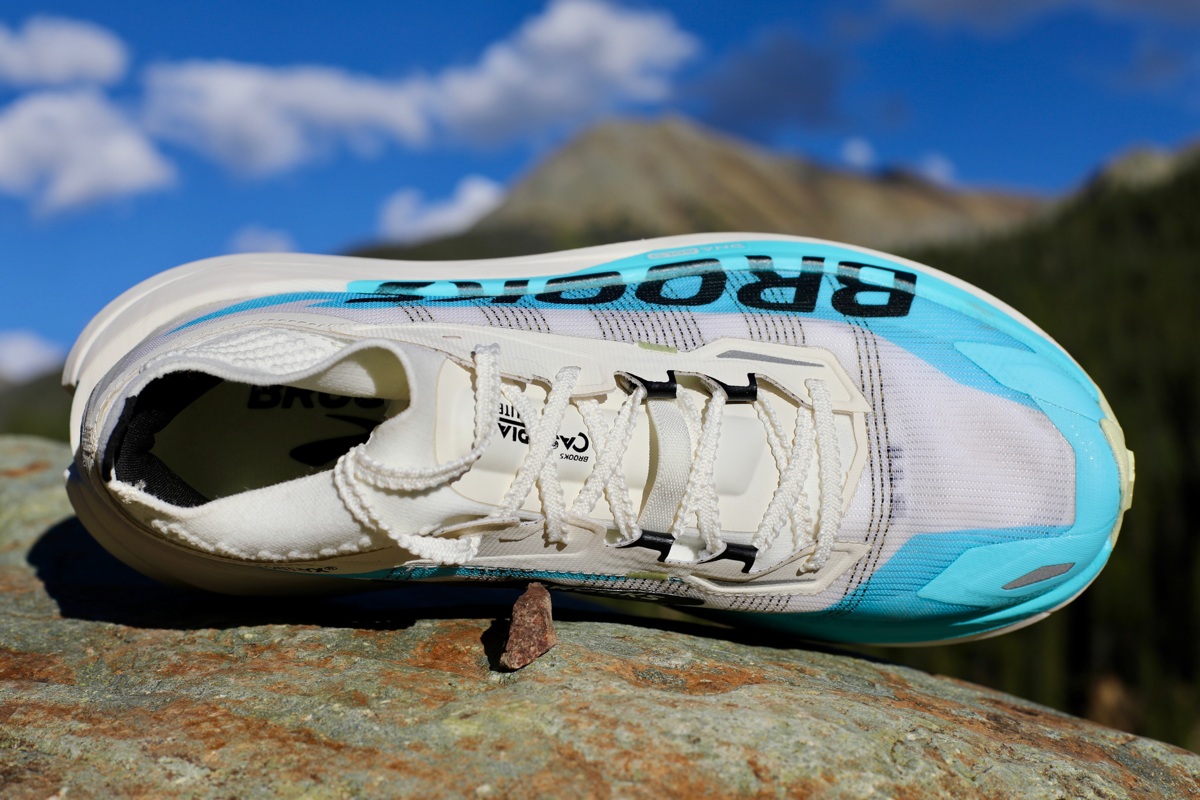
The components of the Brooks Cascadia Elite add up to it being a true trail race shoe.
The Brooks Cascadia Elite represents a significant leap forward for Brooks in the trail category. It is lighter, more responsive, and more performance-oriented than previous Cascadia or Caldera models. This is a true trail race shoe.
If I were purchasing with race day in mind, I would not hesitate. It excels in dry, moderately technical conditions, and it also performs well in rain and snow. The only real limitation appears in very steep, muddy environments where deeper lugs can provide more security.
At $275, it is undeniably a premium investment. However, it performs like one. For runners seeking a plated trail racing shoe that balances propulsion, stability, durability, and comfort, the Cascadia Elite deserves serious consideration. More than that, it is simply enjoyable to run in, and that may be the highest compliment a trail shoe can earn.
Shop the Unisex Brooks Cascadia EliteCall for Comments
- Are you excited to try out the Brooks Cascadia Elite?
- Are you a fan of the increase in super shoes in the trail shoe market?
Our Favorite Trail Running Shoes
Learn more about our current favorite trail running shoes in our Best Trail Running Shoes guide.