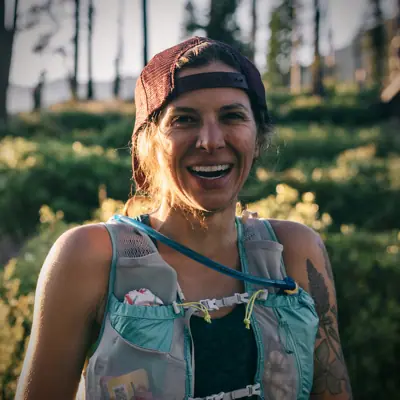
When Yassine Diboun checked himself into a 28-day inpatient recovery program in 2004, he would have never dreamed that his life trajectory would bring him to ultrarunning and helping others struggling with addiction. But, 19 years later, when racing the 2023 Hardrock 100, Diboun got a glimpse of the impact he was having. He’d rolled his ankle about 30 miles in — badly spraining it — and says that he was feeling “really bummed” and limping down the road when another racer approached and told him, “I just wanted to let you know, I just hit five years sober.” He’d heard Diboun on a podcast and had been inspired to pursue addiction recovery. Immediately pulled from his mental low, Diboun went on to finish the race.

Yassine Diboun climbing during the 2023 Hardrock 100. Photo: Steven Mortinson
For Diboun, talking about running and recovery go hand in hand. He would not have discovered running — and enjoyed a long, successful career as a professional trail runner and ultrarunner — if he had not first chosen to pursue a path of recovery. “I wouldn’t have any of this stuff that I have in my life today if it wasn’t for recovery,” said Diboun. “That is still the most important thing in my life.” Diboun, who co-founded the Wy’east Wolfpack — which helps people train for races or adventure trips and runs youth and corporate wellness programs — remains committed to helping others pursue their dreams.
Running Down the Wrong Path
Diboun grew up in Pennsylvania and went to high school in Orlando, Florida, where he played basketball. After high school, he got swept up in partying. After a year playing basketball for Juniata College in Pennsylvania, Diboun moved to Golden, Colorado — sight unseen at age 21 — to be closer to his brother and give himself a fresh start. However, the party lifestyle followed him. “I lived a wild and destructive life,” Diboun recalled. Working in the service industry, his life became a cycle of snowboarding, working, and partying. By 2004, he realized that his life had become unmanageable. “Bad things were happening with drugs and alcohol,” he shared. His brother and mom intervened, and Diboun said, “I was really receptive to it.”

It took an intervention from Diboun’s mom and brother to help him realize he was on the wrong path. Photo: James Richard Kao
Diboun’s brother had moved to Ithaca, New York, and after about four years of living in Colorado, Diboun followed him again, seeking another fresh start. However, his lifestyle followed him once again, and in New York, Diboun said, “I realized I couldn’t stop.” He explained, “I thought I could stop with willpower … but I was pretty heavily addicted to drugs, alcohol, and nicotine.” Once again, his brother and mom intervened and told him they’d had enough. Now 25 years old, Diboun decided he had also had enough, and in July 2004, he checked himself into a 28-day inpatient recovery program.
Recovery and Running
Diboun said that the program was “where my path of recovery started.” In the program, he learned about himself, his patterns of behavior, and why he drank and used. “I had a spiritual awakening, if that’s what you want to call it,” he said. “I had this moment of clarity where I realized that this chapter of my life was over.” During recovery, Diboun gained awareness about how his feelings influenced the way he thought and led to negative self-talk, as well as how his behaviors impacted those around him. He learned how to change the way he talked — particularly about himself — and changed the people with whom he surrounded himself. His life quickly followed suit: He got better sleep, ate better, started working, and at six months of sobriety, he quit smoking.
Although he’d been exercising and lifting weights, Diboun decided he needed cardio to help curb the cravings for cigarettes, so he started running. “I never really liked running,” Diboun admitted. “I ran for sports, but I never just … ran.” However, he quickly realized that he not only liked running, but he was pretty good at it.

It didn’t take long for Diboun to realize he was good at running. Photo courtesy of Yassine Diboun.
One day, someone from his 12-step program saw him out running and suggested that he sign up for the local YMCA triathlon. On a borrowed bike and with little swimming experience, Diboun raced his first triathlon in 2005. The swimming portion took place in the YMCA pool, and Diboun, still freshly off cigarettes, had to stop at the end of each lap to catch his breath. “It was painful,” he recalled. “I had a headache all day, probably from dehydration, but I loved it!” He also discovered that he thrived on the discipline of training. “I now had this structure that I lacked in my prior life,” Diboun explained. “That’s why a lot of people in recovery turn to endurance sports. It’s really redirecting that energy, that obsessive compulsive behavior, into something positive.”
Diboun continued training for triathlons, working up from sprint to Olympic distances. He got his own gear and even came to love the meditative movement of swimming. In 2006, he signed up for the same YMCA triathlon, now more confident and hoping to come back and win. However, on his final training ride, just a week before the race, he collided with a van and was seriously injured. “It just took a split second,” Diboun shared. “My life flashed [before] my eyes.” After being life-flighted to a trauma center and treated for a broken scapula, head injury, and road rash on his shoulder and arm that required a skin graft from his leg, Diboun, shaken, understood how quickly life can change. “Life is short,” he decided. “I am going to run wildly toward my dreams.”

Diboun at the 2013 Cayuga Trails 50 Mile with race director Ian Golden. Photo: iRunFar/Meghan Hicks
As he healed, Diboun literally ran toward his dreams, and started running again while he was still wearing a sling. In October 2006, he ran the Marine Corps Marathon in Washington, D.C., and finished in just over three hours. Next, he returned to Florida for the Miami Marathon, and said that while running among the top 20, he realized that he’d come full circle: “I was literally running past the clubs I used to party in; I was smoking a pack a day not that long ago.” He finished the race in 2:49 with a new drive for the sport. He was still working on himself in recovery, and he was able to see the results of the metamorphosis he was experiencing.
Running Immersion
Although he continued living in Ithaca and training for road marathons, Diboun started spending more time running trails, and — intrigued by the adventure and mystery of ultras — decided he wanted to try a 50-kilometer race. “I was training for my second Boston Marathon at the time,” he said, and recalled thinking, “I can’t wait until this Boston Marathon is over so I can try one of these ultras.” In 2007, he ran the Finger Lakes 50k and had a great day. “I found myself in first place the whole time.” When he finished, he said he was told, “You broke so-and-so’s record! He’s a badass. Now you’re a badass!” Diboun said, “More importantly, I just loved the whole community of ultras. I still do, that’s why I still do it today.”
For Diboun, one thing led to another, and 50k became 50 miles and then 100 miles. “I ran my first 100 in 2008 for my 30th birthday,” he shared. It was a race in the Finger Lakes region near Ithaca that’s now called Virgil Crest 100 Mile, and he won that one, too. “I was a big fish in a small pond,” Diboun said with a chuckle. That same year, he was named the Western New York Ultra Runner of the Year. In 2009, drawn in part by the trails of the U.S. Pacific Northwest, he moved to Portland, Oregon.

Diboun comes through an aid station at the 2012 Western States 100. Photo: iRunFar/Meghan Hicks
By that time, Diboun was a sponsored runner and finishing his degree in exercise science. “The timing was perfect for both me and my running career, and the sport of ultrarunning. The book ‘Born to Run’ had just come out, and people were reaching out to me about coaching,” he said. Diboun had been writing his own training plans and had learned about training in his exercise science program, so it seemed like a natural progression to begin coaching ultrarunners.
Meanwhile, he continued training, racing, and honing his craft — and traveling the world to compete in high-profile races, including the 2015 Trail World Championships in France, where he raced the 52-mile event with Team USA, which earned a silver medal in the men’s team competition. Diboun said he felt that his running career was on a smooth trajectory: “It was almost like every year got better than the last.” He raced the Western States 100 in 2012, 2013, 2014, and 2019, and earned a top-10 finish in 2013. “Western States holds a special place in my heart. My first one was a little bittersweet, though,” he shared. Although he was having a great day, he started to falter near the end. Arriving at the track in 11th place, he got passed in the final yards and finished 12th. “It motivated me so much!” he said. Wanting to try again in 2013, Diboun flew to Alabama to compete in the Pinhoti 100 Mile, where he secured an automatic entry to Western States by placing third. The 2013 Western States was the second hottest year in the event’s history at the time, and at mile 80, Diboun was in 10th place. With the previous year still fresh in his mind, he thought, “I’m not letting that happen again,” and the memory motivated him all the way to the track. As he closed in, he got word of another runner just ahead of him, and he pushed to reel him in and ended up in ninth place.

Diboun running during the 2012 Western States 100. Photo: iRunFar/Meghan Hicks
Running Full Circle
Alongside all his individual running successes, for Diboun, it always comes back to his journey through recovery and the communities he’s built. Through his business, Wy’east Wolfpack, he helps people train for races or adventure trips, runs youth and corporate wellness programs, and leads the running arm of The Recovery Gym, a fitness gym in Portland for people recovering from substance abuse or mental health disorders. Offering both personal coaching and group fitness services, Diboun has built a life around helping people discover a love for movement and the outdoors.
“A big part of recovery is giving it away,” Diboun explains. To this end, he is embarking on an annual fundraiser called Move Through Darkness on the night of December 13, 2025. Starting at sunset on one of the longest nights of the year, Diboun will run through the darkness and only stop at sunrise the next morning. People are invited to support the event by donating per mile, coming out to join the run, or participating however they want. According to Diboun, “People join in the middle of the night and bring energy drinks or have a dance party. Some run a segment, and others run in solidarity from other parts of the country.” Diboun said running through the night is symbolic: “You just don’t know when people are going into these dark places … We all go through dark places in our lives, and you just have to keep moving toward the light.” Move Through Darkness is partnered with the Alano Club of Portland, a non-profit organization that supports individuals recovering from addictive disorders.

Diboun continues to give back to his community, including his fundraiser, Move Through Darkness. Image courtesy of Yassine Diboun.
Many of us move through the world without fully understanding the impact we have on those around us. Every once in a while, however, we catch a glimpse of our impact — and sometimes, this comes as a gift when we need it most. Perhaps, as Diboun does, by sharing a piece of ourselves, more of us can help each other come full circle.
Call for Comments
- Do you have a Yassine Diboun story you can share?