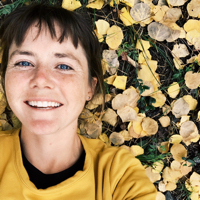
Meet Hilary Yang. Photographer, ultrarunner, race director, graphic designer, and overall badass from the West Coast. Hilary has chased big dreams in the world of ultrarunning, jumping in headfirst with both running and photography. She’s even dedicated some of her work to ensuring more women are recognized in the sport. When not photographing other runners, she’s running around the mountains herself, prepping for her next race. From the mountains of British Columbia to anywhere her feet can take her, Hilary is a Jane-of-all-trades, so let’s hear it from her:
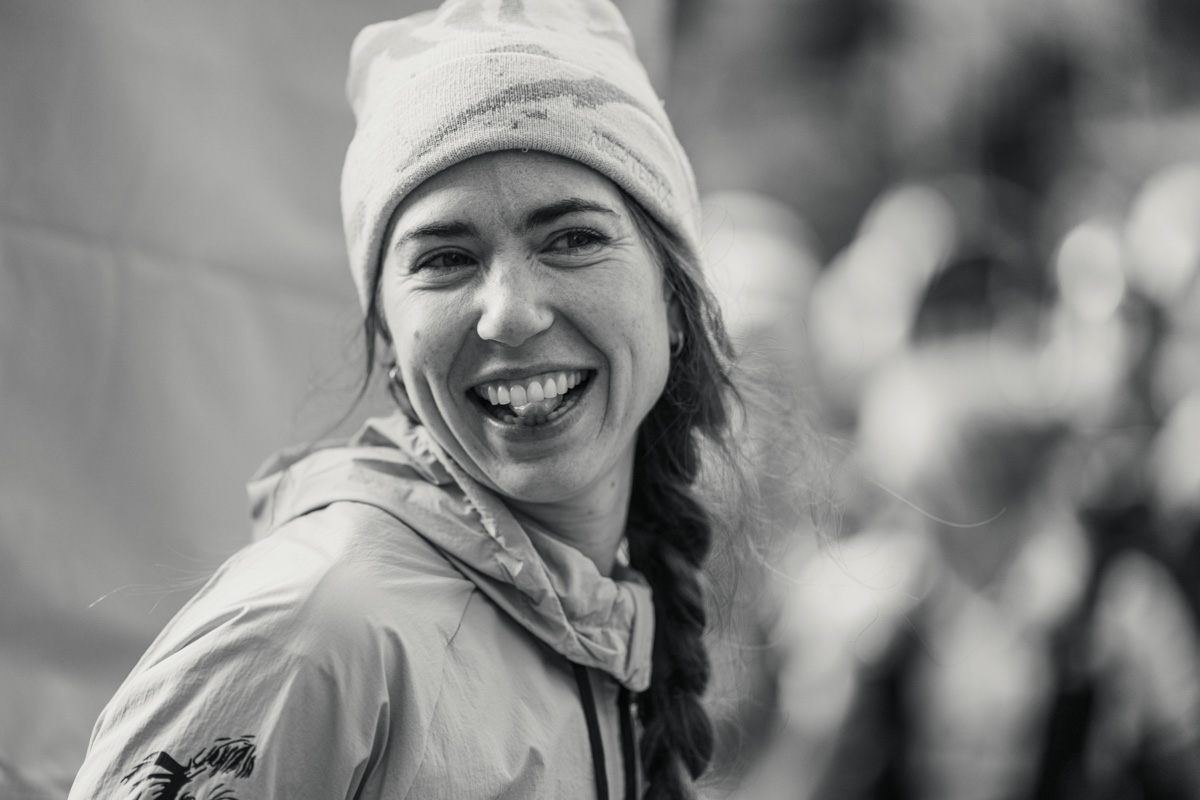
Hilary Yang, a Jill-of-all-trades when it comes to running and creative projects. Photo: Sarah Attar
Tell us a little about yourself!
My name is Hilary Yang, and I wear a lot of creative hats in the outdoor world. I’m originally from Vancouver, Canada, now living in Los Angeles, California, with my husband, Billy Yang, and our rescue pup, Charlie Salami. My journey into the creative world of trail running started when I fell in love with the sport myself. I ran my first ultra in 2013 in Squamish, British Columbia, and was immediately obsessed. As I got into longer races, my training took me to increasingly remote and beautiful places in British Columbia, and I soon found myself frustrated that my humble little iPhone — not so fancy back then either — couldn’t do justice to the places I was exploring.
I ended up diving into the world of photography, taught myself how to use a DSLR camera, and carried it with me everywhere for the next few years. I subjected a lot of my friends to repeats on trail runs as I worked out how to get the shot and figure it all out! There weren’t any other women doing trail photography at the time I could find, which also motivated me to find my niche. I started volunteering to shoot local trail races to get more experience, and pretty soon brands started reaching out.
After a few years, I decided to quit my corporate job, but instead of just going full-time with photography, I went back to school to build a broader creative skill set. I completed a visual communications/graphic design program at the Emily Carr School of Art and Design in Vancouver. When I graduated in 2017, I started building my own business, doing a mix of trail and outdoor photography and graphic design work for whoever would hire me. I cold-called magazines trying to get my work published, and got as scrappy as I could to get my name and work out there until I started getting some momentum.
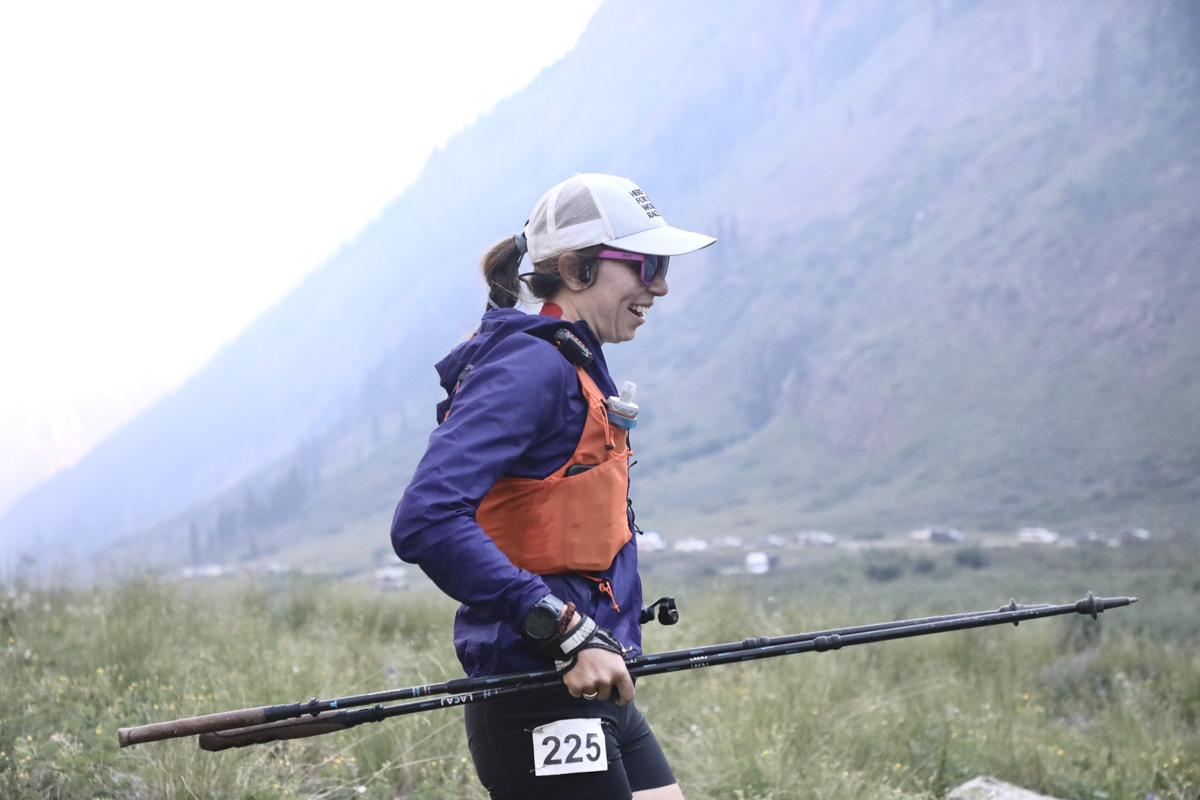
Hilary Yang all smiles in the early miles of the 2025 Hardrock 100. Photo: iRunFar/Meghan Hicks
Humans seem central to your photography. What inspires this?
I gravitate toward photographing humans because I am enamored with the idea of capturing an emotion or feeling or story, all in a single frame. To me, the greatest photos I have ever taken are the ones that tell you a story in that moment, whether it’s a look in someone’s eyes or the scene around them. Art should make you feel things, and in my case, I’ve always wanted my art to inspire others to maybe dare to try something bold themselves or to look for ways to feel those feelings too. We live life in such a safe “emotional” zone in many ways, and I think the allure of ultrarunning is that it forces us into these uncomfortable yet deeply vulnerable and truthful moments. And my greatest satisfaction is to find that moment and do it justice.
Who or what has been your favorite subject for photography or design?
That’s such a tough question. I’ve been photographing runners for the past 12 years, and many incredible moments stand out. Some of my proudest photos have been borne out of times where I was also pushed to my limits physically and somehow still found the energy to be creative as well, so those stand out to me. The first trip I took to Nepal in 2017 with a group of climbers was very memorable in that way, and I ended up writing a feature article and the cover story for “Mountain Life” magazine about it. The feature photos were taken on a morning when we got up early to summit a peak at 18,000 feet, and it was so cold that I couldn’t press the buttons on my camera, so I was using my knuckles. Some of those photos, framed against the incredible backdrop of Lhotse, are ones I still look back on and am proud of for the personal challenges they also represented.
On the design side, I think creating the vision and design for the Mammoth 200 Mile, which I also race directed and co-founded in 2025, was one of the most fun projects I’ve done. Getting to make something that was my own, purely from scratch, was such a wonderful feeling, and it felt full circle in many ways.
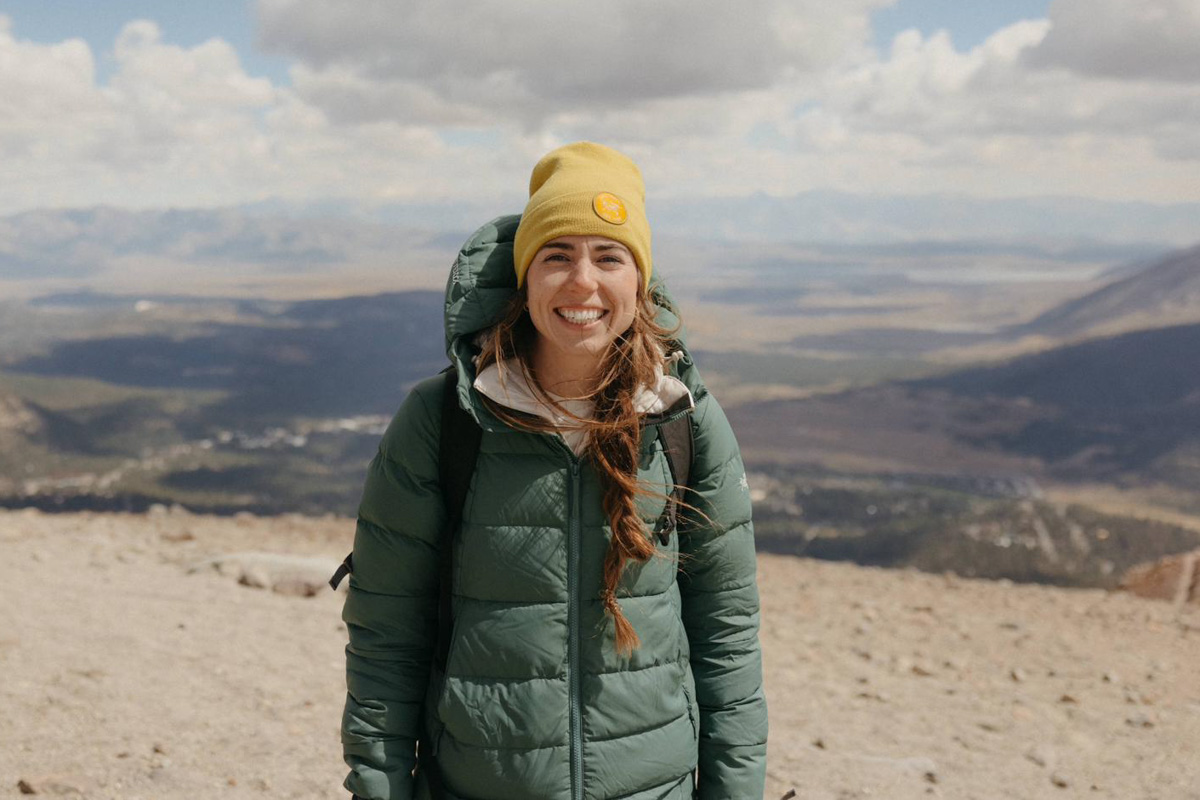
Hilary at home in the mountains. Photo courtesy of Hilary Yang.
Is your creative side influenced by your running side and vice versa?
My creative and athletic sides are absolutely intertwined, and one of the things I love about outdoor photography is that I still have to maintain the fitness and the technical skills (whether that’s running, climbing, skiing, you name it) to be able to keep up with the athletes I’m photographing. It always adds a unique challenge. I am very much inspired by my natural environment, and I shoot primarily using natural light, so I always feel like any shoot is a conversation, and sometimes negotiation, with Mother Nature.
Who has been the primary catalyst in your life, both creatively and in running?
Honestly, as I mentioned before, there were no other women who were combining the creative world with trail running when I first got into it. I had a couple of male friends who were photographers in Vancouver, and we all sort of dove into the trail world at the same time. In the beginning of my career, I also got a fair amount of side comments, or people who seemed surprised that I could keep up with elite athletes or handle the heavy packs required for remote backcountry days. It was an interesting time. As I got further into the professional world, I was very inspired by longtime Arc’teryx photographer Ange Percival, who seemed like she had really broken through as a female badass photographer who worked with athletes at the highest levels and had a lot of industry respect.
If you could influence the running media, what would you change about it?
Funny you should ask. I co-founded the Here For The Women’s Race non-profit movement in 2024 with Corrine Malcolm, purely because we were frustrated at the lack of equal media coverage of women’s races, and we were tired of seeing them being treated as an afterthought. Obviously, a lot of other people felt that way, because it’s ended up becoming a global force, and I’m really proud of the awareness and support we’ve been able to bring to women’s sport through it.
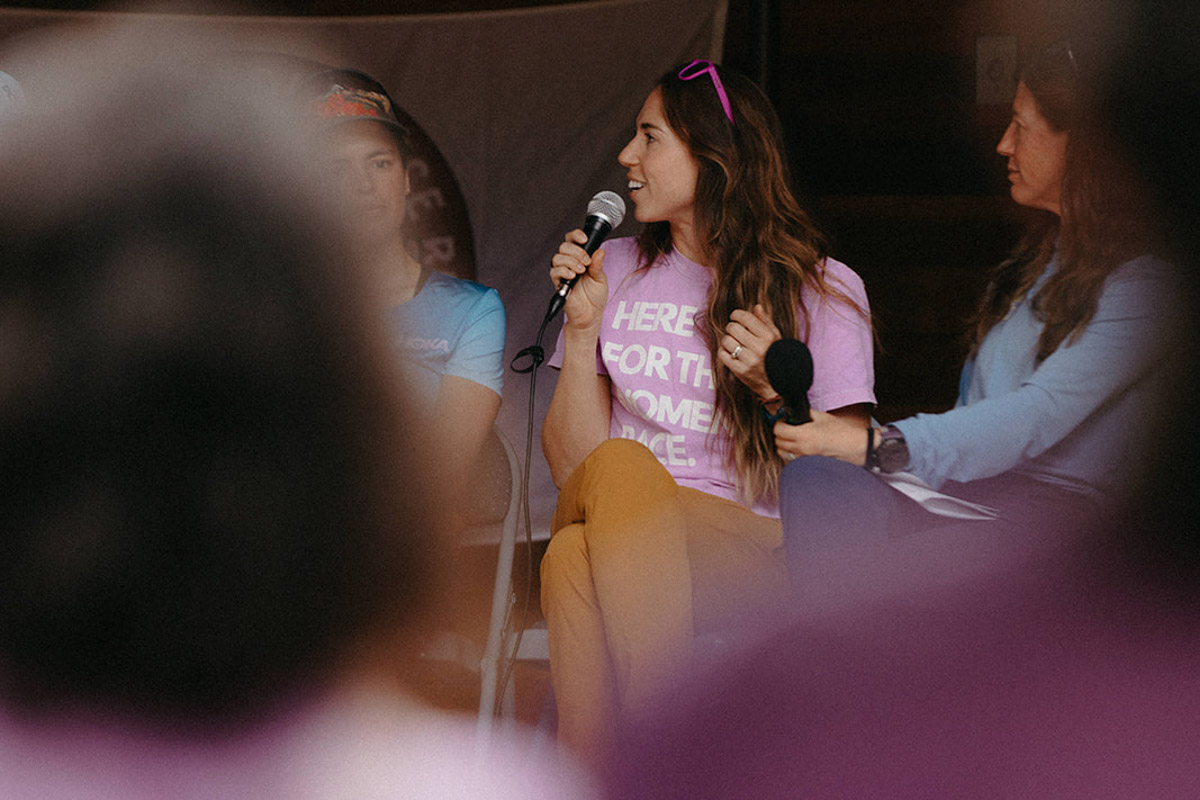
Hilary Yang speaking at the women’s panel at the 2025 Hardrock 100. Photo: Sarah Attar
I am also a big advocate for finding ways to bring more women into running media, especially when it can be hard to break into the boys’ club or get brands to take a chance on someone new. Over the years, I’ve sought out ways to mentor other women into trail running photography, and I always try to make myself available to other female photographers who come to me with questions. We are all stronger when we rise together.
I’d say that’s the biggest thing I’d want to change, but honestly, looking around me at the Black Canyon Ultras recently, I was so stoked to see so many women out there taking amazing photos. It’s so freaking cool, and I believe women have a different perspective and approach to storytelling that’s so important to share. So the thing that’s been a struggle in my own career is slowly changing, and I’m proud of the work that is being done on so many levels to continue that shift in the sport.
What advice would you give to your younger self?
I didn’t grow up with women in my life who were particularly athletic or sporty, let alone those forging more unconventional careers. I only stumbled into trail running in my mid-20s, and it was the incredibly supportive community around the sport that really sucked me in and hooked me. From there, it was really a process of discovering what was possible. While it’s never too late to start at any age or stage of life, if I had the chance to give my younger self a little life heads up, I would say to not be afraid to dream a bit bigger and a bit differently than those around you, and to celebrate being a strong and stubborn woman.
Growing up homeschooled and in a small rural town, my world was small — but I always knew there was a piece of me that wouldn’t be happy without the chance to push myself and see what was possible. So yeah, I would have liked to go full send a little earlier in life just to maximize my own runway, but at the same time, it’s all part of the journey.
Any projects in the works, either running or photo/design collabs?
So many things! Last year was wildly busy. I got into Hardrock 100 after nine years of trying, and successfully trained and completed the loop, even though it was such a busy work and travel season. I co-founded the Mammoth 200 Mile along with Tim Tollefson, and was the race director the first year as we got it off the ground, which was an incredibly rewarding experience.
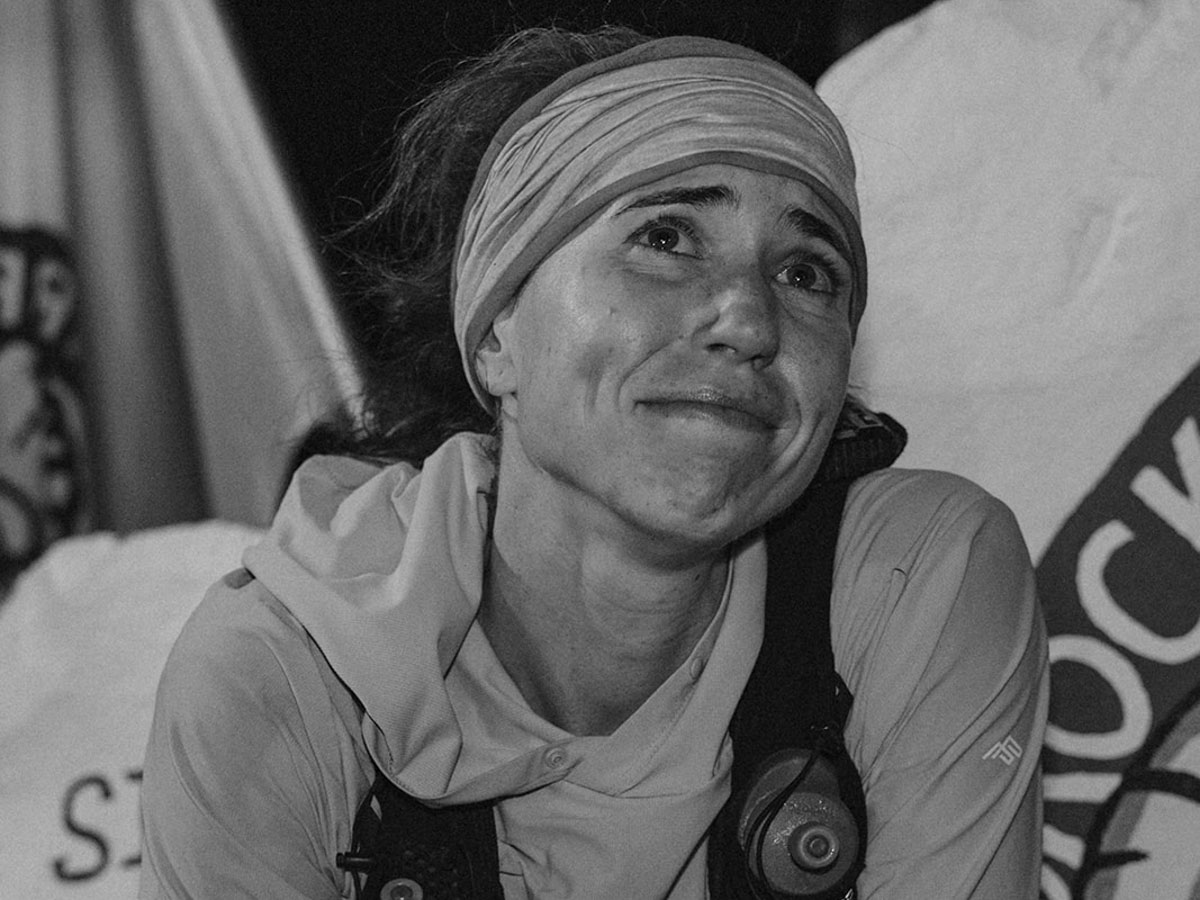
Hilary Yang at the finish of the 2025 Hardrock 100. Photo: Sarah Attar
I also co-directed my first film with my talented friend Carrie Highman. It’s called “Raise the Bar,” and it’s a celebration of where women are in the sport today, framed against the backdrop of the Western States 100. It’s coming out this spring with some cool events around the Western States Memorial Weekend Training Camp and race week, so that’s something I’m very excited to engage with the community on this year.
I decided to step away from race directing the Mammoth 200 Mile this year because I felt like I was losing the balance between my creative self and all the other hats I wear, and one project that’s already emerged out of that newfound space is the chance to be the guest creative director for an exciting new chapter of “Like the Wind Magazine.” We will have more on that soon, but it’s been really fun to immerse myself in the intersection of creative design and running again. The year is just getting started, but I’m grateful to already have a lot of awesome things to look forward to.
What kind of camera do you use when you’re out running?
I used to run with my full Canon 5D DSLR, but as I’ve gotten older, I’ve found that running with a five-pound camera in my hand just isn’t an awesome experience, so I tend to save the big gear for actual dedicated shoots or races now. When I want a little camera with me to capture a run or adventure, I use my little Fujifilm X-T5 with a pancake 27-millimeter lens. Because it’s a cropped-sensor camera, it ends up being a 40-millimeter focal length, which is perfect for a general one-size-fits-all pocket camera, and it fits in the front pocket of my vest perfectly. I’ve dropped it a number of times, and the back touch screen no longer works, so I have to look through the viewfinder to take photos, but I really love it. It makes me feel a lot more creative than just using my iPhone.
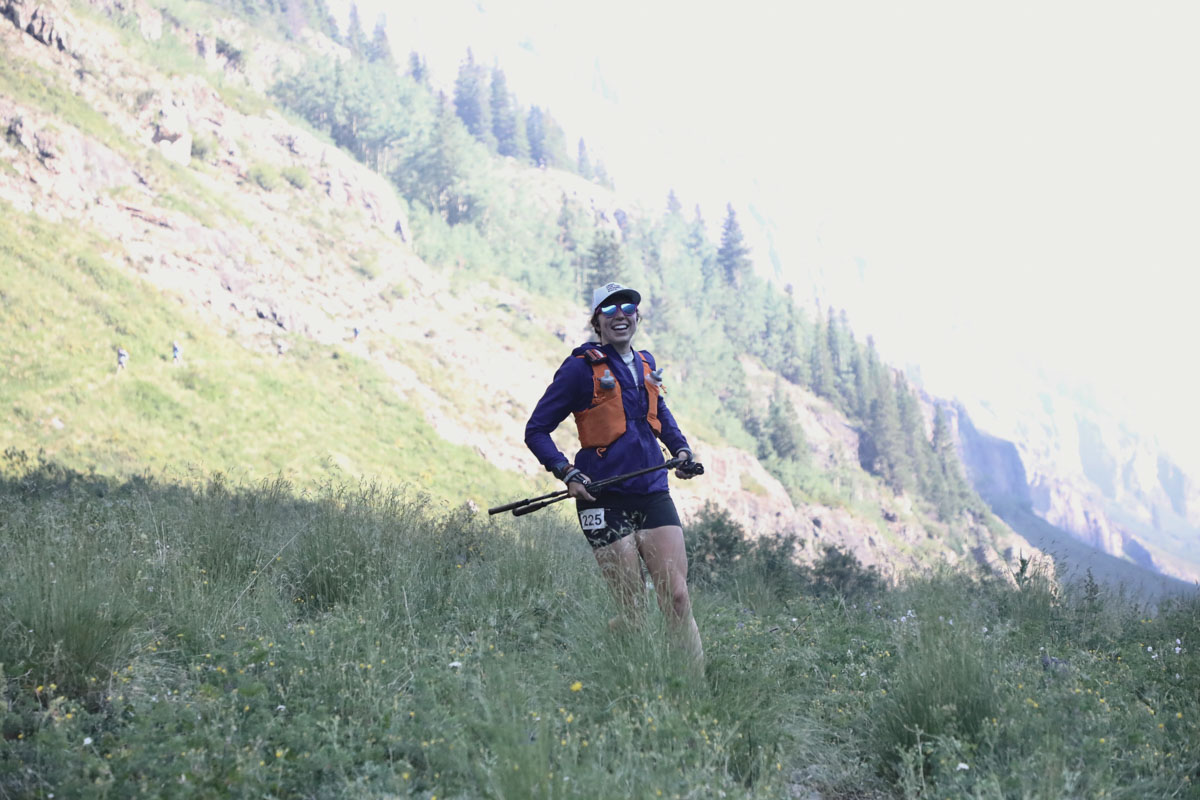
Hilary Yang descending into Cunningham Gulch during the 2025 Hardrock 100. Photo: iRunFar/Meghan Hicks
If you could be a tree, what kind of tree would you be?
OMG, I’ve been waiting for this question my whole life!! As a Pacific Northwest gal, I would have to go with one of the big ol’ beauties from the forests up in British Columbia. There’s a super-famous Douglas fir tree on Vancouver Island that I’ve been privileged enough to go see — he’s called “Big Lonely Doug,” because he’s the only old-growth tree left in a whole swatch of forest that was cut down years ago for logging. But he’s one of the biggest Douglas firs in the world, and he’s just gorgeous — and 216 feet tall, which is insane. So I’d go with Douglas fir.
Call for Comments
- Have you engaged with one of the many projects Hilary Yang has worked on?
- Do you have a Hilary story you can share with us?