[Editor’s Note: This month’s Community Voices article was written by Paul Lask, who is a freelance journalist and community college writing teacher.]
A beeping pierced the quiet morning as my friend and I ran along a logging road on an Oregon Coast ridge. We were high on a hillside that opened onto sweeping views of the Pacific Ocean, with silently breaking waves before a horizon dotted with crab boats. My friend jabbed at the watch in hopes of shutting it up as it insisted that her splits were off, telling her to hurry, or slow down, she wasn’t sure. At the moment, a ghost rainbow was forming beside a solid arc of color already plunging into the sea. Over the years, I’ve spotted bears, bobcats, deer, and elk in this area. At that moment, our attention focused on the digital nagging of the watch.
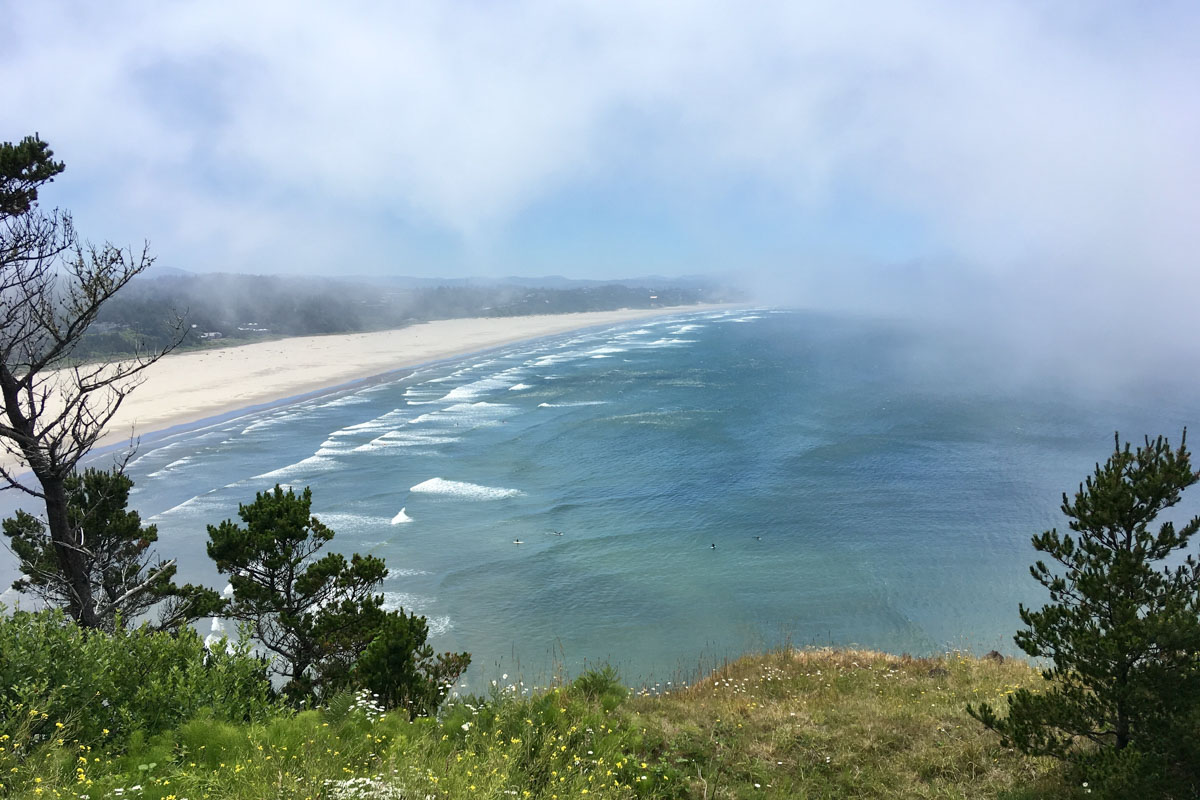
Watching waves breaking on the Oregon coast. All photos courtesy of Paul Lask unless otherwise noted.
A couple of days later, I was running the same area when it started to rain. I had my phone on, anticipating an important call, when a group text exploded. My wet touchscreen was non-functional, the beeping incessant and unstoppable.
Both situations alerted me to how tech-saturated my running had become. I realized I couldn’t remember the last time I’d gone on a long run without a device, and I began to ponder what I was missing by being so plugged in.
Presence
It seems that we lose our presence in the moment when we bring too much technology along. Running in the woods, not through them, is a kind of art I fear is disappearing in subservience to our gadgets.
I knew that high on that ridge with my friend, if an animal had stepped out of the brush or that second rainbow realized its potential, rather than stop and open a space for wonder, I would have reflexively reached to snap a pic, throwing off my tracked pace.
Without a watch or phone monitoring my every move, I’m forced to listen to my intuition. If I’m tired, I’ll turn around. Jazzed, I’ll go on.
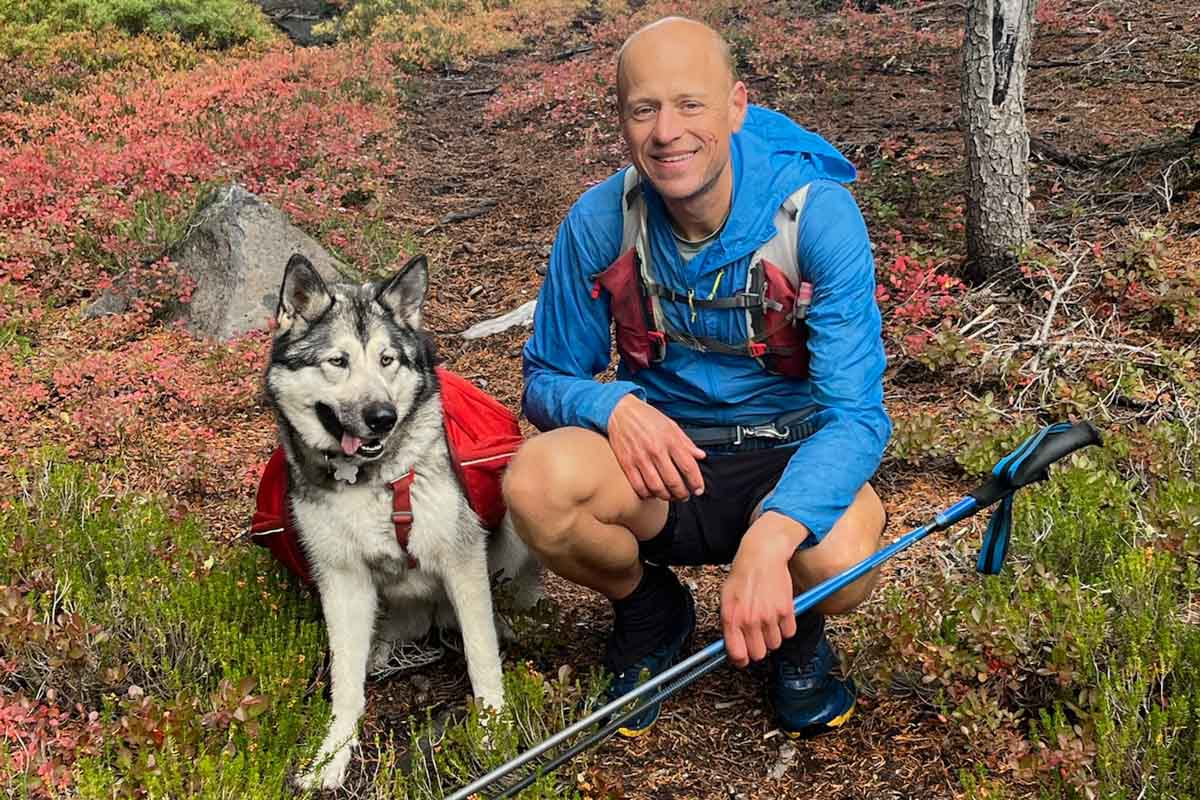
Author Paul Lask and his doggo, who couldn’t care less about a run’s pace or metrics.
Without my usual technology, I’m forced to pay more attention to where I am. Learning new routes or relearning old ones offline offers greater intimacy with the wild world. Without a phone, I’m more likely to customize an internal map with personal landmarks: a double-trunked hemlock, the distant hill, or the rotted dock piling where a kingfisher perches.
Maybe it all comes down to paying more attention.
The Rarámuri proverb comes to mind: “When you run with the earth, you run forever.”
Embracing the Unknown
Our phones provide us with a world of information at our fingertips, but by minimizing the unknown, they also collapse the potential for adventure in the built environment.
Before smartphones or easy internet access, we had to make do with the information we had in front of us. Years ago, after a 60-plus-hour bus ride from southeast Brazil across the Argentinian plains to Santiago, Chile, my wife and I found ourselves in a city we’d never been to before, ready to run. We didn’t have smartphones or watches, so after we checked into a hostel, we headed out to explore the city, dodging forklifts and pickup trucks as we ran along bustling backstreets.
Had we been in the same situation today, I would have found a track online — like the Cicloparque Mopocho river trail — and this gravel path would have made for a “better” run in some ways, while flattening out the potential for adventure in others.

Random runs through cities can lead to the most unexpected finds. Photo: iRunFar/Andy Jones-Wilkins
On that same trip, I met another runner in our neighborhood. We began regularly running a hilly loop around Cerro San Cristobál. I didn’t know his race history, heart rate, or regular pace. We didn’t know or care about the elevation or mileage of our loop. We just went. It was an old-school and seemingly bygone way of making a running buddy in a new place.
Had I met this runner today, I might have looked online for his stats and pre-judged him as too fast, too slow, or anything else that could have discouraged me from running with him.
The Curse of Comparison
“Comparison is the thief of joy,” is a quote commonly attributed to Theodore Roosevelt. I’ve never had a public Strava account, and I eventually deleted the app altogether after finding myself envious of what other runners were doing. Their metrics, beautiful backdrops, and clever captions detracted from my running experience by creating a standard to which I compared myself. It’s been good to feel pen on paper when I want to record information.
For many, social media has resulted in an array of problems, from a loss of privacy to performance anxiety. The digitization of running has the potential to shape the sport into an on-ramp for poor body image and mental health issues, the very things running can be so effective at combating for many.
Jane Baunsgard, a middle school cross-country coach in Bend, Oregon, has a front-row view of the phenomenon. She emphasizes the dangers of athletic comparisons at a young age, noting, “Comparison is such a big thing for middle schoolers, anyway.” She encourages her athletes to think about pace, not with a watch, but by how well they can converse with friends. Baunsgard says, “I definitely could see an emphasis on tech in middle school getting dangerous in terms of athletes and overtraining, eating disorders, Relative Energy Deficiency in Sport (REDs) syndrome, etc.”
Baunsgard’s concerns are echoed by Speedland athlete and running coach Emily Keddie. She says that recently, she began hiding her metrics from public view on Strava, calling them her “daily dose of comparison” rather than inspiration. In her mind, “Those numbers are my information, and they don’t really matter to anyone else.”

Sometimes, it’s worth keeping our metrics to ourselves. Photo: iRunFar/Eszter Horanyi
In his book, “Sweat: A History of Exercise,” author Bill Hayes discusses how Girolamo Mercuriale, an influential sixteenth-century Italian physician, thought about running.
According to Hayes, “What made running supreme in Mercuriale’s mind was not only that it met the definition for exercise he carefully laid out in his book, but that it is ‘granted to all.’ Anyone is capable of doing it — man, woman, child. One doesn’t need a gymnasium. One doesn’t need equipment or an opponent.”
Letting the tendrils of tech worm their way into running creates internal and external opponents. The outdoors get walled in by networks of data, where splits and zones and acronyms replace the soft patter of shoes on a trail. The joy of finishing is replaced by the itch to upload.
The Safety Issue
We live in a connected age, and phones and technology can offer a level of safety without being intrusive. Not everyone feels comfortable running in the backcountry or cities without a phone at hand, but that doesn’t mean they have to be an active part of our running. Airplane mode seems a fine compromise.
I’m not suggesting we overhaul our digital running worlds — it’s probably far too late for that — but it might be worth asking ourselves the last time we ran without a gadget, and what an analog, non-recorded run every now and then would feel like.

How many runs end by looking at an uploaded file and time splits? Photo: iRunFar/Eszter Horanyi
Phones, Tracking, and Racing
These days, many ultras require a phone as part of their mandatory kit, as well as a live tracker where the public can monitor a racer’s position in real time. While this undoubtedly increases the safety of an event — and its logistical ease — phones and trackers can remove some of the mystery and self-sufficiency commonly associated with ultras.
Ken Ward, who finished his 10th Western States 100 in 2024 at age 67, recalled that there was a time when prospective entrants to the Hardrock 100 could write an essay to the organization explaining their experience running in the mountains to show they were capable of handling the difficulties of the challenging, remote course.
The first year of the Hardrock 100, which saw 18 finishers, run director Dale Garland told iRunFar in a previous story that, “I’m surprised everybody came back, to be honest.”

Zach Miller may have technology on board during the 2025 Hardrock 100, but he’s also clearly enjoying the experience. Photo: iRunFar/Bryon Powell
In modern times, it’s ridiculous to shun a digital map and rely on course markings and routefinding skills alone in rugged montane environments. Race directors face legal, logistical, and even existential challenges they didn’t have in the past.
Now with phones and tracking, supplemented with satellite connectivity at remote aid stations, race directors have an easier job knowing what’s happening out on course. Crews have a better idea of their racer’s location and pace. But if racing an ultra is about digging deep within one’s self to get through low points, technology makes it much easier to call for rescue from an aid station. It’s possible to ask for a bit of emotional support during a low patch. A well-timed text message of encouragement can alter the outcome of a race. What used to be an endeavor experienced solely by racers, their crews, and race staff and volunteers has grown into a spectacle that anyone in the world can actively watch and participate in.
Measuring Metrics
Ultrarunning is becoming increasingly professionalized, and athletes of all calibers are paying closer attention to their running metrics to improve their performances. A watch can measure anything from run time and distance to heart rate variability, sleep quality and time, and stress levels. With sweat tests available, runners no longer need to guess how much sodium they should consume during a run. Although all this information inevitably leads to improved performances, it’s important to ask what is lost when everything is measured.
David and Megan Roche, both successful ultrarunners and coaches, have embraced science and data in their running and coaching. In a social media post, David says, “Ultras come down to a science problem.” In this view, it seems like he envisions running as a code to crack, a puzzle whose parts, once found, will fit. Success in running is but a proper harnessing of technological tools.
And yet the Roches often emphasize love in the context of running: love for the sport, love for the capabilities of the body, love for race volunteers, love for the land. “Making love to the mountains” is a line listeners of the Roches’ podcast will recognize.
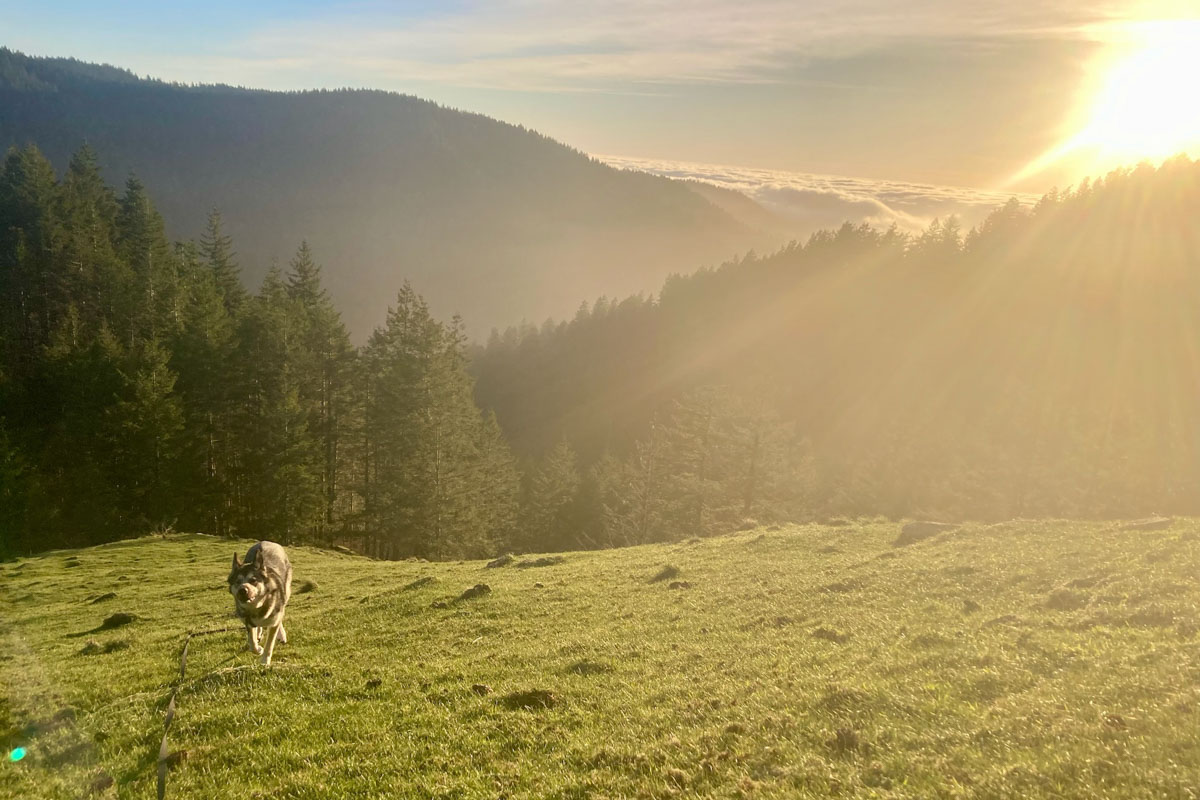
What metrics do dogs use to measure their runs?
There’s more to it than metrics. It’s like Jim Walmsley moving to France to live like the French, then becoming the first American man to win UTMB. “Being French” is not a quantifiable metric.
Love is likewise nebulous and incalculable. For the majority of us nonprofessional ultrarunners, love of the sport is the very thing that tech, in all its spiritless distractions and vivisecting analytics, threatens to upend.
For people like David, technology can enhance running rather than detract from it. In an email, he told me, “For us, technology is a way to help running feel better and more natural.” He continues, “The unfortunate reality is that gravity is an asshole and running is hard. Staying at the front of the science makes it marginally easier, and those margins add up into beautiful experiences.”
He went on to explain that if technology can enhance a runner’s speed, even by marginal degrees, the runner is likely to feel better on a daily basis. Technology and metrics “won’t lead to transcendence,” he said, but will “make the journey a bit smoother.”
Roche’s philosophy offers a potential bridge for those who are uneasy about technology taking over their running. Weaving the spiritual language of beauty, transcendence, and journey into the benefits of using technology to improve the running experience offers a workable way — at least for me — to navigate the sport in the coming years.
Going Into the Woods
As I take off now, untethered from the noisy world of zeros and ones, I sometimes think of author-farmer Wendell Berry’s metaphor of nature as a house in his book “Jayber Crow.”
He wrote, “The woods has many doors going in and out. It is full of rooms opening into one another, shaped by directions and viewpoint. Many of these rooms are findable only once, from a certain direction on a certain day, in a certain light, at a certain time.”
The quote reminds me to stay in the moment, that every run is different and cannot be repeated. The rooms are available now, as long as I am mindful and present enough to enter.

“The woods has many doors going in and out … Many of these rooms are findable only once, from a certain direction on a certain day.”
Call for Comments
- What is your relationship with technology and running? What would you change about it?
- In what ways do you find technology beneficial to your running? How does it detract?