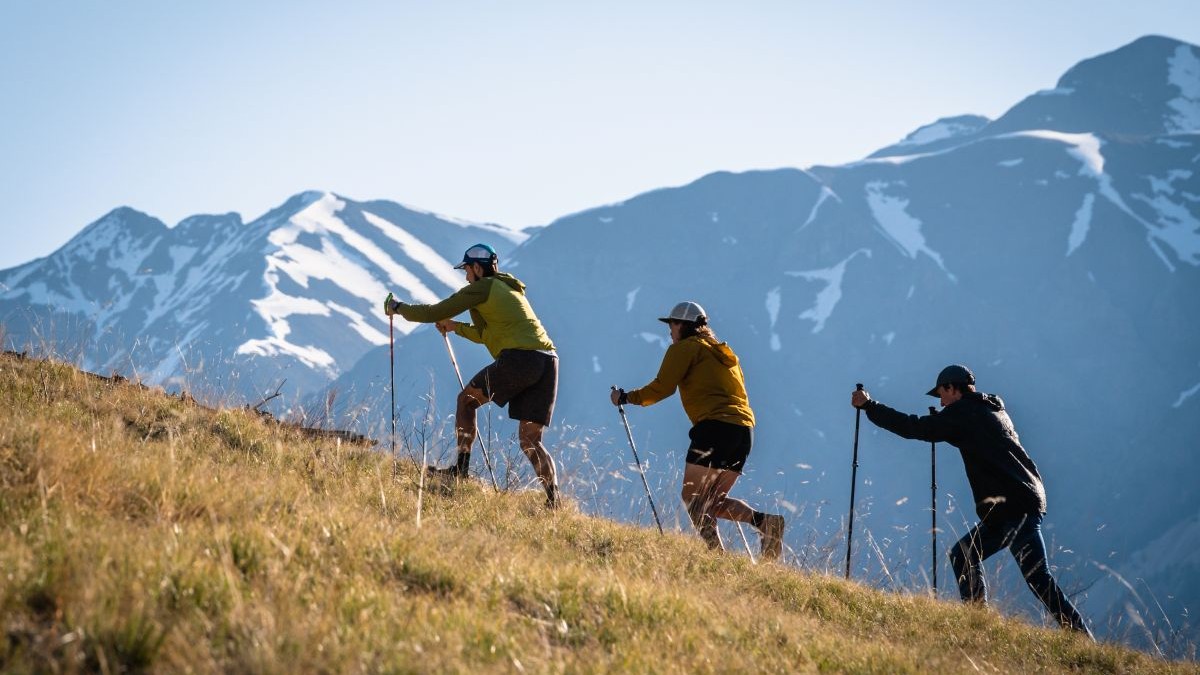
The best trekking poles have become a staple for runners in mountainous terrain. Photo: iRunFar/Eszter Horanyi
While trekking poles have taken longer to gain popularity in the U.S. than in Europe, it is now rare to see anyone without them at the start line of any mountainous ultramarathon. Science has shown that they are effective at harnessing extra power from the upper body while climbing and providing additional stability on steep descents.
The boom in mountain and ultramarathon trail running worldwide has led to companies creating lighter and smaller poles for the growing market, and the best trekking poles have become a staple for runners seeking mountain-goat-like speed and stability when climbing and descending technical mountain trails. These running-specific poles fold into multiple segments, allowing you to store them on a running vest or belt.
For this guide, we tested more than two dozen lightweight trekking poles across various terrains and conditions to provide advice on the best trekking poles currently available on the market. Please note that we tested only foldable trekking poles that runners can stow in or on a hydration pack. Most telescoping poles didn’t pack down small enough for use on a pack and are too heavy to meet our criteria for good running.
Versatility and packability are key when choosing the best trekking poles, and we found ourselves turning to the Black Diamond Distance Carbon Z Poles and the Leki Ultratrail Fx.One Superlite poles as our go-to options when light and fast were our priorities. Those looking for a budget option will appreciate the functionality and price tag of the Paria Tri-Fold Carbon Cork Trekking Poles.
For more background information, see our buying advice, testing methodology, and answers to some frequently asked questions below the picks. Also, check out our overview of three stride benefits of using trekking poles while trail running.
Best Trekking Poles
- Best Trekking Poles: Black Diamond Distance Carbon Z Poles
- Best Clip-In Trekking Poles: Leki Ultratrail Fx.One Superlite
- Best Ultralight Trekking Poles: Leki Neotrail Pro Fx.One Superlite
- Best Value Carbon Trekking Poles: REI Swiftland TT Carbon Folding Trekking Poles
- Best Adjustable Length Trekking Poles:Leki Cross Trail FX Superlite
- Best Fixed Length Aluminum Trekking Poles: Black Diamond Distance Z Trekking Poles
- Best Budget Trekking Poles: Paria Tri-Fold Carbon Cork Trekking Poles
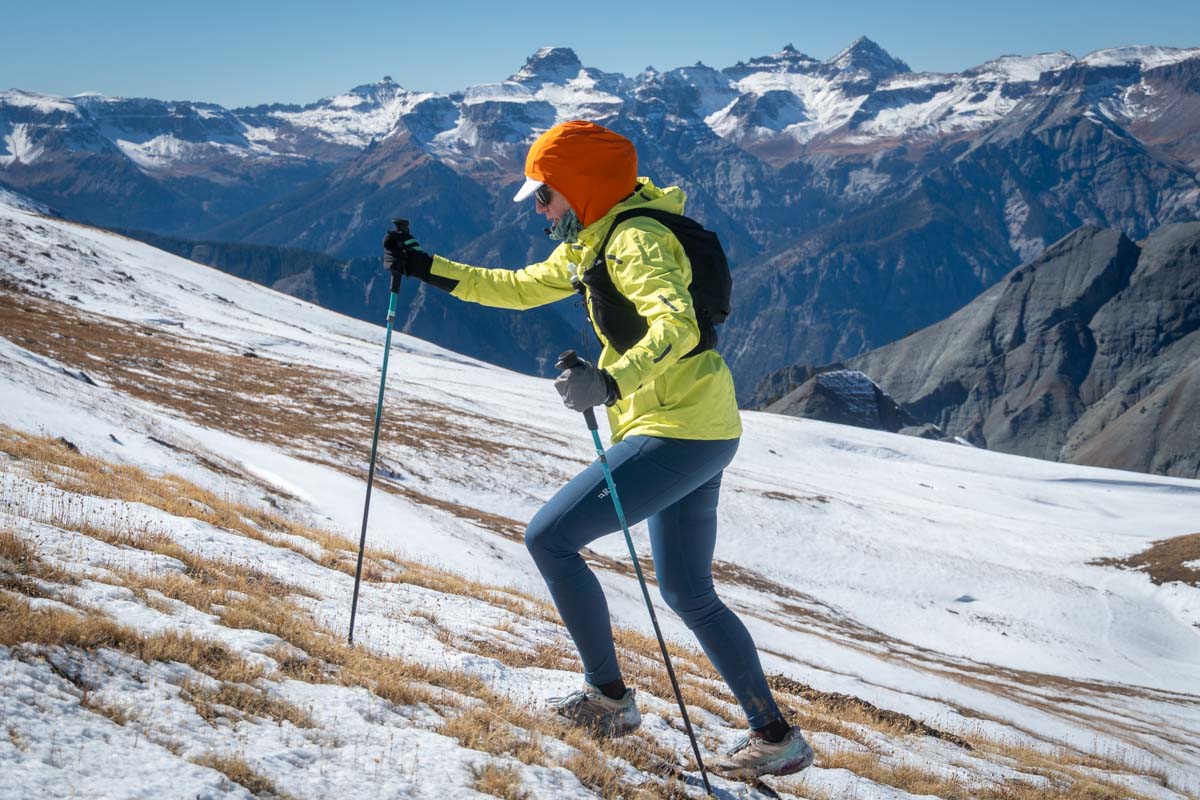
iRunFar’s Meghan Hicks uses the Black Diamond Distance Carbon Z Poles on a snowy climb. Photo: iRunFar/Eszter Horanyi
Best Trekking Poles: Black Diamond Distance Carbon Z Poles ($220)
Pros:
- Relatively lightweight and durable
- Easy to extend and fold the poles
- Widely available
Cons:
- Slightly heavier than similar options on the market
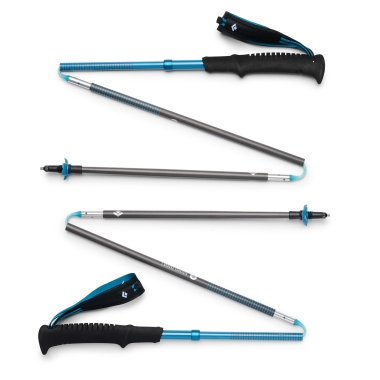
The unisex Black Diamond Distance Carbon Z Poles are considered the best trekking poles among many trail runners and ultrarunners, especially those who travel off-trail frequently, where the terrain may require varied hand positioning or passing poles between hands when scrambling is on the menu.
Their simple, lightweight design is strong and reliable, making them a longstanding favorite among the iRunFar team and an excellent choice for long mountain days. The poles feature 100% carbon fiber shafts with reinforced joints to improve stiffness and durability.
A simple push-button locking mechanism makes extending and folding the pole quick and easy. For storage in or on a pack, the poles quickly collapse into three parts that fold up in parallel. The poles are available in lengths from 105 to 130 centimeters, in 5-centimeter increments, a range that should fit runners of all heights.
The straps are simple, lightweight, and moisture-wicking loops that are easy to put on and take off, making aid station stops and snacking on the go a breeze. A comfortable EVA foam grip provides ample cushion without compromising grip security, especially in wet or cold conditions.
The grips are adequately long (18 centimeters), so multiple hand positions can effectively adjust pole length depending on whether you’re going uphill, downhill, or cruising along flat ground. The second ridge near the bottom of the grip makes it easy to hold lower down if you’re climbing a steep slope or sidling with one pole on the slope above you. This ease of changing hand positions is one of the features we love about these poles.
For long days in the mountains, we frequently used them with the straps around our wrists for longer, straightforward climbs, and just as often without the straps so that we could move our hands around on the grips or carry both poles in one hand for short periods when we didn’t need them.
These poles also have interchangeable rubber and carbide tips and are compatible with snow baskets for winter use, making them a versatile addition to your running gear. However, the pole tips fell off one tester’s poles after heavy use. This isn’t an issue if you notice that they’ve fallen out and replace them immediately, but if you don’t address the problem promptly, the rubber at the end of the pole will wear down quickly, making it impossible to reattach new tips.
You can read more about these poles in our in-depth Black Diamond Distance Carbon Z Poles review.
Available Lengths: 105-130 centimeters, in 5-centimeter increments | Folded Length: 33-44 centimeters, depending on pole length | Pole Material: Carbon fiber shafts, EVA foam grip | Pair Weight: 272 grams (115 centimeter length)
Shop the Black Diamond Distance Carbon Z PolesBest Clip-In Trekking Poles: Leki Ultratrail Fx.One Superlite ($220)
Pros:
- Efficient energy transfer
- Trail Shark grip system reduces the chance of dropped poles
Cons:
- Not everyone loves the Trail Shark grip system
- Only a carbide tip option
- Trail Shark grips can be difficult to deal with when using gloves
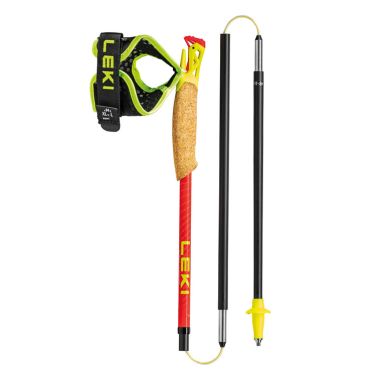
If you look around the start line of any mountainous ultramarathon, there’s a good chance you’ll see an abundance of Leki Ultratrail Fx.One Superlite poles, either in runners’ hands or strapped to their packs. When it comes to efficient energy transfer between the arms and the ground to aid uphill propulsion, these fixed-length carbon fiber poles are hard to beat. They are among the lightest on the market, and Leki’s Trail Shark grip system has proved comfortable and functional. The thin carbon shaft is stiffer than it looks, and when folded into three sections, the collapsed pole measures 33 to 38 centimeters, depending on the pole’s overall length. This is short enough, and the poles are light enough, that they stow easily on running belts, in bungees on running vest, or in quivers.
The Trail Shark grip system has set Leki poles apart from the rest of the market. While other companies have tried similar systems in recent years, the Leki remains the easiest and most intuitive to use. The lightweight mesh strap attaches to your hand with a Velcro strap, in a design reminiscent of Nordic skate ski poles. A small loop attaches securely to the yellow plastic above the cork grip, and it releases with the push of a button on the top of the grip. Since the pole is securely attached to the body, you don’t have to grip the handle of the pole quite as firmly or worry about dropping the pole. The attachment system also allows for more efficient energy transfer without having to death-grip your poles.
With practice, it becomes second nature to attach and detach the poles from the strap part of the system, making it easy to free your hands to grab a snack or stow your poles. You can keep the Trail Shark mesh strap on your hand, and it doesn’t interfere with most on-trail activities. The only time they get fiddly is when you have to put gloves on and off in changing weather. Scrambling on technical terrain may also feel less secure with the straps on the hands. However, our testers agreed that leaving the straps on was comfortable and easy in most conditions, and Leki now also sells a glove with a built-in Trail Shark grip for runs where you know you’ll be wearing gloves the entire time.
A carbide tip on the bottom of the pole is durable and offers solid purchase on a variety of trail surfaces. Unfortunately, Leki doesn’t offer a rubber tip for these poles for those traveling on delicate surfaces. A small trail-running-specific basket is adequate at keeping the pole from sinking into soft surfaces or getting stuck between rocks, though in some instances, we had to pull them out of a holes in the ground.
These are far from the most durable poles on the market, but if used with care, they should last — barring falls and other accidents. Leki recommends using these poles only on race day to keep them protected and ready to perform when it really matters. We’ve tested these poles on various terrains and haven’t seen any durability issues, but if you regularly break poles, these might not be the top choice for you. They are expensive, and once carbon cracks, the pole is done. That said, when it comes to a light and fast pole that offers exceptional energy transfer, the Leki Ultratrail Fx.One Superlite has a lot going for it.
Check out our in-depth Leki Ultratrail Fx.One Superlite review.
Available Lengths: 105-130 centimeters, in 5-centimeter increments | Folded Length: 33-38 centimeters, depending on pole length | Pole Material: Carbon fiber shafts, Trail Shark grip system with cork grip | Pair Weight: 268 grams (115 centimeter length)
Shop the Leki Ultratrail Fx.One SuperliteBest Ultralight Trekking Poles: Leki Neotrail Pro Fx.One Superlite ($210)
Pros:
- Incredibly light
- Regular wrist strap
Cons:
- Potentially questionable durability
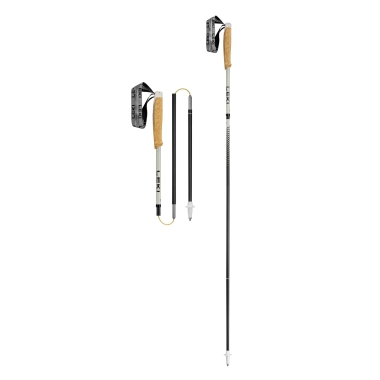
The Leki Neotrail Pro Fx.One Superlite poles fill a niche that several iRunFar team members have been dreaming about for a while: an ultralight Leki pole without the brand’s Trail Shark grip. While the Trail Shark grip increases power transfer and offers many benefits, it’s not ideal for those who regularly incorporate scrambling into their runs or who frequently put on and take off gloves in adverse weather.
These are the lightest poles in this guide, and the only reason they don’t contend for the top spot is uncertainty about their durability. Leki markets these ultralight poles as a race-day-only option for runners experienced with poles. They use the same 14-millimeter diameter shaft as the Leki Ultratrail Fx.One Superlite reviewed above. Leki’s slightly stronger pole, the Leki Ultratrail Fx.One, uses 16-millimeter diameter shafts. While we’ve put these poles through some difficult conditions around the San Juan Mountains of Colorado without any damage, they might not be the best choice if you know you’re prone to snapping poles. It’s also worth noting that Kilian Jornet used these poles during his States of Elevation project this past summer.
Like on other Leki poles, these grips are thinner than most others in this guide, but we found the cork material to be comfortable and secure to grip. The concave carbide tip digs into surfaces effectively, and the pole clicks together and comes apart easily. The poles come with a convenient carrying bag for keeping them together when not in use.
These probably aren’t everyday-use poles for anyone, as they’re pricey to begin with and expensive to replace if broken — and they’re more likely to break than heavier poles. That said, if you are someone who likes to do big, mixed-terrain mountain runs and want a pair of poles that are more conducive to scrambling and weather adaptation than those featuring a Trail Shark grip, or you really just want the absolute lightest poles on the market, these could be your best option.
Available Lengths: 105-130 centimeters, in 5-centimeter increments| Length When Folded: 33-38 centimeters, depending on pole length | Pole Material: Carbon shafts with X grip | Pair Weight: 232 grams (115-centimeter length)
Shop the Leki Neotrail Pro Fx.One SuperliteBest Value Carbon Trekking Poles: REI Swiftland TT Carbon Folding Trekking Poles ($190)
 Pros:
Pros:
- Lower price
- Lightweight
- Hassle-free transition between folded and extended
Cons:
- Clunky grips
- Limited size options
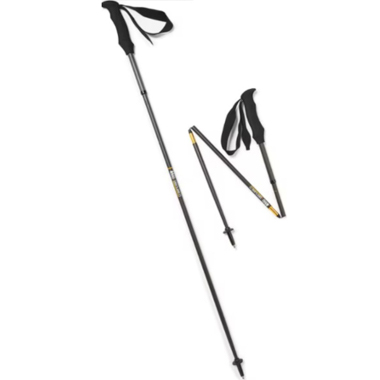
There’s no getting around the fact that fixed-length collapsible carbon trekking poles are expensive, but the REI Swiftland TT Carbon Folding Trekking Poles offer an exceptional value at a lower price point than some other options. The quick-release design is similar in appearance and functionality to the Black Diamond Distance Carbon Z Poles reviewed above, and we found them easier to extend and stow than the Black Diamonds. When folded, the pole collapses to between 33 and 40 centimeters, depending on the length of the pole. Unlike many other collapsible poles that come in 5-centimeter increments, these only come in three sizes: 105, 115, and 125. These size ranges realistically will accommodate all but the very tallest and shortest runners, but those used to a pole length that falls between these sizes may be disappointed in these options.
We were impressed by how easy it was to extend and collapse these poles. To collapse the pole for storage, a small button on the shaft allows the top section to slide down, releasing the tension from the cable that holds the pole together. We appreciated that the button was large enough to press comfortably, even with cold hands, and that the shaft didn’t pinch our fingers when compressing the button. When you’re ready to use the poles again, simply pull the top section out, and the cable snaps everything into place.
Compared to the sleek grips of some of the poles reviewed above, this EVA foam grip is larger. Those used to smaller grips might find them a bit bulky at first — we did, but they’re easy to get used to, and they provide a secure grip. To allow for multiple hand positions and to change the effective length of the pole without actually changing its length, the foam grip has an extension below the main grip area. It’s not long enough to accommodate the full width of a hand, but we still found it functional.
This pole uses a simple nylon wrist strap that can be adjusted to fit your wrist. There’s nothing fancy about the wrist straps, but they’re easy to lean into when climbing a hill and hassle-free to put on and take off. A carbide tip offers grip and durability, and the basket is larger than those on some of the other poles in this guide, helping prevent the pole from getting stuck in soft ground.
A pair of 115-centimeter poles weighs 318 grams, making these poles heavier than the high-end options, but they’re also less expensive and possibly more durable. The carbon shaft is thicker than the ultralight options, and after many miles of use on difficult rocky terrain, these poles have shown no sign of wear aside from scratches to the paint. }
Available Lengths: 105, 115, 125 centimeters| Length When Folded: 33-40 centimeters | Pole Material: Carbon shafts with EVA foam grip | Pair Weight: 318 grams (115-centimeter length)
Shop the REI Swiftland TT Carbon Folding Trekking PolesBest Adjustable Length Trekking Poles: Leki Cross Trail FX Superlite ($220)
 Pros:
Pros:
- Lightweight and packable
- Grip strap helps maintain good contact with the poles
- Adjustable length makes them shareable with family or friends of different heights
- Helpful in setting up fastpacking tarps
Cons:
- Pricey
- Adjustable length adds some weight and bulk
Adjustable trekking poles are not nearly as popular among runners as fixed-length folding poles, mainly because they are heavier. Still, there are some circumstances where they may be the best choice, and the Leki Cross Trail FX Superlite is an excellent option with its versatility, weight, and strap.
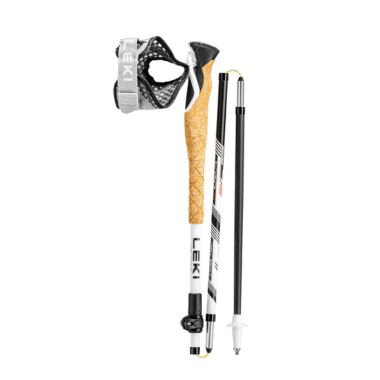
Similar to other poles from Leki, this pole has a glove-like strap called the Cross Shark. It Velcroes around your hand and attaches directly to the grip for improved power transfer. The strap is easy to clip onto and off the pole.
We found that the cork grip is comfortable to hold, and the carbon fiber shaft is relatively light. The carbide tip provides plenty of grip on most surfaces, though people who regularly use poles in rocky areas may miss the option for a rubber tip.
These poles come in two sizes: standard, which adjusts from 110 to 130 centimeters, and compact, which adjusts from 100 to 120 centimeters. Both sizes have an internal locking mechanism for folding and extending the poles, which is a very nice feature that avoids the sometimes-tricky push-button lock system of some other poles. The external speed-lock lever is smooth and easy to use, even with gloves on, making it effortless to adjust the pole length on the fly.
These trekking poles fold into three sections for easy storage when not in use. When folded, the section with the grip is approximately 8 centimeters longer than the other two shaft pieces, but this was not a problem when storing the poles. The longest section is 42 centimeters, similar to the length of other folded 120- or 130-centimeter fixed-length poles.
The cork grip on these poles is longer than that of Leki’s running-specific fixed-length poles, providing a more ergonomic fit and multiple hand positions. Leki bills these poles as dual-use for trail running and hiking. Even with all of these features, they are impressively light.
We frequently use adjustable-length poles to set up fastpacking tents and tarps. Their variable lengths make it easy to set up a tent that requires a specific pole length and to adjust a tarp setup to fit the terrain. You can learn more about trekking pole-supported shelters in our Best Ultralight Tents guide.
Available Lengths: 110-130 centimeters for the standard version, 100-120 centimeters for the compact version | Length When Folded: 42 centimeters | Pole Material: Carbon fiber shafts, Cross Shark grip system with cork grip | Pair Weight: 372 grams (standard)
Shop the Leki Cross Trail FX SuperliteBest Fixed Length Aluminum Trekking Poles: Black Diamond Distance Z Trekking Poles ($180)

Pros:
- Affordable in comparison to other carbon fiber poles
- Full-featured poles
Cons:
- Heavier than carbon poles
The Black Diamond Distance Z Trekking Poles are the aluminum version of the popular Black Diamond Distance Carbon Z Poles reviewed above. Made from 7075 aluminum alloy, these fixed-length folding poles are an excellent option for both trail running and hiking. While heavier than their carbon counterparts, they are still lightweight and durable, and they easily fold into three parts to stow on your pack.
These poles offer most of the same features as the Distance Carbon Z Poles, including a foam grip and moisture-wicking wrist strap, interchangeable carbide and rubber tips, removable low-profile trail basket, and snow-basket compatibility.
At $40 less than their carbon-based sibling and weighing fewer than 100 grams more, these aluminum poles are an excellent option for runners and hikers who want a light — but maybe not ultralight — pole for a lower price. Aluminum poles sometimes bend instead of breaking when put under an unexpectedly large horizontal load, which can happen during a fall. While a bent pole isn’t ideal, in a pinch, it’s better than a pole that has snapped in half. Carbon is a very strong material under vertical loads but relatively weak under horizontal ones, and will most certainly snap with enough horizontal force.
Available Lengths: 100-130 centimeters in 10-centimeter increments | Length When Folded: 33-44 centimeters, depending on pole length | Pole Material: 7075 aluminum alloy shafts, EVA foam grip | Pair Weight: 367 grams (120 centimeter length)
Shop the Black Diamond Distance Z Trekking PolesBest Budget Trekking Poles: Paria Tri-Fold Carbon Cork Trekking Poles ($70)
Pros:
- Inexpensive and sturdy
- Packs down small for easy storage
- Good crossover for hiking, backpacking, and running
- Adjustable lengths make them helpful in setting up fastpacking tarps
Cons:
- Heaviest pole we tested
- The screw on the adjustment lever can loosen and may need adjusting when deploying
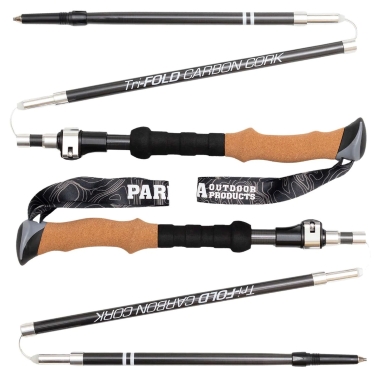
Many of the running and trekking poles we tested and chose for this guide are hefty financial investments, but the Paria Tri-Fold Carbon Cork Trekking Poles are a great budget option. At just over a quarter of the price of the most expensive poles in this guide, these impressive, adjustable-length folding carbon poles won’t break the bank, but they might shatter your assumptions of what a sub-$100 trekking pole can do.
While not explicitly marketed for running, their size and features make them more than capable of transitioning from hiking to running.
The poles come in two sizes to accommodate a wide range of heights: a 100- to 120-centimeter option and a 115- to 135-centimeter option. They have carbon shafts with aluminum connectors, carbide and rubber tips, cork grips, and a wide, comfortable nylon strap. They fold into three 38-centimeter sections, making them easy to store in or on your pack.
These poles have a thicker shaft diameter than the other trekking poles we tested and are potentially more durable. One of the main downsides to these poles is that they weigh significantly more than others on this list. However, weight is one of the few compromises these poles make, as the height adjustment lever is simple, and the click-button locking mechanism is also comparable to that of other, pricier poles.
Available Lengths: 115-135 centimeters and 100-120 centimeters | Length When Folded: 38 centimeters | Pole Material: Carbon shafts with aluminum alloy connectors, cork grip | Pair Weight: 510 grams (115-135 centimeter length)
Shop the Paria Tri-Fold Carbon Cork Trekking PolesComparing the Best Trekking Poles for Running
| POLES | PRICE | WEIGHT* (grams) | LENGTHS |
|---|---|---|---|
| Black Diamond Distance Carbon Z | $220 | 272 (115 cm) | 105 to 130 cm (5-cm increments) |
| Leki Ultratrail Fx.One Superlite | $220 | 268 (115 cm) | 105 to 130 cm (5-cm increments) |
| Leki Neotrail Pro Fx.One Superlite | $210 | 232 (115 cm) | 105 to 130 cm (5-cm increments) |
| REI Swiftland TT Carbon | $190 | 318 (115 cm) | 105 to 125 cm (10-cm increments) |
| Leki Cross Trail FX Superlite | $220 | 372 (110-130 cm) | 110-130 cm (standard) or 100-120 cm (compact) |
| Black Diamond Distance Z | $180 | 367 (120 cm) | 100 to 130 cm (10-cm increments) |
| Paria Tri-Fold Carbon Cork | $70 | 510 (115-135 cm) | 100-120 cm or 115-135 cm |

American ultrarunners Zach Miller and Caleb Olson used Leki poles at the 2025 Trail World Championships Long Trail race. Photo: iRunFar/Eszter Horanyi
Buyer’s Guide: How to Choose Trekking Poles for Running
Types of Trekking Poles
When shopping for the best trekking poles for running, there are three common designs: fixed-length folding poles, adjustable-length folding poles, and fixed-length non-folding poles. Telescoping poles designed for hiking are also available, but they are generally too heavy and bulky for trail running.
Folding poles do what their name implies — they fold into three or four sections to make them short and easy to store when not in use. Folding poles are available in both fixed-length and adjustable-length versions.
Fixed-length poles, like the REI Swiftland TT Carbon Folding Trekking Poles, only have one length when extended. Adjustable-length poles, such as the Leki Cross Trail FX Superlite, feature an extra sliding section that allows for size adjustments up to 20 centimeters.
Non-folding poles are one solid piece, much like traditional ski poles. They are generally only used for very specific trail-running applications, such as vertical kilometers, where you have your poles out the whole time and desire both maximum lightness and rigidity.
Carbon fiber and aluminum are the two most common materials used in trekking poles. As with all pieces of gear, each has pros and cons, depending on your budget and planned use. The Black Diamond Distance Z Trekking Poles, an aluminum version of the more expensive Black Diamond Distance Carbon Z Poles, share all the same features and functionality, weighing fewer than 100 grams more.

Kyle Curtin and Maggie Guterl use Leki poles to climb a steep hill. Photo: iRunFar/Eszter Horanyi
Folding Versus Non-Folding Trail Trekking Poles
Most runners want to be able to store their poles on their packs when they don’t need them. Folding poles are significantly lighter and fold up much smaller than telescoping poles, which are more commonly used in the hiking world. Because of the versatility and popularity of folding poles in trail running, we focused our testing on them. You can see different ways to carry poles in our Best Running Vests guide.
Folding poles have three to four sections of carbon fiber or aluminum, held together with a cord threaded through the center of each piece. All of the poles in this guide collapse into three sections.
When the poles are extended, the cord in the center of the shaft tightens, and the pieces lock together at reinforced joints, creating a stable and secure pole. When not in use, the poles fold up for easy storage in or on your hydration pack. The Leki Ultratrail Fx.One Superlite can fold down to 33 centimeters, which is easy to fit on most running belts or hydration packs.
Fixed-length non-folding poles are the lightest poles available because they do not require the extra materials needed for the construction and mechanics of folding poles. However, these poles are difficult to store on a pack, so you will need to carry them in your hands throughout a run, which can be inconvenient on long sections of runnable or flat trails. They are best suited for uphill-only events, such as vertical kilometer races, where the poles will be in use for the entire run. Because their versatility is significantly lower than that of folding poles, there are fewer options on the market, and we chose not to include these in our testing for this guide.

Nearly everyone at the Hardrock 100 uses trekking poles, including Hannah Green, who finished third in 2022. Photo: iRunFar/Bryon Powell
Adjustable-Length Versus Fixed-Length Trekking Poles
Fixed-length folding trekking poles, such as our top picks, the Black Diamond Distance Carbon Z Poles, Leki Neotrail Pro Fx.One Superlite, and the Leki Ultratrail FX.One Superlite, as well as the REI Swiftland TT Carbon Folding Trekking Poles are the most popular choices for ultrarunning and trail running. They easily fold into a compact carrying size and extend to a set length while in use.
Adjustable-length folding trekking poles, such as the Leki Cross Trail FX Superlite, fold similarly to fixed-length folding poles but can be adjusted within a range of lengths once extended. This can be a budget-conscious option if sharing poles among runners of different heights. The ability to adjust the length of your poles on the fly can be helpful in specific terrain settings, such as extending poles for descents and shortening them for climbs.
If you are fastpacking and using a pole to set up an ultralight tent, an adjustable pole lets you use your preferred length for running and a different length for setting up your shelter. We especially liked the Leki Cross Trail FX Superlite poles for setting up tents. Adding adjustability means using more materials, which increases the pole’s weight compared to a fixed-length pole.
Carbon Versus Aluminum Trekking Poles
Almost all the best trekking poles for running are made of aluminum, carbon, or a combination of the two materials. Both materials are very durable, but there are some key differences to consider when choosing the best option for you.
Carbon fiber trekking poles are the lightweight gold standard, and you’ll see them at the start of nearly all mountain trail races. Aluminum poles tend to have many of the same features as carbon poles, but at a heavier weight and lower price point.
Aluminum trekking poles, like the Black Diamond Distance Z Trekking Poles, are generally made of 7075 aluminum, a strong, lightweight alloy with a high fatigue point. These poles are durable and can withstand repeated vertical loads.
Under high stress — especially lateral forces — aluminum poles are more likely to bend rather than break. Aluminum is less brittle than carbon fiber, so it will often bend under horizontal loads that could snap a carbon pole. While no one wants to end up with damaged equipment on the trail, a bent pole can be usable, even if inconvenient, while a fully snapped carbon pole will be useless.
Some users have noted increased vibration when striking the ground with an aluminum pole compared to a carbon one. Carbon’s resin matrix can deform slightly under load, which allows it to absorb forces better than many other materials, including aluminum.

Courtney Dauwalter used a pair of Leki Ultratrail Fx.One Superlite poles during the early miles of the 2023 Hardrock 100, which she went on to win. Photo: iRunFar/Eszter Horanyi
Aluminum is a less expensive material, making aluminum poles more budget-friendly than full carbon fiber ones. We named the Black Diamond Distance Z Trekking Poles our best aluminum fixed-length trekking poles for their relatively low weight and cost.
Temperature extremes, particularly cold temperatures, can affect the durability of carbon fiber trekking poles, making them more brittle and susceptible to breaking. The epoxy glue bonding the sheets of carbon fiber together is sensitive to temperatures below freezing. While higher-end carbon uses epoxy that is less sensitive to low temperatures, aluminum might be a better option if you use your poles in genuinely frigid temperatures, as the metal isn’t affected by temperatures in the range that humans exist.
The incredibly low weight of Leki Neotrail Pro Fx.One Superlite simply can’t be accomplished with aluminum, and that’s what makes carbon poles so appealing. The lighter weight of carbon poles means you’ll conserve more energy with every arm swing. On paper, the weight savings of carbon over aluminum might seem negligible, but every little bit counts during a 30-plus-hour 100 miler in the mountains!
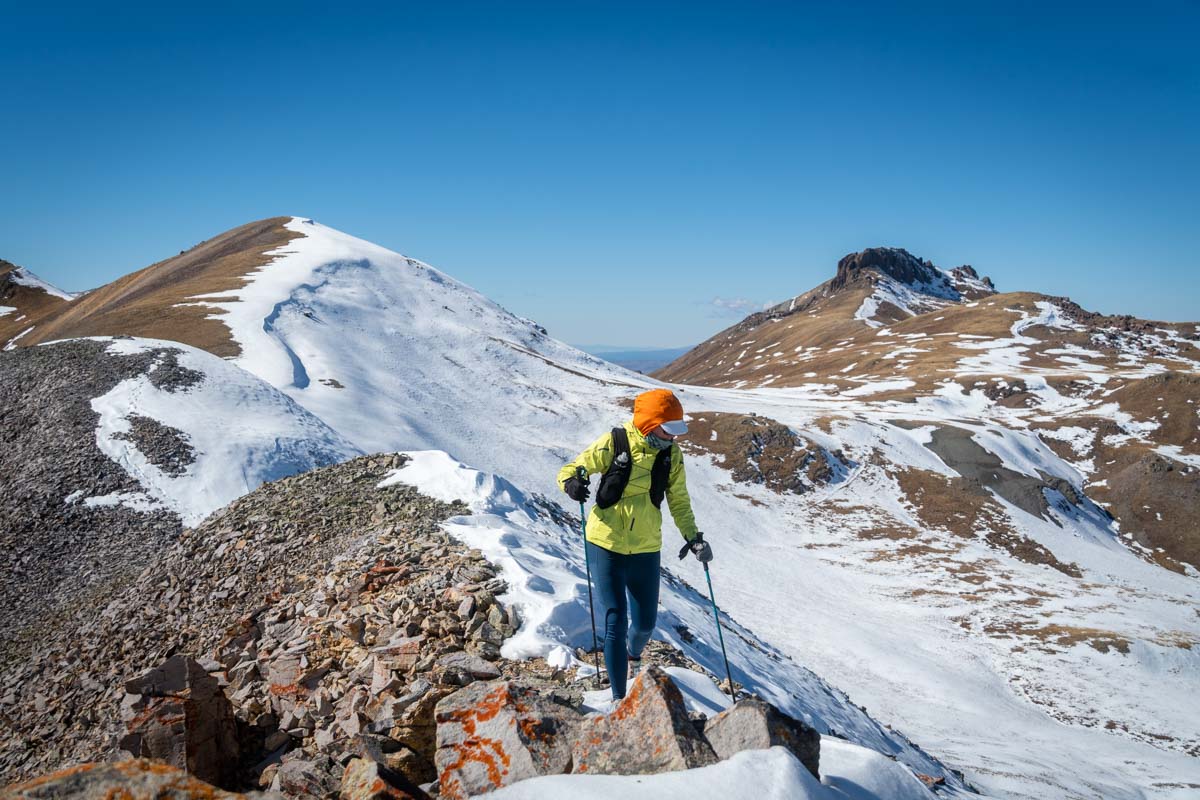
iRunFar’s Meghan Hicks uses the Black Diamond Distance Carbon Z Poles for balance on a snowy ridge in the San Juan Mountains of Colorado. Photo: iRunFar/Eszter Horanyi
It’s also worth noting that since the pole’s weight is distributed along its length, with its tip a decent distance away from your hand and wrist, the extra weight has a bigger impact on energy use because it’s swinging from a pivot point compared to the same amount of weight being carried statically close to your body. This additional rotational mass can put extra strain on your wrists, hands, and arms, and the strain can add up over time.
The weight savings come at a premium, though, as the highest-end carbon fiber trekking poles are more expensive than those with larger diameter shafts and less streamlined features. The Paria Tri-Fold Carbon Cork Trekking Poles are about twice the weight but a quarter the price of the most expensive poles on this list, the Leki Ultratrail Fx.One Superlite.
Sizing
The correct length of a trekking pole depends on the user’s height and body proportions. Your overall height will give you a pretty good idea of the pole length you need. A simple way to determine the ideal length of a trekking pole for your body is to stand with your elbows flexed at approximately 90 degrees and your forearms parallel to the floor. The distance from your hands to the ground will be approximately the length you need for your trekking poles. Most manufacturers provide a size chart or calculator on their website to help you determine the appropriate pole length based on a range of heights.
If you’re unsure which size to choose, consider an adjustable-length pole, such as the Leki Cross Trail FX Superlite. If you’re in between sizes, consider whether you want your poles to perform better on climbs or descents. For going uphill, choose a shorter pole for increased power. For going downhill, opt for the longer option for enhanced stability.
These measurements and guides are a good starting point, but ultimately, the best trekking pole size for you depends on what you feel comfortable using — practice makes perfect!
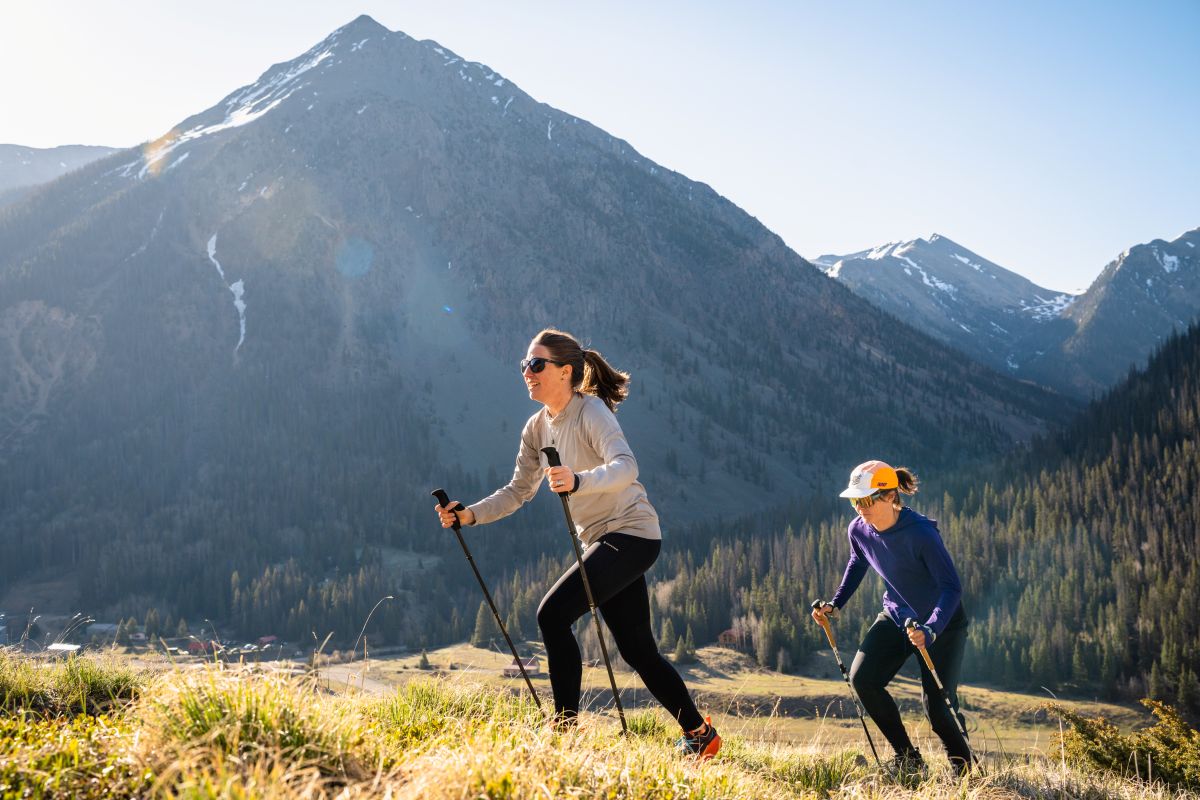
Practicing with your trekking poles is the best way to become comfortable using them. Photo: iRunFar/Eszter Horanyi
Features
In theory, all trekking poles would be equal — because really, how many ways can you reimagine a stick — but in reality, there are many subtle differences to consider when shopping for the best trekking pole for you.
As we mentioned above, foldable trekking poles are the most popular option for trail running. The way the poles fold differs slightly from one brand or model to another, which is something to consider when choosing your poles.
They all have a joint of some sort where the pieces come together, and a cord threaded through the middle keeps them in place. This cord is typically made of Kevlar and sometimes covered in a plastic sheath for added protection.
Some poles fold up easily and loosely, while others are under more tension and harder to keep folded. The length of the folded poles can vary, and not all poles work well with every pack’s pole storage system. Our Best Running Vests guide explains different ways to attach poles to a pack.
The pole grips are one of the most widely varied features of trekking poles. Grip material usually features cork or foam, and some have unique features. The Black Diamond Distance Carbon Z Poles’ grip is quite long, allowing many hand positions, a feature that can be useful when traveling over varied terrain.
By holding the poles lower on the grip, you’re essentially shortening the pole, which can make it more comfortable and useful on steep ascents or while traversing across a slope. The REI Swiftland TT Carbon Folding Trekking Poles have the largest grip in this guide, and it may be too big for some small-handed runners.
A traditional pole grip features a wrist loop, usually made of a lightweight, moisture-wicking material that loosely encircles the wrist and allows you to loosen or adjust your grip without dropping the poles. These straps may include a little padding or a Velcro adjustment for added comfort and a more secure fit.
Some trekking poles, including the Leki Ultratrail FX.One Superlite, have glove-like Velcro straps that stay securely fastened to your hand and click on and off the pole at an attachment point. This system is reminiscent of those found on cross-country skiing poles, where the goal is to maximize energy transfer. If you like Leki poles but not the Trail Shark grip, the Leki Neotrail Pro Fx.One Superlite features a normal strap.

The Trail Shark grip system of the Leki Ultratrail Fx.One Superlite makes it easy to unclip from the poles and carry them for short, runnable sections of mountain trails. Photo: iRunFar/Eszter Horanyi
The tips of trekking poles are an important and often unappreciated feature. Most poles have carbide tips on the ends, which are durable and provide excellent traction on rocky or icy terrain. Rubber tips are softer and better suited for areas where ground damage may be an issue, such as environmentally sensitive alpine tundra or softer ground.
Carbide tips can also leave marks on softer rock, such as the sandstone found in Utah deserts. Rubber tips are a good choice for long stints on pavement as well, as they are also less noisy.
Some poles have interchangeable tips, such as the Black Diamond Distance Carbon Z Poles and Black Diamond Distance Z Trekking Poles. Other brands include a cap that can be placed over the carbide tip to protect your pack from damage. The Leki Cross Trail FX Superlite, Leki Neotrail Pro Fx.One Superlite, and Leki Ultratrail Fx.One Superlite only come with a carbide tip.
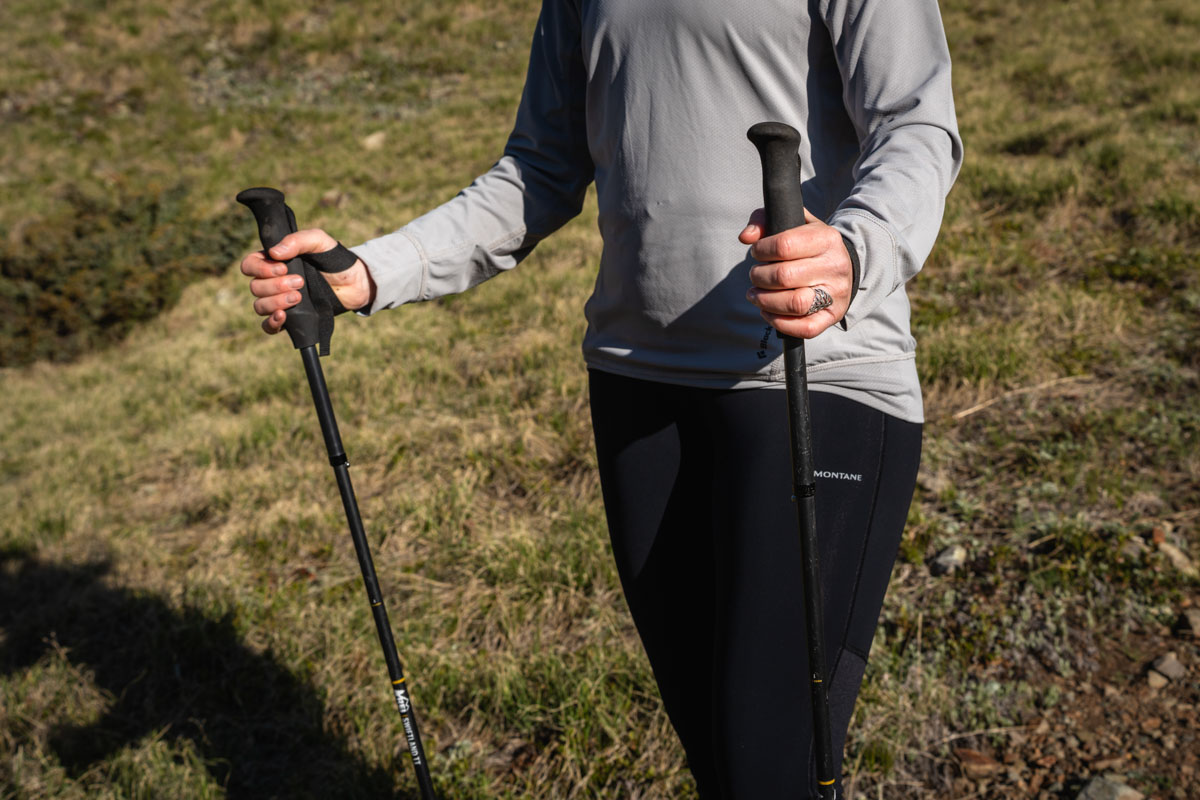
The grips on the REI Swiftland TT Carbon Folding Trekking Poles can feel big for small hands. Photo: iRunFar/Eszter Horanyi
Why You Should Trust Us
While many trekking poles are available, specific features make some better for running than others. The iRunFar team has been using trekking poles for runs and races for years, and our testing process ensures you get the best gear for your needs. We began the initial version of this guide by extensively researching the trekking poles on the market and narrowed our list to 15 top candidates for testing.
Our testing team, primarily based in the mountains of Colorado, tested the poles on miles of rocky, mountainous terrain there and on the rocky, rooty trails of the U.S. East Coast. Our Colorado- and Utah-based testers used poles for long training runs, races, and FKT efforts, including the Hardrock 100 and Nolan’s 14.
From long climbs to scree-filled descents on summer summits to wintry treks to long slogs through sandy canyons, we tested the efficiency and durability of the poles to decide which were the best for trail running. When evaluating trekking poles, we considered their strength and stiffness, weight, grip comfort, strap attachment system efficiency and comfort, and tip and basket options. We also considered the ease with which the poles extended and collapsed.
We tested both adjustable- and fixed-length poles at various price points, allowing us to suggest one for nearly any runner’s specific needs. Many of the poles featured in this guide have been used by iRunFar testers for years, and our team continues trying new poles on the market to keep this guide updated.
Frequently Asked Questions About Trekking Poles
How do trekking poles help when running?
There are several ways trekking poles can enhance your trail running performance. The most common use, and the one with arguably the most benefit, is climbing. Poles can help with leg strain by offloading some stress to your arms, improving balance, and providing additional power. You can read more about the three stride benefits to using trekking poles.
Getting your upper body in on the fun can improve forward propulsion when climbing, particularly on steep, mountainous terrain. And it’s not just on uphills: A study published in the European Journal of Sports Science found a decrease in force on the feet when using poles on level and downhill terrain (1).
Several studies, summarized in an analysis of the biomechanics of using poles, found that the relative perceived exertion of walking up a slope decreased with the use of poles, even though heart rate increased (2).
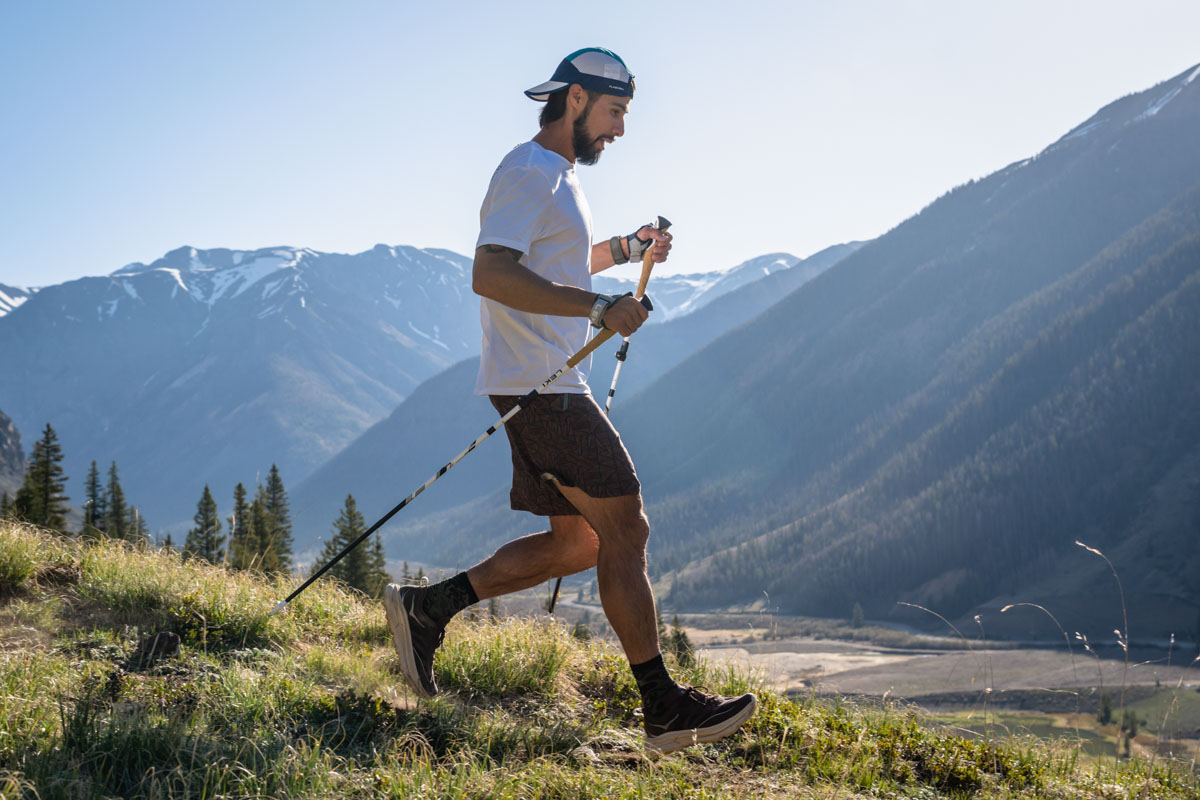
The Leki Cross Trail FX Superlite poles are adjustable and collapsible, making them highly versatile poles. Photo: iRunFar/Eszter Horanyi
What goes up must come down — and in the case of mountain ultras, the descents can be pretty darn treacherous. Those trekking poles that helped propel you up the mountain can also help keep you stable and upright on the way back down.
The extra points of contact on a steep, rocky downhill can help you maintain speed when cruising over obstacles and slow you down when it is so steep that your poor quadriceps muscles are in over their head. A study found that using poles on a descent can decrease delayed-onset muscle soreness (DOMS) and reduce immediate isometric strength loss (3), allowing you to run downhill longer with less muscle fatigue.
In addition to using upper-body strength to offset leg fatigue, trekking poles can help keep you upright, reduce strain on the lower back, and expand your chest to optimize breathing. While trekking poles aren’t a substitute for strength and core work, they help keep you standing tall as the fatigue from the late stages of a race kicks in.
Hiking speed also increases with the use of trekking poles. The arm swing and audible click of the poles on the trail can function like a metronome, keeping your hiking rhythm going as you ascend steep terrain. A study has found that using poles while walking can increase stride length (4).
The extra contact points are crucial for maintaining balance, whether running or walking. Poles are also handy when crossing rivers, both as a brace in deeper water and to stay balanced on rocks when you’re trying to keep your feet dry.
Traversing uneven or slippery terrain with poles is much easier than trying to do it without them, and poles can save you from a slip and fall along the way. Since most of the best trekking poles for running are incredibly lightweight, including the lightest in this guide, the Leki Neotrail Pro Fx.One Superlite, you don’t have to pay much of a weight penalty to get a significant advantage.

Using poles to cross rivers can help with balance and keep your feet dry. Photo: iRunFar/Eszter Horanyi
What are some downsides to using trekking poles?
Using poles correctly takes some practice. If you hit the trails with them and haven’t gotten the hang of your arm swing or pole placement as you climb or descend, they can get in the way and cause more harm than good.
The excess energy spent holding and swinging poles while hiking or running will be for nothing if you aren’t placing them properly and pushing off efficiently. This can turn any potential power gains into losses and tire you out in the process.
A study summarizing the effects of using poles during sports finds ample evidence that poles increase heart rate due to the engagement of upper body muscles (2). Therefore, it’s important to use the extra effort to generate forward propulsion.
While trekking poles can improve running and hiking speed and reduce leg fatigue, they are, simply put, another thing to carry. Becoming proficient at hand placement, carrying them while running, eating and drinking without dropping them, navigating aid stations without stabbing volunteers or other runners, and attaching them to a pack takes a lot of practice and repetition to make it second nature when fatigue sets in.
As we discussed above, one of the benefits of running with trekking poles is additional stability and improved balance. While they help a lot here, they aren’t magic sticks, and slips and falls still happen. Inadvertently falling onto a pole has the potential to cause serious injury. Falling on a pole can also cause it to bend or snap.
These dangers increase if you use grips and straps that attach your hands to the poles very securely, like the grip system on the Leki Cross Trail FX Superlite or the Leki Ultratrail FX.One Superlite. This is certainly not a reason to skip trekking poles altogether, but we recommend keeping it in mind as you practice your pole running technique on the trails.

Trekking poles can provide additional propulsion and stability on many different types of surfaces. Photo: iRunFar/Eszter Horanyi
Trekking poles are another item to manage in your run or race kit. Even the bulkier of our selections for the best trekking poles, like the Paria Tri-Fold Carbon Cork Trekking Poles, aren’t outrageously heavy and arguably compensate for their weight by providing extra propulsion. However, having more gear to deal with can add complications.
Trekking poles can also be cumbersome in highly vegetated terrain where they can get caught up in branches, shrubs, and high grasses.
What type of terrain is best suited for using trekking poles?
Trekking poles provide the most benefit on steep terrain, where they can increase power and speed on climbs, engaging your arms and core to help do some of the work of moving your body upward.
A peer-reviewed analysis of many pole-use studies from across various sports found that poles consistently increased heart rate and VO2. However, the studies did not find an increased rate of perceived effort accompanying the increased heart rate (2). This could indicate that using poles puts a greater strain on the aerobic system while reducing the strain on the muscular system, especially the legs (2).
Using the extra points of contact when rock-hopping your way back down the descents is an acquired skill — as is using your poles as an emergency brake on those steep downhills where it feels like you might start somersaulting instead of running!
With an adjustable pole like the Leki Cross Trail FX Superlite, you can make the most of your poles by shortening them on the ups and lengthening them on the downs. The longer grips of the Black Diamond Distance Carbon Z Poles allow multiple hand positions, making them efficient on various terrain types.
If you’re running on moderate terrain, you will want to leave the poles at home, as they will more likely be a hindrance and just add extra, unnecessary weight to your kit. That’s not to say we have never used them in the late stages of a flatter 30-hour race to keep ourselves awake and upright — but these situations are few and far between.
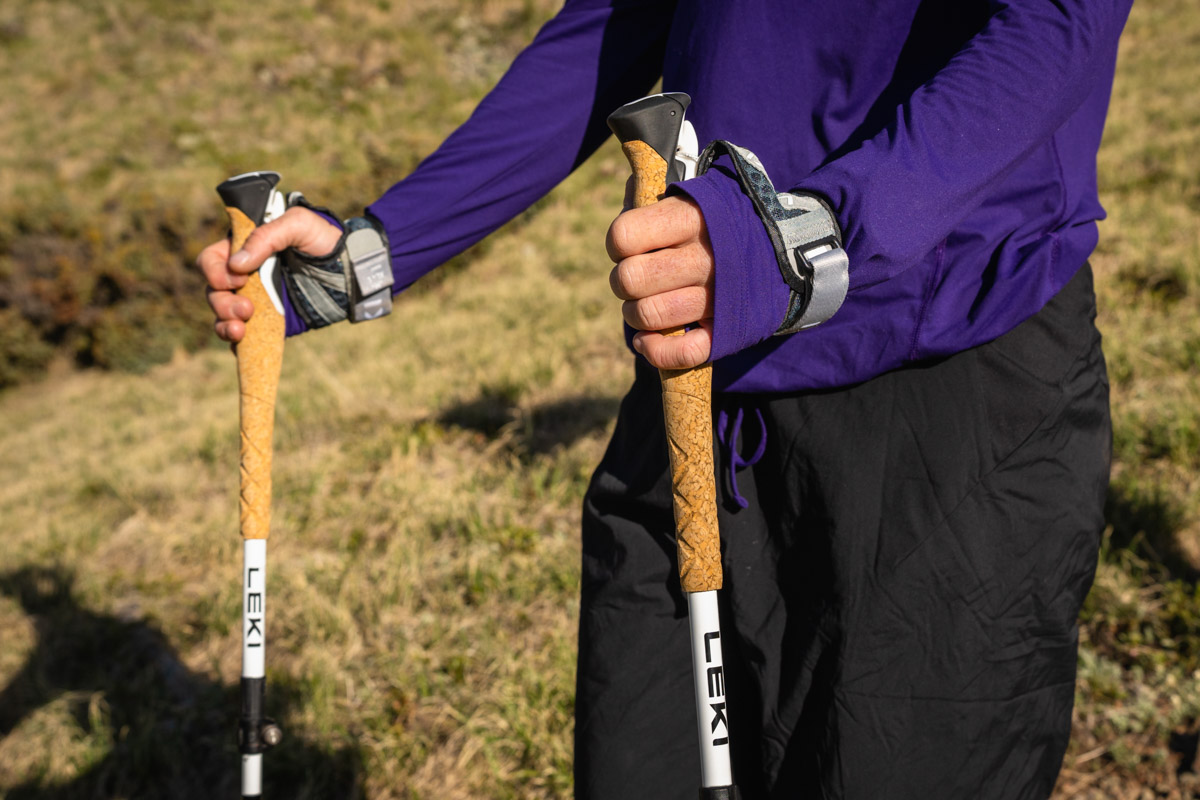
The long grips on the Leki Cross Trail FX Superlite allow for multiple hand positions. Photo: iRunFar/Eszter Horanyi
Should I use aluminum or carbon trekking poles?
The short answer is … yes. Many great aluminum and carbon poles are on the market, and either will work for running. When deciding which type of poles are right for you, the most significant factors to consider are budget, the amount you will be using them, and how you plan to use them.
Aluminum poles, such as the Black Diamond Distance Z Trekking Poles, are less expensive than their carbon counterparts, the Black Diamond Distance Carbon Z Poles, but they are also heavier. If you are just starting with poles, will only be using them sporadically, or don’t care too much about gear weight, aluminum may be the best choice.
Carbon poles, like the Leki Neotrail Pro Fx.One Superlite are the best choice for individuals who want to keep their running gear ultralight for long days in the mountains and those who are ready to invest in running equipment they plan to use frequently.
Can I use trekking poles at races?
Most races allow the use of trekking poles. In many mountainous races, especially in Europe, you’d be hard-pressed to find someone not carrying them. There are exceptions to the rule, though, notably the Diagonale de Fous on Réunion Island, where poles aren’t allowed on the trails, even outside of the race, and, until 2026, the Western States 100 in California.
Run Rabbit Run in Steamboat Springs, Colorado, didn’t allow poles for a long time, but has changed its rules about them in recent years. It’s always good to double-check race rules for any restrictions on trekking pole use. If you’re looking for a race pole, we recommend the Leki Neotrail Pro Fx.One Superlite for its incredibly low weight, easy storage on a hydration pack, and grip system that optimizes energy transfer.
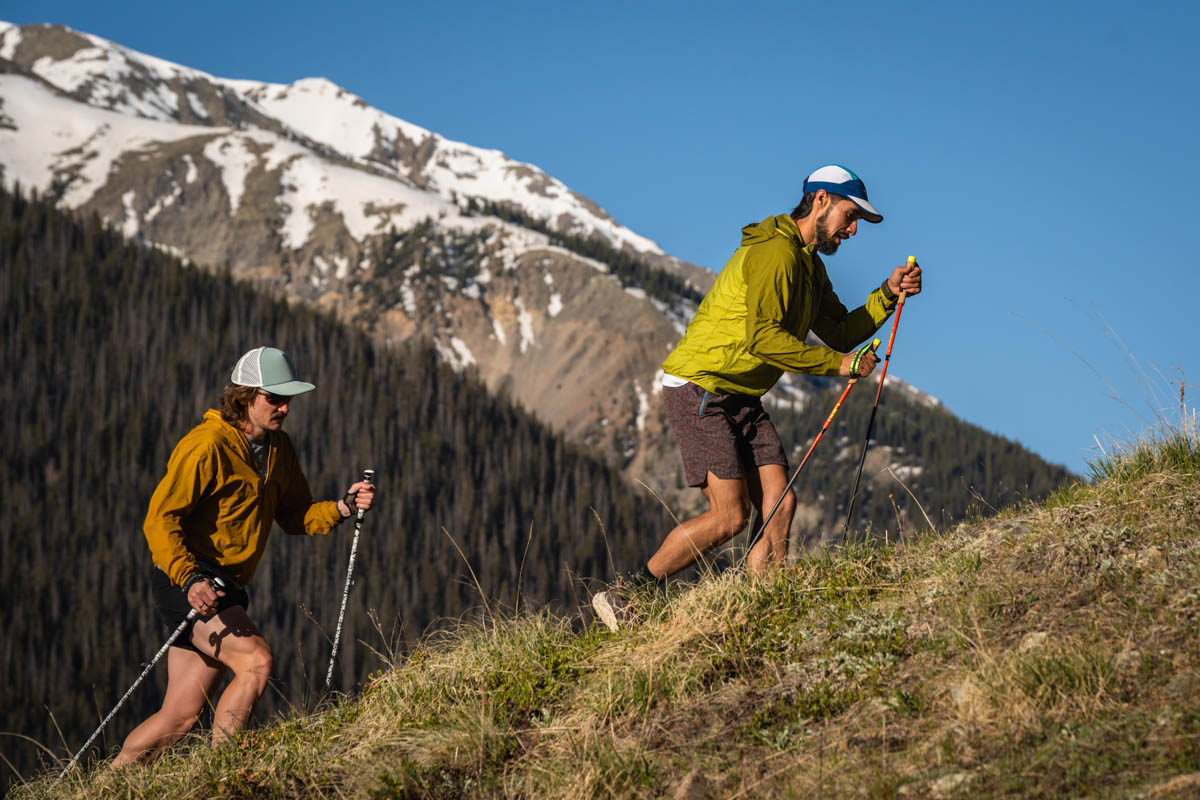
Using poles to go uphill can reduce leg fatigue and increase speed. Photo: iRunFar/Eszter Horanyi
How do I learn to use trekking poles when running?
Practice makes perfect! Or, at the very least, proficient. There are a few strategies for using trekking poles while running and hiking that depend on the terrain. Before you hit the trails, get comfortable with the poles on even ground.
Try out the wrist straps and grip. Hold them while walking to get used to the feel of your arm swing with trekking poles in hand. Getting used to the glove-like grip system of the Leki Ultratrail Fx.One Superlite or Leki Cross Trail FX Superlite can take a little more time than the regular wrist strap of most other poles, like the Black Diamond Distance Z Trekking Poles.
Once you feel comfortable with your poles’ basic grip and swing, practice on the hills to dial in that power and efficiency boost. The most common ways to use the poles are by alternating with your arm swing or by planting both poles in front of you as you push off, either going up steep terrain or downhill over rocks.
Can I use hiking poles for running?
Hiking poles serve the same basic function as trekking poles and can certainly work for running. Their design will be slightly different, as hiking poles put less emphasis on weight than running poles. Many hiking poles also don’t fold up, though many telescope down to become shorter. Telescoping poles are heavier and don’t collapse as short as foldable poles. The Paria Tri-Fold Carbon Cork Trekking Poles are a versatile, affordable option for both hiking and running.

Team USA’s Tracen Knopp uses a quiver to stash his poles during the 2025 Trail World Championships Long Trail race. Photo: iRunFar/Eszter Horanyi
How do I carry my poles if I’m not using them?
The simplest way to carry trekking poles when you’re not actively using them is to keep them in your hands. This is the only option if you are using a fixed-length, non-foldable pole. Having lightweight poles like the Leki Neotrail Pro Fx.One Superlite can make this a lot more comfortable. However, this option requires a little juggling act every time you eat, drink, refill hydration, or do any other trail activities requiring one or both hands. Plus, no one wants to carry fully extended poles around for long if they’re not using them.
A common way to carry poles when not in use is by using trekking pole attachments on a running vest or running belt. Most hydration packs on the market today have at least one attachment system to secure poles to the outside of the pack, with many having multiple configuration options, either on the front or the back of the pack. You can also store trekking poles inside a pack with a rear pocket that is large enough. Some companies, such as Salomon, CamelBak, and Raidlight, also offer a separate pouch or “quiver” that holds trekking poles and attaches separately to the outside of the pack. These systems are similar to an archery quiver, which holds arrows.
The iRunFar team doesn’t recommend storing poles on the front of a pack because a fall can cause injury.
What are the best trekking poles for fastpacking?
Poles are a popular gear item among fastpackers. They help with balance and provide extra propulsion on steep uphill terrain, making it easier to carry a heavier pack over technical terrain.
Fastpacking also often involves traveling off-trail on steeper-than-normal running terrain, where having a set of poles to get up and down loose slopes can be critical for safety and efficiency. Like for regular running, fixed-length collapsible poles are an excellent option for most situations.
Fastpackers, since they don’t run as much as someone out on an unloaded day trip, can take better advantage of adjustable poles, like the Leki Cross Trail FX Superlite, by shortening and lengthening them depending on the type of terrain they’re on.
Adjustable poles are also great for setting up shelters, as many ultralight tents require a specific pole length to pitch properly. An adjustable pole lets you use your preferred pole length for running while still setting up your shelter properly.

Adjustable-length trekking poles are useful for setting up fastpacking tarps. Photo: iRunFar/Eszter Horanyi
Call for Comments
- Do you run with trekking poles?
- What type of terrain do you take your poles on?
- What trekking poles are your favorite?
Back to Our Top Trekking Poles Picks
References/Notes
(1) Daviaux Y., Hintzy F., Samozino P., Horvais N. Effect of using poles on foot–ground kinetics during stance phase in trail running. Eur. J. Sport. Sci. 2013;13:468–474. doi: 10.1080/17461391.2012.740505.
(2) Saller M, Nagengast N, Frisch M, Fuss FK. A Review of Biomechanical and Physiological Effects of Using Poles in Sports. Bioengineering (Basel). 2023 Apr 21;10(4):497. doi: 10.3390/bioengineering10040497. PMID: 37106684; PMCID: PMC10135831.
(3) Howatson G., Hough P., Pattison J., Hill J.A., Blagrove R., Glaister M., Thompson K.G. Trekking poles reduce exercise-induced muscle injury during mountain walking. Med. Sci. Sport. Exerc. 2011;43:140–145. doi: 10.1249/MSS.0b013e3181e4b649.
(4) Willson J., Torry Decker M.J., Kernozek T., Steadman J.R. Effects of walking poles on lower extremity gait mechanics. Med. Sci. Sport. Exerc. 2001;33:142–147. doi: 10.1097/00005768-200101000-00021