I can’t be certain why I’m drawn to China, but the seeds were planted early. I remember my kindergarten class representing the People’s Republic of China during our elementary school’s celebration of the 1984 Olympic Games. I’m sure it’s not coincidental that I often perused the large-format National Geographic book “Journey into China” that sat on our living room shelf in the same time range.
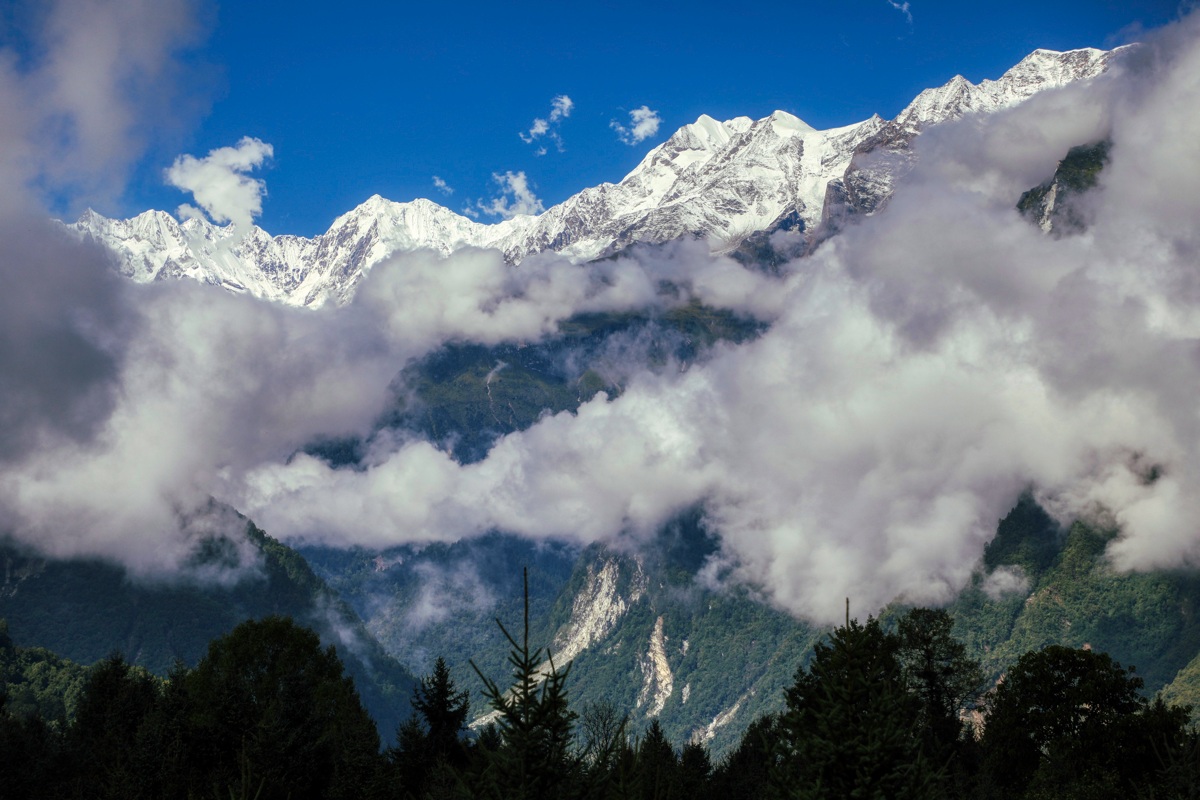
Mount Gongga and friends. All photos iRunFar/Bryon Powell unless otherwise noted.
That interest went mostly dormant until I ran the 2015 Ultra Gobi 250 Mile in remote northwestern China. That experience, along with an increasing desire to travel to regions less frequented by Western tourists, sparked a new fire. Over the intervening years, I’ve taken a few trips to western Sichuan province at the edge of the Tibetan plateau and run Ultra Gobi 250 a second time.
As luck would have it, I found myself traveling to China in the fall of 2025 to participate in the inaugural Kailas Fuga Gongga Extreme Glacier Challenge Race in western Sichuan province, commentate on the Ultra Gobi 250’s live stream, and run Ultra Gobi’s 120-kilometer race. I hemmed and hawed a bit about this trip, though, as it meant spending three very busy weeks in China and away from home, but in the end, my curiosity and Sinophilia won out. I was soon on my way to Chengdu, the megalopolis that’s the gateway to western Sichuan.
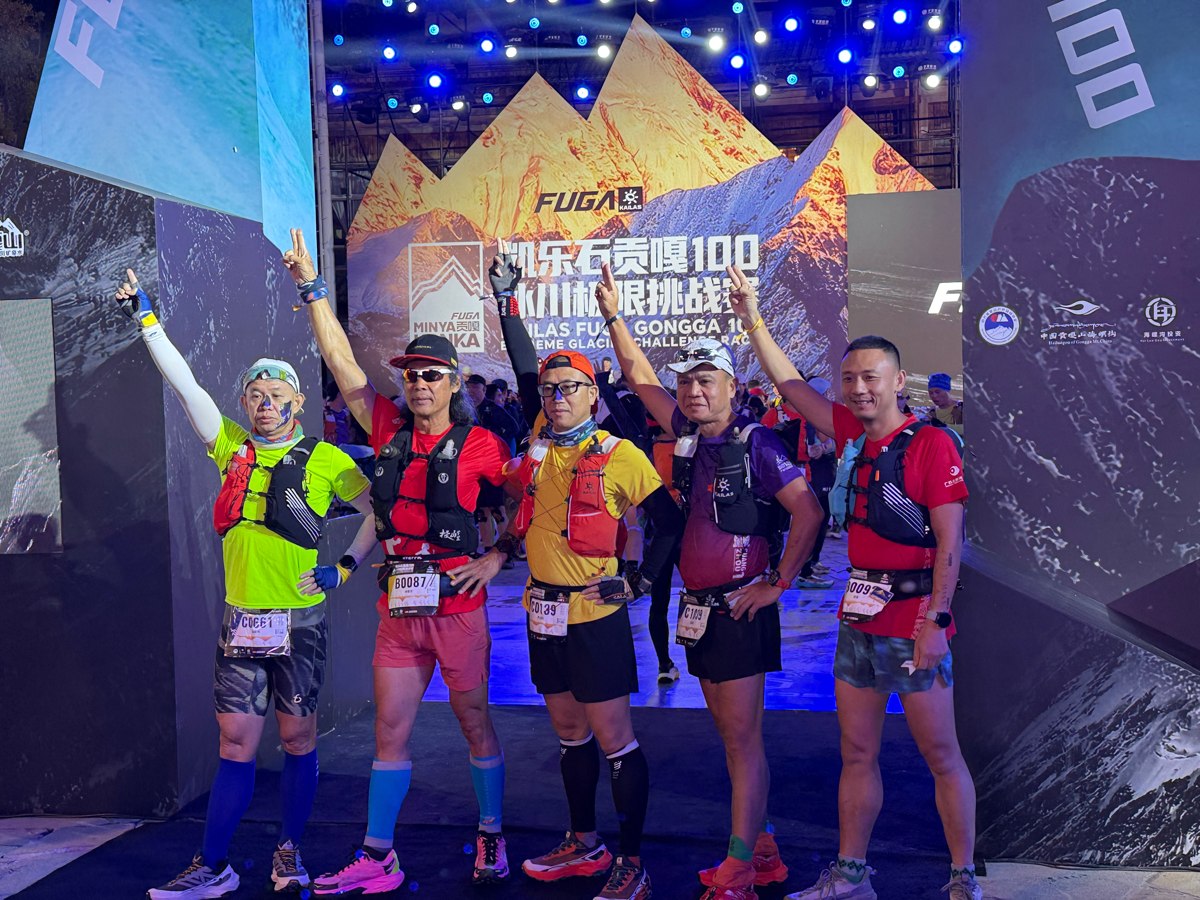
Race morning vibes at the 2025 Kailas Fuga Gongga Extreme Glacier Challenge Race.
Into Chengdu
Nominally, Chengdu is a city of 21 million people, but Chinese cities can encompass areas significantly beyond what we think of as a city in the West. Still, if we look at Chengdu’s urban area, we’re looking at 16.5 million people. To give you a more familiar comparison, the comparatively larger Los Angeles urban area is home to 12.2 million people. So, Chengdu has a whole lot of people.
In Chengdu, I stayed at the edge of the International Finance Square (IFS), maybe a mile from the geographic heart of the city and well within the city’s first ring road. If there’s a high-end consumer brand, it’s likely to have a store amongst the hundreds in the area. The IFS made a convenient, low-traffic running route with plenty of people watching and a taste of modern Chinese consumerism.
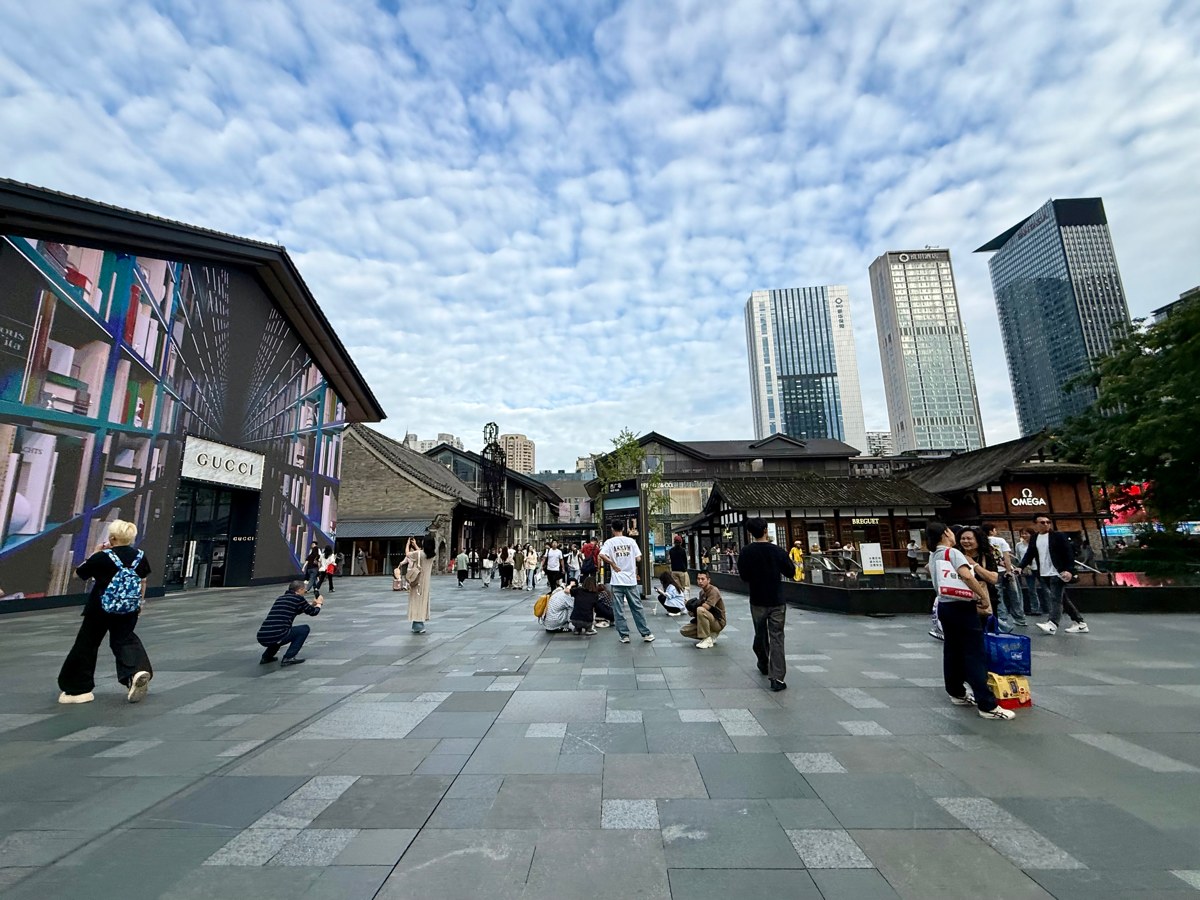
A not atypical scene from the IFS in Chengdu.
In contrast, on other days, I stuck primarily to the riverside corridors that cross the heart of Chengdu. For all the city’s modern hustle and bustle, there is a deep calm in these areas. Tree-lined promenades with their attendant parks provided space for early morning walkers, groups practicing tai chi, and the occasional minnow salesman. The latter satisfied the bait needs of the dozen or two fishermen scattered around the parks. They stood on the sidewalks 10 to 20 meters above the river with their bait cast. And stand there they did — often with a slowly burning cigarette — barely moving, if ever, not unlike the occasional heron in the river below.
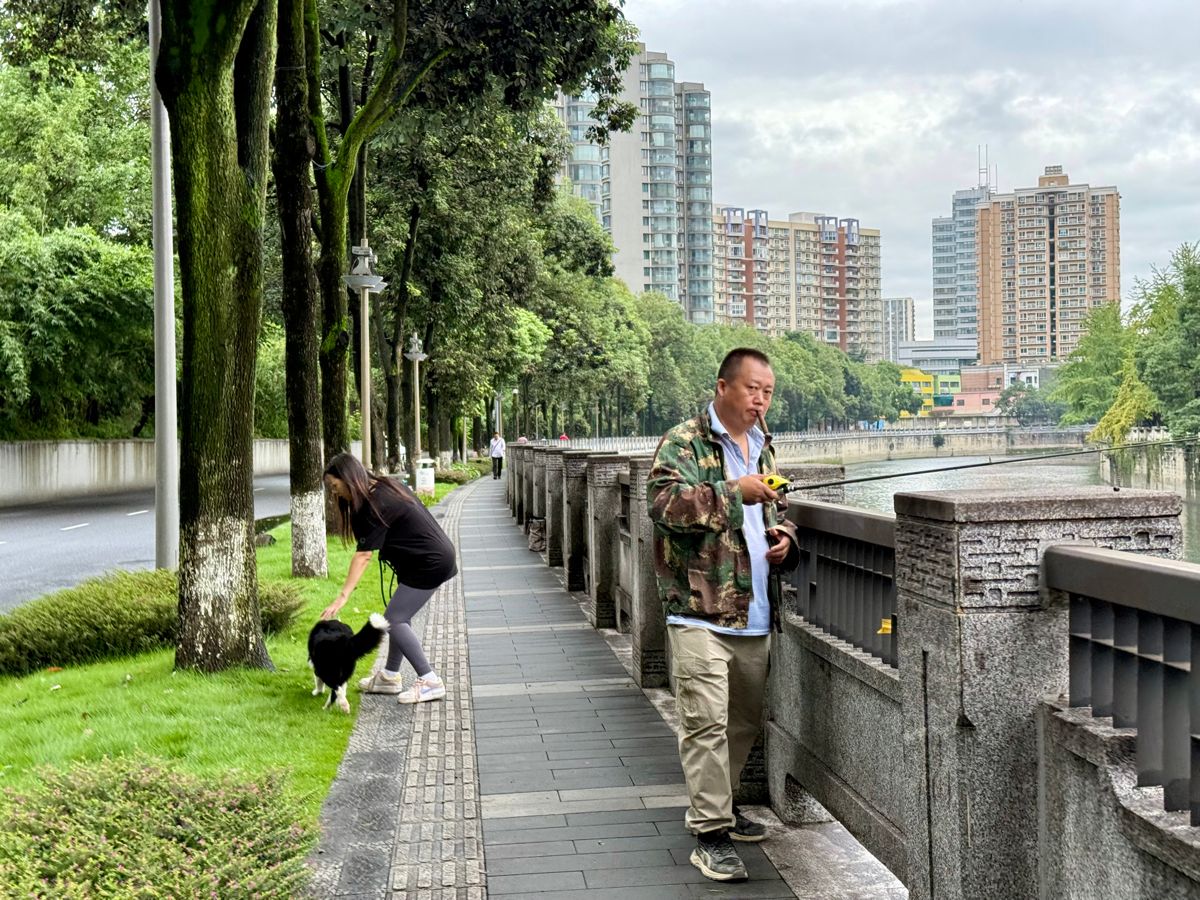
One of Chengdu’s many fishermen.
These fishermen are emblematic of Chengdu’s improbable peace and tranquility. Sure, you’ve got to pay attention when crossing the street, and there are more shops than one could ever visit, but for a megalopolis, there’s a lack of hurry and fury. I don’t get caught up in being frantic, as I might in a similarly sized city elsewhere. There are no New York City, Tokyo, or Bangkok vibes here. And I like it.
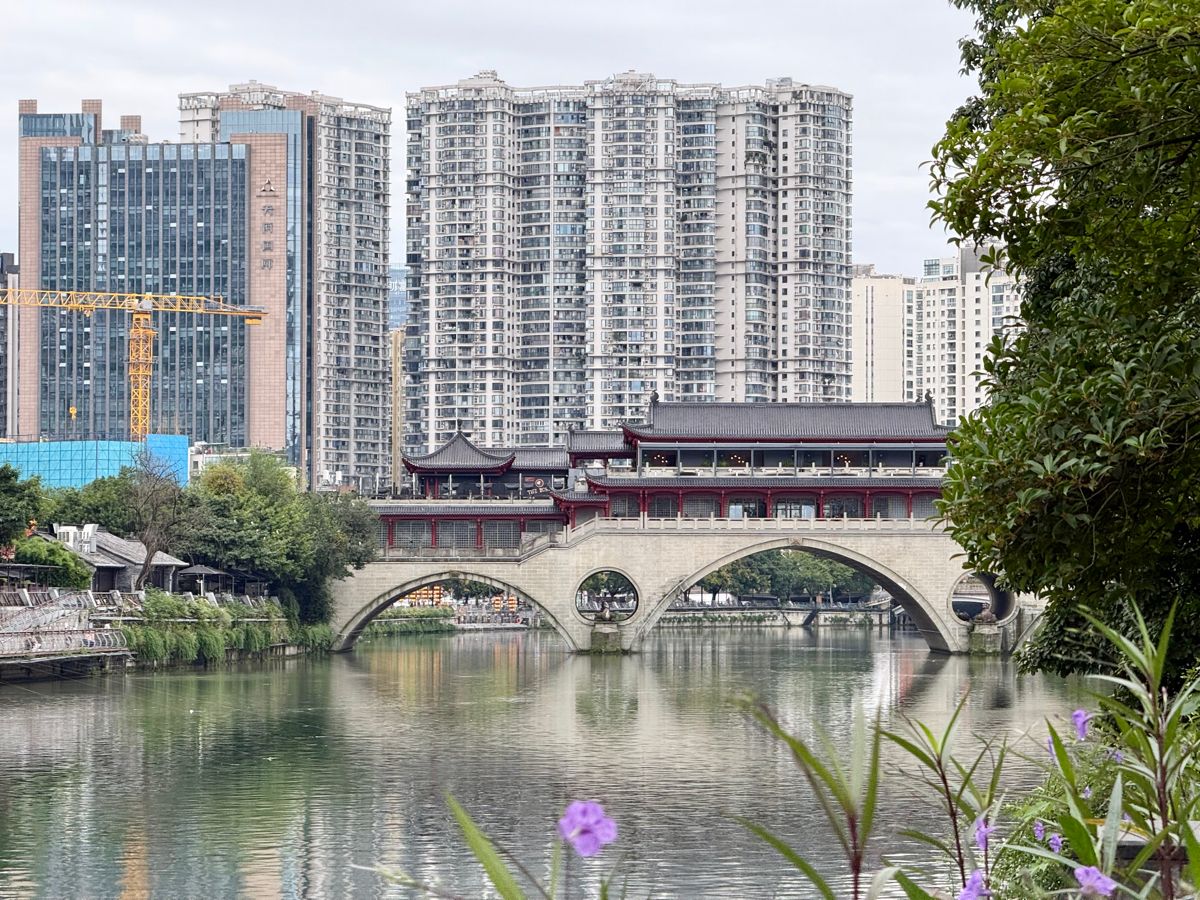
Chengdu, old and new.
My Experience at the Kailas Fuga Gongga Extreme Glacier Challenge Race
To my knowledge, in the region around Mount Gongga, there has been only a single, low-key, mostly hiking event, back in the late 2010s. Planning for an early version of the Gongga Extreme Glacier Challenge Race started in 2018, but first COVID-19 happened, and then, in 2022, a 6.9 earthquake devastated the area, killing nearly 100 people. Most of Moxi Town, the town where the race is based, was destroyed. The charming pair of main streets is almost entirely rebuilt, with beautiful facades projecting a quaint vibe.
But this place begs, no, demands a race. Mount Gongga is the easternmost 7,000-meter mountain in the world. It stands at 7,556 meters (24,790 feet) high. Often hidden by clouds or its surrounding “hills,” on occasion it or its nearly-as-tall neighbors shine their snow-topped beacons upon the upper reaches of Moxi Town. Anywhere in Europe or most of North America, with more than 20 million people and a major international airport just four hours away, and it’d have had a trail running festival 15 years ago. Even if Gongga itself is rarely ascended, the region is an iconic, accessible, vertiginous mecca.
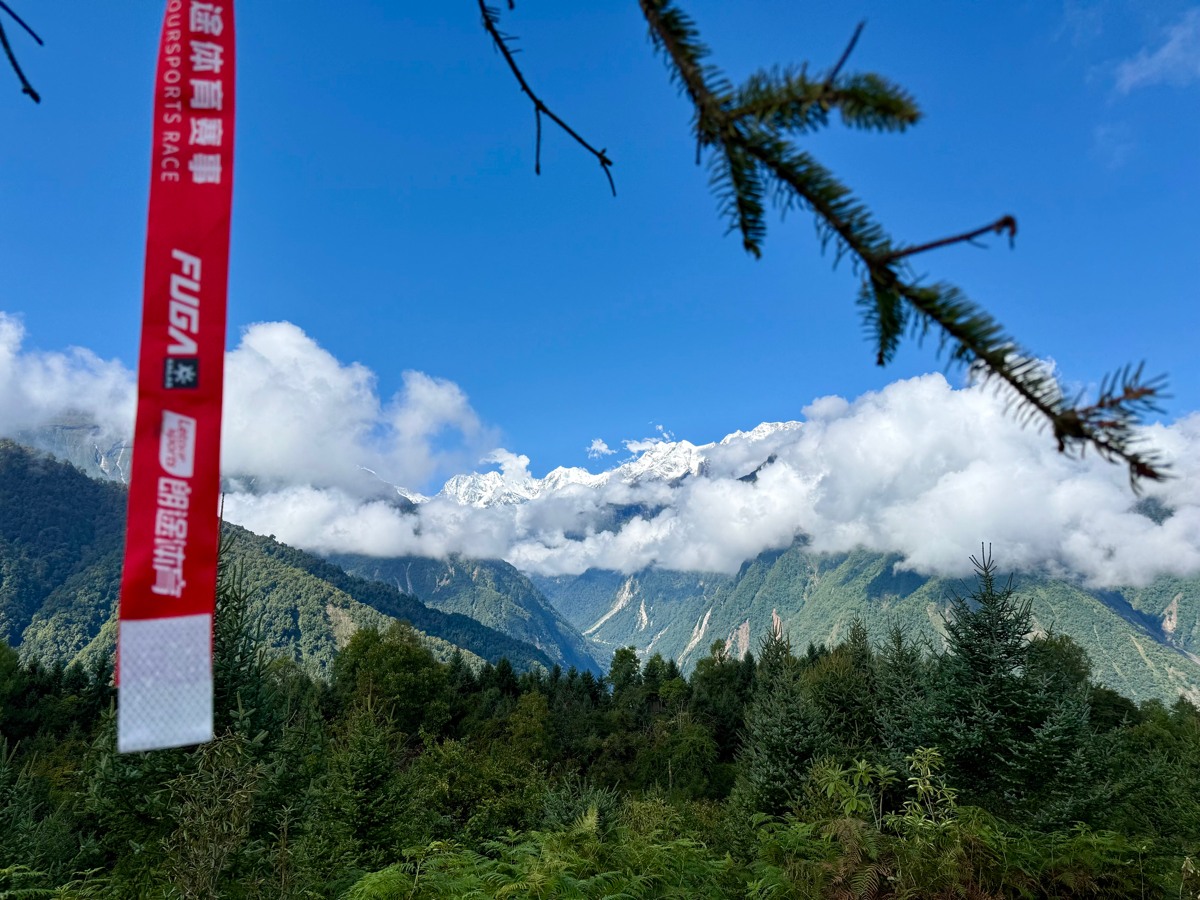
A view of Mount Gongga from the race course ahead of the race.
From a Western perspective, one thing that’s lacking is recreation trails. Sure, much of the landscape has been traversed by humans for millennia. Its hillsides have been grazed, farmed, and lived upon for ages. There are dirt roads, primitive trails, and footpaths traversing the hillsides, but true singletrack has not been developed.
Numerous factors, including the fact that I’d be running a 120k race a week later, helped steer me to the shortest of the festival’s three races. Still, the Trail Blazer 30k would be no joke with the 27k (16.7 miles) having over 2,762 meters (9,000 feet) of gain on paper.
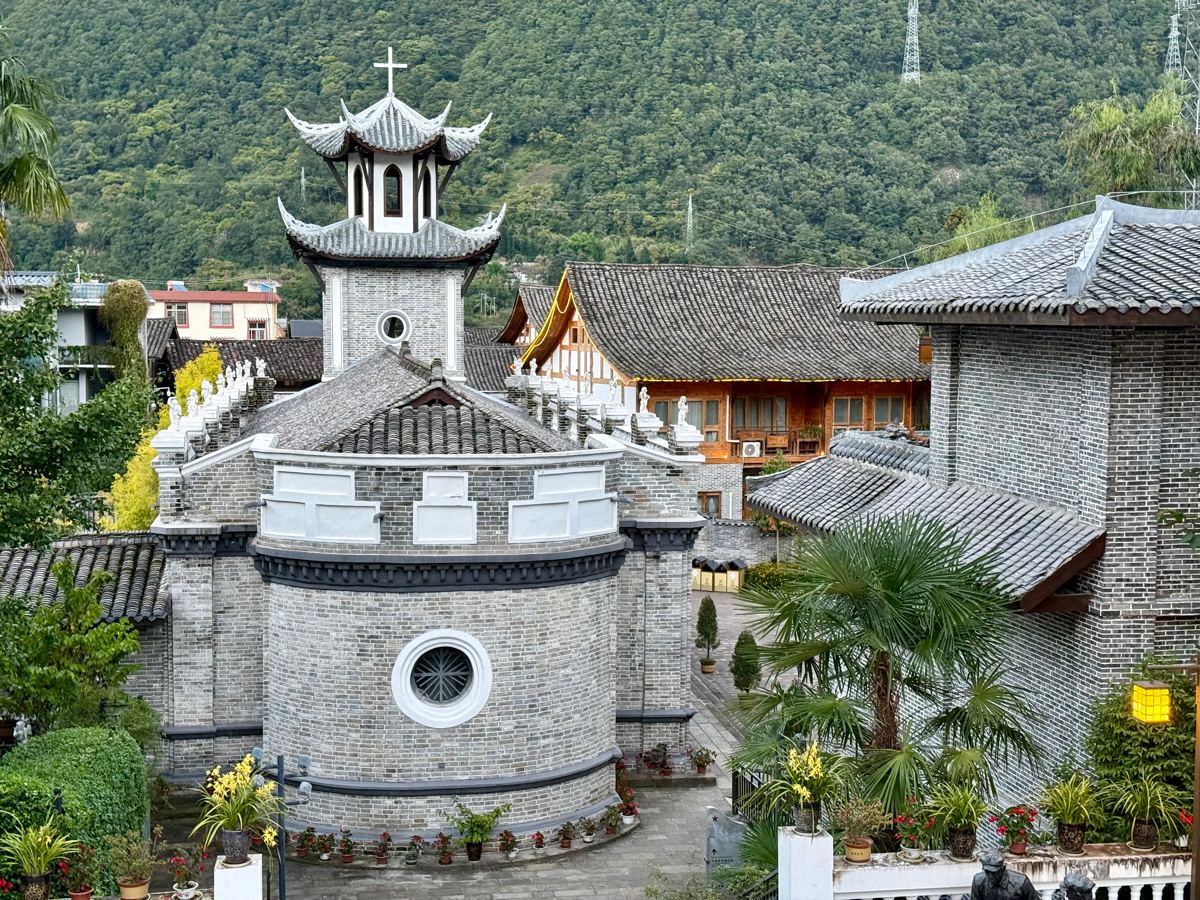
St. Anne’s Catholic Church in Moxi Town.
I spent four days in Moxi Town before the race with a group of journalists and media hosted by Kailas’s marketing team. We went to a remote “refugio,” hiked a glacier, and enjoyed the food. We took in some local history, mostly in the form of an old Christian missionary church where Chairman Mao had stayed during the Long March. A surprise bonus was staying at the aptly named Long March Hotel, with its hot springs, including on-demand spring-fed hot tubs in some rooms. I enjoyed daily evening soaks with a cold beer and a gratitude journal.
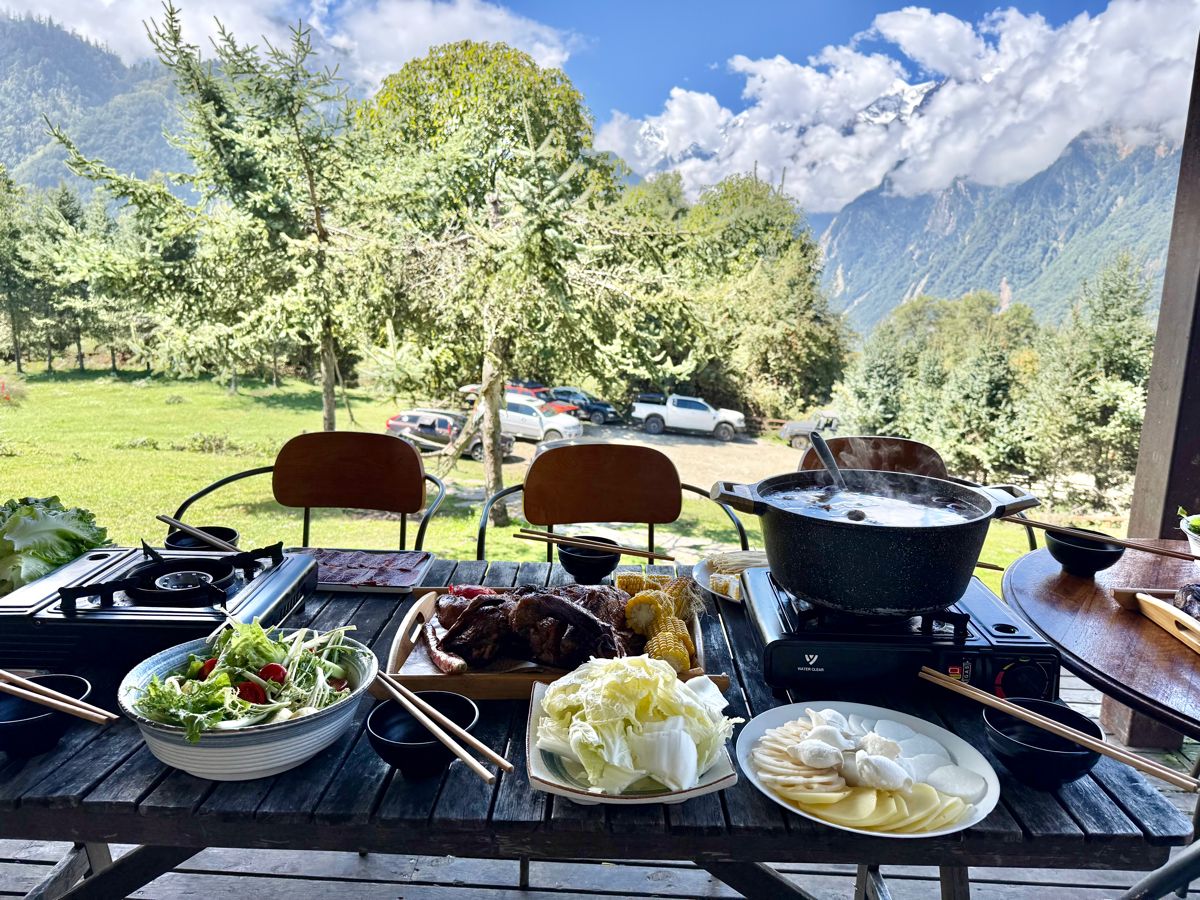
The view from lunch on the porch of Abu’s refugio.
Still on a daily running streak, I enjoyed running the town and its surroundings. I truly value these views into real local life as much or more than touristy activities. Moxi Town has a ton of small and microscale agriculture. Yes, kitchen gardens are common throughout the world, but here, many tiny plots held corn at some stage of the harvest. I loved running past the countless cement driveways and patios that held bushels of corn kernels spread out to dry before becoming animal fodder.
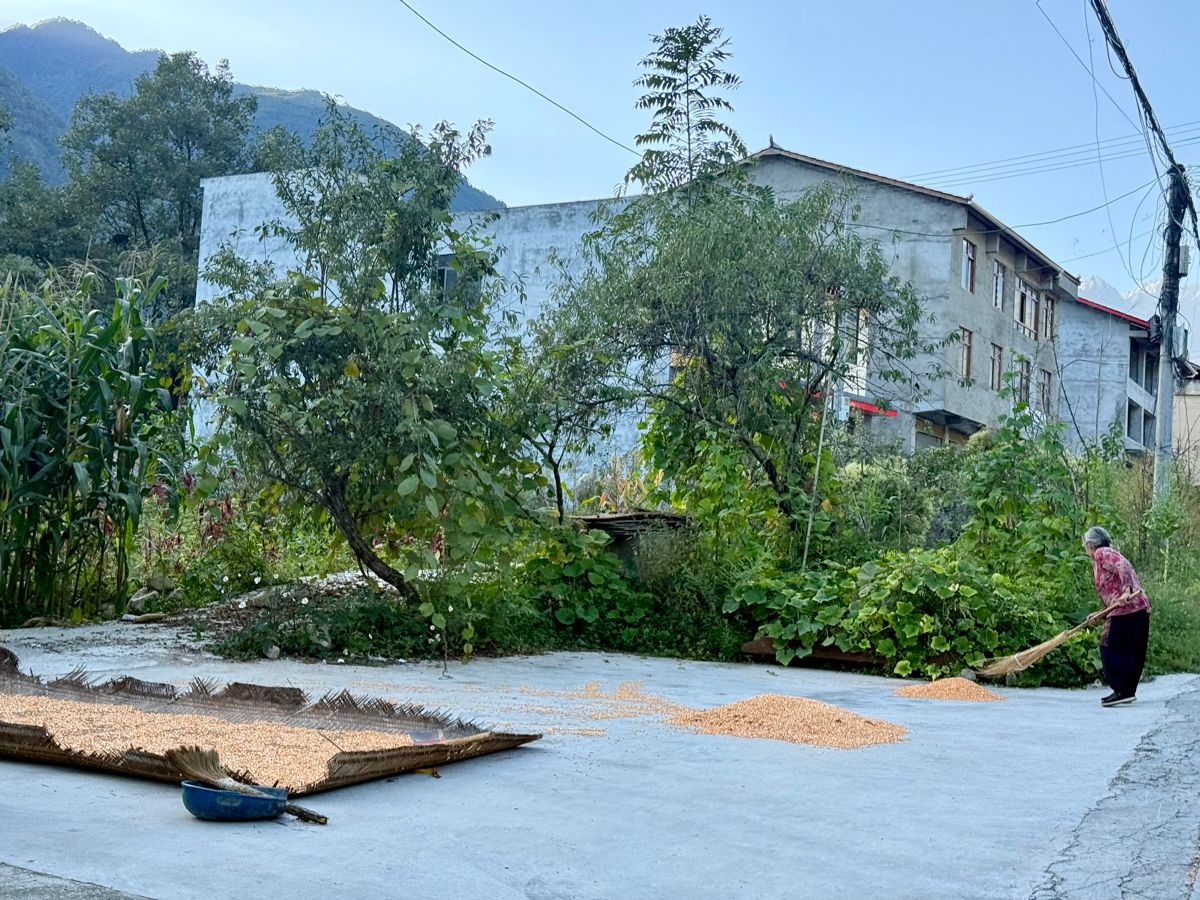
Corn drying in the driveways of Moxi Town.
Just as I enjoy running and wandering through far-off towns, I like navigating foreign interactions. There’s both novelty and a sense of accomplishment — however trivial — in encountering an unfamiliar situation and working through it. As such, the day before the race, I headed to the race check-in solo. I got myself headed in the right direction, and then a race official gently stewarded me through the process. A local journalist also spotted this foreigner and asked for a quick interview. A kindly fellow runner randomly stepped in as a translator — thanks, Iris! The process was smooth, and I’m happy to share that any reasonably adventurous English-speaking foreigner can navigate the race experience.
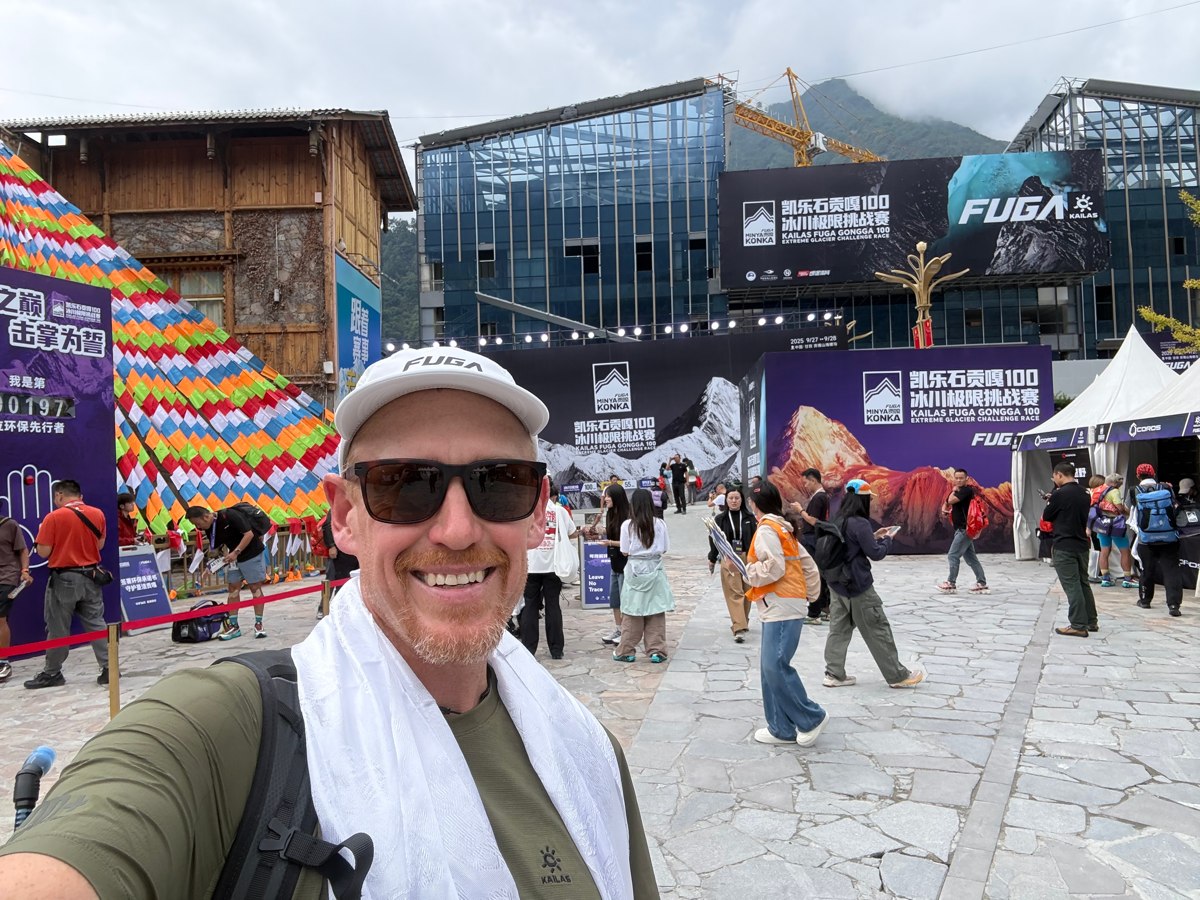
Check-in at the Kailas Fuga Gongga race.
Race morning saw a crowd of 600 or 700 runners from the two shorter races gather in the town square before lining up on one of the town’s two main streets facing downhill. Aside from a slight but marked difference in runner regalia and the six drones I could see in front of the start, it was a normal, if boisterous, starting line with a bit more enthusiasm for communal stretching than I’m accustomed to.
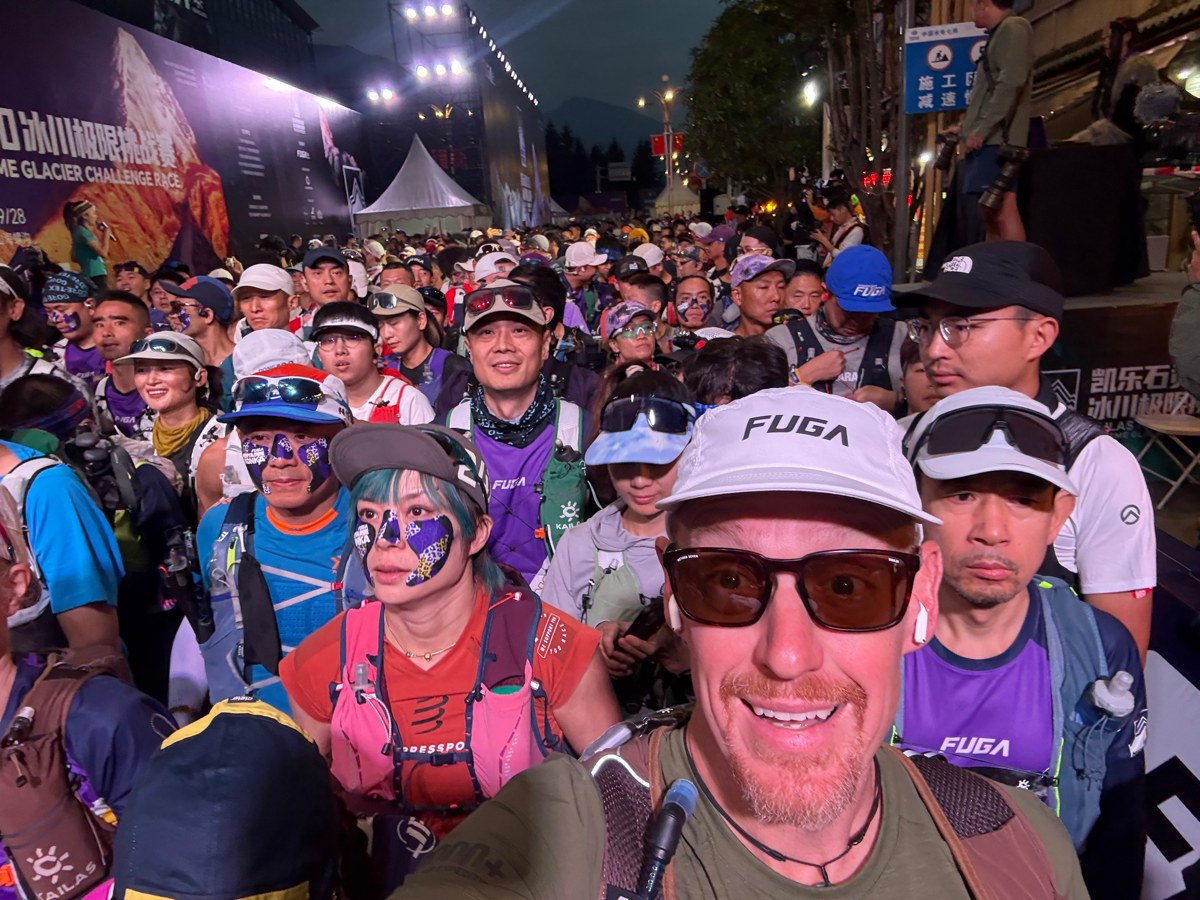
Lining up for the start of the race.
During various explorations on the remote roads around the area in the four days before the race, we saw lots of race flags, so I suspected that much of the race would be on hilly pavement. The early kilometers were in line with those expectations.
People flew off the start line at incredible paces. I settled in and enjoyed working my way up during the first 3k through town and down to the nearby river. From there, things quickly shifted to a mostly runnable climb on rough pavement to the first aid station just over 5k into the race.
The tenor changed after the aid station, with a steep climb on singletrack through the forest. There’d be a lot of this. The next 4k were a mix of steepish, rough singletrack, moderate climbing, and a rare contour on a nice trail. While it wasn’t hot, I was drenched in sweat in the extreme humidity. Fortunately, I was eating and drinking as if this were an ultra.
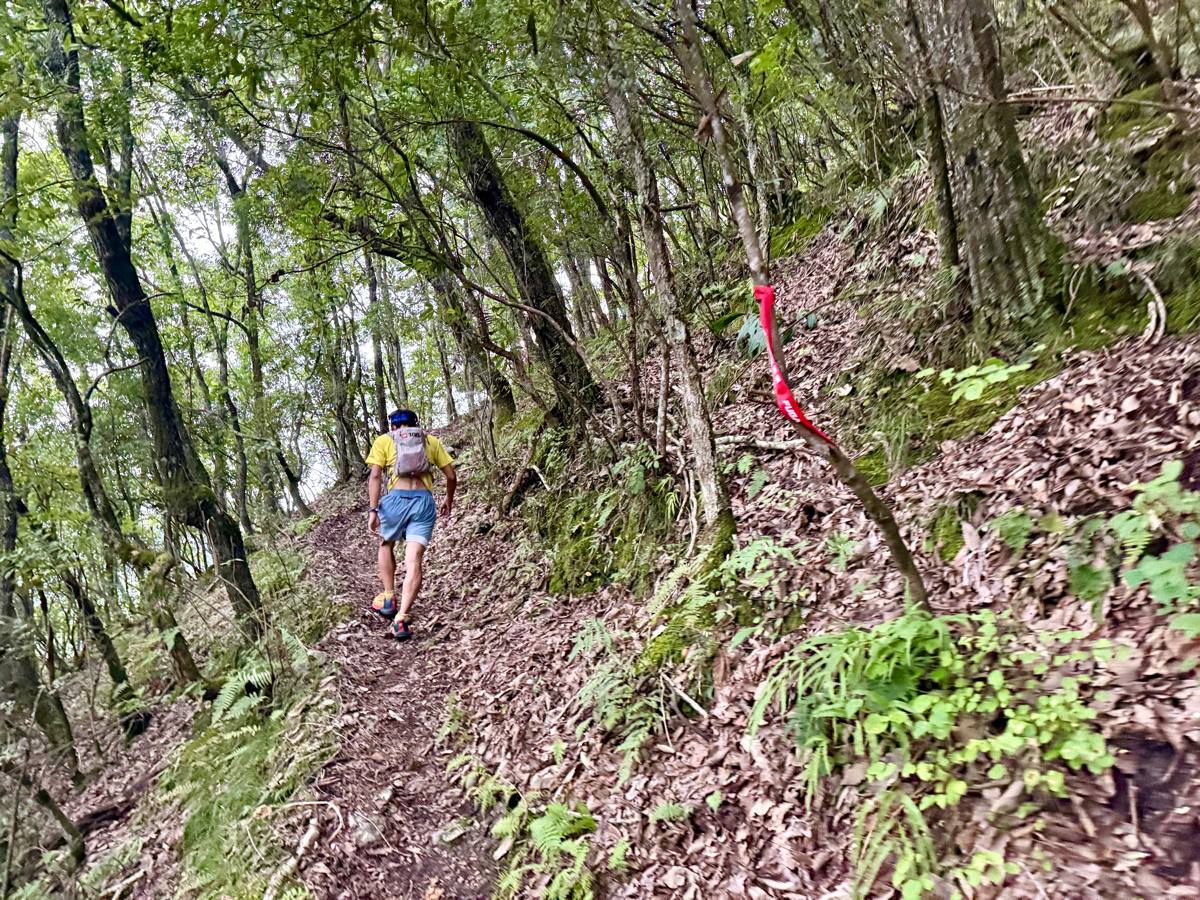
Following another runner up the race’s first climb.
Eventually, we ended up at the race’s high point, at the charismatic and locally named Abu’s refugio that we’d visited earlier in the week, which housed the second aid station. I stayed longer than necessary to get a selfie with a local volunteer who was randomly wearing a Colorado hat. Another English-speaking volunteer explained that Colorado hats are apparently a thing in China right now.
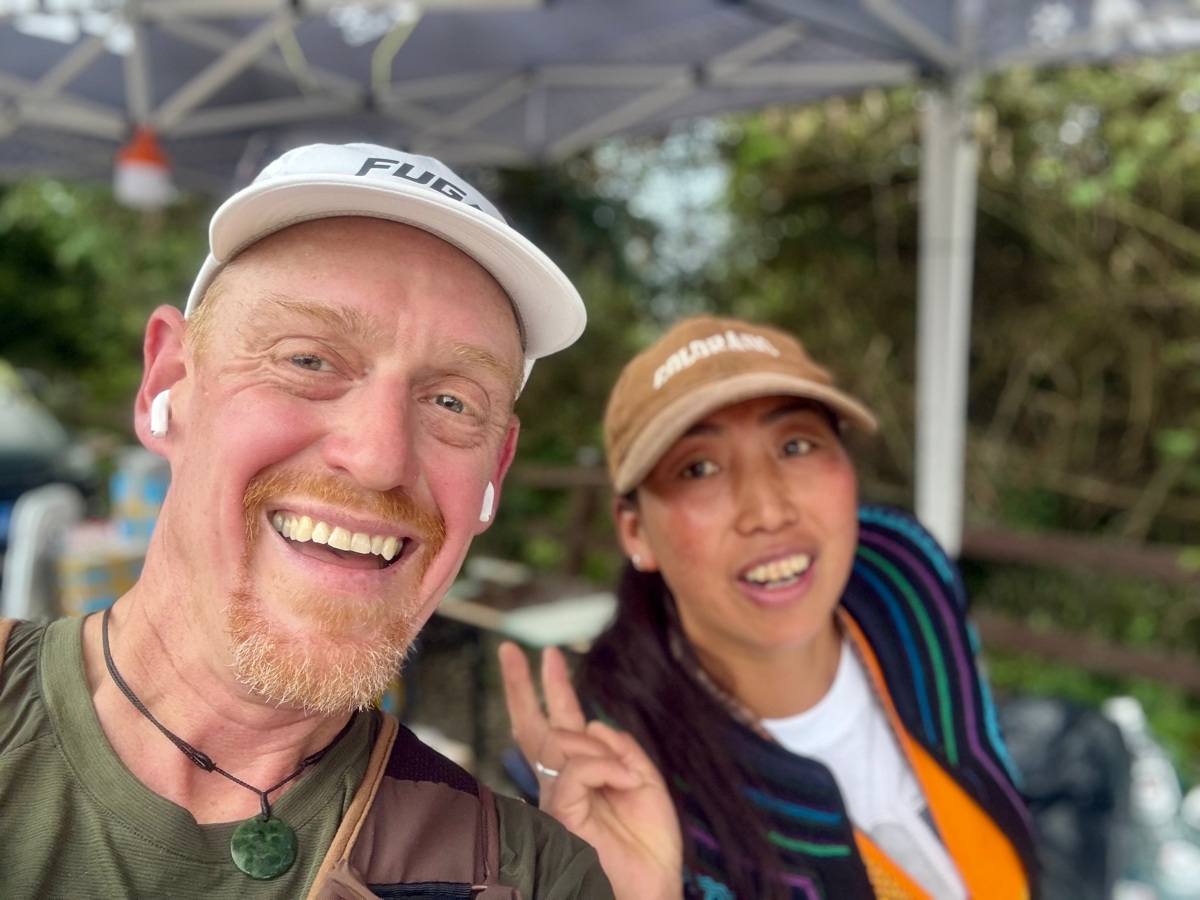
Pausing for an aid station selfie.
Then it was down, down, down. First on steep singletrack. In fact, it was over-the-top steep in places, but not so often as to confuse it with what was to come. More than 2,000 feet of descending later, I was down to the valley-bottom town that housed the next aid station. Lots of locals cheered me into the aid station, and I exchanged encouragement with another runner on the way out of town. I was vocal in my cheering for other runners, and they always reflected the vibe back. All week, I felt totally welcomed as one of a few foreigners at the event.
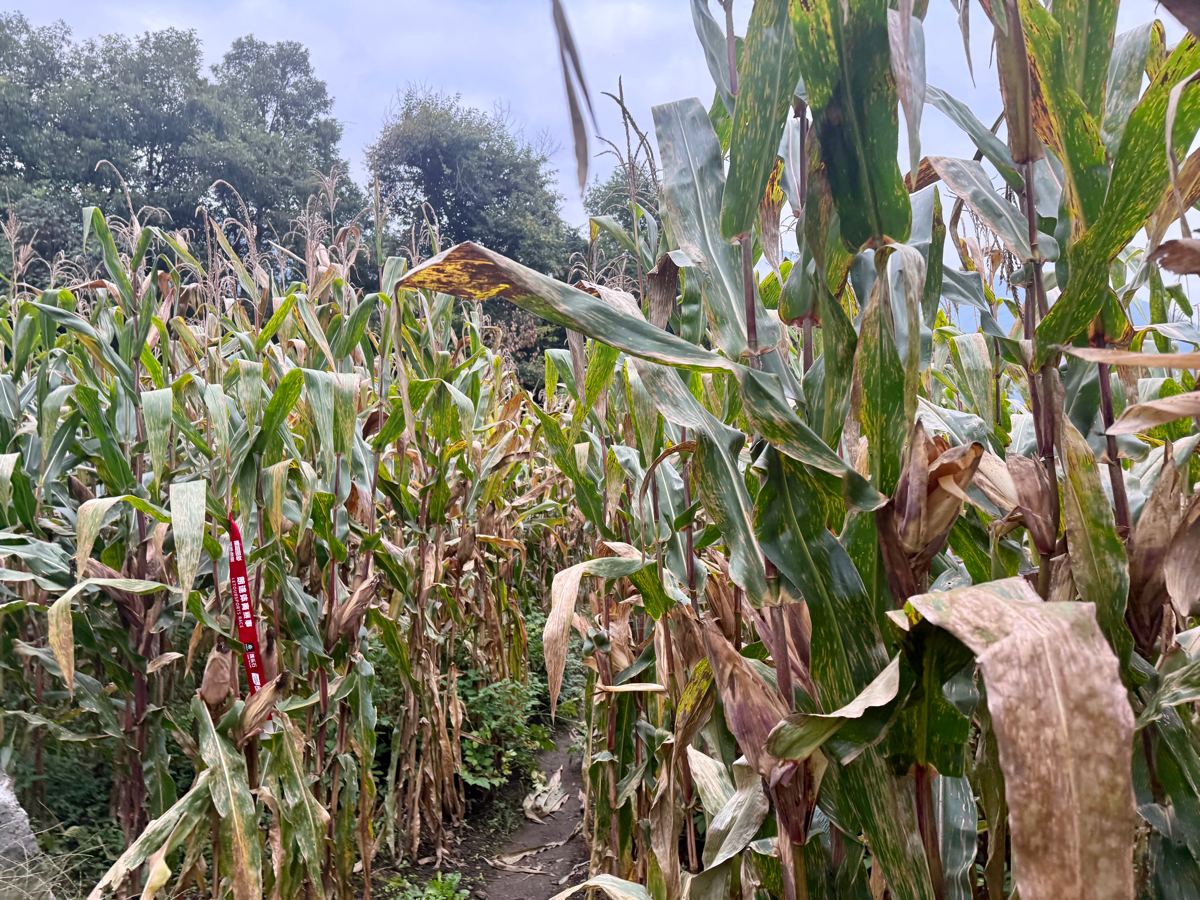
Running through the corn fields in a mid-race valley.
At the outskirts of this second town, we started climbing singletrack again. For a bit, we popped onto a primitive road, and I followed another runner briefly off course. After turning around, I ran a bit of rough but contouring singletrack before climbing again. This second climb was notably shorter than the first, but OH MY GOODNESS! The final few 100 meters near the top were about as steep as a grassy meadow could be. I encountered a bunch of runners here. Most headed straight up, but without a distinct trail or intermediate markers, I cut the steepness with my own micro switchbacks. What a thing!
A bit later, we started descending. Maybe there was a real trail somewhere, but in my memory, it was just the roughest of tracks blazed down through the forest. I was so happy to be wearing the Kailas Fuga DU 2, as I’d have slipped multiple times in a normal trail running shoe. Post-race, I described the DU model as a tank of a shoe with tractor-tire outsoles to Kailas marketing manager, Pippa Ebel. And, in this instance, that’s exactly what I needed. Pippa, a Brit who won the women’s 30k race, explained that the DU shoe model and many of Kalias’s other products are designed specifically for the rigors of Asian trail racing. Plenty, if not most, trail races have off-the-charts downs and ups — hence, DU! There are some faster and lighter products, but Kalias’s trail shoes are true to their roots, just as you’d expect of fell running worthy products from Inov8 or scramble worthy mountain products from La Sportiva. For a long time after Montrail discontinued its Hardrock model, folks mourned the lack of an adequate replacement. Well, the Kailas Fuga DU model might just fill that you-don’t-need-to-think-about-it trail shoe.
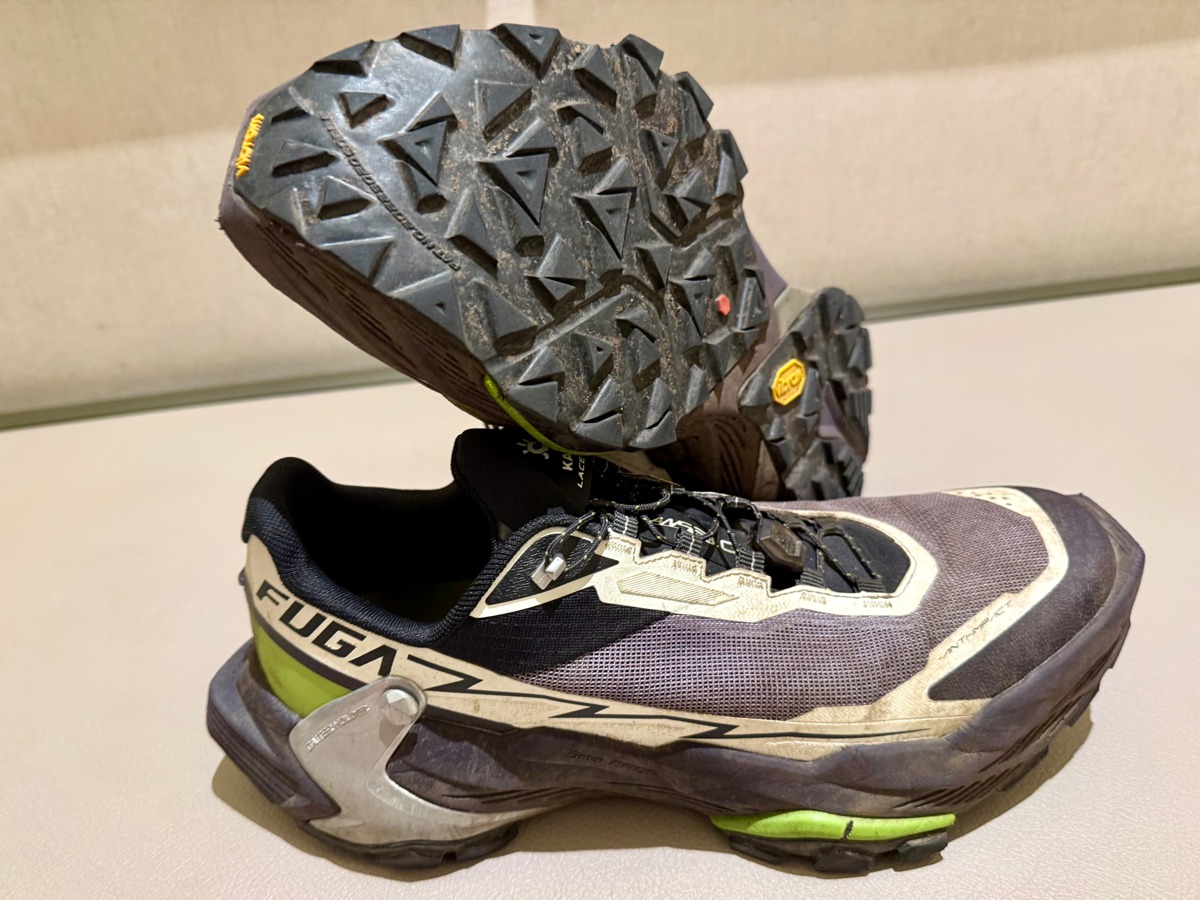
The Kailas Fuga DU 2.
I had a blast bombing down the less-than-singletrack through the forest. I don’t quite have the booster rockets 17-year-old me once had, but I can still carom down a steep slope. Eventually, I reached the outskirts of a settlement and hit a slightly more established trail and then pavement, coming to the final aid station and the second low point.
I’d actually given a pretty hard, honest, consistent effort for the first three-plus hours, so why not finish strong? I ran the slight grade to the base on a long bridge, crossed it, and started climbing toward Moxi Town with a few shoulder checks along the way. I was in the clear. I saw a familiar building, maybe 100 meters from where I thought the finish was. I was wrong, though, and the course turned uphill for a final 1,200-meter lap around town, including a final climb to the finish.
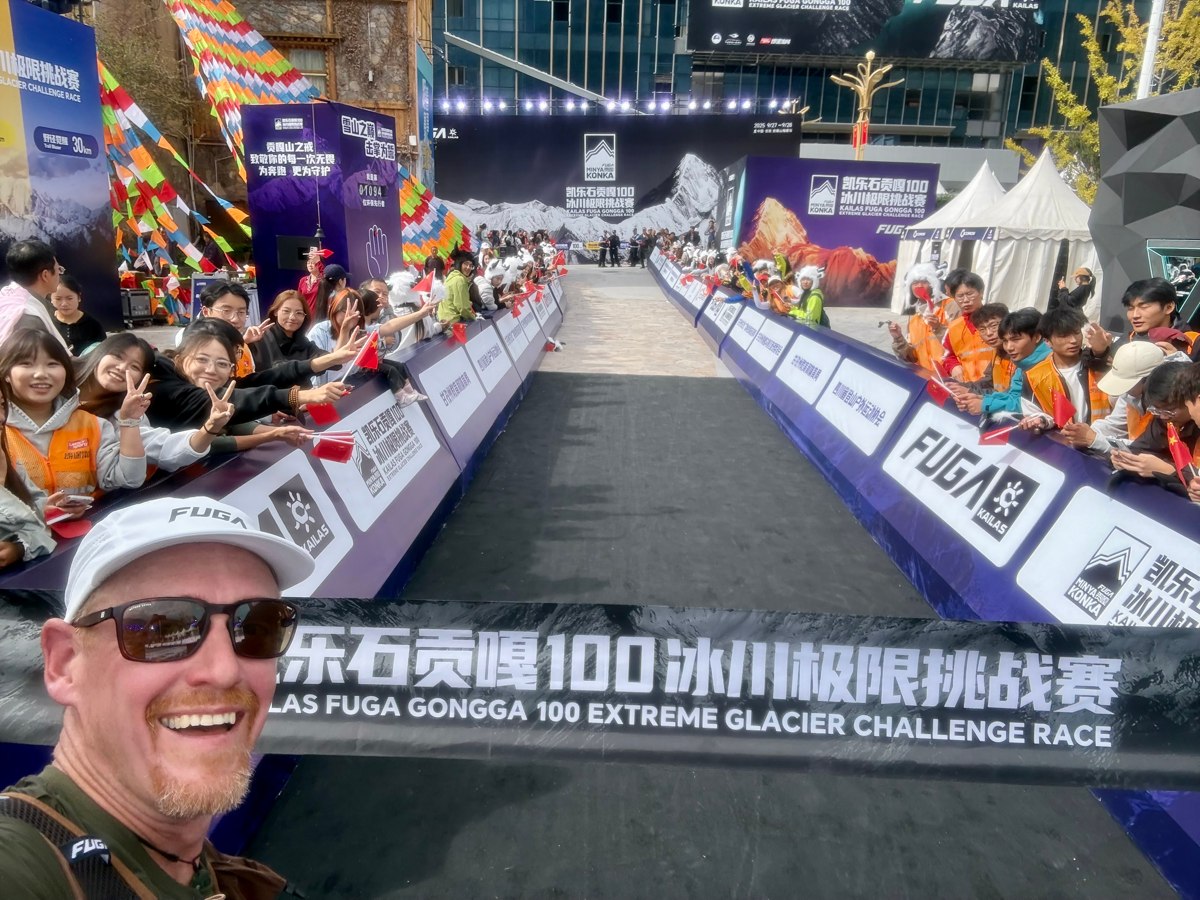
Taking a photo with the crowd after crossing the finish line.
I was fifth guy, and eighth overall out of 400 or so starters. Those numbers didn’t matter. I’d raced well for three and a half hours. I’d moved fast enough down the pavement, run a decent amount of the paved uphills, hiked well up the singletrack, trotted the rare contour, held my own on the steep dirt descents, cruised the paved descents, drank and ate well, and worked hard. Totally unexpectedly, it was one of my best days of running of the year! Here’s the data on Strava.
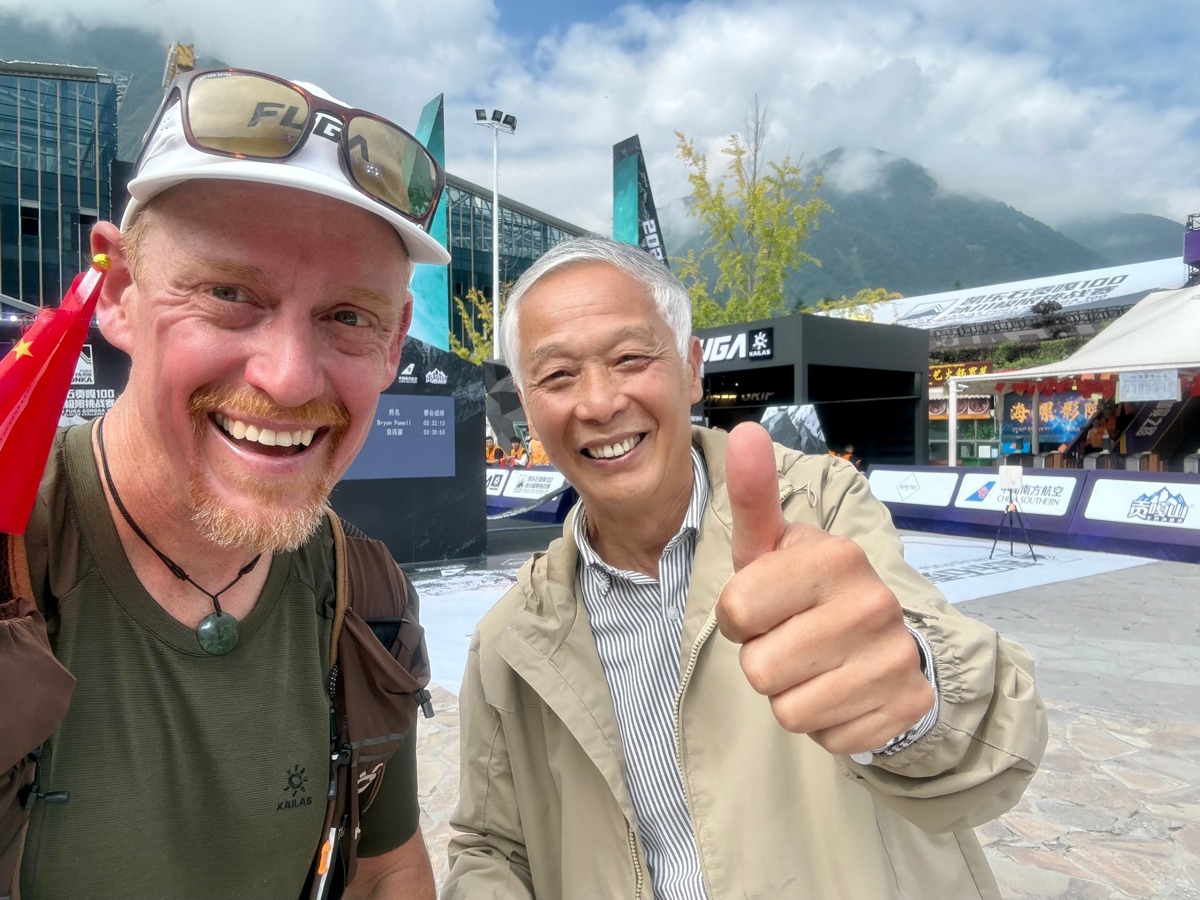
There were lots of welcoming locals at the finish.
Watching the Queen Race, the Extreme Glacier Odyssey 100k
On paper, the 100k queen race, the Extreme Glacier Odyssey 100k, had 7,926 meters (26,000 feet) of climbing and a bit more descent on a net downhill course over 98.3 kilometers (61.1 miles). It reached about 4,578 meters (15,000 feet), and the course crossed a few kilometers of the Hailuogou Glacier. Crampons and a helmet were rightly required, and safety teams were on site. Incredibly, after the glacier crossing, runners descended on a gondola and continued with another 50 miles and plenty more vert before the finish.
I’ve known Lewis Wu, the head of Coros, casually for many years and know that he is an athlete and a runner. In early September, he joined Kilian Jornet on Colorado’s La Plata Peak during his States of Elevation project. I didn’t know he was adventurous enough to try this event as his first 100k, but not only did he try it, he did it!
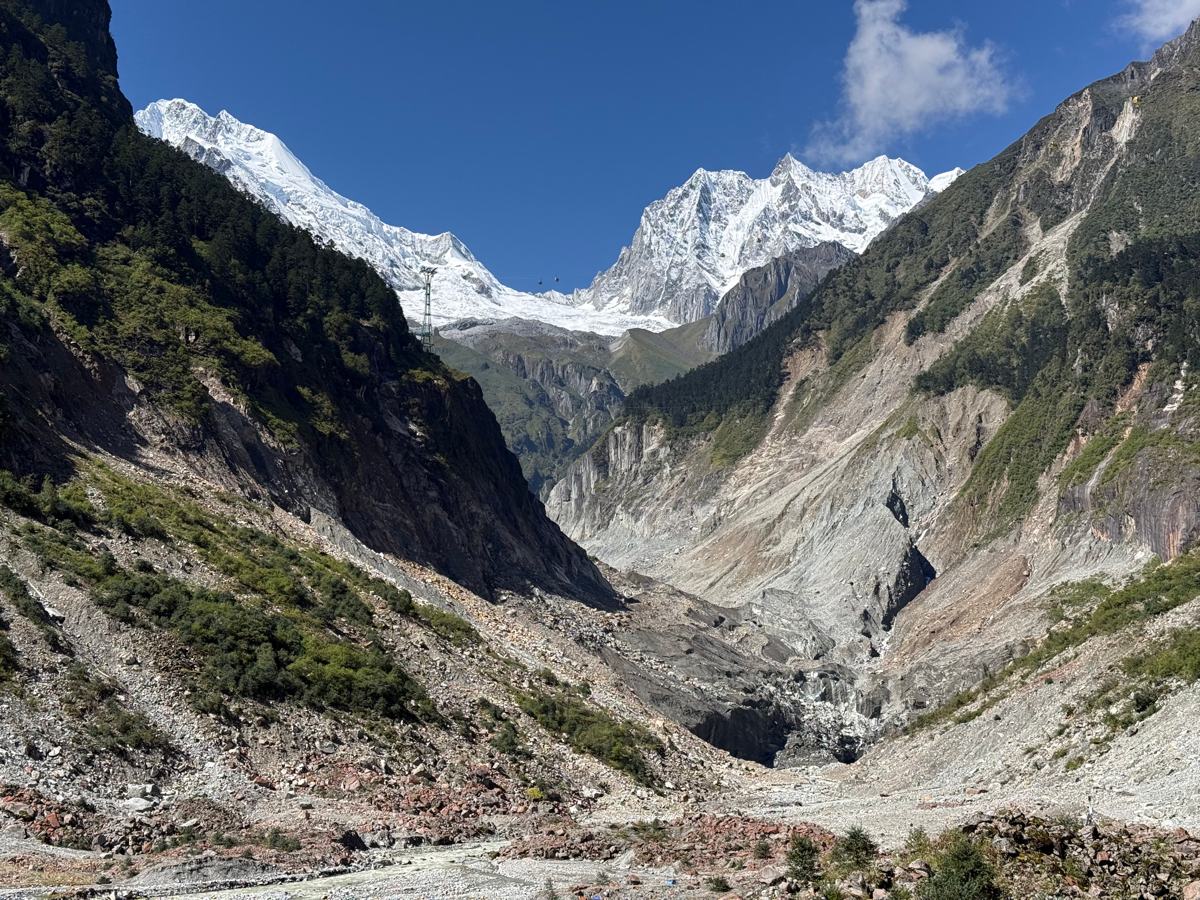
The foot of the Hailuogou Glacier with lifts towering above.
Sure, there was a 900-meter climb to 4,500 meters altitude at the start, but Lewis highlighted two even bigger challenges for him: “The hardest part of the race was something I did not expect: downhill. The first section was fun, running back down the climbing route. It was a little technical, but my downhill legs were fresh, and it felt like dancing under Mount Gongga. One of the best moments of my life … After [the gondola ride] came 20k downhill on a paved road. I had been told to slow down here to save my legs, but I could not hold back. I ran down at 4:30 to 4:45 per kilometer pace. I paid the price later.”
Lewis also recounted, “At the bottom of the valley, another challenge appeared: heat. Since it was a high-altitude race, all my preparation was for cold. I was still wearing the same layers from the climb to 4,500 meters, and I did not pack a short-sleeve shirt. The sun burned everyone on an uncovered uphill road. To cool down, I lay down and put my head into every shallow mountain spring I could find. Many runners struggled badly here; some even started throwing up, and we were not even halfway yet.”
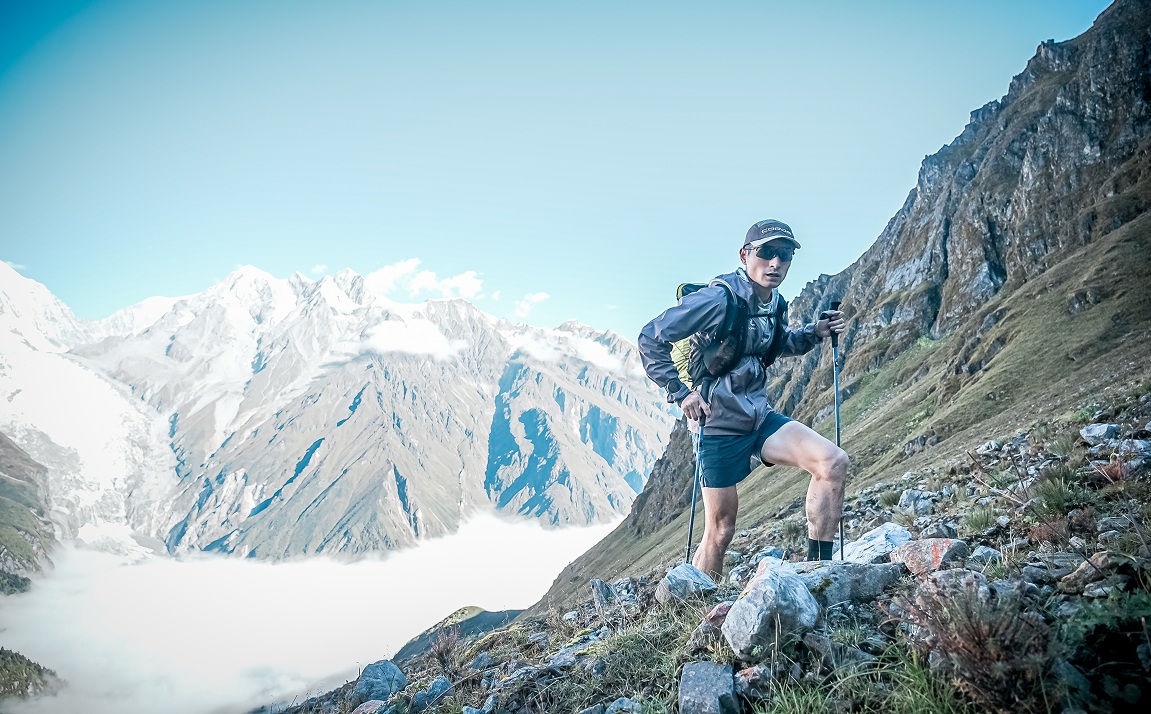
Coros founder Lewis Wu during the Kailas Fuga Gongga Extreme Glacier Challenge Race. Photo: Letour Sports – GONGGA 100
The Kailas Pioneering Spirit
I’ve got to applaud Lewis for his pioneering spirit and go-getter approach. As a very experienced ultrarunner, I was proud and thankful for my accumulated decades of knowledge in running the mere 30k race at Gongga. Kailas mirrors Lewis’s pioneering spirit with the Kailas Fuga Gongga race and beyond.
It’s no ding on China to say that its trail and ultra scene is developing later than those of North America and Europe. China’s growth has been phenomenal, and its population with the luxury to pursue trail running is relatively new.
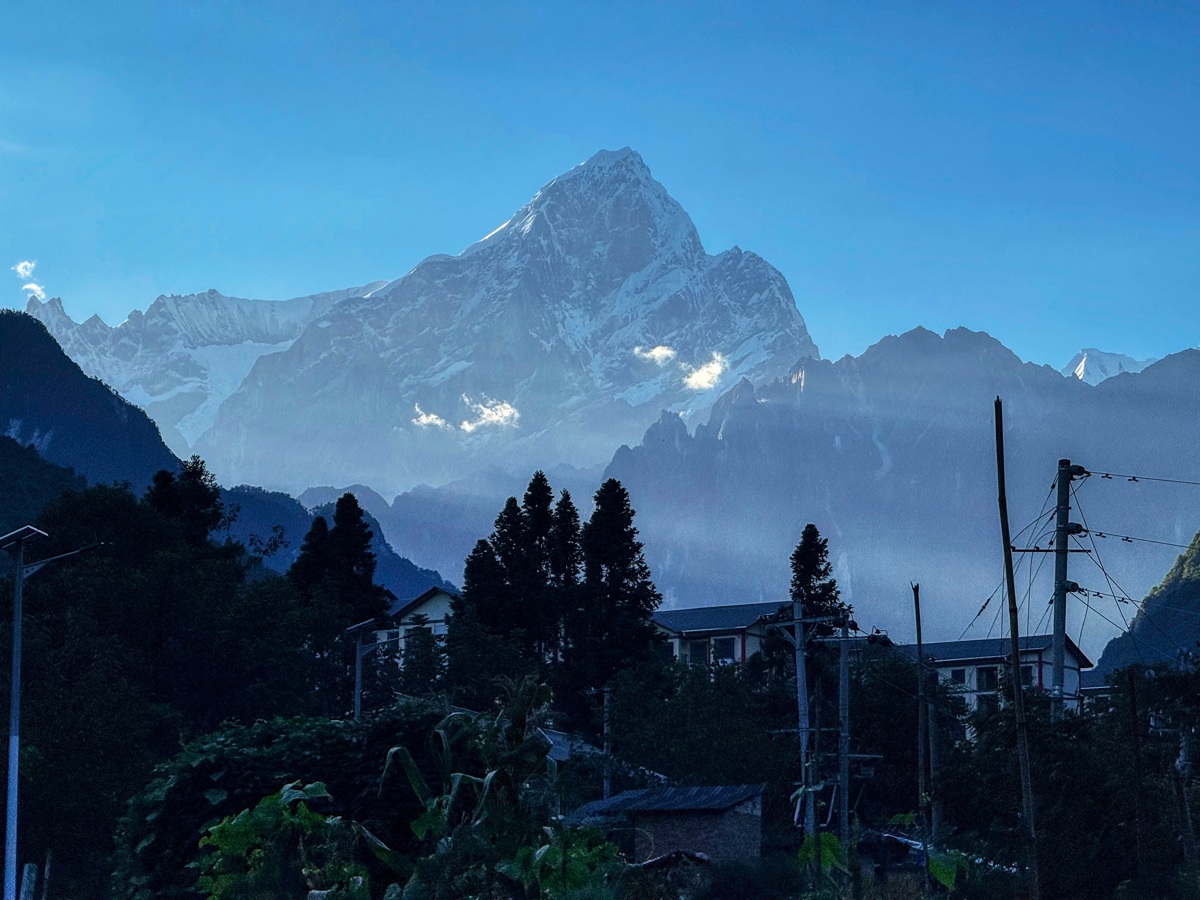
An evening view of big mountains from within Moxi Town.
Sure, Kailas has been one of China’s native leaders in trail running equipment, but it’s been there on the race, athlete, and community side too. In 2025, Kailas Fuga sponsored more than 400 runners worldwide, aiming to make the sport more accessible through training camps and events. To that end, last year, Kailas Fuga launched its Alice series, consisting of 50 coach-led trail running events across China, encouraging women to try trail running in an inclusive and safe environment. As with this Gongga event, Kailas Fuga sponsors more than 400 races worldwide.
Kailas’s philosophy toward education and the growth of outdoor sports is long-standing. In the mountain space, Kailas operates the largest outdoor education organization in China, training thousands of aspiring coaches and outdoor experts and providing mountaineering certification.
While I’ve been ultrarunning just a bit longer than Kailas has been around, I still have to thank them for giving me and others the opportunity to expand ourselves at the Gongga race.
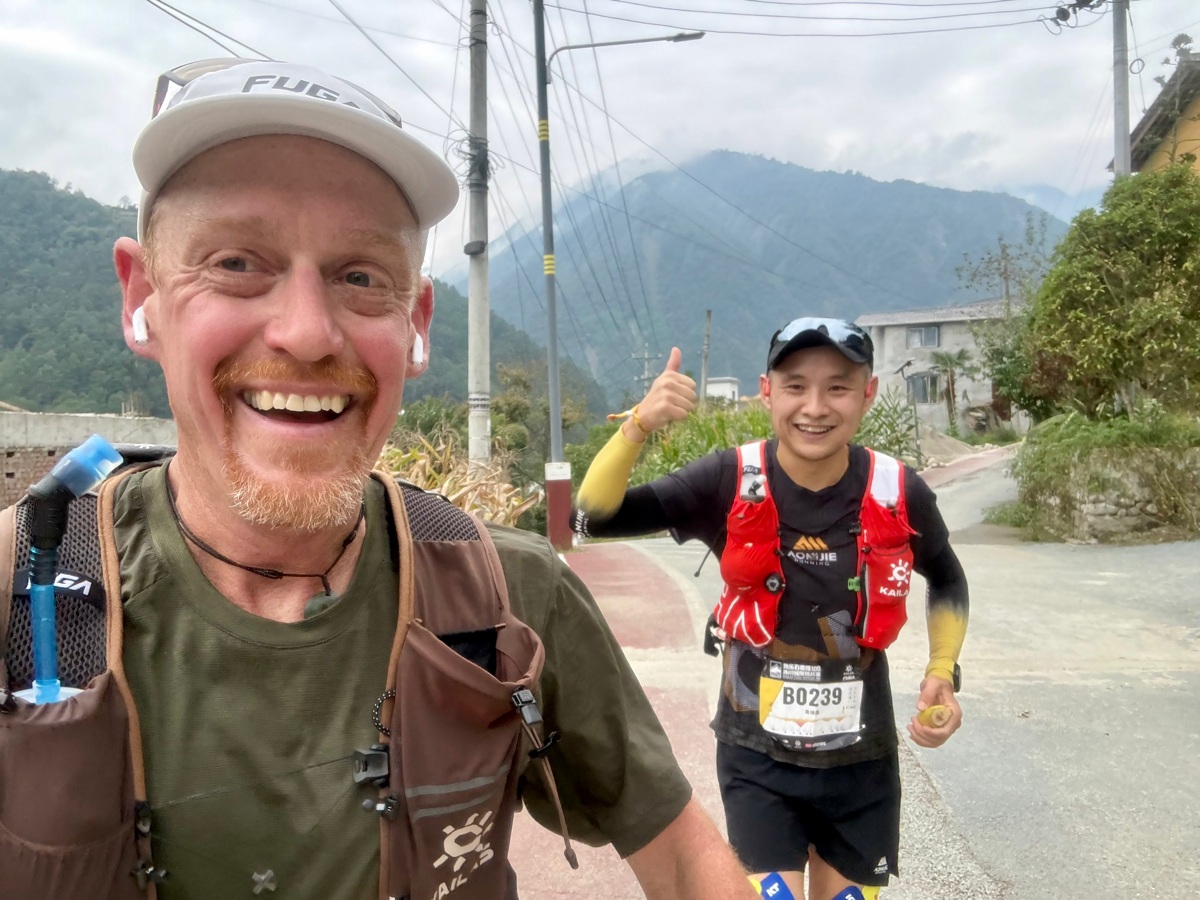
Good vibes with another runner during the race.