For runners, the hips can be one of the most confounding and frustrating parts of the physiological puzzle for efficient movement. Every runner knows how crucial hip strength is — and how mobile hips are essential for both fast and pain-free running.
Yet healthy, happy hips remain elusive. For many of us, our hips stay stiff no matter how much we massage and stretch them. For others, their hips are weak and quickly plateau in strength, even if they do precision running-specific exercises or heavy-resistance weightlifting.

Mobile hips are key to an efficient and fast running stride. Photo: iRunFar/Eszter Horanyi
Yet there are other runners who barely stretch, do minimal hip and core strength work, and still stay healthy, mobile, and strong.
There may be a reason for the differences: hip efficiency.
Efficient hips move smoothly with minimal resistance. They are more easily — and powerfully — driven by the large prime mover muscles, including the glutes, hamstrings, and hip flexors.
So what makes a hip joint efficient or inefficient? And if it’s so important, how can runners achieve and maintain efficient hips?
Hip Efficiency Defined
The hip — like the shoulder— is a ball-and-socket joint, where a round, spherical femoral head sits in a bowl-like acetabulum in the pelvis. Roughly 21 muscles cross the hip joint, where the ball of the femur connects to the socket of the pelvis. Hip efficiency means that, for any given motion, many — if not most — of these muscles work in unison to move the femur relative to the pelvis.
At its most basic, hip efficiency can be defined as joint motion involving multiple muscles firing in a coordinated fashion to move the ball in the socket with the least amount of force and resistance.

About 21 muscles around the hips keep everything moving efficiently. Photo: iRunFar/Eszter Horanyi
There’s more to hip efficiency than large motions of the femur on the pelvis. The real key is the hip muscles’s ability to keep the femoral head centered in the pelvic socket.
For many, their hip joint alignment is as simple as a scoop of ice cream in a deep bowl. But for most of us — and with different levels of severity — that ball-in-socket alignment is more like a teacup on a saucer. The cup can sit on the saucer without being centered in the middle.
Occasionally, the cup can slip off the edge (joint subluxation) or fall fully off (dislocation), requiring external help to reset. Far more common is a cup sitting off-center by a few millimeters, sometimes a couple of centimeters. This is an inefficient hip.
Passive structures — including ligaments and the connective-tissue joint capsule — are usually sufficient to prevent subluxation or dislocation. But consistent centering of the ball in the socket depends on two main factors:
- Hip muscle coordination
- Balanced myofascial tension
We’ll explore myofascial tension in Part 2 of this series, but first, let’s look at how poor muscle coordination is a primary driver of distorted, excessive tension that pulls the hip off-axis.
Hip Tug-of-War Creates Chronic Stiffness
Think of the hip muscles as a team. A well-coordinated team works together, flowing with and around one another. Even under heavy load, they stay relaxed and effective.
A poorly coordinated team struggles. Maybe one muscle is truly weak and doesn’t pull its share. Others compensate, activating to make up the difference — but because they’re functioning outside their normal role, they do it poorly, pulling at odd angles or with excessive force. This results in other muscle groups needing to pull even harder to provide a counterbalance.
This push-and-pull creates a vicious cycle of increasing overcompensation. It’s like voices in a crowded room. One person speaks louder to be heard, which raises the overall noise, so others start to speak louder. The volume escalates endlessly.

Hip muscles need to work together as a team to create efficient motion. Photo: iRunFar/Eszter Horanyi
In a discoordinated and inefficient hip, muscles pull too hard and in the wrong directions. The result is chronic myofascial stiffness that fuels even more muscle hyperactivity during subsequent activities, forming a vicious cycle.
Returning to the teacup analogy, poor coordination causes the cup to slip off-center, or off-axis. At best, it moves in this off-axis position with more friction and resistance. At worst, the competing muscles pull the teacup in an endless tug-of-war in conflicting directions across the saucer.
A discoordinated hip joint might seem strong; the muscle groups can even look big and defined, but a discoordinated hip is always stiffer than an efficient one.
Moreover, it isn’t truly strong. In metrics of peak force production or functional measures like top running speed or endurance, a discoordinated hip is always inferior to an efficient one.
Training hip muscles to improve coordination will be the topic of Part 2 of this series, but the first step is to free the hip from excessive myofascial tension and get the ball back centered and on-axis in the socket.
Improving Hip Efficiency: Release and Realign
The first step in improving hip efficiency is mobilization: freeing excessively stiff myofascial tissue around the hip, then improving the alignment and movement of the ball so it stays centered in the socket. This latter concept is called on-axis alignment and motion, when the teacup both sits and moves in the very center of the saucer through all hip motions. To stay on-axis, the hip must slide, glide, or roll in just the right way to keep the femoral head centered in the socket. This happens naturally when the muscles are coordinated, and fascial tension is balanced.
For specific rotations:
- Internal rotation: When the femur rotates inward, the femoral head should translate slightly posterior, deeper into the socket.
- External rotation: When the femur rotates outward, the femoral head should translate slightly anterior.
In inefficient hips, we often see the opposite, with the femoral head translating excessively forward during internal rotation and rearward during external rotation. Both off-axis motions result in increased hip stiffness, weakness, and movement inefficiency.
To correct this, we first release the myofascial tension. Then we use corrective rotational movements to recenter the femoral head on-axis in the socket. We’ll accomplish both with a foam roller.
Front-of-Hip Myofascial Release
This position targets hip internal rotation efficiency. Start by rolling the anterior (front) and lateral (side) aspects of the hip with a foam roller. Spend extra time on any dense or sensitive spots, using oscillatory motions (up-down or side-to-side) or static, prolonged pressure.
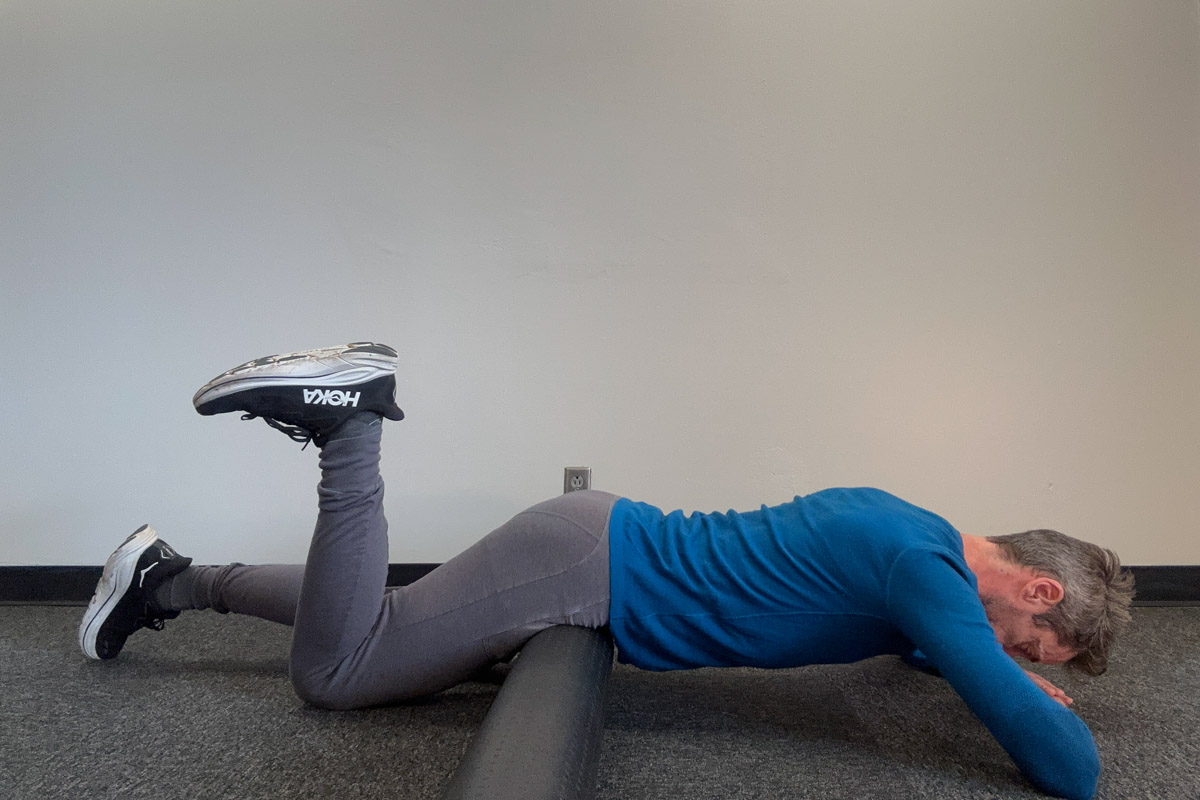
A side view of anterior hip rolling. Photo: iRunFar/Joe Uhan
Next, for the front of the hip, add rotation. With the knee bent, rotate the lower leg outward while keeping the front of the hip in contact with the roller:
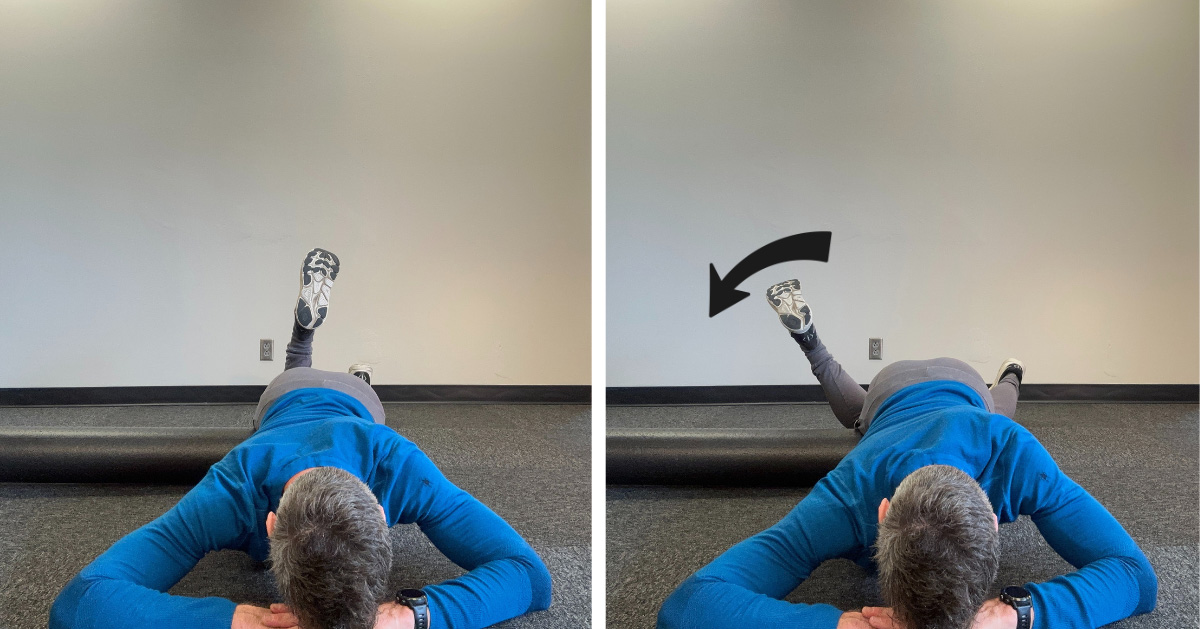
With the knee bent, rotate the lower leg outward while keeping the front of the hip in contact with the roller. Photo: iRunFar/Joe Uhan
Oscillate outward and back to neutral. When you outwardly rotate the bent leg, the femur glides forward into the roller. Inefficient hips tend to glide excessively forward, creating more pressure, and often more pain.
Continue rolling on and off the sensitive areas. The goal is to reduce both soreness and the sense of density/pressure of the femur against the front of the roller.
[Editor’s Note: Click here to watch the film on YouTube.]
Massage the front and side of the hip for two to three minutes per side. Then perform the rotations for three 30-second bouts. Do this daily until one or both sides feel less sore and dense, and the hips feel equal.
Back-of-Hip Myofascial Release
This position targets hip external rotation efficiency by rolling the posterior hip.
Sit on a foam roller with the leg crossed over the opposite knee. Rotate the pelvis roughly 30 to 45 degrees toward the crossed-leg side. Then begin rolling use oscillatory motions (up-down or side-to-side) across the glute.
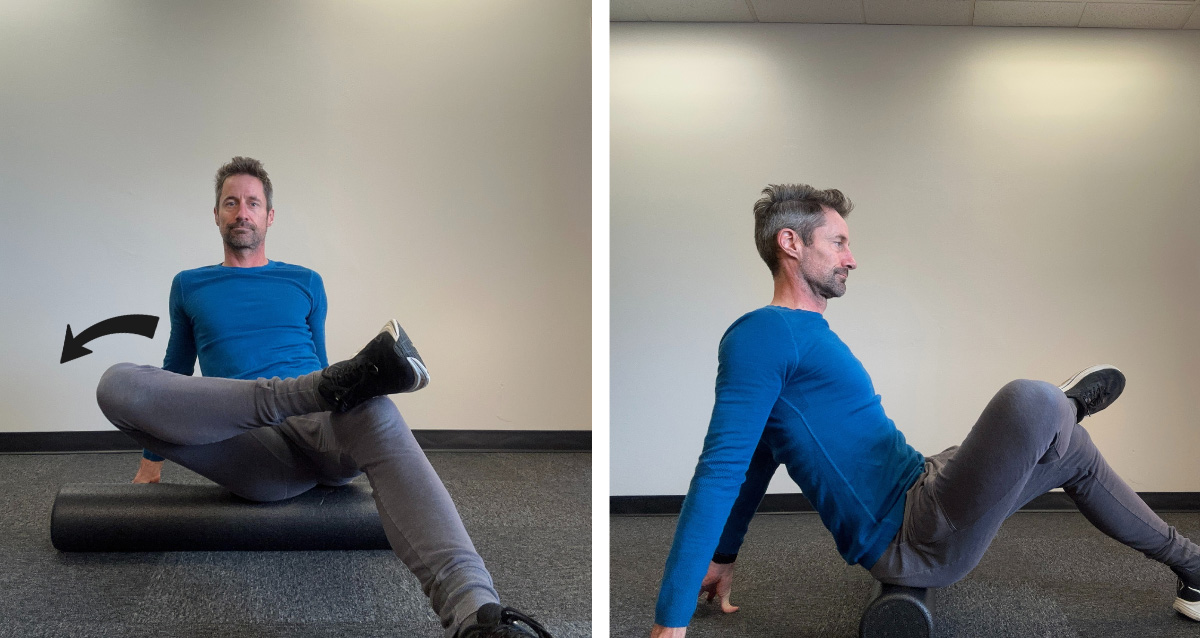
Add rotational movements of the crossed leg to further mobilize the femoral head. Photo: iRunFar/Joe Uhan
While rolling, you’ll feel what I call “the baseball in the pillow.” The pillow is the soft tissue of the posterior hip (gluteals and deep rotators). In the middle sits the femoral head, which feels firm and spherical. In this crossed-leg position, roll up and down, side to side — first loosening the “pillow” tissue, then rolling around and across the “baseball.”
Add rotational movements of the crossed leg to further mobilize the femoral head.
As with the front, the goal is to reduce both soreness and the density/pressure of the femoral head against the back of the roller.
[Editor’s Note: Click here to watch the film on YouTube.]
Perform this for three to five minutes per side, daily, until one or both sides feel less sore and dense, and the hips feel equal.
Next Steps
The combination of myofascial release plus roll-resisted rotation is a powerful one-two punch. It frees stiff tissue while actively helping re-center the hip on-axis, setting it up for better movement and function.
In Part 2 of this series, we’ll introduce a three-dimensional strength routine to restore coordinated hip movement and control, keeping your hip efficient, strong, and mobile.
But for now, get it moving!

On-axis hips can lead to faster and more efficient running. Photo: iRunFar/Eszter Horanyi
Call for Comments
- Have you struggled with tight hips limiting your running efficiency?