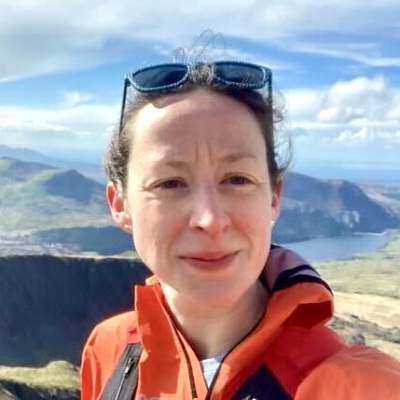
I would describe Norwegian trail runner and mountain runner Henriette Albon as glittery. Maybe it’s because on the morning when we speak, she has just been for the first proper snow ski of the winter. A summer in which she’d won Transgrancanaria and the Trail du Saint-Jacques 80k, but couldn’t start UTMB due to injury, is long in the past, and winter has set in around her home in Norway, which she shares with her husband, Jon Albon, also an accomplished ultrarunner and obstacle racer.
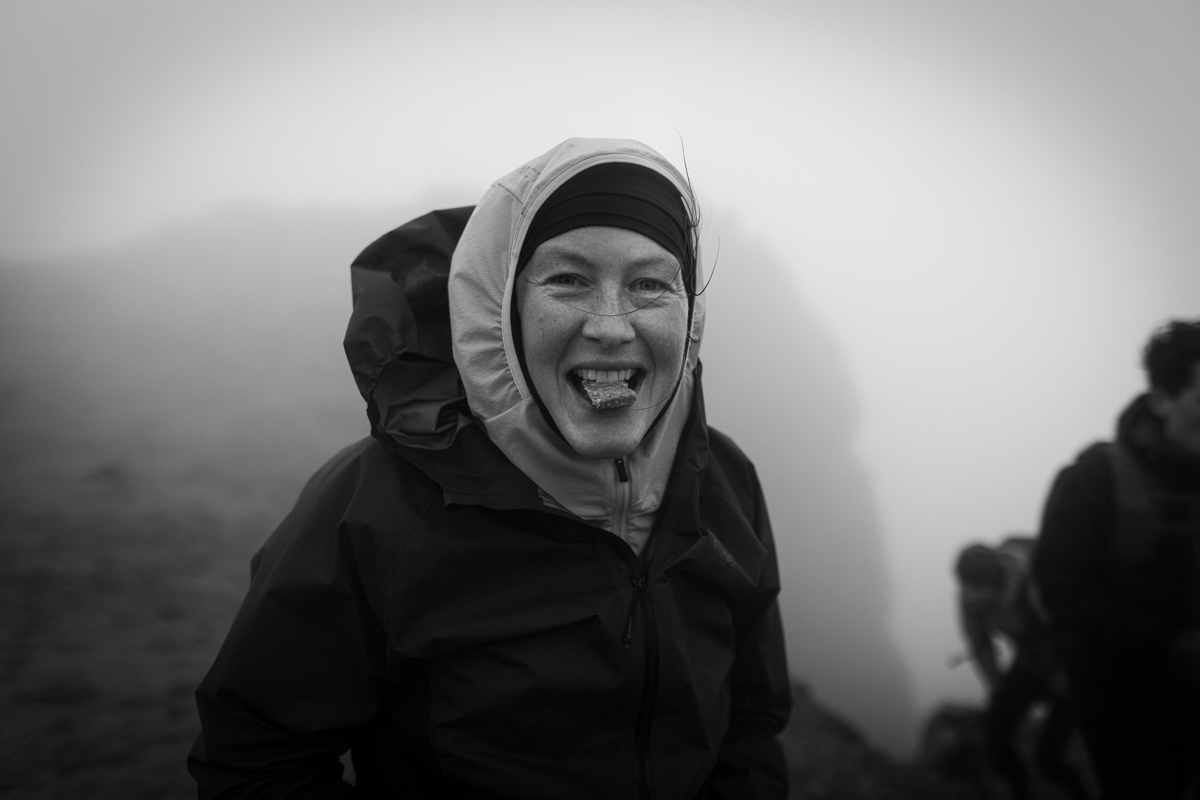
Henriette Albon. Photo courtesy of Henriette Albon.
She is vibrant, bubbly, bright, and open. Both during our one-on-one conversation and on her social media, she comes across as a no-nonsense, realistic voice for women in the sport. I ask about a particular Instagram post from earlier this year where she’d sought recommendations for trail running shorts that wouldn’t chafe “mountain legs.” At the time, I remember looking at my own thighs, which I had cursed for rubbing together. Of course, I realized after reading the post that I don’t need thinner thighs; I need shorts that are fit for purpose. Henriette laments, “It just amazes me how they’re yet to actually crack making decent shorts for female mountain runners with slightly bigger thighs than the average runner.”
What does Henriette want? A longer inner short that isn’t made of compression fabric. Quite simple, really.
Finding Running
Henriette’s own mountain legs, fierce competitiveness, and solid work ethic have seen her at the front of many ultras over the years, including wins at the 2024 Ultra Trail Snowdonia 50k and 2023 Les Templiers 50k and sixth places at the 2023 Lavaredo Ultra and 2022 CCC, just to name a few. She comes from a family that has always been involved in orienteering, and she grew up dancing and playing football. In her late teens, she felt that she needed to set aside physical activity to focus on her studies, securing her future with a good job. In retrospect, she laughs, unsure why she felt she couldn’t do both. But if we look at the way she targets and trains for races as a professional athlete now, it’s clear that she thrives with having a singular focus, and that might be key to so much of her success.
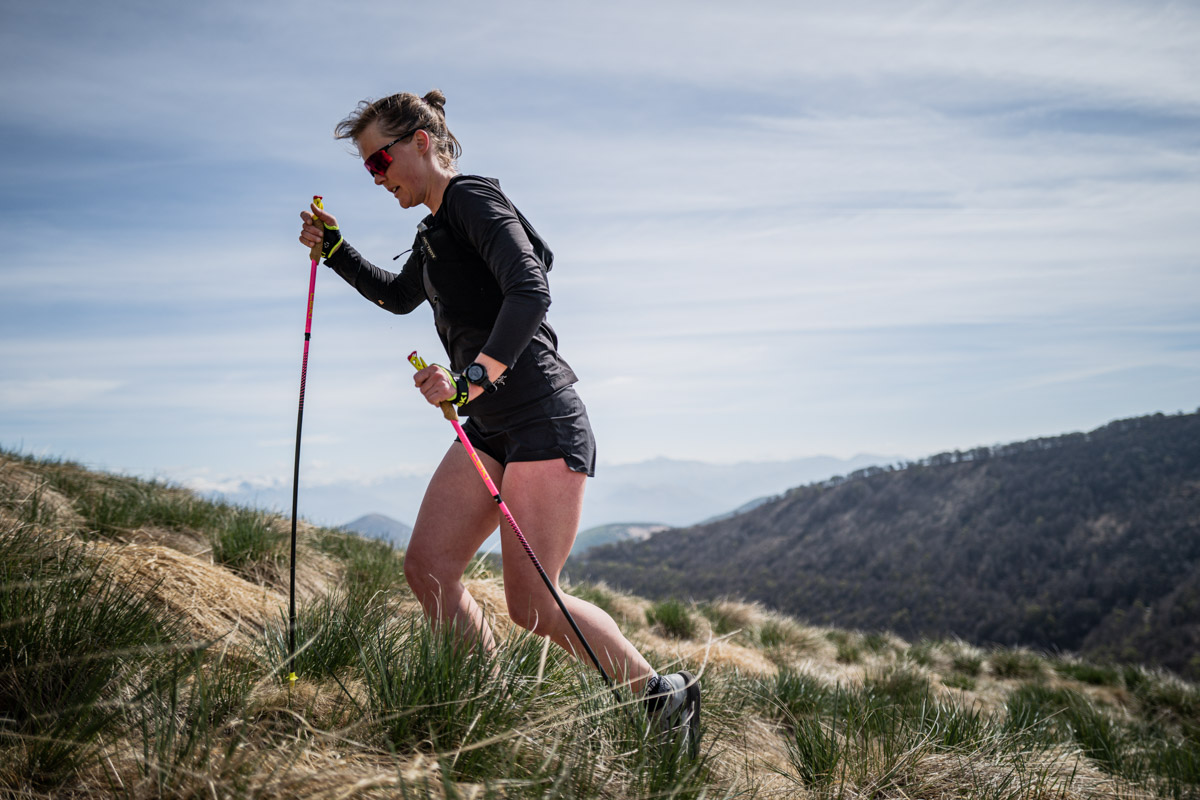
Henriette at a training camp, putting full focus into her goals. Photo: Philipp Reiter
In 2014, after graduating with a Bachelor of Business Administration from Bath University in the U.K., Henriette and Jon, who’d met on a ski trip as teenagers, moved to Norway so that Henriette could pursue a master’s degree. Trail running was initially just a hobby alongside high-level obstacle racing for both of them, but they fell in love with the sport enough to do the Tromsø Skyrace together for their honeymoon. She said it rained the whole time. I find this uniquely romantic.
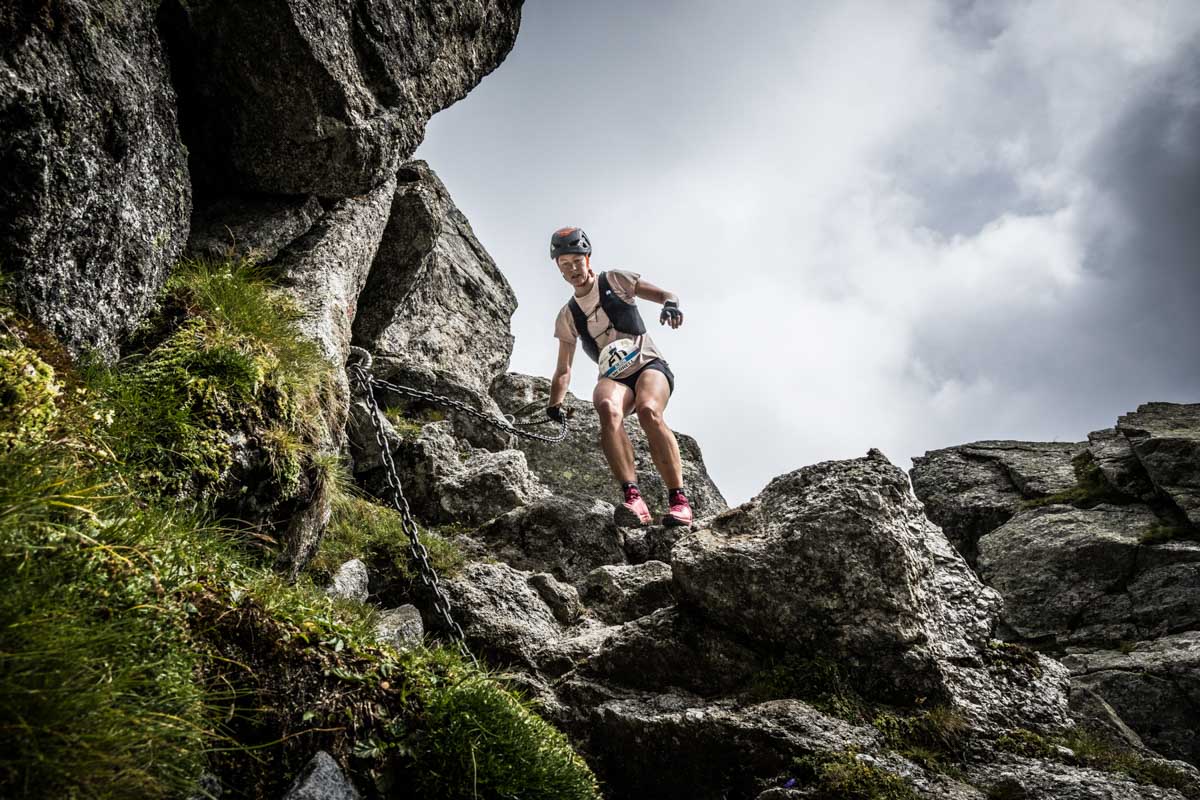
Henriette on the technical terrain of the 2024 Trofeo Kima Skyrace. Photo: Maurizio Torri
Henriette got into skyrunning for a few years, balancing her training alongside her work as an auditor. But increasingly, Henriette realized that something had to give: She was burning out with training before work, training after work, and yearning to be outside. She quit her job, moving her focus toward the obstacle racing coaching business she and Jon had recently started. Then the COVID-19 pandemic hit. While skyraces were on pause, Henriette and Jon started doing longer days out on the trails. Henriette realized that it was the length of time outdoors that most appealed to her — some of the skyraces had been easily five hours long — and furthermore, she realized the longer distances played to her strengths. An ultra demands fitness and competition, but crucially, she reflects, “You also have that bit of adventure in it.”
Ultra Successes and Setbacks
It didn’t take long for Henriette to transition from shorter skyrace efforts to longer ones. In 2020, she set out to chase the fastest known time on the Norge På Tvers across Norway. The 120-kilometer route crosses the country at its narrowest part, and Jon acted as her support crew. She and Jon made a really sweet film about the experience, which encapsulates as much of the charm and warmth of their relationship as it does her drive as an athlete. Jon chases Henriette across the scrubby Norwegian landscape by foot, van, and bike, singing, “Here is my wife! I’ve found my wife!’ and yelling into the dark of the woods, “The things you do for love!” In return, she gives him short shrift when he encourages her to eat, alongside a winning smile and a kiss.
Nearly nine hours in, Henriette seems entirely miserable. Her feet are covered in mud, her pace has slowed, she’s grumpy, and food isn’t staying down. Jon keeps insisting she has to try to eat something. The last 10k are on flat tarmac, and it looks like a completely joyless grind. She finishes at 9:45 p.m. at the Stjørdal train station, with a new record of 14:45:32. She sits down and stops her watch. There are no smiles, no words of celebration. Jon says wryly from behind the camera, “I’m glad you’re happy.”
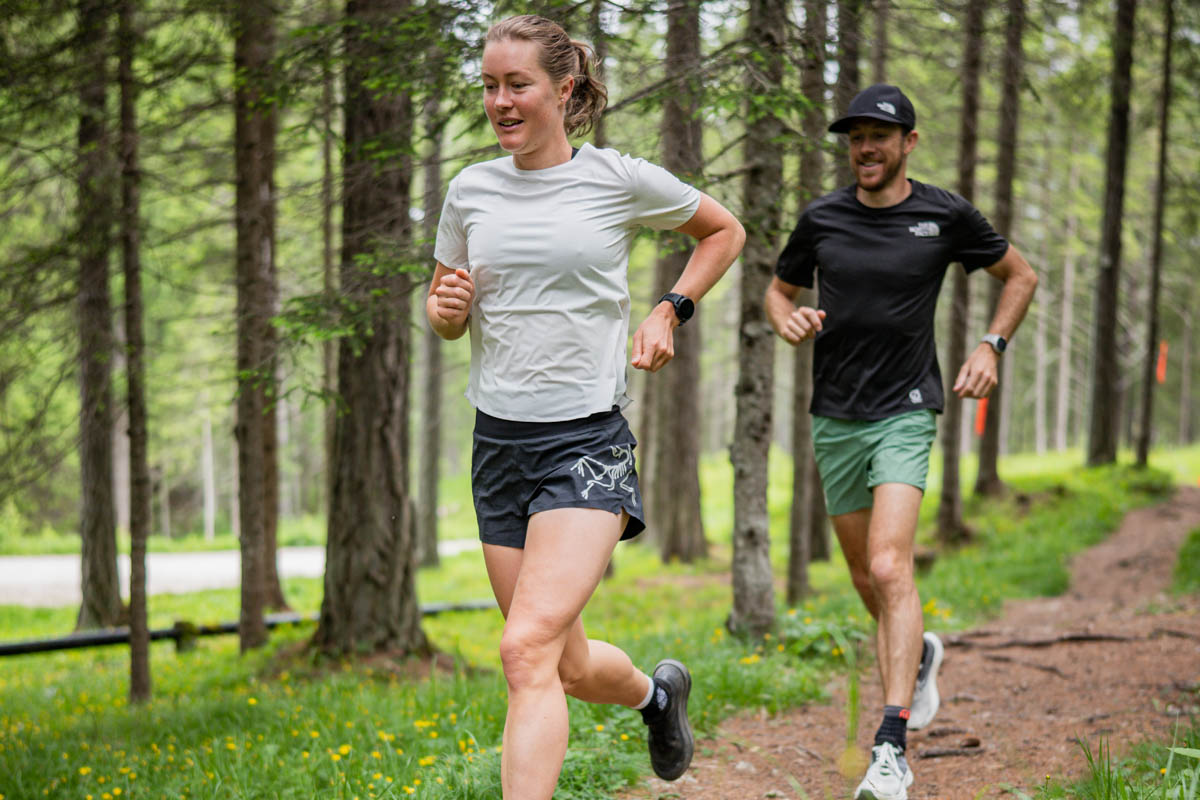
Henriette runs with her husband, Jon Albon. Photo: The Adventure Bakery
And yet, it was this adventure that propelled Henriette into ultrarunning. Despite saying, “I feel awful. I dunno’ why people do this,” something about the experience got into her bones. After having focused on 50k races for a few years, Henriette jumped up in distance with the 2021 Ultra Pirineu 100k, where she finished in fourth. In 2022, she tried the 100k distance again at CCC and finished in sixth, despite a suboptimal lead-up, involving drinking from streams in the Alps and spending seven days in bed with a high fever. Still, Henriette says she is really proud of the way she executed the race. From the outside, her career as a trail runner and ultrarunner was off to a great start. She was sponsored by Arc’teryx, and she was already near the front of competitive fields. How much further and faster could she go?
Unfortunately, within Henriette’s first year of being a sponsored athlete, after having problems with her hip, she was diagnosed with a stress reaction linked to relative energy deficiency in sport (RED-S) syndrome. What followed was a dark period of questioning her self-worth. Who was she if she couldn’t do what she loved? It was a two-year recovery to return to full health. Reflecting now on her injuries over the years, Henriette says, “Every disappointment takes a lot out of you in the sense that you ask yourself, ‘Well, how many times am I going to stand up again from this? Is it worth it?’ You feel so defeated, embarrassed, and like maybe you should be doing something else.” Henriette has brought away lessons from her experience with injuries and says, “It’s important to remember that we are doing this for ourselves and no one really cares. If you want to go after it, you should.”
A Midwinter Bob Graham Round
While Henriette executed some excellent performances in races during those two years, the real comeback was a 2023 midwinter Bob Graham Round in the U.K.’s Lake District.
The Bob Graham Round is a challenge to complete a 106k lap around 42 peaks in the Lake District within 24 hours. It began in 1932 when Bob Graham, a local fell runner, wanted to run 42 peaks to celebrate his 42nd birthday. The route has since become legendary, and the “Midwinter Bob” is as gnarly as it gets. During the month of December, when Henriette decided to run, the weather is unpredictable. Besides being wet and windy, the conditions underfoot are boggy, and there’s less than eight hours of daylight. Nonetheless, Henriette says it’s her best running memory: “The whole experience was just very unique and powerful.”
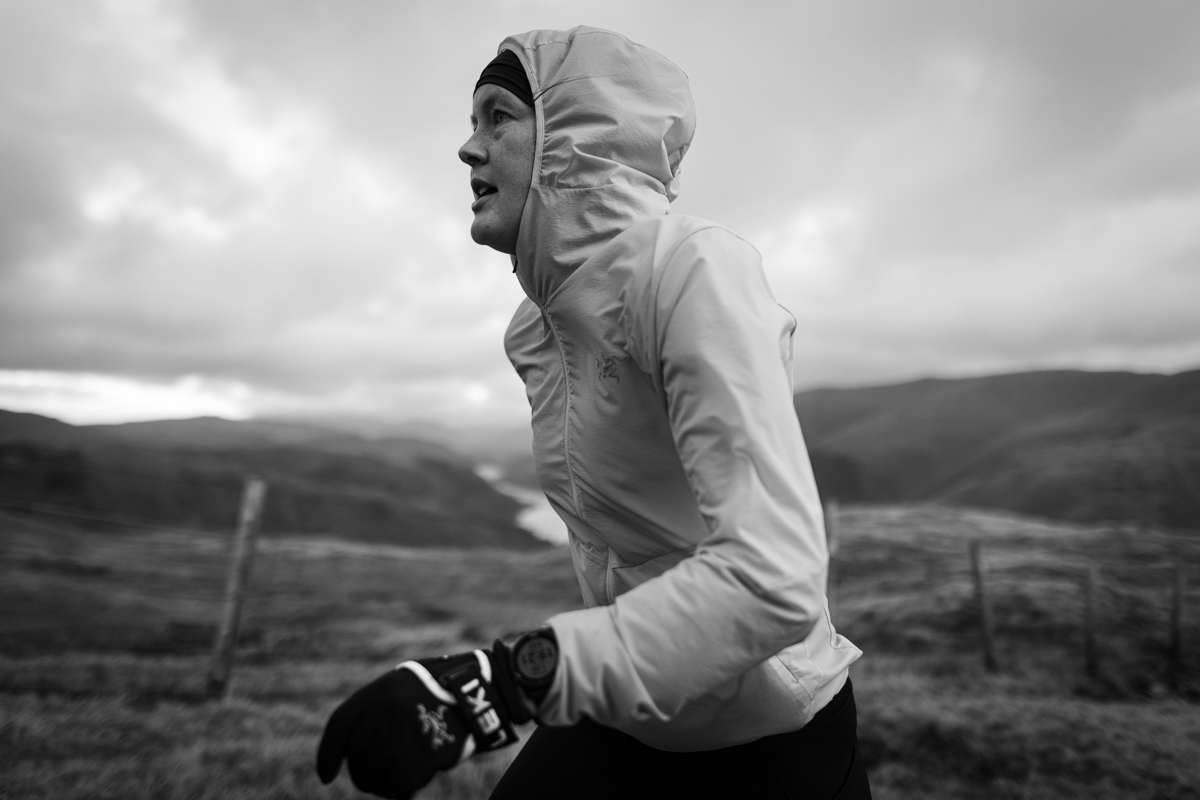
Henriette on her way to setting a new speed record on a midwinter Bob Graham Round in 2023. Photo: James Appleton
The rules at the time stated that you had to have a witness on each of the 42 peaks, which means you do not run it alone. Henriette’s round was very much a team effort, including pacers she had never met before but who turned up at the beginning of each leg and set off with her to navigate the peaks in the dark. The film about Henriette’s adventure, “A Bob Graham Round – #2,818” — so named because she was the 2,818th runner to complete the round — is an excellent expression of the wild fun and grit it took to complete the challenge. “The first two legs are very much a matter of not screwing it up,” Henriette says in the film, as she adjusts her head torch before starting her attempt at 2:45 a.m. beside Moot Hall in Keswick, the iconic building that serves as the adventure’s start and finish. “And the third, fourth, and fifth also,” Jon interjects, helpfully and wittily.
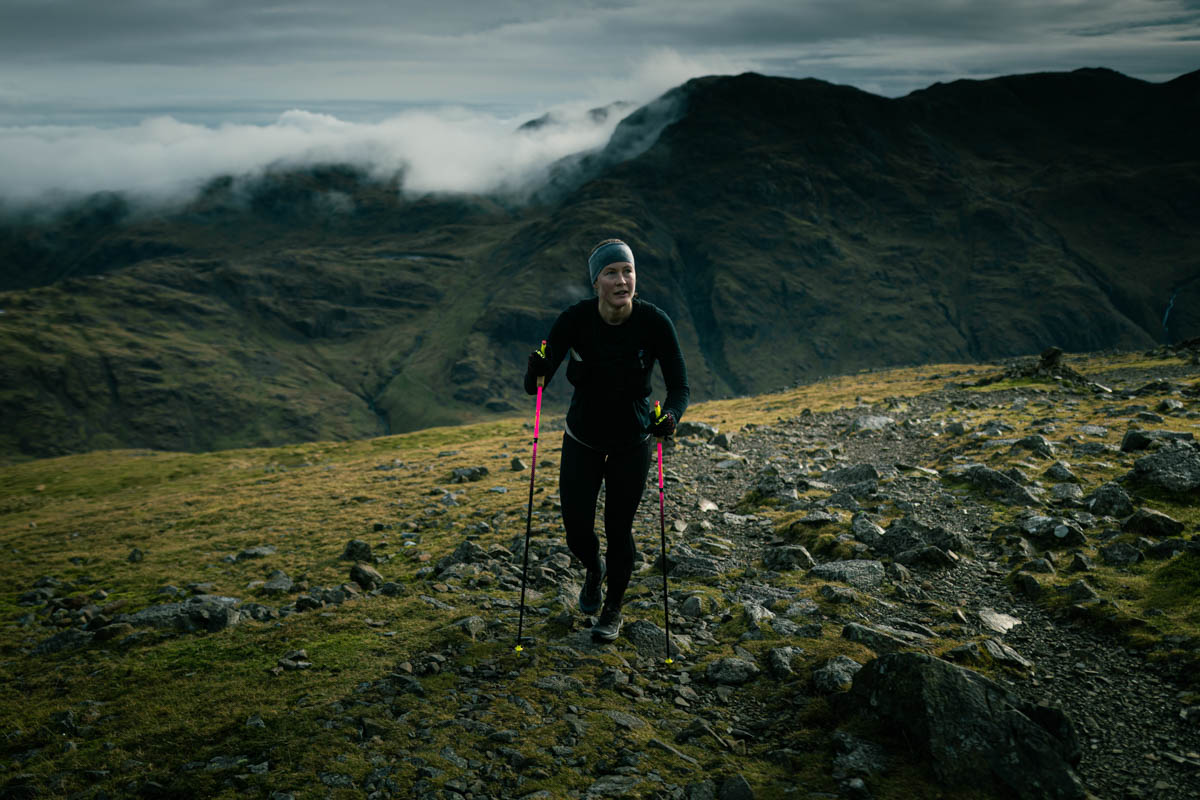
Henriette training in the U.K.’s Lake District. Photo: James Appleton
She doesn’t screw it up. Not any of it. Not when the wind got so strong that Henriette says, “It nearly picked us up!” Not hiking up Yewbarrow listening to music. Not clawing up Scafell Pike through a gully of loose, moving rocks, a section she describes as something out of “Lord of the Rings.” She is flexible, taking a cup of tea she didn’t know she would want. She is stoic, going into the last big climb on the fifth leg, saying, “I’ll survive it.” She is humble, noting, “It’s fascinating how people would get up in the middle of the night just to help me do this thing.” When she finally runs back into Keswick to finish the round in a new record time of 17:55, there’s a sense of inevitability along with the joy. She bounds up the steps of Moot Hall and touches the door to applause, cheering, and a dog barking. She addresses the small assembled crowd, “This has been the best run day I’ve ever had.” Jon hugs her and muffles, “I’m very, very proud.” It’s all very beautiful.
A Sense of Self
Talking to Henriette, it’s clear that she has a strong sense of her own identity, and her competitiveness is palpable. “Oh, I’m super competitive, ridiculously competitive. Probably less so as I’m getting older, but I’ve always been very competitive, no matter what it is.” Henriette realizes the trait is a double-edged sword. As much as it’s a driving force, inspiring her to train really well in pursuit of a win, the tunnel vision can lead to forgetting about anything else that matters in life. Henriette says, “Then if the race doesn’t go well, it feels like a big failure.” She is keen to emphasize that she’s much better at balancing everything now, but an injury she sustained this past summer, ahead of UTMB, that kept her from starting was still gut-wrenching. She says, “I was so ready to stand on that start line and really give it a go.” While UTMB always felt too far and too big in the past, it had seemed almost achievable in the months leading up to it. Henriette says, “When you set these goals, you have to find a goal which feels like it’s slightly bonkers, and slightly crazy, and you can’t quite believe you could do it, but at the same time, you believe you could. And I think that’s why UTMB hit the spot for me.”
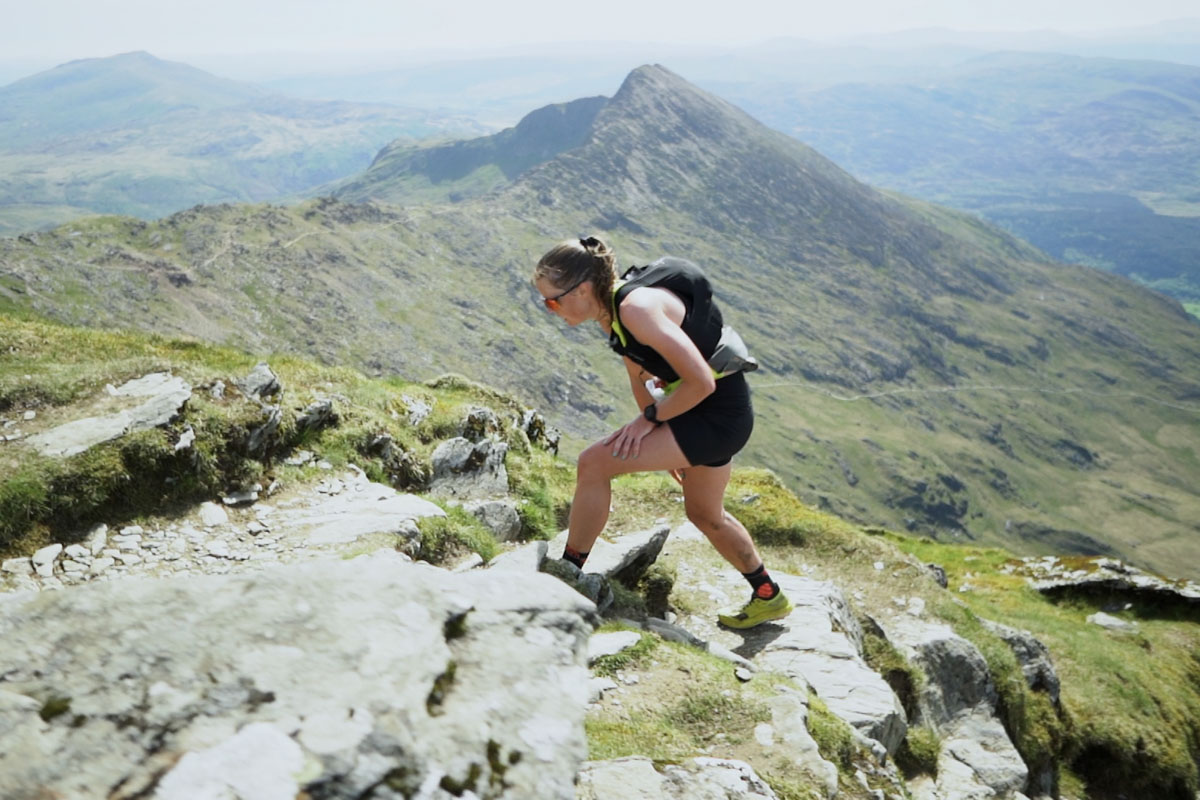
Henriette on her way to winning the 2024 Ultra-Trail Snowdonia 50k. Photo: Ross Brackley
With the summer in the rearview, Henriette is now focused on the future. She and Jon live in Romsdal, a training mecca for trail runners and mountain runners. The likes of Kilian Jornet and Emelie Forsberg are nearby, as is Ida Nilsson, and when they’re not all traveling for races, they enjoy having the chance to train together. “In winter, we can spend almost every day skiing together,” Henriette says. With regard to running together, though, Henriette says, “I have to choose my moments.” She joins a local group for interval workouts once a week, but otherwise asserts, “If you train with other people, it just doesn’t tend to be the right effort level that you need.” The group understands each other’s lifestyles and priorities, though.
For the next few months, both Henriette and Ida will be focused on training for the 2026 Transgrancanaria in February. “Ida is one of the athletes who inspires me,” Henriette says. “Because I’ve seen her go through the tougher times, she’s had some setbacks through the years.” It’s clear Henriette admires her friend, “She will work really hard for those moments of success. I think that’s pretty cool to see when someone puts in work over a long amount of time and then manages to pull it off.” Sometimes the qualities we admire in others can be true of ourselves, too.
Looking to the Future
Henriette has high hopes for 2026. She’s returning to Transgrancanaria after an astonishing performance in 2025, and she wants to really nail the training block this time, be injury-free, and have a proper race against a competitive field. She laughs that this intention is a “recipe for disaster!” But she says that it’s exciting as well. In terms of execution, it seems like we can expect another Henriette-style attack from behind. “I’m not a runner,” she says. I laugh. “I can’t really run.” I am confused. “I can’t run fast. It’s all relative, isn’t it? I can’t run very fast off the start,” she explains. “My top speed is much slower than the fastest females, so I end up toward the back. But I’m also very good at pacing my efforts.” I offer, “That really suits UTMB, doesn’t it?” Henriette replies with that glittery grin.
“I think it’s important as well to know we are doing this for ourselves because it is a personal hobby in a way,” she says. “So I know that when I make it to the start of UTMB, obviously everyone dreams of winning, but I think for me personally, just being able to race it to my potential on the day, that’s going to be a really satisfying experience. Just to be able to go there and give it your all … making it around knowing you did your best. I think that’s what everyone can relate to in trail running.” Henriette observes, “We’re all just out there playing this game of: How well can we do today?”
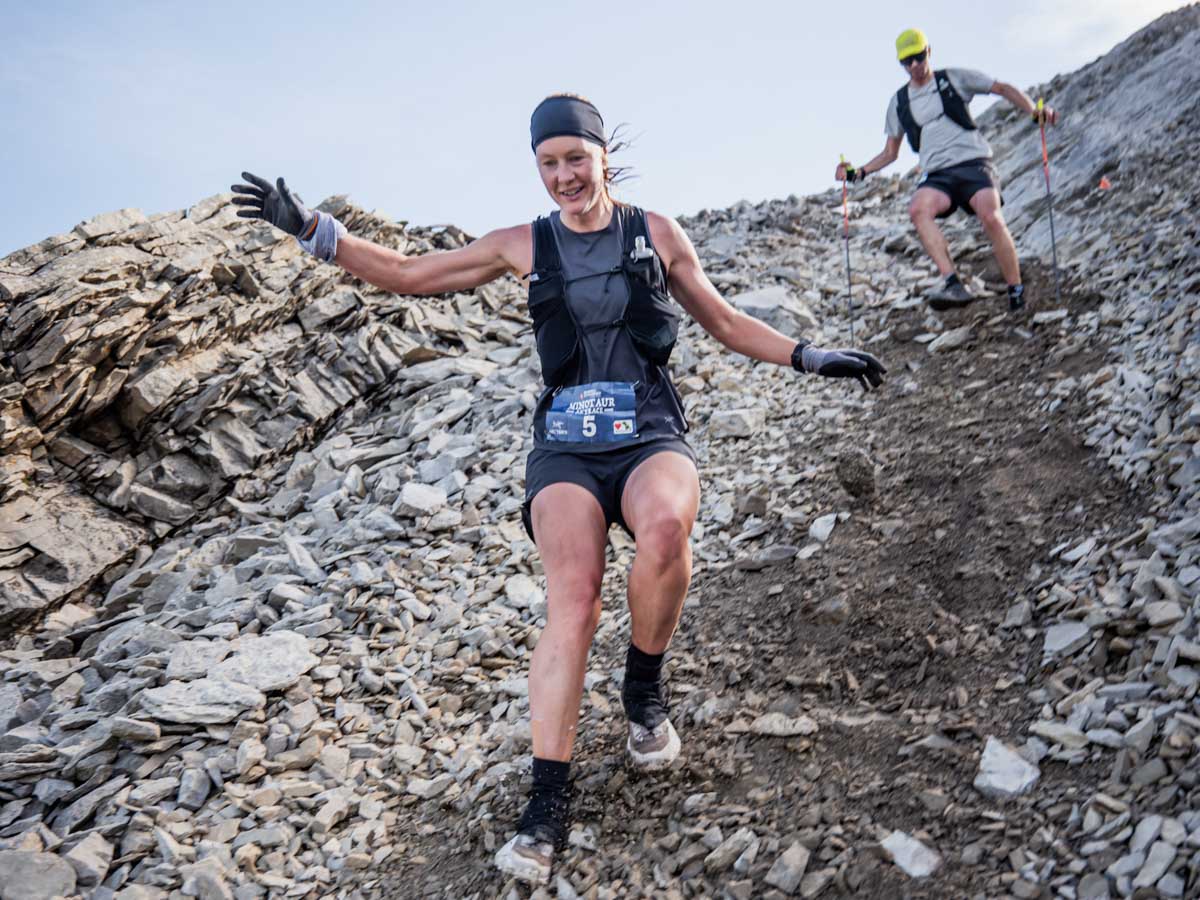
Henriette descending during the 2024 Minotaur SkyRace. Photo: The Adventure Bakery
Henriette dreams big, but she’s also realistic. She’s keen on planning, research, and organization, but has also learned over the years that sometimes, “you just have to let stuff be.” She also doesn’t want to think too far ahead. Henriette has faith that whatever the next thing is after UTMB in 2026, it will hit her, she’ll catch the bug for it, and go all in. She says, “I don’t want to overthink it now because you just know when you find that thing.”
Whatever it is, it’s the kind of thing that will set her soul on fire.
Call for Comments
- Do you have a Henriette Albon story to share with us?
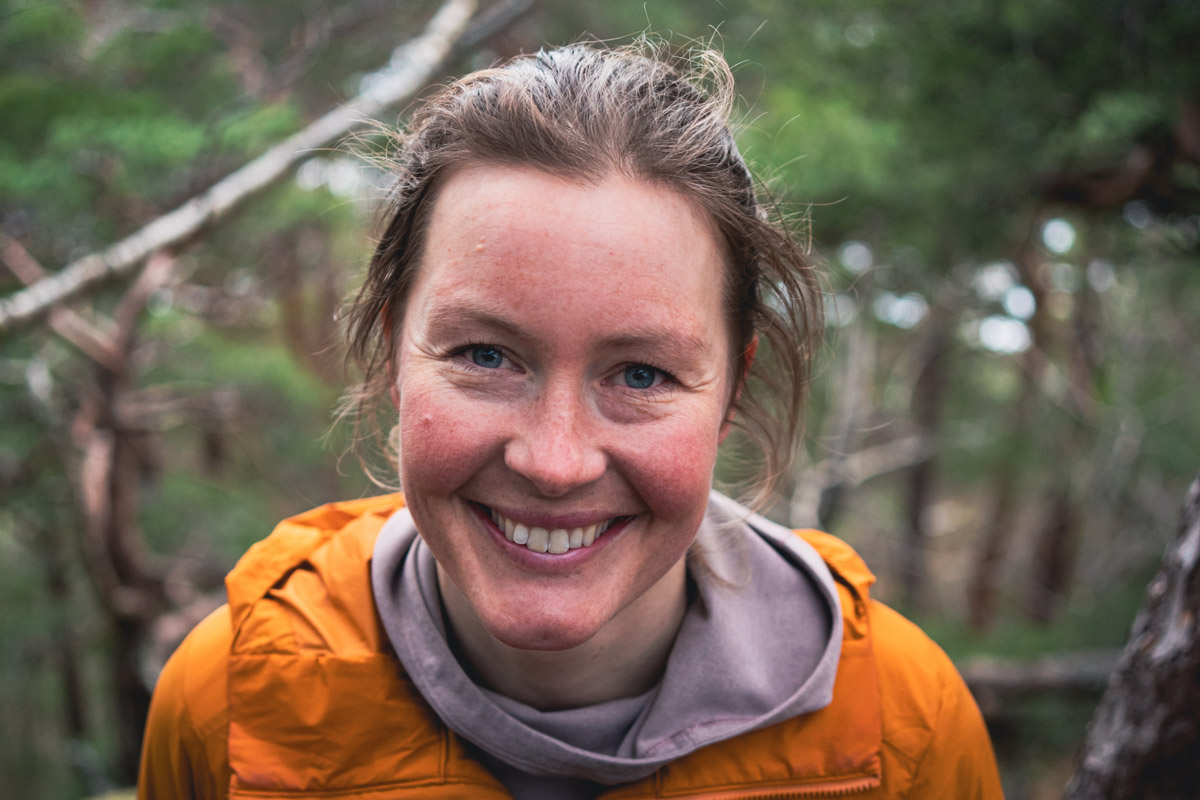
Henriette says of racing, “We’re all just out there playing this game of: How well can we do today?” Photo: Petter Engdahl