The backyard ultra race format, originally created in 2011 by Gary Cantrell, or Laz, of Barkley Marathons notoriety, is a rapidly growing corner of ultrarunning. The timed-lap race format, which values attrition over speed, lends itself to some interesting pacing strategies. Runners can either run fast and have a lot of rest between laps or run slower at the expense of rest. At the 2025 Big Dog’s Backyard Ultra, winner Phil Gore of Australia — the current record holder for the format — completed 114 laps as he ran 475 miles (764.4 kilometers), and Ivo Steyaert of Belgium was the last person to drop with 113 laps. They had vastly different pacing strategies, which we’ll examine in this article.
Big’s is Laz’s original event and considered the world championships of the race format. While Gore didn’t set a new record this year, Sarah Perry of the U.K. set a new women’s standard by running for 95 hours and 395.8 miles (637k). The racing format involves running a 4.167-mile (6.705k) course, also called a “yard,” every hour, starting on the hour. Runners continue until they miss the 1-hour cutoff, or don’t want to run anymore, and the winner is the last person to complete a lap. The second-to-last person is considered the “assist” since the race ends after the last person has completed their final solo lap. Runners qualify for Big’s by winning their national championships or maintaining a high spot in the backyard world rankings.
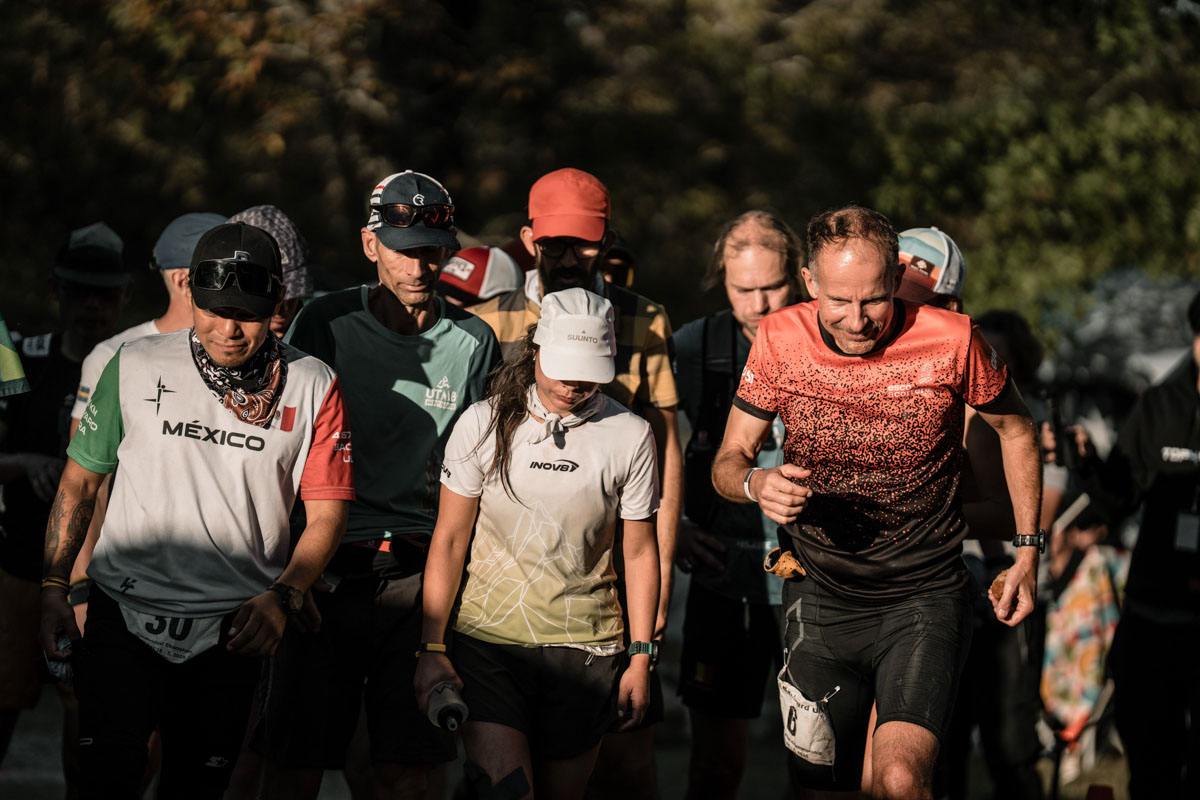
From left, Rodolfo Ramírez (Mexico), Sarah Perry (U.K.), and Harvey Lewis (U.S.) lining up in the front row for a fresh lap at the 2025 Big Dog’s Backyard Ultra. Photo: Jacob Zocherman
In this article, we dive into some strategies you can use to perform well at a backyard ultra based on the performances and pacing of top runners at this year’s event, with a specific focus on the top 25 runners. All data was pulled from the 2025 Big Dog’s Backyard Ultra results.
Pacing
Balancing the pacing for a backyard ultra is critical. If you run fast, you have more time to rest, but you also wear down your muscles faster and deplete your energy stores. The fine line to balance is how slowly you can run while ensuring sufficient recovery time between stops. During some stops, you will just grab some food and water before continuing on, while other breaks you might want to sit down, eat a full meal, or take a nap. If you run a 40-minute lap, you get 20 minutes of rest. If you run a 59-minute lap, you only get 1 minute to rest. Striking a balance of this run-to-rest ratio is critical. Looking at the results of the 25 runners who went the farthest, we see an average pace of 50 minutes and 50 seconds per lap.
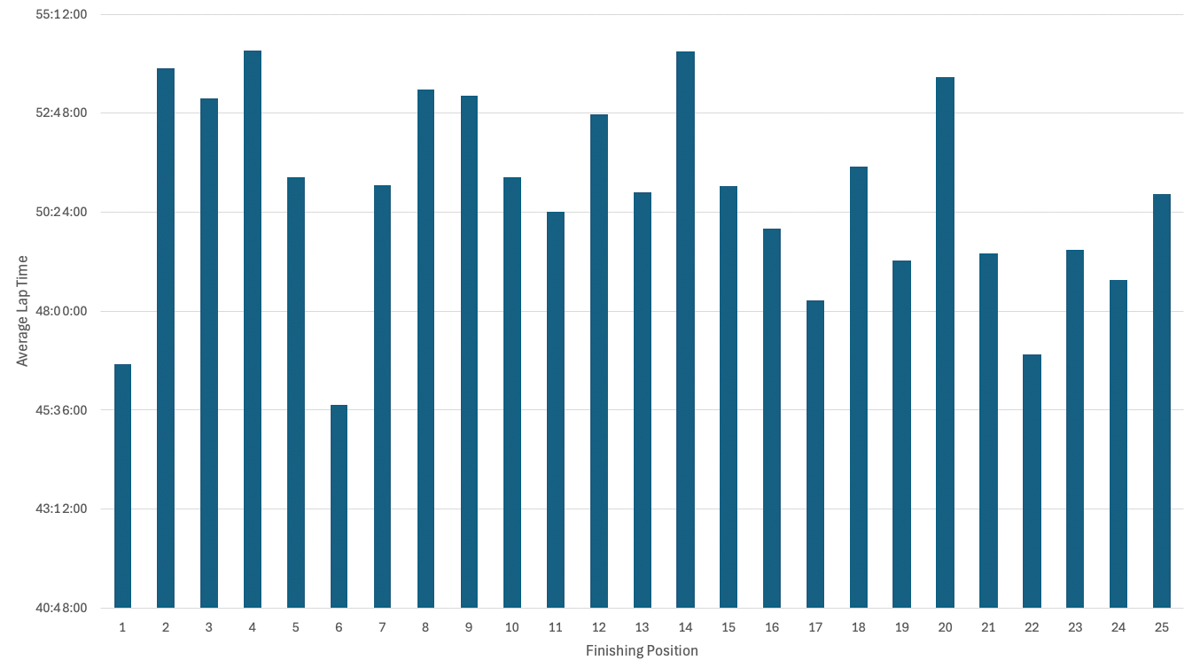
The average lap times for the top 25 runners at the 2025 Big Dog’s Backyard Ultra.
This pace is roughly 12 minutes per mile, which, for high-level runners, isn’t particularly fast. But the goal is not to be fast; the goal is to last as long as you can. It’s worth noting that the winner, Gore, had an average lap time that was around 6 minutes faster than the rest of the top four runners.
It is also interesting to consider how slightly faster laps compound over time to a significant difference in total moving time. The top four runners each covered at least 111 laps over 111 hours — or 4 days and 15 hours. Over that number of laps, a few minutes here and there really add up. Below is a graph of the total moving time of the four runners who made it the furthest.
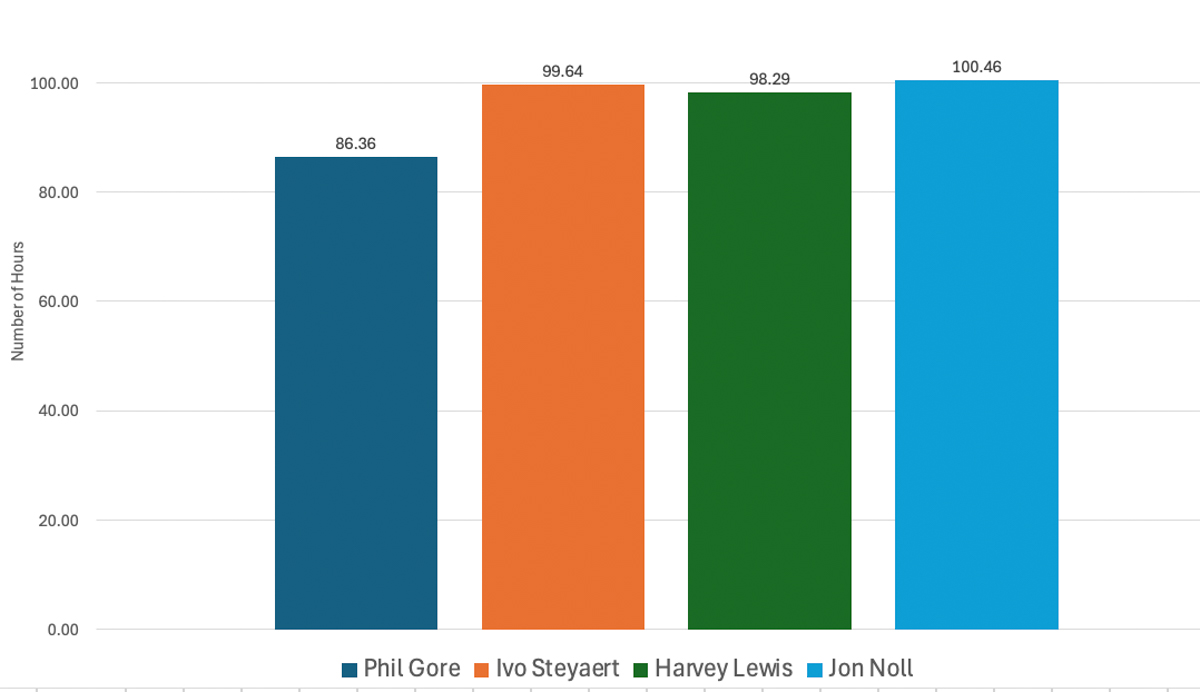
Total run time for the top four over the first 111 laps of the 2025 Big Dog’s Backyard Ultra.
As we can see, Gore, who was running significantly faster than the rest, had a total moving time that was about 12 hours less than the next runners in the top four after 111 hours. Historically, slower laps to conserve energy and prevent muscle breakdown have been the preferred strategy for backyard ultras, but Gore’s performance shows the potential benefits of more rest and less time on feet if a runner can run efficiently without causing too much muscle damage. Twelve hours is a lot, and that time can be spent recovering, sleeping, and fueling, which brings us to our next topic.
Strategic Pit Stops
The next piece of data we were curious about was the consistency with which the athletes completed their laps. Some stayed steady in pacing, while others fluctuated significantly between laps. One interesting thing we observed in the data is that the eventual winner, Gore, not only had one of the fastest average pace, as shown in the above chart, but his lap times also had the highest level of variation among the top 25 runners, which is measured as the standard deviation. This is a statistical measure that quantifies the amount of variation or dispersion in a dataset, and Gore’s standard deviation per lap was 5 minutes and 43 seconds. A high standard deviation means there was a large spread in the speed he was running laps — some were quite fast and others were just under the cutoff. The average standard deviation for the rest of the top 25 runners was 4 minutes and 1 second, meaning they generally kept a much steadier pace.
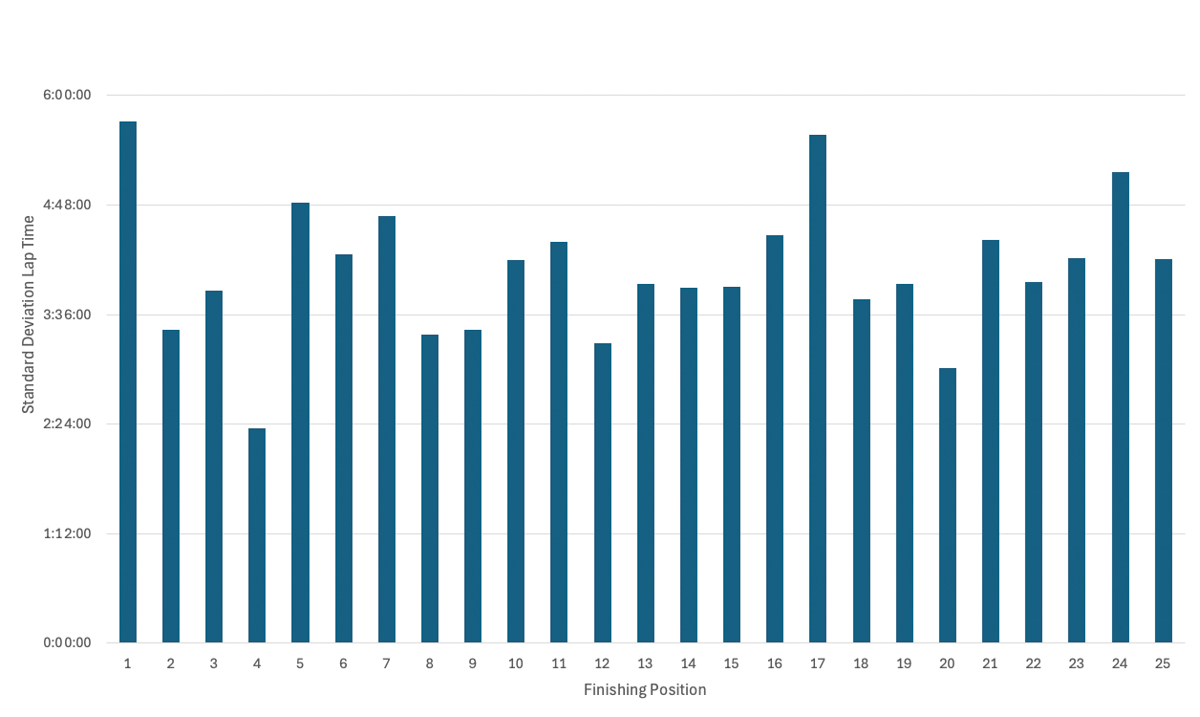
The average variation in lap times of the top 25 finishers of the 2025 Big Dog’s Backyard Ultra.
This is an interesting piece of information as we think about how athletes structure their running and rest time. During the first day, Gore’s fastest lap time was 38 minutes, while his slowest was his first at 57 minutes, just under the 1-hour cutoff. On his 66th lap, he ran under 37 minutes. This is a significant spread and shows that there might be beneficial points during the race to have more or less rest time.
Looking at the approach of the top two finishers in terms of strategy, we see two different styles of racing. Gore, as we mentioned, had varied his timing across laps with significant deviation and quickly alternated between fast and slow laps. Steyaert, on the other hand, had very consistent lap times with a few dips for faster lap times and increased rest. One additional factor to consider when examining this data is that the race is held on two different courses, one during the day and one at night. The daytime laps, which include some trail, are considered more challenging than the nighttime laps, which are run on the road. The race consists of 11 daytime laps and 13 nighttime laps each 24-hour period, and this variation is evident in the trends of Gore’s splits, while Steyaert seemed to aim for a steady lap time regardless of the time of day.
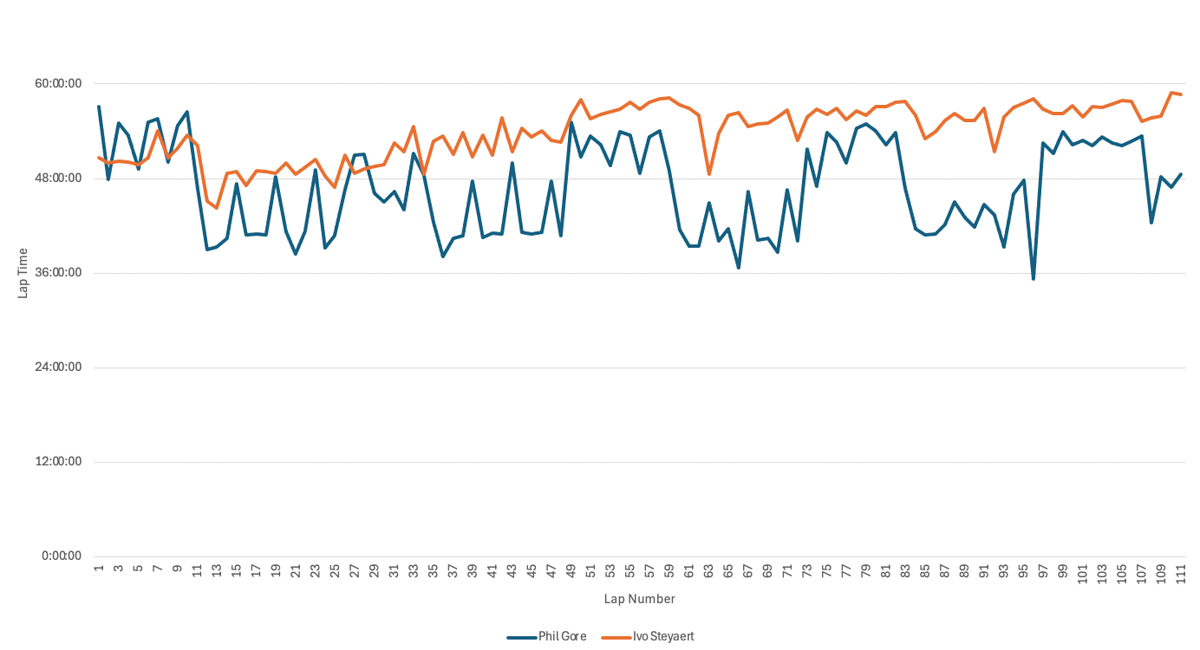
A comparison of the lap times of Phil Gore and Ivo Steyaert, the winner and assist at the 2025 Big Dog’s Backyard Ultra.
Taking on different strategies that allow you to move as slowly as possible while still having enough time to rest and recover for the next lap is key in this event of attrition. The slight upward trend in Steyaert’s lap times had me curious to see the trends of the rest of the top 25 runners. Looking at runners 21 to 25, we see a similar upward trend as they got closer to stopping. For the first 50 laps, their times hovered close to or below 50 minutes, while after lap 50, the times jumped to around 55 minutes. Note that all of these runners passed the 3-day mark and 300 miles, which is an incredible feat of endurance.
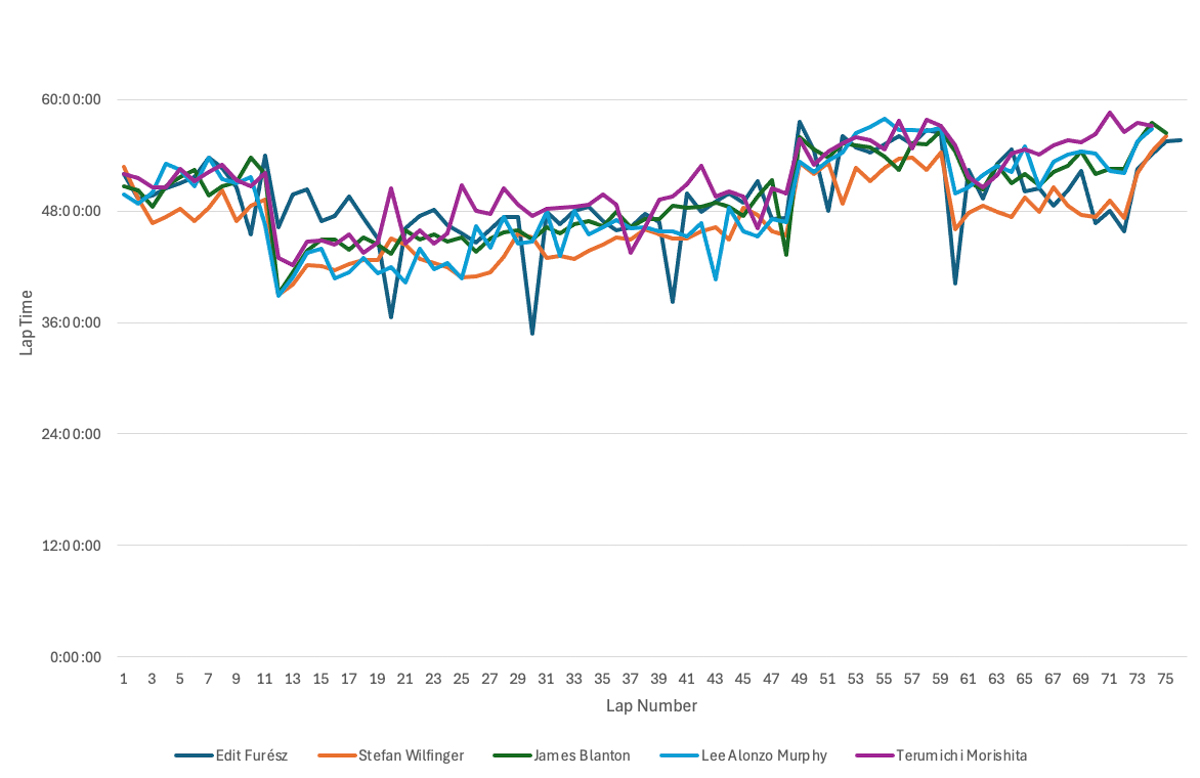
Lap times of the 21st through 25th place runners at the 2025 Big Dog’s Backyard Ultra.
Final Thoughts
The end of a backyard ultra event is as unpredictable as they come. With only one listed finisher and the rest of the participants DNFing, it is a true event of attrition. Pacing yourself is critical for keeping your body intact and being able to continue moving just fast enough to finish the lap and recover before the start of the next. The rest strategies vary among participants, with many opting for consistent pacing, while the current world record holder, Gore, had significant variance in his lap times.
This style of event has been gaining popularity over the last several years, with the record continually being pushed to new limits. With the record only able to be broken when the “assist” is also able to go the distance, essentially meaning that two people must be able to run to or beyond the current record, it will be interesting to follow how times and distances increase as more and more people become interested in the sport. Gore’s final lap time was 37:03, one of his fastest, clearly indicating that he still had plenty in the tank to keep going had it been a possibility.
Call for Comments
- Have you run a backyard ultra? What did you think?
- For those experienced with backyard ultras, what’s your pacing strategy?
- Do you think Gore’s fast-and-slow pacing strategy could carry over to more traditional ultramarathons?

