• Home
  • Blogroll
  • Book
    • RFP Home
    • RFP Resources
    • Buy RFP
    • Spread the Word
    • RFP Samples
      • Table of Contents (pdf)
      • Chapter 1 (pdf)
      • Chapter 2 - partial (pdf)
    • Reviews and Interviews
    • Media Kit
  • Support iRunFar
  • Archive
  • About
    • iRunFar.com
    • Bryon Powell
    • Contributors

ultramarthon training

  • Store
  • Reviews
    • Shoes
    • Apparel
    • Other Gear
  • News
    • Races
    • Interviews
  • Columns
    • AJW's Taproom
    • Chick's Corner
    • Dakota Jones
    • Geoff Roes
    • Stay the Course
  • Trail Guides
  • Resources
You are here: Home / Columns / Happy Trails / Calculated Splits

Calculated Splits

April 29, 2012 by EJ Murphy · 13 Comments 

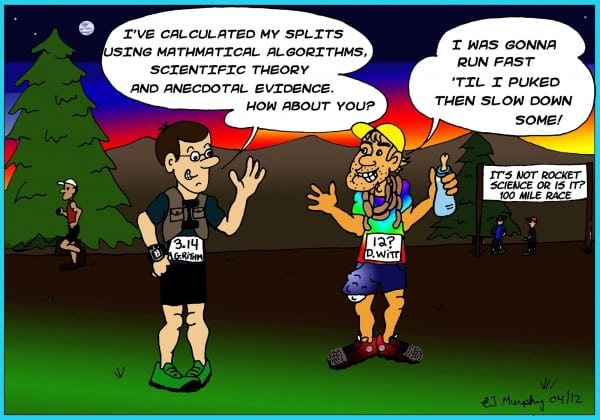
Calculated Splits[Click here  for full size comic.]

Call for Comments (from Bryon)
Do you take a highly analytic approach to your races, completely take it as it comes, or something in between?

Related articles:

  1. The Hardrock 100 and Badwater Ultramarathon… Happy Trails Style The Happy Trails comic takes a look at the Hardrock 100 and Badwater 135....
  2. It’s Just Running An insider look at the ultrarunner United Nations summit....
  3. A Run Three Years in the Making… After three years of commanding iRunFar, Editor-in-Chief Bryon leaves his website in (mostly) able hands and goes for a run....

Filed under Happy Trails · Tagged with

EJ Murphy draws the Happy Trails comic strip for iRunFar.com, while also creating the Ultrarunning Guy comic.
All posts by EJ Murphy

Comments

13 Responses to “Calculated Splits”
  1. Joe says:
    April 29, 2012 at 8:12 am

    I dislike predicted pace charts simply because when I fall off my prediction one of 2 things happen. 1. I blow up trying to catch up. 2. I fall into a depression funk and slow down. Its much better for me to just run with how I feel and take what the day has to give.

    Reply
    • EJ Murphy says:
      April 29, 2012 at 12:49 pm

      Joe I so know that feeling of shutting down when the watch doesn’t give you the feedback you were hoping/expecting to see. It can drain me emotionally even if I wasn’t feeling so bad before I look at the watch. I guess it is just one more thing I’ll have to prepare myself for prior to a race now.

      Reply
  2. art says:
    April 29, 2012 at 8:20 am

    same thing happens to me (Joe’s #2), but I continue making pace charts anyway because at least then I know why I’m depressed.

    Reply
  3. EJ Murphy says:
    April 29, 2012 at 1:45 pm

    I don’t think D. Witt gets depressed. Sometimes I wish I were more like him, except I’d never wear that T-Shirt.

    Reply
  4. Serena says:
    April 29, 2012 at 5:56 pm

    I’m definitely in between! Done a little of both!

    Reply
  5. KenZ says:
    April 29, 2012 at 10:13 pm

    All about predictive analytics and pace charts, but I make mine with 3-4 variables for fastest, expected, and slower. The key in the race however is to use your pace chart info on a short term level, not a race level. If you use it to focus on making that 24 (or 20 or 30 or whatever) hour self-imposed cutoff, then yes, as soon as you SLIGHTLY fall off it you get depressed and/or push yourself too hard to catch up and then blow up. Your body has optimal pace(s) throughout the race that will maximize your efficiency and minimize your finishing time. A rigid pace chart has no consideration for how your body is performing that day, the weather, your ankle sprain, etc.

    I find the real value of well thought out pace charts is on an aid station-to-aid station level. Based on how I’m running, I know whether I’m in my faster, average, or slower than average pace range. Now I know almost exactly (like +/- 2 minutes) how long I’ll take between aid stations, which in turn allows me to carry the right amount of water and calories between each. So I don’t use my pace chart to pace, I use it to predict times within the race and find it super useful.

    I use my heart rate monitor and how I feel to pace: those are methods that actually do relate to optimizing your performance throughout the event.

    Reply
  6. Alex from New Haven says:
    April 30, 2012 at 8:28 am

    I think pace charts are good in two instances:

    1) Early in races (first 10-20%) to help keep you from going too fast.
    2) 60-80% into the race to know if you need to push to make your goals or just stay consistent and consolidate time.

    For any flatish trail or road ultra I’d have A) and B) splits for both cases above.

    For something like Western States (old, but far from flat), ignore the “averages” and find people in your ability range who run really “smart” races. The “average” splits for say 24-hours are the combinations of heroes who tried to run 21 and stumbled home in 23:50 and savvy racers who passed 90 people in the last 30 miles and ran 23:00.

    Summary: I use pace charts to force myself to slow down the first part of a race

    Reply
  7. Hone says:
    April 30, 2012 at 8:55 am

    “I found that if you have a goal, that you might not reach it. But if you don’t have one, then you are never disappointed. And I gotta tell ya, it feels phenomenal!” -dodgeball

    There is something extremely beautiful and gratifying about just winging it.

    Love the cartoon (as always) EJ!

    Reply
  8. Andy says:
    April 30, 2012 at 11:53 am

    I agree with Alex about using pace to keep from going out too fast and save something for the end. Other than that, our daily lives are so filled with demands, appointments, deadlines, technology, and expectations, I prefer to eschew most of that in running and just run free. Probably easier said as a mid-packer who isn’t plannning to break any records, just out for for a long day of pleasure and pain on the trail.

    Reply
  9. Gary Gellin says:
    May 1, 2012 at 12:38 am

    Doesn’t she know I wear contact lenses?

    Reply
  10. KenZ says:
    May 2, 2012 at 8:38 am

    Just heard Lee McKinley quote Eisenhower: “Plans are worthless, but planning is everything.”

    Translation for ultras: Invaluable to plan (possibly to the level of pace chart), but for the actual race stay flexible.

    Reply
  11. EJ Murphy says:
    May 2, 2012 at 10:14 am

    Ken, Love the quote, so true.

    Thanks to everyone for joining in the conversation. Sorry Gary, I forgot you have the contacts now:-) And Evan, I’m glad you liked the cartoon;-)

    Reply
  12. Adam St.Pierre says:
    May 2, 2012 at 2:28 pm

    I like to use pretty intricate pace charts (taking into account distance and elevation loss between aid stations) to approximate a best case scenario and a more probable scenario. This allows my crew to know approximately when to expect me. it also helps me plan what to carry between stations (hand bottle or bladder pack, how many gels, etc.). I also use it to stay conservative early in races, although I aspire to some day “race” an ultra instead of just running them.

    Reply

Speak Your Mind

Tell us what you're thinking...
Click here to cancel reply.

  • The iRunFar Store

  • Advertisement

  • An iRunFar Featured Video

  • Join the iRunFar Community

    Subscribe to iRunFar via RSS
    Subscribe to iRunFar via Email
    Become a Fan of iRF on Facebook
    Follow iRunFar on Twitter
  • Please Support iRunFar!

    Make any purchase from Amazon via the link below to help fund iRunFar.com. It costs you nothing and helps us big time!
    Support iRunFar.com!
    In one of these countries? use the appropriate link to support us! UK, Canada, France, Germany and Austria, Spain, Italy!
  • The Latest from TrailPorn.com

    Sean Storie running through Buttermilk Falls in Ithaca, New York during the Cayuga Trails 50.

Photo: Ron Heerkens, Jr.
    TrailPorn.com
  • Advertisements

  • Ultra & Trail Resources

    • Ultramarathon Training
    • Finding Trails
    • International Resources
    • Energy Gels Comparison
    • Ultramarathon Coaches
    • Ultramarathon Clubs
    • Trail Running Camps
    • Choosing an Ultra
    • Heat Acclimation
    • Improve Running Economy
  • Top Gear Reviews

    • Suunto Ambit
    • New Balance MT1010
    • Merrell Trail Glove
    • Brooks Cascadia 7
    • Salomon Sense
    • New Balance MT110
    • NB Minimus Trail/Road Zero
    • Salomon Speedcross 3
    • Brooks Pure Grit
    • New Balance Minimus Trail
    • Other Shoes
    • Apparel
    • Packs and Other Gear
Home · Privacy · Advertise on iRunFar · Contact

© 2013 iRunFar, LCC