In this monthly article series, ultrarunner, race director, and coach Gabe Joyes answers reader questions about anything and everything running. Learn more about this ask-the-athlete column, and be sure to fill out the form below to submit your questions for a future article!
In this article, Gabe answers questions about international racing, training transitions between marathons and trail ultras, and the differences between wind and rain jackets. Also, gels.
Gabe’s Tip of the Month
Sometimes, spring long runs are tricky to keep interesting and adventurous due to lingering snowpack or wildlife-related trail closures. If you are like me, contrived routes with multiple out-and-backs are just part of spring. To avoid getting stuck in an early-season rut, wrangle up some friends and a couple of cars and scheme a point-to-point long run that would not be feasible on your own.
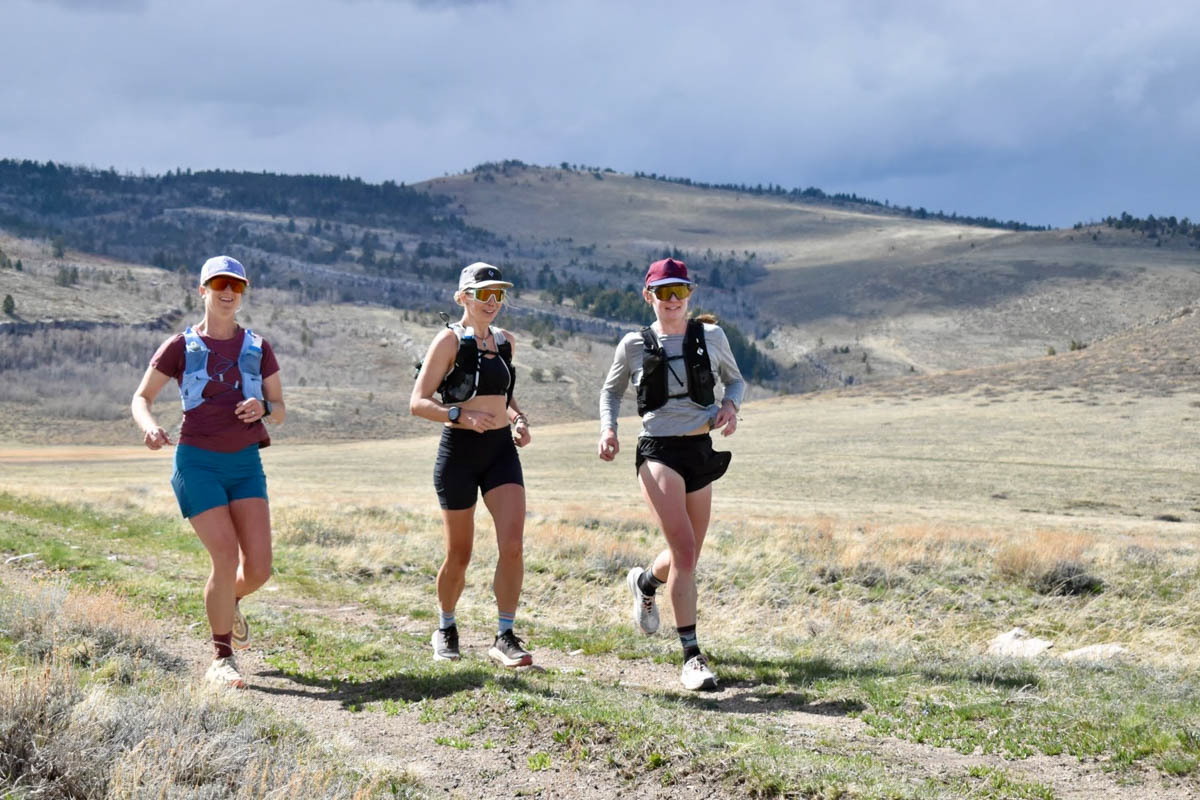
Jenny Joyes, Kelly Halpin, and Amy King wrapping up a point-to-point 30-mile spring fun run. Photo: Gabe Joyes
Many of us got into ultrarunning because of the sheer thrill of covering an enormous amount of ground between points A and B, and creating an aesthetic line to make that happen with some friends is a pure and fun adventure. For extra excitement, leave some donuts, or a cooler full of guacamole and chips — or whatever else sounds satisfying — in the car at your finish line so you can have a post-long-run celebration together as well, and no one drives home with dangerously low blood sugar!
International Racing
I signed up for my first overseas ultra in Switzerland, and I really do not know what to expect besides beautiful mountains. I know everyone says that European races are different from American races, but how so? How do I prepare for the unknown? -Claire
Very cool of you, Claire, for stepping outside your comfort zone and seeking something new. Most Americans traveling to a European race will certainly experience cultural differences, as well as differences in landscape and environment.
If you haven’t already, do a little bit of research on YouTube or social media about the specifics of the race. How many participants are there? What does the starting line look like? What kind of snacks and drinks can you expect at aid stations? All of these details will begin to help you visualize your race-day experience, which will go a long way toward helping you prepare for the day(s).
If you are looking for a new and different experience, be prepared to embrace that as well. I vividly remember running into a major aid station at the Lavaredo Ultra in Italy, eager for my first salty, satisfying hit of potato chips, but when I looked around, I could not find any. With desperate eyes, I asked a volunteer, “Potato chips?” The stern-looking Italian lady declared to me, “No potato chips!” Instead, I pivoted to a handful of cubed cheese and dried apricots, which was a lovely salty, sweet, and soft combo.
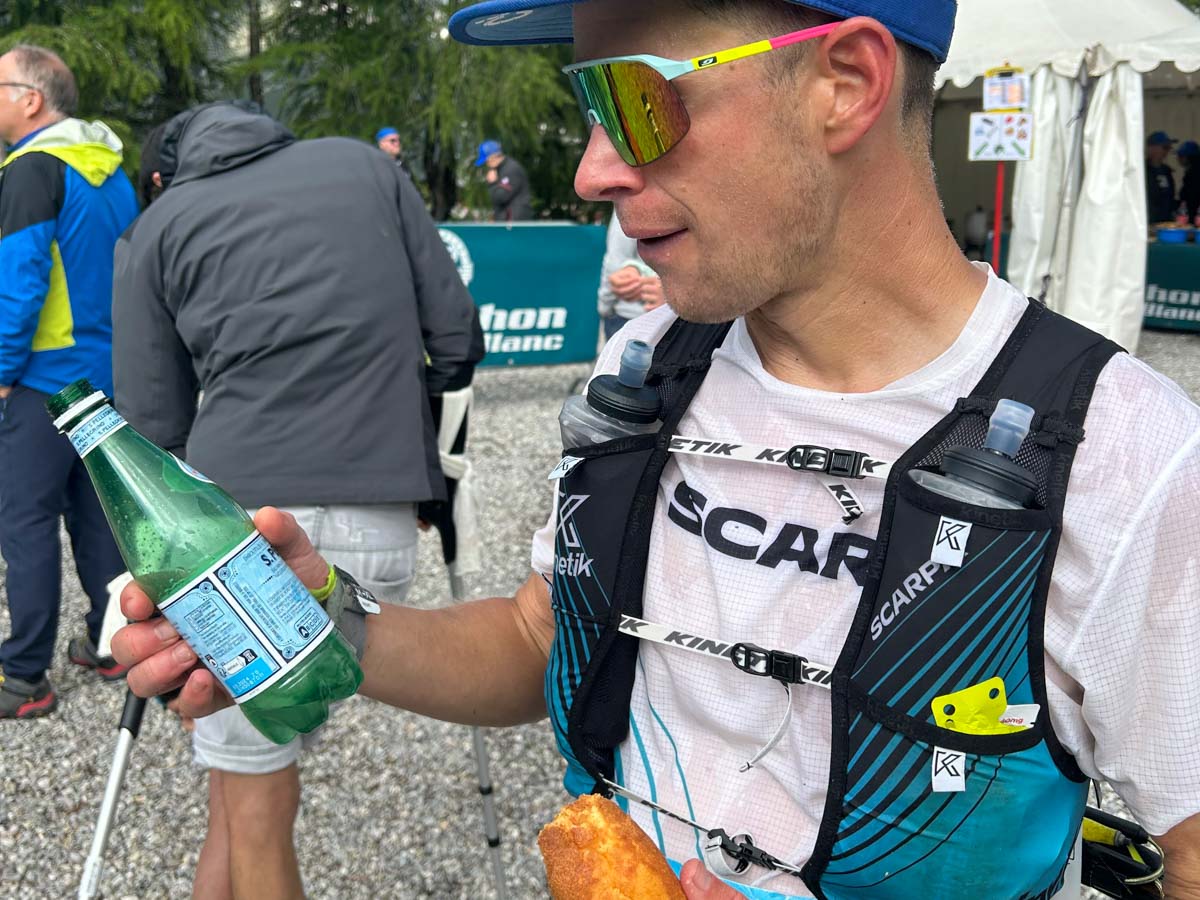
Your author going local by swapping out potato chips and Coca-Cola for San Pellegrino and Italian plum cakes at the Mont Blanc 90k. Photo courtesy of Gabe Joyes.
Depending on where you live, you might find the landscape a stark contrast to what you are used to as well. I do the majority of my training on the rainshadow side of Wyoming’s Wind River Mountains, a semi-arid, high-desert landscape with relative humidity regularly below 20%, and I have found the Swiss Alps to be almost unbearably humid in comparison. But if you are traveling from somewhere like Virginia, you might not think that European humidity is a big deal at all.
It is probably a safe bet that if you are running in Switzerland, you can expect mega-long, dramatically steep, and extremely rocky climbs and descents. My perception is that I enjoy technical trails more than most Americans do, and I still often find some European trails to be an eye-opening experience. Many are hundreds of years old, and American-style trail work and switchbacks are clearly not much of a thing. To create a similar experience in your training, you might consider off-trail hill repeats in a canyon or a similarly steep landscape.
Finally, remember that part of the fun of this type of race is that there are many unknowns, and you will not have it all figured out before you arrive. Don’t let this fuel anxiety, but embrace it as something interesting and as part of the experience you are looking for. Allow yourself to try new things, be uncomfortable at times, and still have a bit of a laugh about it all as you spend some time being humbled.
Road to Trails Transition
I just ran the Boston Marathon, and I am quietly proud to say that I set a PR. I like World Marathon Majors, but I love mountain 100-mile races, and I am running the Bighorn 100 Mile in less than two months. What are your suggestions for switching from road marathon training to 100-mile trail training? –“J-Dawg”
Woof! Congratulations, J-Dawg! A spring road marathon training block before a 100-mile mountain trail race is a great platform for success, so well played and definitely wag your tail about that.
My first suggestion is, even though Bighorn isn’t all that far out, be sure to take a bit of a break and allow your body and brain to recover from and absorb the marathon experience. The frequently high-intensity training — and racing — that comes from road marathons often burns athletes out faster than the relatively lower intensity and longer training of ultras, so be sure to let your body fully bounce back from Boston before going all-in on Bighorn. Remember, you won’t get any physical benefits from the marathon if you don’t actually recover from it.
Once you do recover, that road marathon will have helped improve your running economy, leg speed, and stamina at higher efforts. But as it sounds like you already know, running on mountain trails is not quite the same thing. Once you do get back into training, spend as much time as you can on trails and terrain that look more like the Bighorn Mountains. If you don’t have daily access to this type of terrain, I recommend adding plyometrics to your schedule a couple of times a week to help prepare your body for the off-kilter, dynamic movements of trail running. Be extra diligent to keep your effort and intensity low, as your 100-mile race pace will be dramatically slower than it was in Boston.
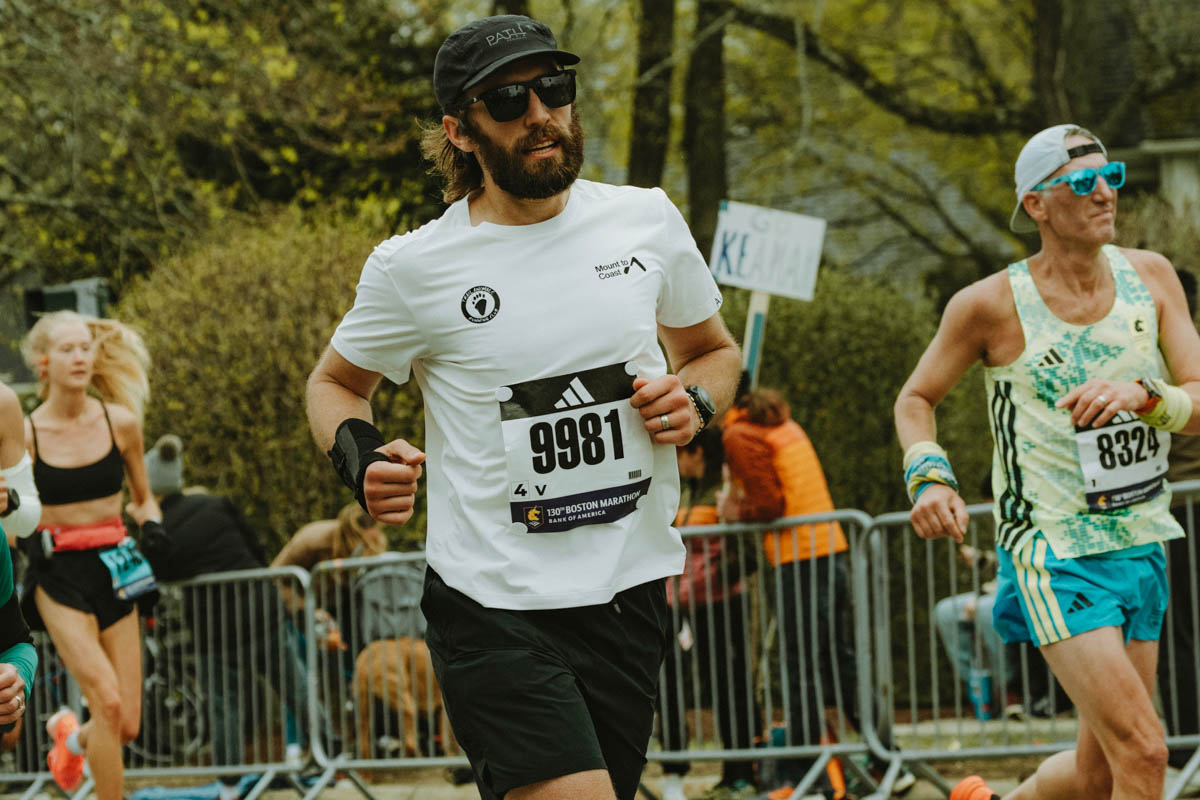
Bill Dittman wrapping up the 2026 Boston Marathon before jumping into a training block for the Hardrock 100 in July. Photo: Dave Hashim
Many folks can get through a road marathon with a few gels and paper cups of a mystery sports drink, but that fueling and hydration strategy won’t work for the duration of a 100-mile race. Practice eating and drinking in a way that is sustainable for 18 to 36 hours — depending on how fast you hope to finish Bighorn. You want to keep energized mile after mile, and this takes effort and practice to get right!
Good luck at Bighorn, one of my favorite 100-mile races ever!
Wind Versus Rain Jackets
What is the difference between a wind jacket and a rain jacket? I only learned recently that they are not the same thing. -Sarah
The main difference, Sarah, is that I like wind jackets and generally dislike rain jackets. Kidding! Sort of.
At first glance, wind and rain jackets look remarkably similar, but they are made of different materials and serve different purposes. In the context of trail running, a wind jacket is typically made from a single-layer, extremely lightweight, porous fabric. The itsy bitsy teeny tiny holes in the fabric are very important because they let moisture through, both from precipitation and from sweat. That means if precipitation is falling from the sky, it will soak through your wind jacket and get you wet. Most wind jackets have a durable water repellent (DWR) coating that helps keep a little moisture from soaking through, but honestly, don’t count on that to keep you dry in any real rainfall. The sweat that you work up while running will also evaporate through those pores in your wind jacket, but don’t expect it to be as airy as a tech running t-shirt either. Wind jackets block the wind in some capacity, with some being nearly completely windproof, while others take more of a bite out of the breeze.
Rain jackets block the wind and keep precipitation out as well. Does this mean they will keep you completely dry? Not exactly. Rain jackets use microscopic membranes or coatings that aim to allow water vapor — sweat — to escape while preventing liquid water — rain — from entering. This fancy fabric relies on the fact that water vapor molecules are significantly smaller than liquid water droplets. If it sounds like a big stretch to you that water can travel through the fabric one way and not the other, then you are definitely on to something.
While rain jackets do “breathe” in some capacity, it is unrealistic to expect a rain jacket to let your perspiration from hard uphill running escape. My experience is that rain jackets rarely, if ever, keep me dry while running, but they sure do keep me warm. Rain jacket fabrics trap much of the heat you generate while running, and even if you are soaked underneath your rain jacket, you will stay warm rather than cold.
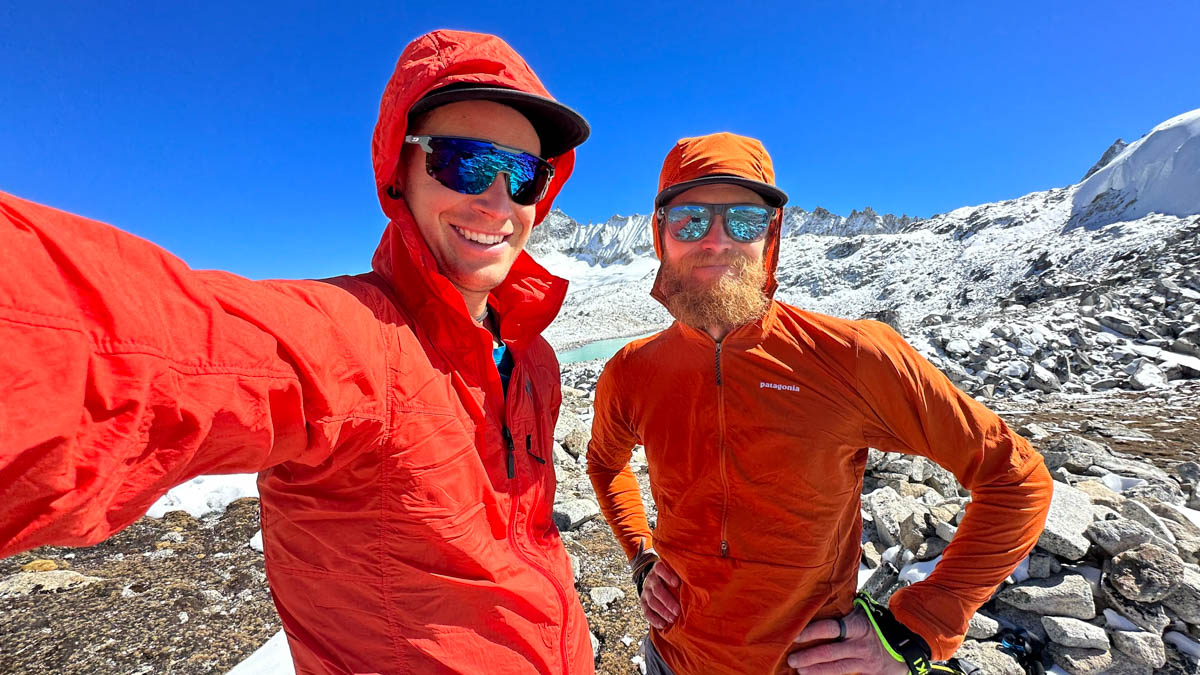
Photo: Gabe Joyes
So, when would you use one jacket over the other? I take a wind jacket on almost every run because it’s lightweight, takes up little space, and keeps me relatively comfortable in a wide range of conditions. But in certain situations, a wind jacket alone is definitely not enough to keep you comfortable and safe. I remember going on a long run in Grand Teton National Park with two friends, and both of my friends packed the Patagonia Houdini wind jacket, which weighs about 3.7 ounces, and I packed a proper rain jacket, which weighed about twice as much. We were trying to pack light so we could move quickly, but the weather forecast and the clouds suggested the possibility of cold, severe afternoon storms.
We were eight miles and 3,700 feet uphill when the clouds let loose with lashing rain, hail, and wind. We all layered up, and while I wasn’t “comfortable” in my rain jacket, it was good enough, and I was happy to keep making the most of the day. My friends in the wind jackets were chilled to the bone with chattering teeth, and desperately wanted to return to the trailhead. I absolutely count every ounce that I pack, but trying to save two to three ounces with your jacket can be the difference between a sensational mountain day and a sad slog back to the trailhead — or your own safety!
To check out some options for rain and wind jackets, take a look at iRunFar’s Best Running Rain Jackets and Best Windbreaker Jackets guides.
Gel Flavors
What is your favorite gel flavor? What taste is the most tolerable for ultra-trail races? –Jurien
Flavor fatigue is a real challenge in ultras, especially when you get over 100 kilometers in. I have found the way to avoid it is to try to avoid much flavor at all! As much as I love eating, taking in sugary calories every 30 minutes for more than 20 hours is a true challenge. I have found that the less I taste my trail snacks, the more I can keep taking them in, mile after mile. Unflavored gels have been a game-changer for me, particularly when I am racing hard, and I really depend on them for the vast majority of my energy.
I often recommend that athletes eat like they have the flu during ultras — the most delightfully bland yet high-calorie and easy-to-digest food available. If I do have anything stronger-tasting, like sensational and calorically dense Peanut M&Ms, I’ll immediately rinse my mouth out with plain water to get the sugar and flavor off my teeth and tongue. For lower intensity adventure-oriented runs with friends, I’ll definitely mix up my snacks with more fun and interesting flavors, textures, and variety. But for higher-intensity racing and XXL durations, flavor falls into the “less is more” category.
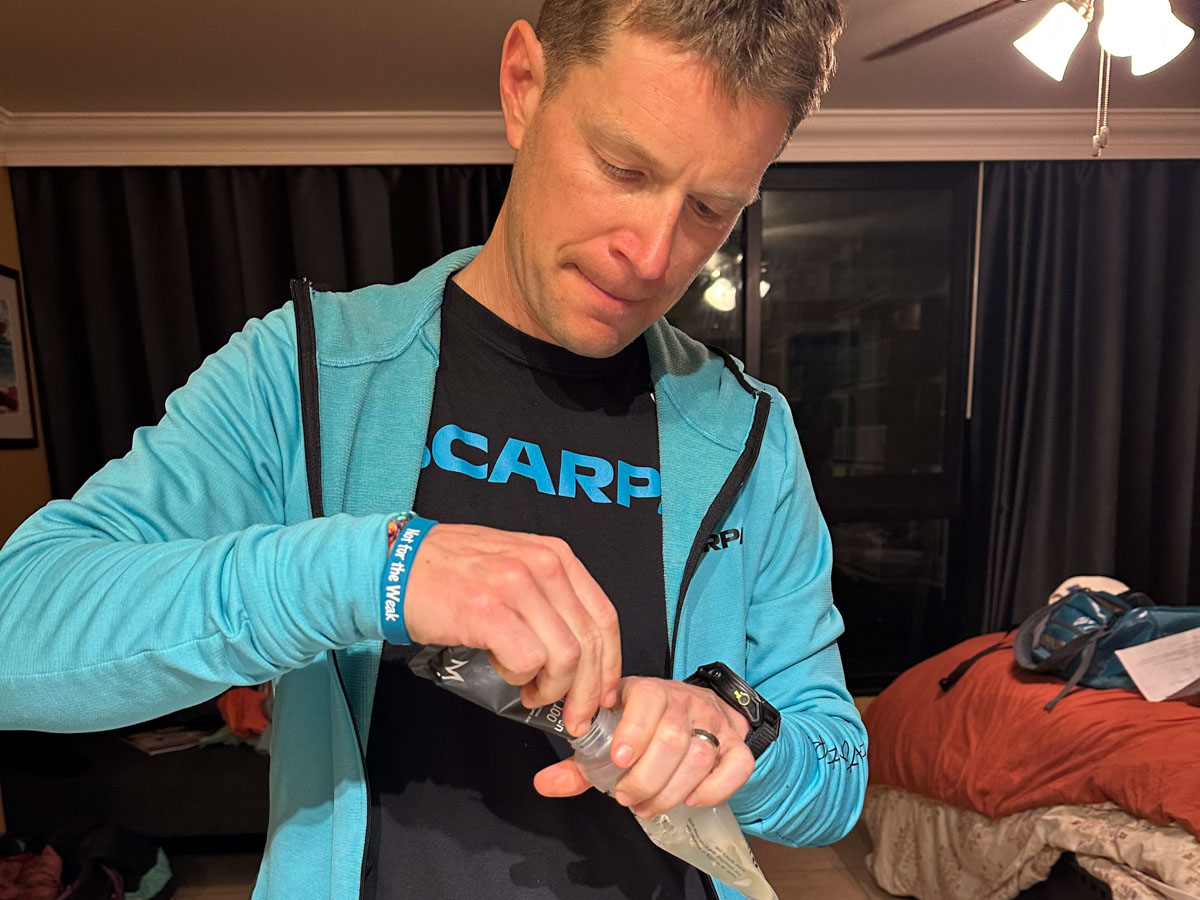
Your author getting ready to eat 55 unflavored gels over the course of HURT 100. Photo courtesy of Gabe Joyes.
Submit Your Questions
Send us your questions! Use the form below or send us a message on Instagram, and we’ll consider your questions for future articles.
Call for Comments
- What are your thoughts on Gabe’s answers this month?
- What pressing running questions have you always wanted answers to?

