Long-distance running is growing, with lotteries for trail ultramarathons becoming ever more competitive and qualification standards for major marathons becoming increasingly stringent.
Still, one area of the sport that’s struggling to gain traction is ultrarunning world championships, and the IAU 50k World Championships have been especially hard-pressed. This biennial event could appeal to both marathoners and ultrarunners, yet it hasn’t attracted the top-level fields one would hope for, and in recent editions it has suffered a notable decline in participation.
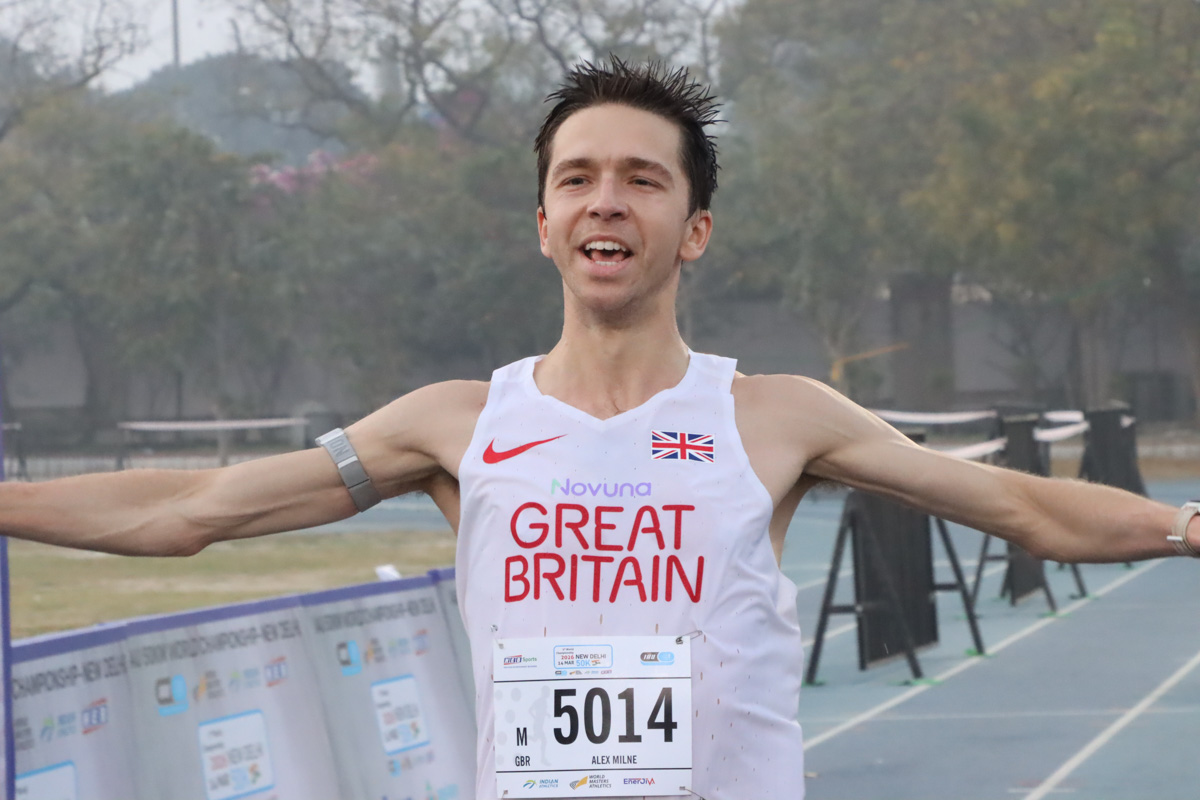
Alex Milne, the 2025 IAU 50k World Championships men’s winner. Photo: André Mingneau
The 2025 IAU 50k World Championships, originally set to run in mid-December in New Delhi, India, but rescheduled to March 2026 due to air quality concerns, drew only 76 runners, just over half of the 2019 event, held in Brasov, Romania. While the times run in New Delhi were fast — Alex Milne (Great Britain) set a new European record for the men in 2:46:09, and Great Britain’s Naomi Robinson’s 3:13:39 was one of the fastest times achieved at the world championships — the event was arguably a step backward from increasing the legitimacy of and excitement around the IAU 50k World Championships.
In this article, we examine some of the challenges the IAU 50k World Championships faces in garnering attention and consider ways to increase participation, not just for the 50k but for all of the federated ultrarunning world championships.
Federation World Championships Background
The International Association of Ultrarunners (IAU) organizes the IAU 50k World Championships and the other ultrarunning world championships, operating under the authority of World Athletics. Unlike commercial races, which are open to anyone who wants to enter — albeit sometimes through a lottery process — world championships are contested by national teams chosen by each country. Some countries place a high value on these events, fully funding their teams, while athletes from other countries must self-fund to participate.
At these events, runners represent their countries, not their individual sponsors. Since national teams are often sponsored by specific brands, professional athletes with other sponsorship commitments find themselves in a bind, having to wear clothing and logos from sponsors other than their primary ones. There’s also a lack of prize money, making them less lucrative for professional runners.
Although federation events have historically faced an uphill battle in attracting top runners, the 2025 World Mountain and Trail Running Championships in Canfranc, Spain, featured highly competitive fields across all events and showed what’s possible. While federation-organized trail and mountain running world championships face many of the same challenges as the road ultrarunning world championships, the World Mountain and Trail Running Championships have secured high-quality venues for many editions, including Cape Town, South Africa, for 2027.
Also, unlike commercial races based in a specific location, the world championships rotate for each edition, with the IAU taking bids from potential host countries before selecting a venue. Host countries are required to provide a certain amount of funding, accommodations, and other resources to the event.
In the case of the 2025 IAU 50k World Championships, the bidding process, venue choice, and event timing raised serious questions about how the IAU is making these decisions.
Poor Air Quality Postpones the 2025 IAU 50k World Championships
With the 2025 IAU 50k World Championships scheduled for December 7, the IAU announced on November 22 that it was postponing the event due to air quality concerns. Just two weeks before the scheduled event, travel and accommodations were booked, and athletes were in peaking mode. A few days before the announcement, India’s Supreme Court, supported by the Commission for Air Quality Management in the area, requested that all schools cancel outdoor activities for the next one to two months due to deteriorating air quality in the city of more than 30 million people.
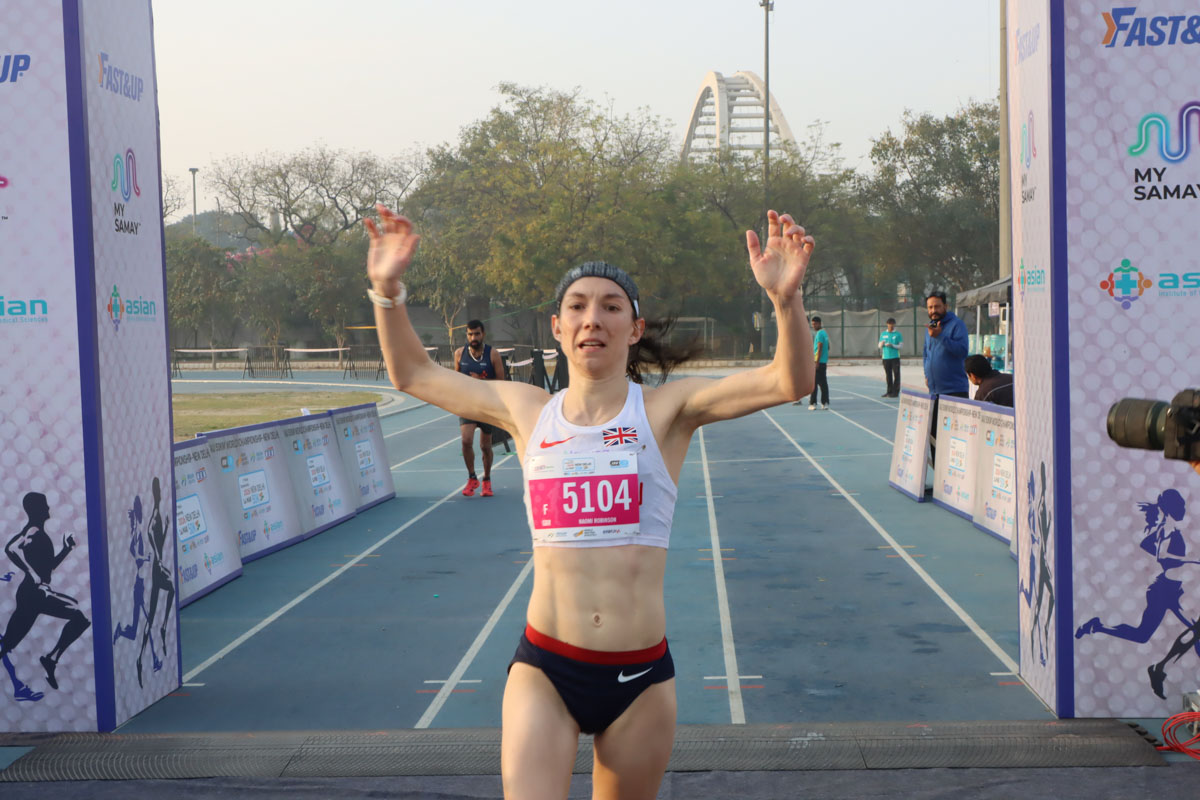
Naomi Robinson, the 2025 IAU 50k World Championships women’s winner. Photo: André Mingneau
The Air Quality Index (AQI) in New Delhi, based on measurements of ground-level ozone, particulate matter, carbon monoxide, sulfur dioxide, and nitrogen dioxide, and measured on a scale of 1 to 500, had been hovering in the mid-300s. An AQI below 200 is generally considered safe for exercise, though people sensitive to air quality issues may experience some discomfort with an AQI over 50. Above 200, breathing difficulties are more likely.
Historically, in December, the average daily AQI in New Delhi rarely falls below 200, and can exceed 400, which is considered hazardous. The main reasons for poor air quality in winter include burning crop fields to prepare them for spring, temperature inversions, and calm winds that trap pollutants near the ground. These meteorological conditions have been likened to a huge saucepan lid, preventing pollutants from dispersing.
To be candid, no one should have been surprised by the need to postpone due to poor air quality, and we wonder why this location and time of year were ever under consideration.
Effects of Rescheduling the World Championships
Postponing the world championships to March 14, 2026, was the right call, but it required athletes and federations to reschedule flights and accommodations — shaking up national teams. When the new date was announced, federations had to resubmit team rosters, and some runners chose not to attend the new event, either by choice or due to prior commitments.
According to Team USA manager and multi-time past team member, Meghan Canfield, “The original USA team had further withdrawals for the rescheduled date, some due to concerns around pollution and the possible effects on health. The U.S.’s Courtney Olsen had concerns, having run in India at previous world championships in the 50k in 2023 and the 100k in 2024, possibly underperforming in the conditions. She also had prior spring commitments in running the Two Oceans [Marathon].” The U.S.’s Charlie Lawrence, the 50-mile world record holder, who was originally selected for the December date, withdrew from the event prior to the postponement due to concerns about the AQI.
While some athletes chose to skip the rescheduled event, the new date opened the door for others to attend, including men’s winner Milne, who says he couldn’t attend the December race because he was racing the Seville Marathon on the same day. He said when the event was rescheduled, “I threw my hat in the ring for the new date. Great Britain kept the four men and women athletes originally selected, but opened up a second selection round in January.”
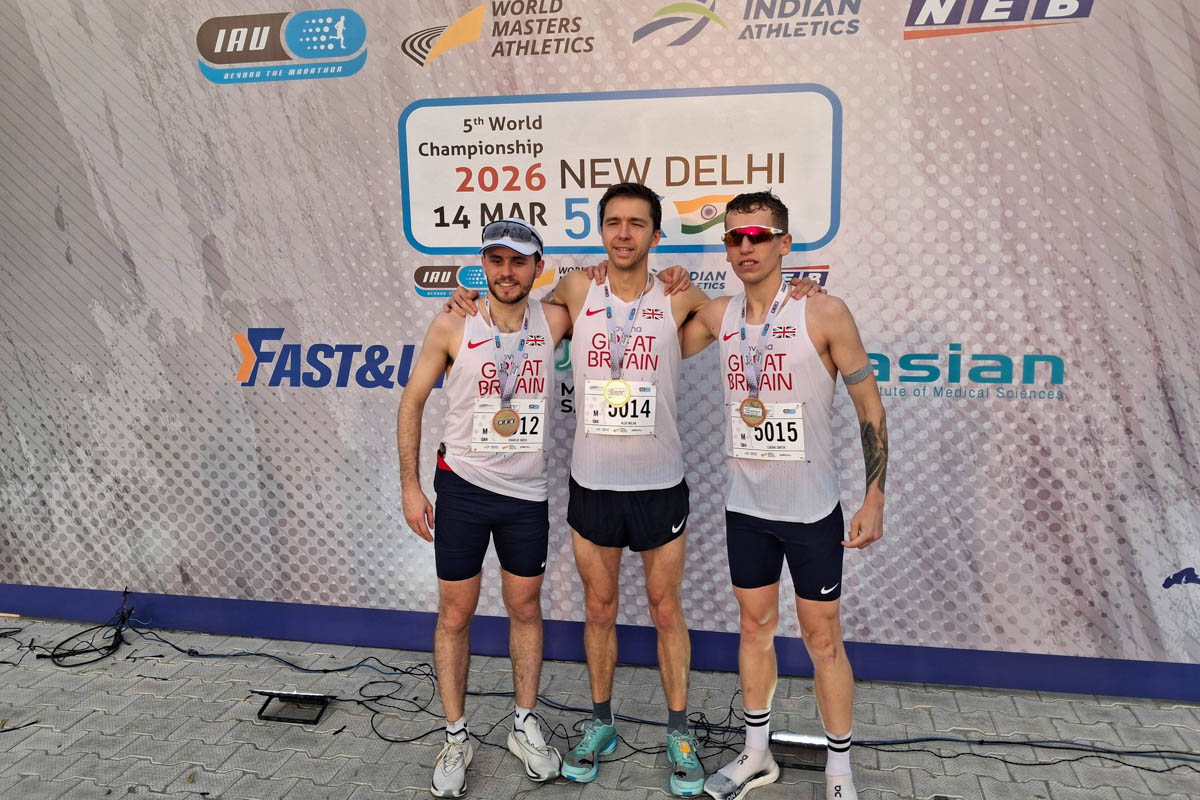
The 2025 IAU 50k World Championships men’s podium (left to right): 2. Charlie Davis (Great Britain), 1. Alex Milne (Great Britain), 3. Logan Smith (Great Britain). Photo: International Association of Ultrarunners
Women’s champ Robinson was originally going to race in December and had to recalibrate. “I opted for the IAU 50k World Championships in December, despite having a Seville Marathon entry. With the postponement, I decided to use my fitness and run Seville as a training run at 50k race pace. I took a couple of weeks easy after that before repeating the 50k training block for the March date.”
All the national teams shuffled their rosters, with some — including Spain — choosing not to attend the rescheduled event. Ultimately, the March event had fewer participants than the original December roster, which was already smaller than normal.
Questions About Host Venues
When the IAU announced New Delhi, India, as host of the 2025 IAU 50k World Championships, some were immediately surprised by three key factors: the timing of the announcement, the multi-year hosting agreement, and known air pollution concerns.
First, the venue was only announced on June 5, 2025, only six months prior to the December event, when many elite athletes already had autumn and winter race schedules in place.
Second, New Delhi was awarded the championships for three editions — 2025, 2027, and 2029 — breaking with the precedent of world championships moving venues each edition. The location and duration of the contract were especially surprising since the 2023 event was also held in India, in Hyderabad. This places a total of four sequential 50k world championships over seven years in India.
Finally, New Delhi’s pollution levels have historically been some of the worst in the world and are known to be exceptionally high in December, the time of the proposed race.
This combination of factors raises questions about whether the IAU was making decisions with the best interests of the IAU 50k World Championships and the mission of the sport it serves in mind.
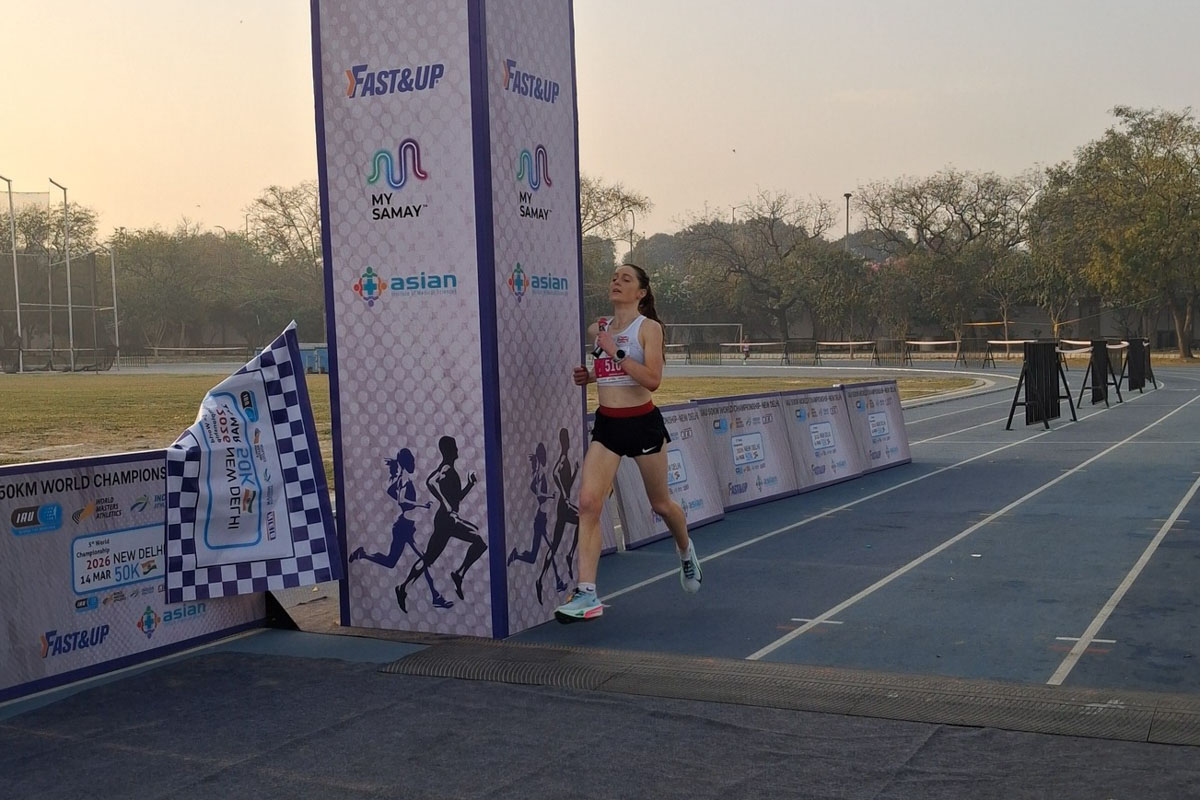
Katrina Ballantyne (Great Britain) finishing second at the 2025 IAU 50k World Championships. Photo: International Association of Ultrarunners
Digging Into the IAU’s Three-Event Contract with India
Some people questioned whether hosting the championships in the same country for four races in a row was the best way to develop the event.
The IAU clearly has good relationships with the Indian federation. They also hosted the 2024 IAU 100k World Championships in Bengaluru in December 2024.
India, like many emerging economies, uses sports to raise its global profile. India aspires to bid for the 2036 Olympics, and the country has been gradually investing in infrastructure and hosting events in a variety of sports.
For reasons we don’t totally understand, the IAU has struggled in recent years to attract bids for its world and continental championships.
So, when presented with the security of holding the IAU 50k World Championships in one place until the end of the decade, over a one-championship venue deal and future uncertainty, the IAU chose India. IAU Secretary Hilary Walker, when asked about the three-year deal, confirmed, “There were no other bids at the time for future championships, so this might have provided some security.”
This raises the questions of why there were no other bids, what the IAU needs to do to make it attractive for a venue to host world championships, and whether it needs additional support from World Athletics and national federations.
For now, yes, the championships are stable, but can that translate into an event that attracts athletes capable of challenging C.J. Albertson’s (U.S.) and Des Linden’s (U.S.) world records and create a globally competitive event?
How to Attract Top Runners to the IAU 50k World Championships
The IAU must juggle many factors to attract top talent at the IAU 50k World Championships — or any world championships. The 50k lags behind the IAU 100k World Championships in popularity and recognition for a variety of reasons, including the fact that World Athletics has recognized the 100k for record purposes since 2004, and only began recognizing 50k world records in 2022.
Still, the shorter 50k distance makes it accessible to a larger number of runners — including elite marathoners — and could become highly competitive. For a quality marathon runner who is just below the threshold of making a national marathon team, the 50k is an opportunity to represent their country. Great Britain, Spain, and the U.S. all actively recruit top marathoners to race the 50k distance.
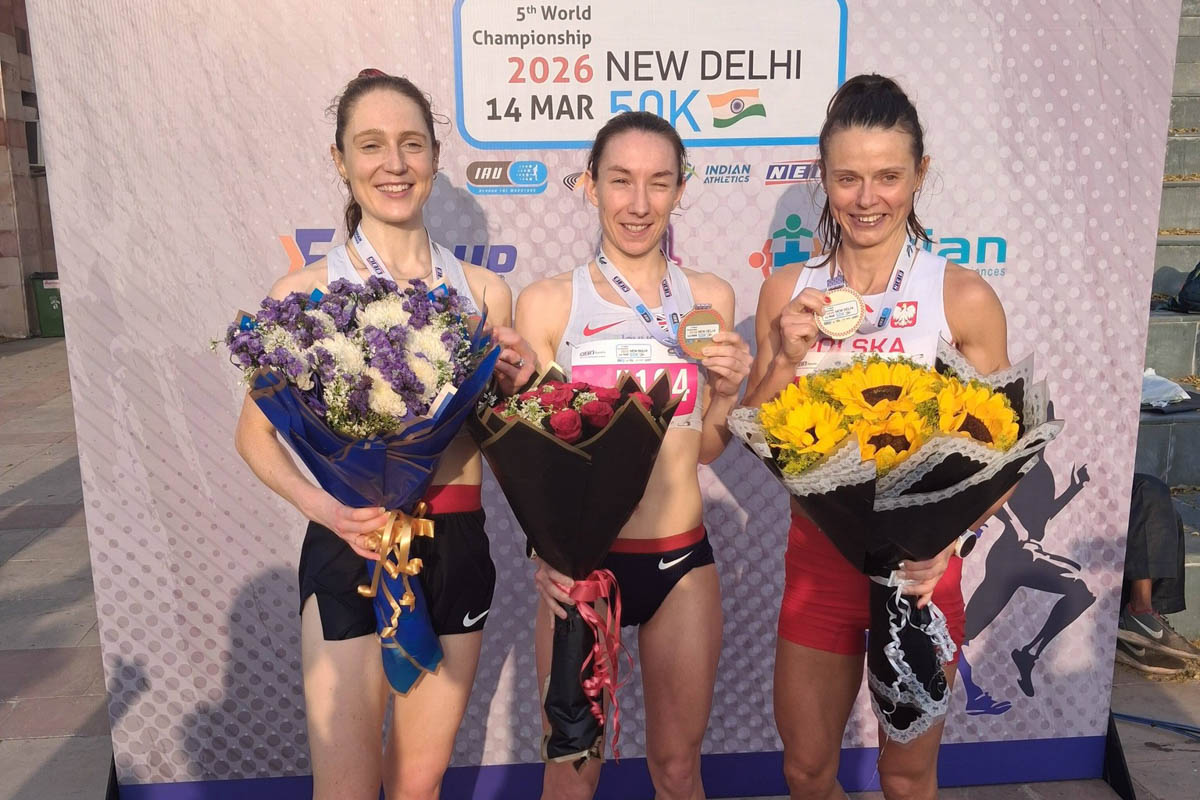
The 2025 IAU 50k World Championships women’s podium (left to right): 2. Katrina Ballantyne (Great Britain), 1. Naomi Robinson (Great Britain), 3. Monika Brzozowska (Poland). Photo: International Association of Ultrarunners
To attract elite marathoners to the 50k, the IAU should avoid the peak spring and autumn marathon seasons. While the original December date for the 2025 IAU 50k World Championships avoided such conflicts, it fell in one of the worst air quality months in India.
Contending With Race-Day Conditions
With decades of historical data readily available, we expect the IAU was aware of potential air quality issues but did not anticipate AQI levels that would be prohibitive. According to Walker, the IAU has learned from the situation: “After the issue of air pollution in December … the IAU medical committee specifically asked for medical advice. Future local organizing committees will have their weather conditions, etc., checked.”
There’s no such thing as a perfect venue, and race-day conditions will favor different types of runners. Looking at the overall performance levels at the 2025 IAU 50k World Championships, quoting the wisdom of coaches, “The stopwatch doesn’t lie,” seems very appropriate.
Despite the event’s various problems, performances were exceptional. In addition to Milne’s new European record, the top seven men all ran below 2:50. For the women, Robinson’s time of 3:13 was the third-fastest one run at a world championships, behind only countrymates Ally Dixon’s 3:07 and Helen Davies’s 3:09, both run at the 2019 event.
Milne approached the conditions as entering the unknown and said, “I’ve run in warm conditions before, but never really in a lot of pollution, so I didn’t know how it would affect my lungs.” He continued, “Maybe my time was a little quicker than I thought possible with the warmth of 20 to 21 degrees [Celsius] for most of the race, together with the pollution. We got a little lucky with the pollution when the AQI reduced compared to the previous days, so it was only in the unhealthy range rather than the dangerous range.”
Robinson accepted the fact that race-day conditions are just that, and everyone has to deal with them. “It’s like any championships, really. If the location’s set, sometimes it’s just going to be bad conditions, and you just have to be as fit as possible,” she said. “The best way to cope with it is just to be fit and as good at running as you can be.”
Both Milne and Robinson said that they’d received advice on the conditions ahead of time and arrived prepared.
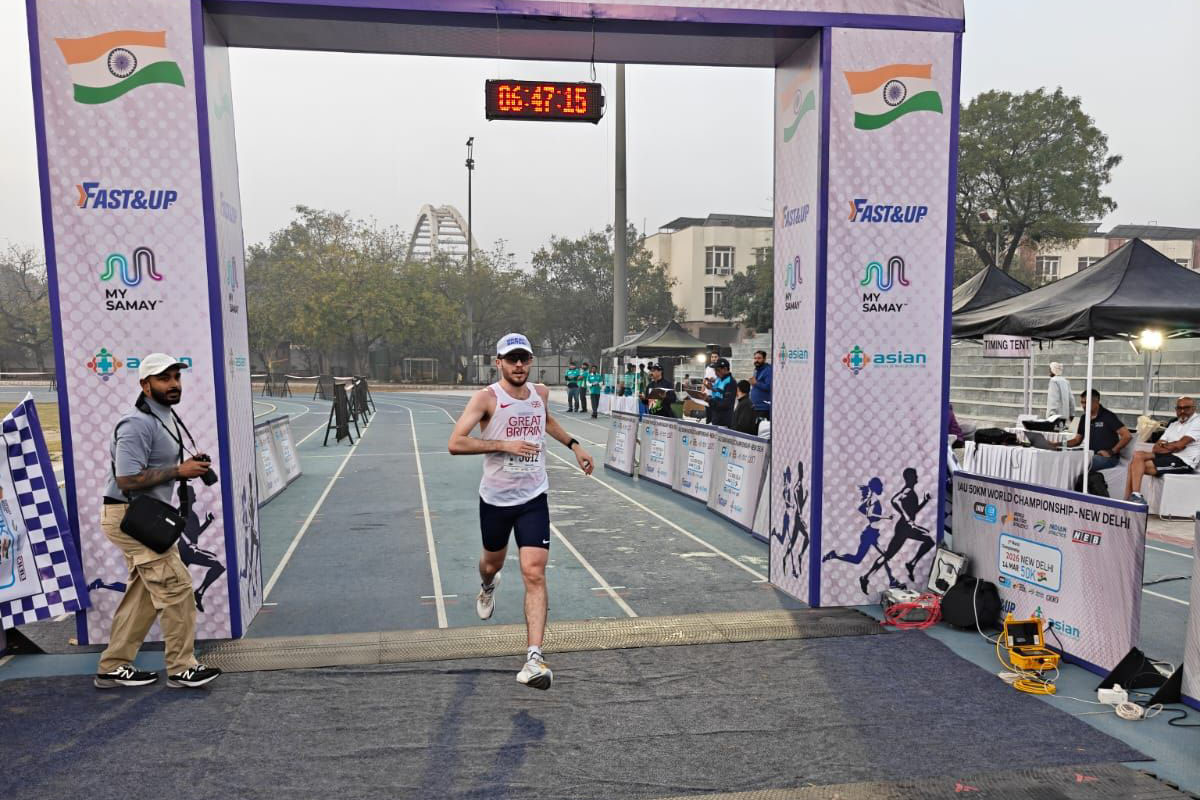
Charlie Davis (Great Britain) finishing second at the 2025 IAU 50k World Championships. Photo: International Association of Ultrarunners
While these runners mitigated the heat, humidity, and air quality, others struggled. According to Team USA manager Canfield, “Our fastest woman, Sophie Seward, was affected by the air. She started having difficulty breathing — she does not have asthma — and was so frightened she dropped. Our next woman was Melissa Tanner, who said she felt she had been smoking cigarettes. Our third was Alexandra Niles, who had a bad day but attributed it more toward having peaked for the December event.” Canfield also noted that the Team USA men were happy with how their races unfolded: “Nolan McKenna set a PR in the 50k and the marathon. Ryan Root had a great race, coming off a stress fracture last year. Steve Mance also ran well.”
Of the Team USA and Team Great Britain athletes who raced, none have reported lasting health issues. Milne ran in the elite field at April’s world record-breaking 2026 London Marathon, recording 2:13:51 just six weeks after the IAU 50k World Championships. Robinson won the Manchester Marathon on April 19 in 2:36:57. Canfield said of the U.S. athletes: “I haven’t heard from any of the athletes regarding post-race illness or recovery issues.”
The Future of the IAU 50k World Championships
Most agree that the IAU 50k World Championships should improve, though some are more critical than others.
Canfield has been vocal in questioning the long-term contract with India and its impact on the potential strength not only of Team USA but also of other teams. She said, “When the event was last held in Europe, in Brasov, Romania, in 2019, it saw a spike in entries, and you felt 50k was actually getting recognized. The last two championships in India have seen the number of competitors reduced by almost half.”
However, it’s also important to realize that not all championships should be held in Europe or other Westernized countries. Bringing the events to other areas has the potential to grow running on a global scale.
Also, runners traveling from other parts of the world to race in Europe or North America face challenges similar to those experienced by European and North American runners in India. Moving the venue offers runners from varied backgrounds and geographies an opportunity to excel.
Growing the ultrarunning world championships likely requires a multifactorial approach. Canfield thinks that change is needed on an organizational level and said, “There must be a way with marketing to shine a light on these road events. Trail didn’t take off all by itself, nor road marathons. It feels like there isn’t leadership in the IAU to get them unstuck.” Canfield also calls for increased federation support: “Support from World Athletics and other [national-level] federations would be huge.”
Milne has a logistically simpler answer: “Prize money would help. I mean, obviously, it’s difficult to find, but offering a little prize money would definitely help.” He also noted the need for the championships to switch venues: “Although it is good that championships are shared around the world, rotating continents would definitely seem better for the overall development of the event.”
With the 2025 event in the rearview and 2027 ahead, now is a great time for organizations, athletes, and national teams to gather ideas for improvement from the experienced global ultra community. With constructive dialogue and a federation-level commitment to evolution and growth, the problems that occurred at this event could serve as a catalyst for elevating ultrarunning’s world championships to the next level.
Call for Comments
- What thoughts do you have about professionalizing federation-level ultrarunning world championships?

