The fifth time’s a charm for American mountaineer and trail runner Tyler Andrews of the U.S., who has set a new fastest known time (FKT) for ascending Mount Everest with supplemental oxygen in a reported time of 9 hours and 55 minutes, on May 27 and 28, 2026.
This effort bests the previous fastest speed ascent set by Lakpa Gelu Sherpa in 2003 of 10 hours and 56 minutes by a massive 61 minutes.
Andrews has been training at and around Mount Everest for several years, made one prior unsuccessful speed attempt a few days ago and three attempts in the spring of 2025. In these prior attempts, myriad factors have stopped him, including weather, insufficient bottled oxygen, and gear problems. Andrews made this successful attempt near the close of the mountain’s spring climbing season.
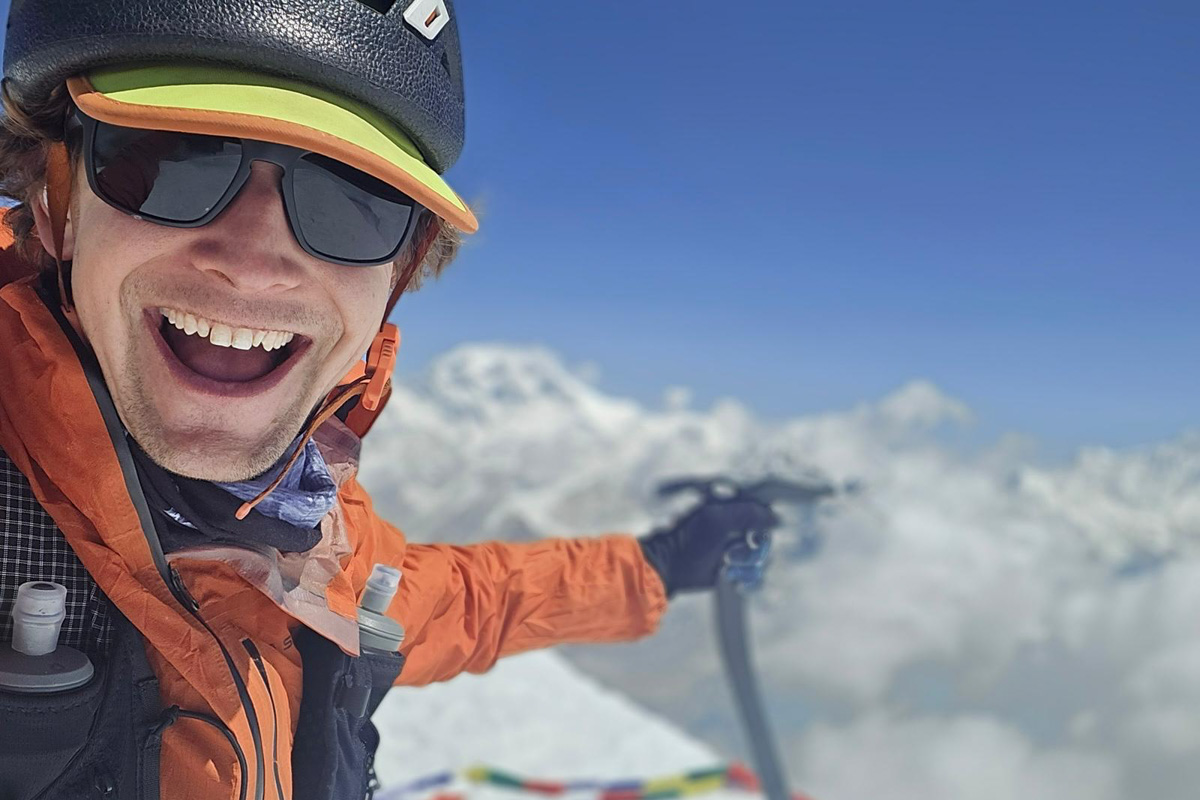
In May of 2026, Tyler Andrews set a new fastest known time for ascending Mount Everest using supplemental oxygen. In this photo, Andrews trains in the Himalayas in 2025. All photos courtesy of Tyler Andrews.
Everest, which stands at 8,848 meters (29,031 feet) tall, has a relatively short climbing window governed by when the “Ice Doctors” — local climbing Sherpas who set the route across the treacherous Khumbu Icefall — first set up the route on the front end of the season, and when the monsoon season arrives with too much snow for climbing.
The route extends from Everest Base Camp, located at 5,364 meters (17,598 feet) altitude, through the Khumbu Icefall, past Camps 1 through 4, and onto the South Col before climbing up onto the massive ridgeline extending to the summit. All told, the route is something in the vicinity of 13.5 kilometers (8.4 miles) long from base camp to the summit, with around 3,500 meters (11,500 feet) of climbing through mountaineering terrain of all kinds.
Remarkably, following his first attempt of this climbing season only a few days ago, he was back at it, beginning on Wednesday, May 27, at 7:11 p.m. local time, just as darkness set in.
His map tracker worked intermittently, so it was helpful to see reports in the updates section of his tracking website, uploaded manually by his team from time to time. He reportedly made it through the Khumbu Icefall and into Camp 1 in 2:08 elapsed, and to Camp 2 (about 6,750 meters/22,145 feet) at 3:16 elapsed. Andrews passed Camp 3 (7,300 meters/24,000 feet) at 4:47 elapsed, and reportedly arrived to Camp 4 (7,920 meters/26,000 feet) at 6:46 elapsed. The final report before the top was from the lower south summit, which came in at 9:25 elapsed. It seemed that, barring major disaster and with plenty of padding on the record, success was only a short climb away.
At 5:06 a.m. local time on Thursday, May 28, after a night of climbing, his team reported that he had reached the summit. This resets the record at 9 hours and 55 minutes. His team has indicated on social media that they’ll confirm this time once Andrews is off the mountain.
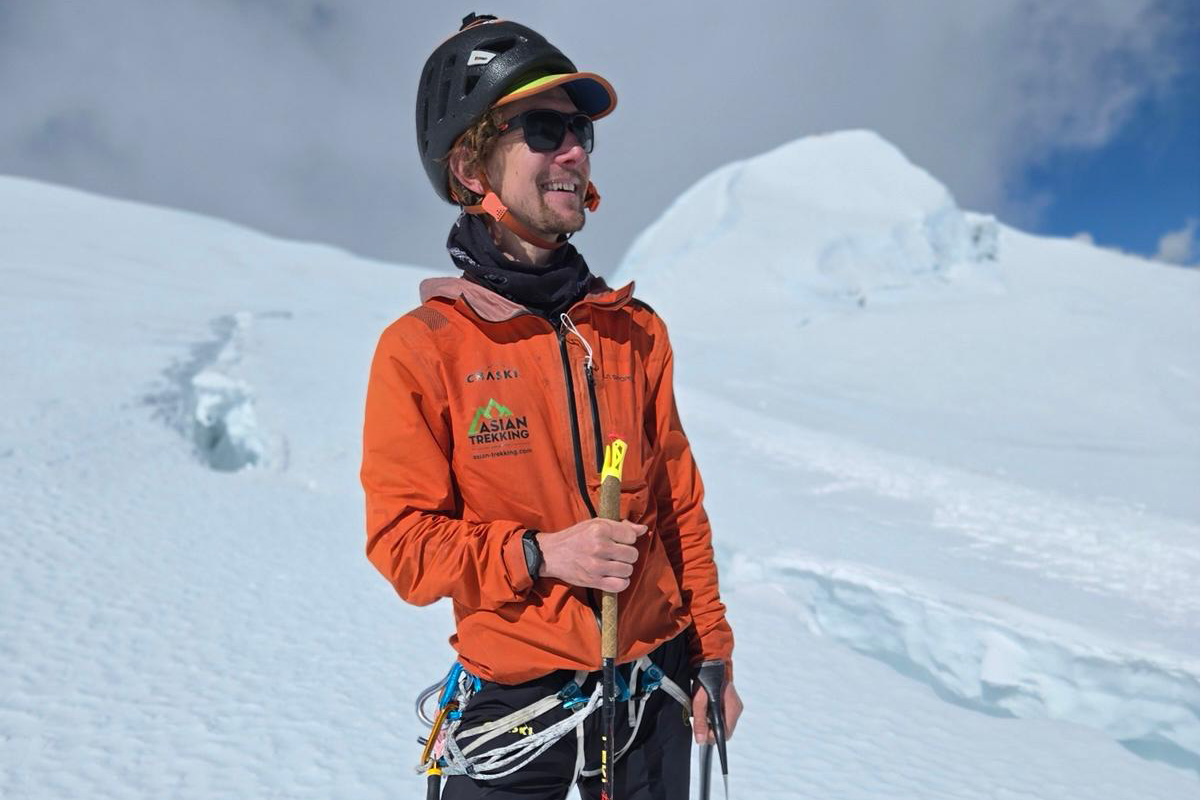
Tyler Andrews pictured training on the mountain in 2025.
Andrews has seen success in a variety of disciplines, including running and high-altitude mountaineering. In 2021, he won the Javelina 100k, and that same year, he placed 15th at the Leadville 100 Mile. Earlier, in 2016, he placed second at the IAU 50k World Championships, and he was crowned the USATF 50-mile national champion when he won the Tussey Mountainback 50 Mile in 2019. In recent years, he’s focused more on big mountain efforts, and he currently holds the FKT for the round-trip climbs of 8,163-meter (26,781 feet) Manaslu and 6,812-meter (22,349 feet) Ama Dablam in Nepal. In 2023, he set FKTs on Mount Kilimanjaro (5,895 meters/19,341 feet) in Tanzania and Aconcagua (6,961 meters/22,837 feet) in Argentina.
Our sister website, ExplorersWeb, reported that Andrews started using oxygen at Camp 2. For more information, visit ExplorersWeb, which has been covering the Everest climbing season and these speed attempts in much more detail.
ExplorersWeb also reported that Andrews returned to Everest Base Camp 16 hours and 32 minutes after he started. We believe there’s currently no round-trip oxygen-assisted speed record, so this time in effect establishes the first one.
This story is evolving, and we’ll update it as needed.
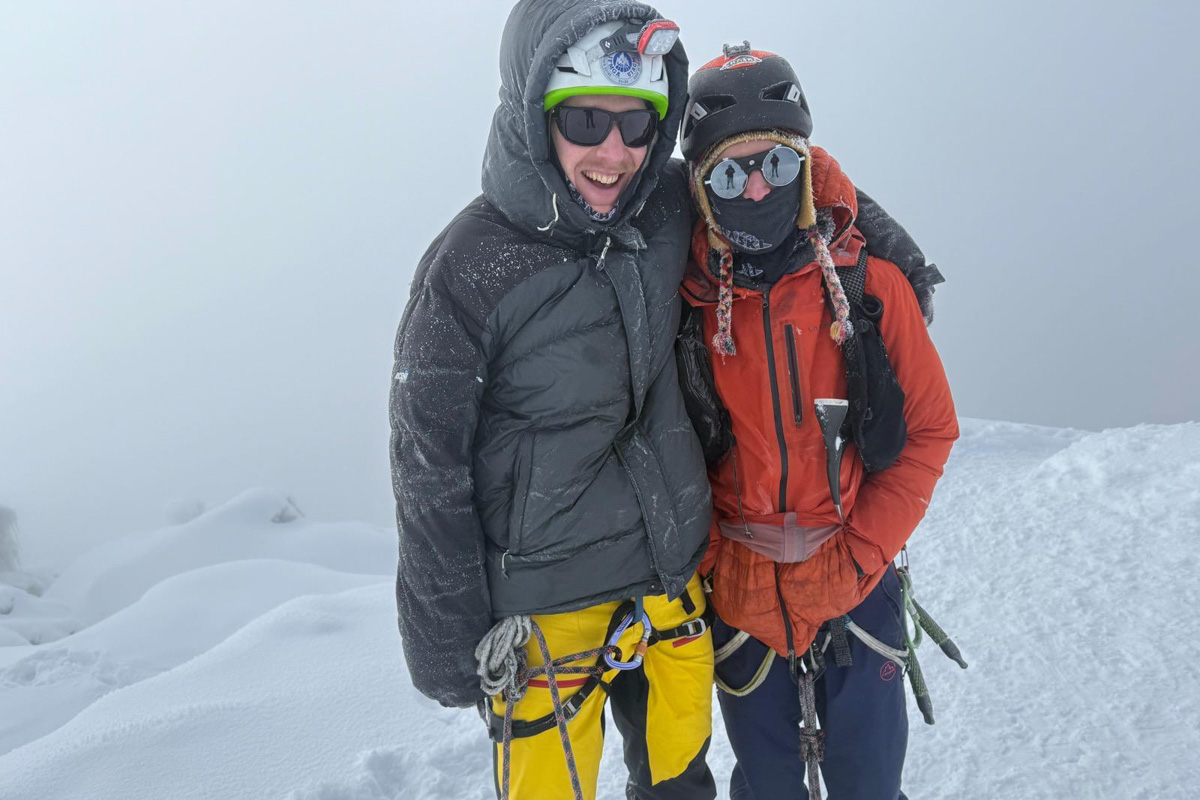
Tyler Andrews during one of his many training and acclimatization climbs on Mount Everest.


