Whether I was crouched in the blocks before a 200-meter race in college or lined up at the start of a turkey trot 5k in my late 40s, I’ve always been nervous as heck ahead of shorter races. There’s an immediacy to them. In most cases, there’s no grand strategy or saving it for later. Go. Hard. Now. It’s flashbulbs and high ISO.

Light at play in the early miles of the 2026 Bishop High Sierra 50k. All photos: iRunFar/Bryon Powell
On the other hand, I don’t get particularly nervous at the start of an ultramarathon, and definitely not before something like the Hardrock 100 or Ultra Gobi 250 Mile. As the miles and hours stretch out, we get to be the considered painters of our own gigantic canvas. Anything is possible. If we make a mistake, we’ve got plenty of time to cover it up or at least to shift the focus elsewhere.
When looking at the gigantic canvas of an ultramarathon, I invoke my own version of the Rule of Thirds. Rather than framing a visual landscape, I divide the race into three distinct psychological and physical phases: restrain, maintain, and attain. Let’s jump in!
Restrain: The Discipline of the Ego
The first third of an ultra is the hardest to execute. We’re fresh. We’ve trained. We’re excited. We’re around others. Woohoo! Let’s go!
Not so fast. Literally and figuratively.
Go into your race with a plan for early pacing and stick to it. And by pacing, I mean effort. That might be a heart rate cap or rate of perceived exertion. Personally, I rely primarily on heart rate, but only because it’s easier to measure and I’m more familiar with it; my perceived effort is always there too, guiding me in transitioning between walking and running on climbs.
I tend to set my heart rate cap based on efforts of similar duration over the past few years, knowing that, as a soon-to-be 48-year-old, I should err on the side of a downward trend in that heart rate cap over time. During the Old Ghost Ultra 50 Mile in February, I aimed to cap my heart rate at 130 to 135 beats per minute for the first third and largely succeeded, with a few minor deviations on small climbs while in a conga line. In May at the Bishop High Sierra 50k, I raised the cap to 140 beats per minute for the first third and was able to maintain that or go higher for the remainder of the race (except for falling slightly below on some descents).
Other than recent personal history, I sometimes use an old trick I used at the Leadville 100 Mile in the 2000s. Let’s call it “looking in the mirror.” On that out-and-back course, at any point in the first third, I’d ask myself, Can I see myself running this effort at this same point on the way back? Having run a handful of 100 milers at that point, I knew that even pushing late in the 100 miler, the effort was always muted. My effort outbound should match that.
Let’s be clear: This is a mental test, not a physical one. You’re disciplining your own ego. In real time. That’s a legitimate challenge when you’re prepared, motivated, fresh, and excited. However, few race-day efforts can have better payoffs than checking yourself before wrecking yourself.
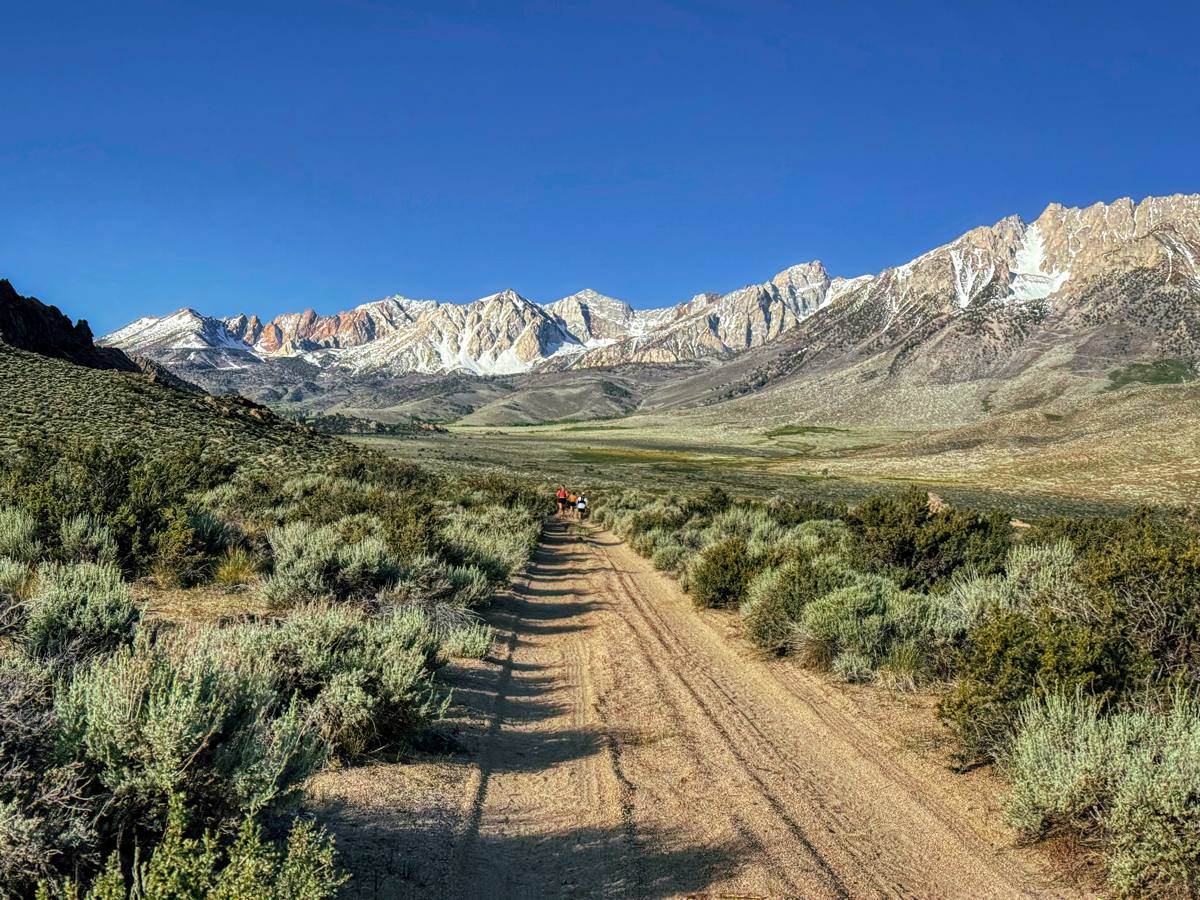
Keeping cool in the first third of Bishop High Sierra Ultra.
Maintain: The Discipline of the Body
The middle third of an ultra is where you put your knowledge and experience to work. For me, it’s always about focusing on taking care of myself. It’s about eating, drinking, and staying cool or warm. It’s about self-awareness and adjustments. Is something causing me to struggle now, or possibly to struggle later? If so, address it.
As for pacing, I try to stick near my initial heart rate cap through this third, even a little more tightly than the first third. It’s more of an average than a cap, though I try to keep the heart rate no more than five beats per minute above the initial cap. Still, with some inevitable heart rate drift, that very much feels like maintaining an effort and a pace.
You could call this the boring middle, just maintenance. I heartily disagree. If the first third is the psychological challenge, the second third is the intellectual challenge. It’s full of introspection, analysis, and application.

Maintaining in the high altitude middle third of the Bishop High Sierra Ultra 50k.
Attain: The Discipline of the Spirit
The last third of an ultra is where your emotions matter most. I’ve long said any race is as hard as you make it, and that, obviously, includes ultras. Whether it’s exuberance, toughness, joy, grit, gratitude, pride, or any of the countless other emotions and motivations we might engage with, now is the time to put them to full use.
Fortunately, if you restrained your effort early and maintained your condition well in the middle goings, you’re now in a position to let it all out and to have fun doing it. It’s a blast to hit mile 20 of a 50k and actually start working harder, accelerating all the way to the finish. While I trust that the vast majority of us hope nothing but the best for our fellow competitors, there’s no denying that it feels better to be passing late in a race than the other way around. There are also the senses of awe and wonder that come from recognizing that humans and we as individuals can still move so well after so many miles, and that’s its own boost.

Letting it out in the final third of the 2026 Bishop High Sierra Ultra 50k.
Conclusion
Of course, this strategy isn’t a one-size-fits-all formula for the entire sport. It might not apply to elites hunting for a win at a world-class event like the Western States 100 or UTMB — or even at a stacked local 50k where tactics demand matching aggressive moves early on. But it is an incredibly potent framework for the vast majority of us who are trying to run up to 90% of our potential while actually enjoying the journey.
The math of these thirds is also fluid. While these thirds line up neatly for a standard 50k, they require a bit of sculpting based on weather, topography, and intent. However, during a 250-mile race, the proportions likely shift completely: the restrain phase might last 50 miles until the initial nervous energy burns off, and the maintenance phase becomes the crux of the event for 150 or more miles, while the attain phase is 50 miles tops — and likely less, if finding that extra gear is attainable at all.
Ultimately, adapting this framework puts you in a position to succeed both physically and psychologically. By meting out your effort early, you avoid the dramatic late-race blowups that crater your time, trading the traditional final-miles slog for an exciting, confident acceleration. You don’t just finish strong; you minimize the suffering, maximize the magic, and paint a masterpiece you can be proud of.
Call for Comments
- How do you best allocate your effort throughout an ultramarathon?

An ultra can appear to be a huge mountain. It doesn’t have to be one.