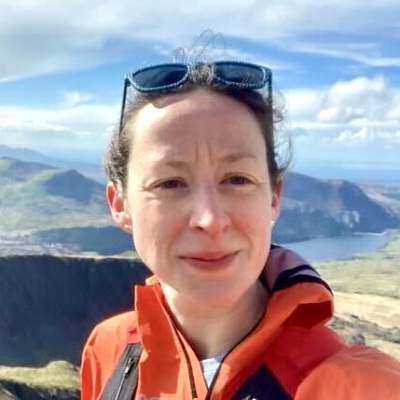
When Sarah Lesko, MD, MPH, states, “In my work with Bras for Girls, I feel like I’m affecting more people’s health positively than I did as a physician,” it feels seismic. How does providing sports bras to school girls create more impact than providing front-line medical care?
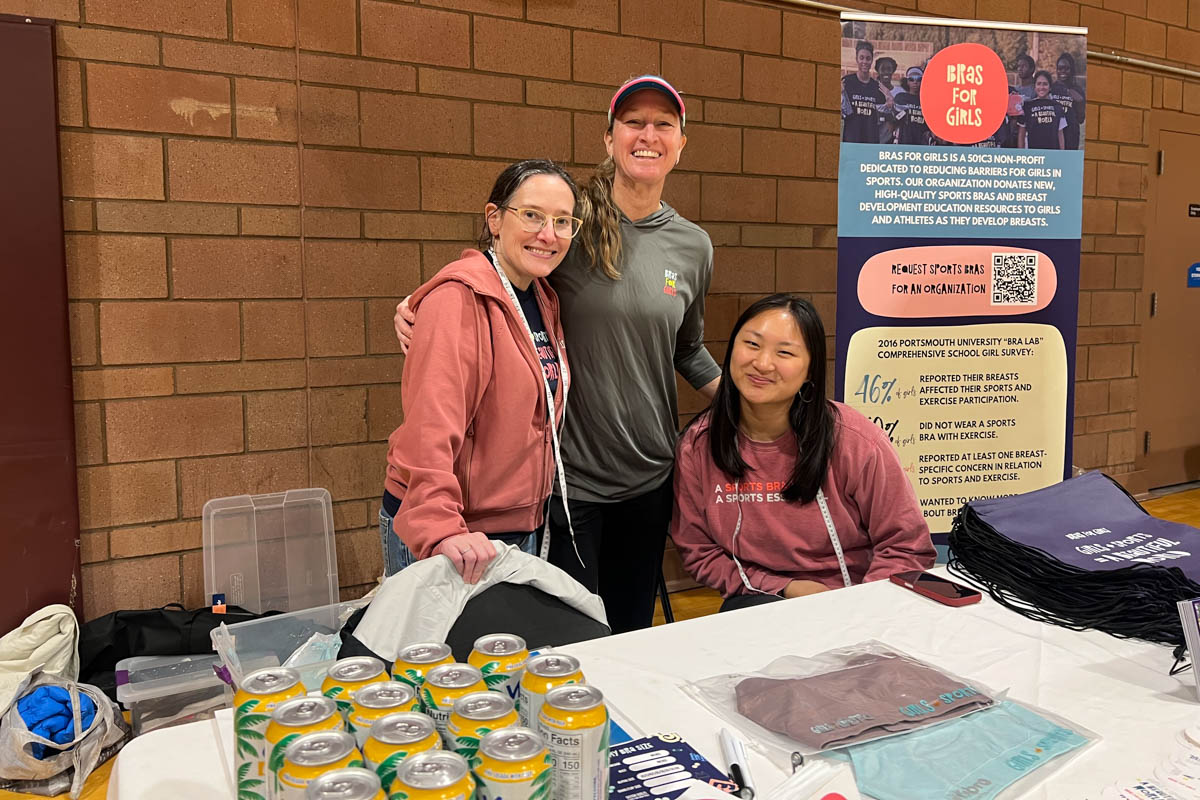
Sarah Lesko (center) is flanked by Bras for Girls team members Meris Williams (left) and Maddy Lee (right). All photos courtesy of Sarah Lesko.
In many ways, it’s a case of prevention rather than treatment, and this kind of sharp, lateral thought sets the tone for our conversation. Lesko is the executive director and board president of the Bras for Girls nonprofit organization. She is a former collegiate runner, grew up on a hippie commune, has written a book, and used to be a family medical doctor. Now she’s helping young girls stay active and remain in sports as their bodies change.
Keeping Girls in Sports
Bras for Girls provides sports bras to girls in economic need, including those in Title 1 middle schools in the U.S. — schools that are financially under-resourced compared to the national average — and girls in low-income families worldwide. “Up to 60% to 70% of girls in physical education [P.E.] classes in Title 1 middle schools do not have a sports bra. That’s what the P.E. teachers are telling us,” says Lesko. According to Lesko, many girls drop out of playing sports during puberty due to negative self-image and feeling self-conscious about their changing bodies. If they develop breasts earlier or develop larger breasts, they are more likely to turn away from sports. A sports bra that fits properly is an easy fix: “When you provide them with that assurance that it’s completely normal what they’re going through,” says Lesko, “and that everyone deserves to have a well-fitting sports bra, and that you deserve to feel comfortable moving your body, it’s such an impactful moment.”
The messaging is important, too. Bras for Girls also provides an educational booklet about the changes girls’ bodies undergo and how to measure for a correctly fitting bra. At a time when so much can feel strange and different, the overwhelming message is one of normality. Lesko has been proud to see the direct impact the sports bras have had on girls in school settings, seeing the girls who were shy, uncomfortable, and had to be bribed into conversation with socks or coconut water transform into confident girls who, the following year, report that they need a bigger sports bra. By then, says Lesko, “The culture has already changed, and they’re much more excited. They’re talking about their bodies in different ways that are just accepting … It’s kind of like throwing a pebble in the pond.”
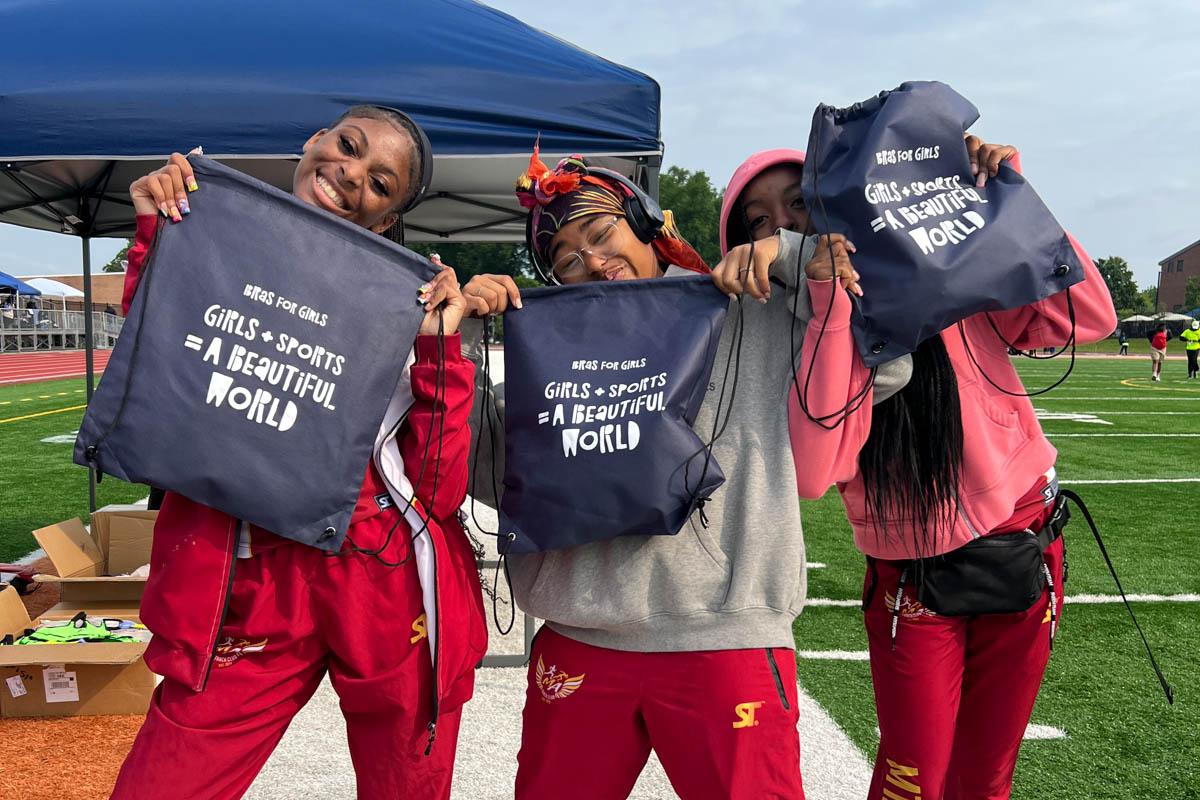
Bras for Girls helping track athletes in Pennsylvania stay in sports.
In conversations with school teachers and coaches, Lesko has heard of girls who were going to turn away from sports but haven’t because of Bras for Girls’ support. “That decision, that moment, is so much more impactful for overall health than when someone comes to a doctor’s appointment. You have 15 minutes to half an hour to have a conversation with them, but you’re not providing them with an opportunity for sports.” There isn’t the time to discuss overall well-being. Providing a tool to instill a love of sport and activity early in a girl’s life has a much greater impact.
Start of Bras for Girls
Lesko doesn’t miss her job as a medical practitioner. She stopped practicing in 2015 due to her son’s mental health. She thought she was just taking a break, but then she never went back. Instead, that same year, she began working for the sports apparel brand Oiselle as the director of corporate development. In 2016, Portsmouth University’s Research Group in Breast Health published a survey showing that 46% of school girls in the U.K. reported that their participation in sports was affected by their developing breasts, and that 87% of them wanted to learn more about their breasts. Lesko clocked that Oiselle had some extra bra inventory that hadn’t sold.
That sharp, lateral thought came into play, and Lesko said, “Hey, let’s do a little program. We can put these bras to good use.” Oiselle added a page to the website, ran a few community programs, and shared the campaign on social media. Within that first year, even without any paid advertising, they got requests for almost 70,000 bras. “So that was the first indicator of, ‘This is a huge issue that no one’s solving right now,’” remembers Lesko. It soon became clear that the demand was so high that Bras for Girls would have to become its own entity, with the capacity to accept donations from other brands and manufacture its own garments. It became a 501(c)(3) nonprofit organization in 2021.
The Bras for Girls team gets ready to distribute sports bras at a New York City school with teachers and coaches.
Demand for sports bras from Bras for Girls remains high, and donations and production have shifted in response to tariff instability. There are many details to handle, but Lesko has an Ivy League education and graduated from a highly ranked medical school. She’s used to working in high-pressure, fast-paced environments. However, that’s not the dynamic she wanted for Bras for Girls. “We’re actually a slow-paced work environment in that we form community collaborations that are real and long-lasting,” says Lesko. “We’re not trying to build something that is not going to be sustainable. So we try to just take things in a very natural and deliberate pace, and the relationships that we have with all of the organizations that we work with are authentic.”
Did this holistic culture come from her? As Lesko has grown older, she’s found that the deliberate pace aligns with how she wants to operate. “I never want to be forcing an agenda through,” she says. “So if something is not naturally gaining steam, it’s probably not the right direction to go. So just allowing for that space for things to grow naturally, I think, is super important.”
An Evolving Personal Relationship With Running
Lesko ran collegiately at Yale University and majored in molecular biophysics and biochemistry. However, she kept getting injured, so she decided to put running behind her and pursue medical school. “I probably didn’t come to peace with that until my late 40s,” says Lesko. She wanted to keep running, and she picked it back up in her early 40s. After some personal training, she finally identified the causes of her injuries and spent 10 years racing cross country and road races in the masters category. Now in her 50s, her focus has switched to serious weightlifting twice a week, and she still runs four to six miles more than half the days of the week. “Nothing major,” she says.
Lesko reflects on how her body has changed. “I think there are some masters women who just keep running and kind of maintain a light frame,” she notes. “But as folks get into their 70s and 80s, you really want the muscle bulk to help you as you age.” She continues, “I really tried to put on quite a bit of muscle, and just feel stronger than I ever have in my life. So that’s exciting.” Another seismic statement: Lesko feels stronger now than she ever has in her life. And she’s having fun with it. Her gym is run by a former University of Washington football strength coach, and she says, “He’s incredibly knowledgeable, but also very positive and encouraging.” According to Lesko, the class attracts people of all ages, from high schoolers up through people in their 70s and 80s, and they follow a set routine. “You just turn your brain off and do the workout,” says Lesko.
Lesko says that running has simply felt harder over the past couple of years, and she no longer reaches the elusive meditative state she used to, but she still really appreciates just getting outside every day. “I haven’t given it up,” she says. Lesko is still a massive fan of track and field and is on the board of the USATF Foundation, a non-profit that fundraises and distributes funds to U.S. track and field athletes who need additional support to continue competing. She visibly fizzes when recapping the excitement of the recent 2026 World Athletics Indoor Championships in Poland.
Removing Barriers for Sports
The way Lesko talks about the benefits of moving is so passionate and heartfelt. Once you know the benefits of exercise first-hand, it’s easy to understand the furious urge to remove as simple a barrier to that feeling as access to a sports bra. “Just getting out and moving the body is so important,” Lesko simply states. She talks fervently too about conveying the message that there’s no “one type” of body for exercise, and highlights American basketball player Audi Crooks as an example: “She’s a large-bodied player, and she’s absolutely dominating women’s basketball in the NCAA. The more examples we see of that, the better.” One can hope that the more girls who stay in sports as teenagers, the more body types we will see in professional sports in the future. This goes for female coaches, too, Lesko points out.
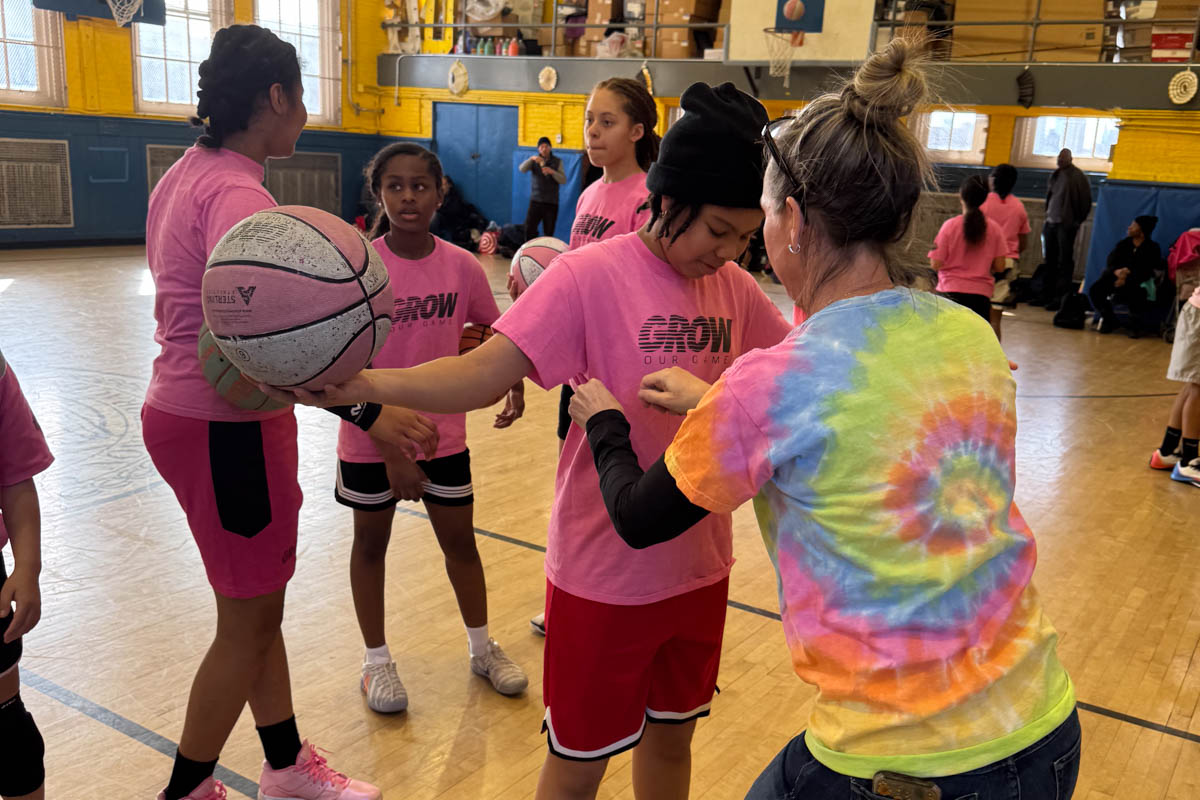
Lesko measures a student for a new sports bra with the Grow Our Game organization.
In terms of the future for Bras for Girls, Lesko is excited to roll out a curriculum for P.E. and health teachers to use about how to fit a sports bra and communicate that every girl deserves to feel comfortable staying in sports and moving her body. There will also be education around binders, seeking to make the curriculum as accessible as possible for all kinds of issues that might start in puberty, such as gender dysphoria. “Our position is that anyone who’s developing breasts needs the support,” says Lesko. “People potentially will be developing breasts when they do not want to be developing breasts. And so that’s a matter of understanding. Like, how can you feel comfortable moving your body, even in the context of all of those different factors?” We reflect again on just how important the mental health benefits of activity are, in light of such a challenging time in a young person’s life.
Projects for the Future
Lesko speaks with pragmatism, intellect, and warmth, ideal for tackling social issues with science. Even the book she has written with her eldest son has a scientific background. The book chronicles her son’s mental breakdown at age 19. His first mania with psychosis, which turned into a diagnosis of bipolar 1 — a mental health condition associated with bouts of mania and depression — was linked to marijuana use. Lesko included data from scientific papers about the effects of THC — the active ingredient in marijuana — on everyone, not just on those with bipolar disorders. She hopes the book will provide guidance to other families struggling with similar issues, something she didn’t have back in 2015, and help answer the basic question of: “How do you actually live with someone who is having these struggles?”
Writing the book was enjoyable and therapeutic, and her son now works as a mental health therapist in California. “He’s an amazing person,” Lesko says, but says it was a disruptive eight years for them. Throughout the time period, both she and her son made notes of their experience that they used to write the book, which doesn’t yet have a publisher.
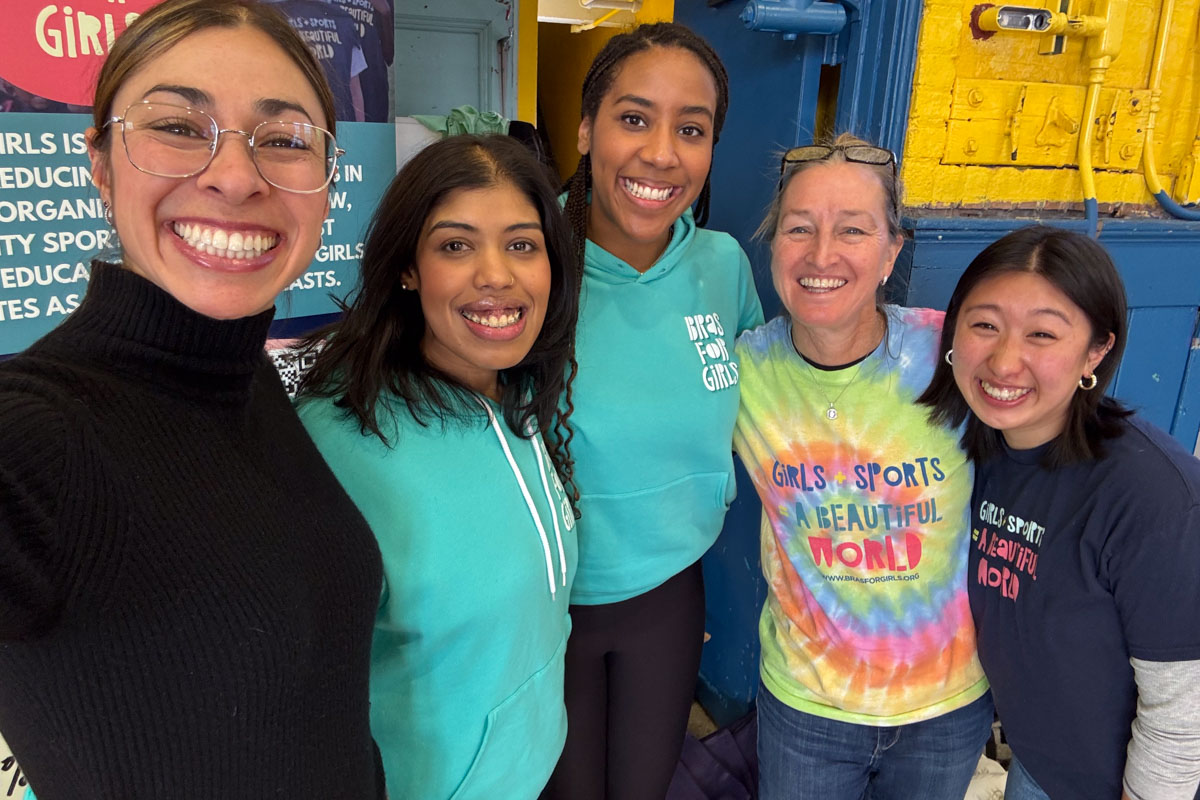
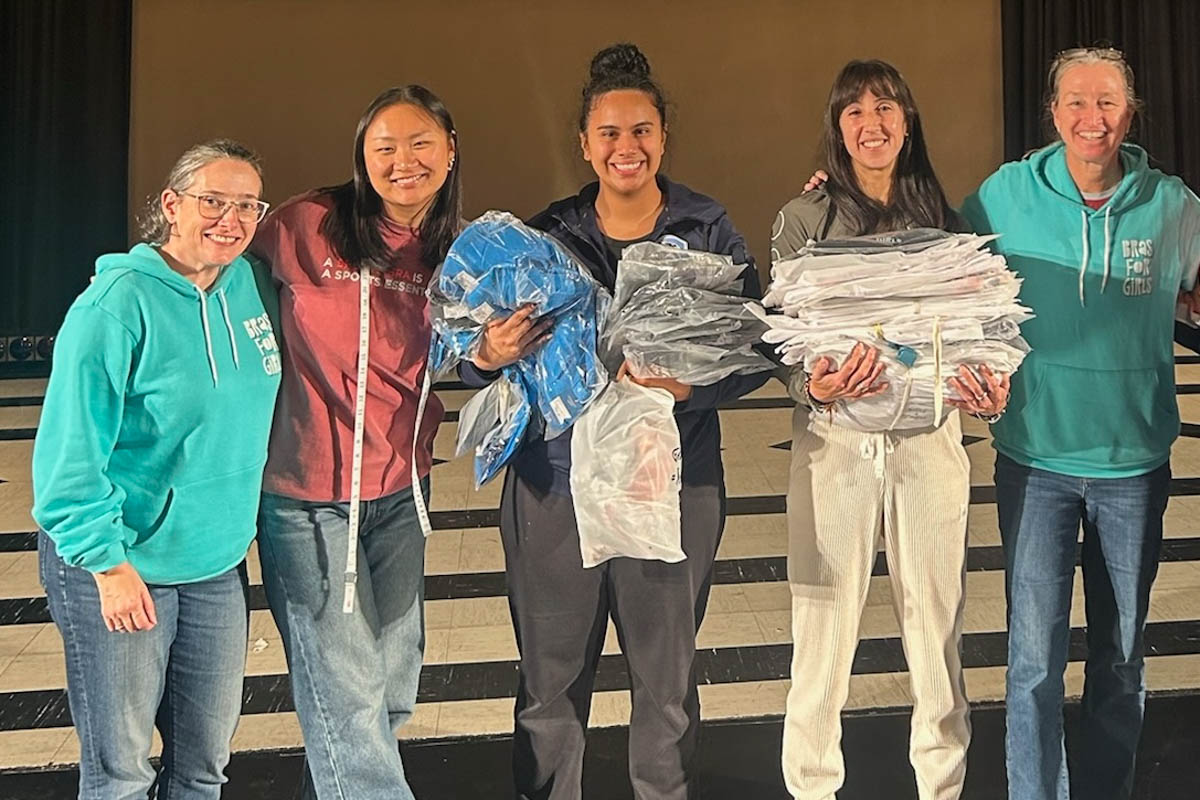
Lesko (second from right) and other Bras for Girls team members and volunteers are trying to remove barriers for girls staying in sports.
The book feels like a million miles away from Lesko’s work with Bras for Girls, but it’s still in the vein of improving human experience with education, stories, and science. It’s difficult to pigeonhole Lesko. She says, “It’s fun to have many different things I’m working on. I think I like to not be defined by a single thing.” When examined as a whole, a common theme emerges in Lesko’s work, summed up perfectly by her thoughts on Bras for Girls: “I think just knowing that there’s a simple intervention that can have such a profound impact for people just makes me very motivated to make sure that lack of information is never the reason that someone has a worse life outcome. It’s just so unnecessary. It’s a fixable thing. That really motivates me to keep doing this work.”
Call for Comments
- Were you deterred from participating in sports because of a changing body?
- What other barriers have you observed that keep young women from participating in sports?