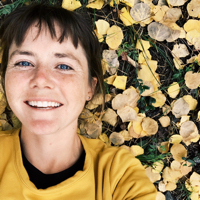
Meet Michael Versteeg. For many, Mike doesn’t actually need an introduction. He’s a fixture at races throughout his home state of Arizona and the San Juan Mountains of Colorado. Depending on your view, you might call him a curmudgeon, but despite his disdain for fanfare, he has become somewhat of an icon, or rather an iconoclast, in our sport. He wears a Casio watch and simply likes big days in the mountains.

Michael Versteeg races through the rain during the 2025 Cocodona 250 Mile. Photo: iRunFar/Bryon Powell
I met Mike several years ago during the John Cappis 50k in Silverton, Colorado — a notoriously difficult, mostly off-trail race that he’s completed five times. He was having a rough day, and I would catch him on the uphills, and he would dance away on the downhills. He looked like he was out for a stroll; meanwhile, I found myself in an all-out sprint to keep up. Mike — aside from running — is a musician, builder, race director, husband, and dad. He gravitates toward experiential genres both in life and sport, and I’ve always found his perspective refreshing.
Without further ado, here is Michael Versteeg in his own words.
When did you get into running and music?
I was into music a lot earlier than running — since I was a kid, growing up skateboarding and being in sh#tty punk and hardcore bands. As long as I can remember, I have gravitated toward music and the scenes that surround it. This sort of just felt natural as a kid. I had the fortune of growing up in a time when cell phones and the internet weren’t really a thing, and the community I happened to fall into was pretty unique and special. It still influences me to this day, thinking about that time and those people.
Running was less of an obvious path. As an adult, I found myself expressing myself through physical endeavors in the mountains and desert. Reading too many books about Everett Ruess and John Wesley Powell, I guess I was sort of that “Into the Wild” stereotype as a young man wanting to experience the beauty in the world.
I still can’t exactly pinpoint how I ended up a sponsored trail runner. It still doesn’t sit exactly right when people refer to me as an “athlete” or “runner.” My pursuits have never been fitness or athletic achievements, so it’s kind of hard for me to talk about them without feeling silly. I still have this real burning desire to experience the world, and whatever that entails, and it turns out running has been a big part of that.
You have a knack for building things.
Building is one of the most obvious forms of creation. That, and kids, maybe? It’s always bewildering to me how construction has fallen into a world of square boxes, done by drones for a paycheck. But just because the majority of people who build don’t see it as such, it can be one of the most satisfying expressions. I think this is why I have always done it. It seems natural, or it fits my personality.
I’ve had the fortune of building in some pretty wild places around the world and doing so in a way that has scratched the creative itch. It’s also possible I’ve just been poor most of my life, so I had to build everything myself. That could be true, too.
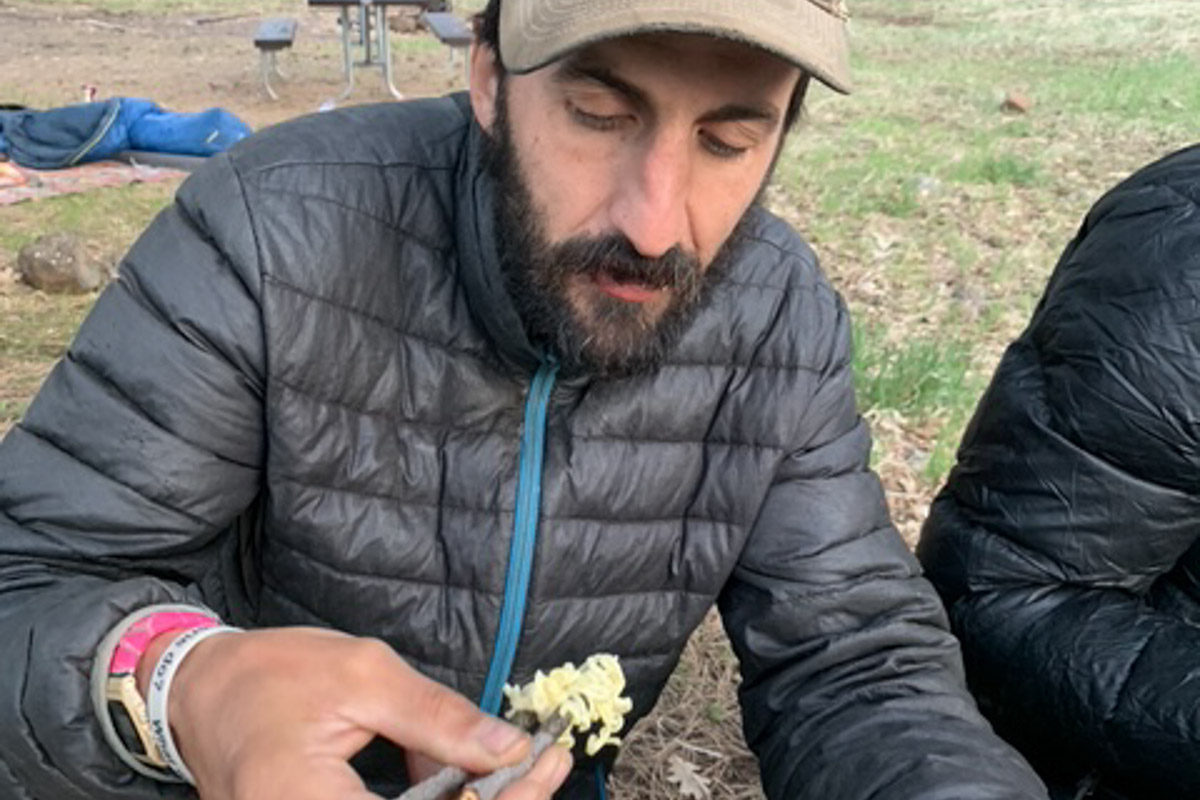
Versteeg eats noodles with self-fashioned chopsticks during a backpacking trip. Photo: Hannah Green
Any other creative hobbies? Is being a parent a creative endeavor?
Having kids is wild. The idea has been normalized, muted, and beaten down by society to the point of normalcy and boredom (much like construction and running), but it is absolutely the craziest and most expressive thing a person can do. If art is meant to titillate the human experience and arouse emotion, there is nothing that comes close to the experience of your own kid.
As a parent, I find myself with the burden and responsibility of returning that level of inspiration to her. Basically, everything I do now — running, building, music, art, writing — is to show my daughter how to exist in this world. She didn’t ask for life; it’s something we as parents impose on our kids, and they deserve the devotion of a proper understanding and experience in this world. It really messes with your motivations and the whole “why” thing.
What kind of music is your current jam?
A lot of what I listen to these days is pretty far apart from traditional Americanized music. Droney, esoteric soundscapes with little to no structure, odd timings, if timings at all. I have grown a real disdain for vocals, so mostly instrumental stuff. There are still a lot of traditional music and bands that I enjoy listening to, which all seem to gravitate toward a slightly more structured approach to what I said before, but I find myself increasingly drawn to artists who prioritize creativity or art over craft.
Oddly enough, I never listen to any music while running.
Do you consider running to have an element of creativity?
I think it can, but it is mostly uncomfortable. I think those of us who try to experience running through this lens are, more often than not, left frustrated and discontent. Maybe it’s because running and climbing are, in their nature, athletic pursuits, and fall very much into the class of a “craft” versus art. The repetitive motion and honing of a skillset rather than the spark of creation.
I think the aspect of running that is undoubtedly artistic is the triggering of human emotions. There is something artistic and even esoteric about wandering in the wilderness, stumbling and hallucinating through the desert. In our modern American experience, we lack a certain expression for this pursuit. We have no pilgrimages, no rights of passage, nothing that encourages people to experience the state of mind and body that cultures have found to be a prerequisite for being a human for thousands of years. I think ultra/trail running, with all its flaws, social media, marketing, brands, bucketlisting, performative, industrial awfulness, fills this void for people. I think that is evident in the sport’s explosion over the last decade.
Running to me is an inherently introverted and subjective experience. The real creative and experiential aspects of it occur internally, in the mind of the person doing it. I think artists/runners have had a hard time conveying that experience to others. In that way, I admire running: You can’t walk into an art gallery or buy a ticket to a show. You, the observer, have to become the artist to see the art.

Versteeg on his way to winning the 2020 Fuego y Agua. Photo: Fuego y Agua
What do you think about when you’re running and playing music?
Ideally nothing. Both are real escapes for me. Playing music helps me escape, but running makes me think about life a lot. A lot of therapy and thoughtfulness happen while running. Sometimes not great, sometimes pretty negative, but I think it’s important. Both have become physiological crutches and necessities for me.
How has the Arizona landscape influenced how you live and run?
Probably a lot more than I would like to admit. I think we all like to think we are special, unique beings, but the reality is that we are products of our environment and upbringing. I have lived in Arizona most of my life. In many ways, I feel like I am a very predictable product of Arizona. It’s an easy place to be inspired and shaped by.
Any desert landscape lends itself to creative and philosophical pursuits. I think there is a reason why most of the world’s parables and mythologies often invoke desert landscapes. If nothing else, I feel it has ingrained in me a sense of wonder for the wild.
Who has inspired you in life, creativity, and running?
I am inspired by people who experience life and the world that they are on. It’s a low bar that surprisingly few people achieve. Most of my heroes are explorers, both literally and artistically. But of all the demigods to worship, I am mostly inspired by people who do things, create things, and aren’t on social media.
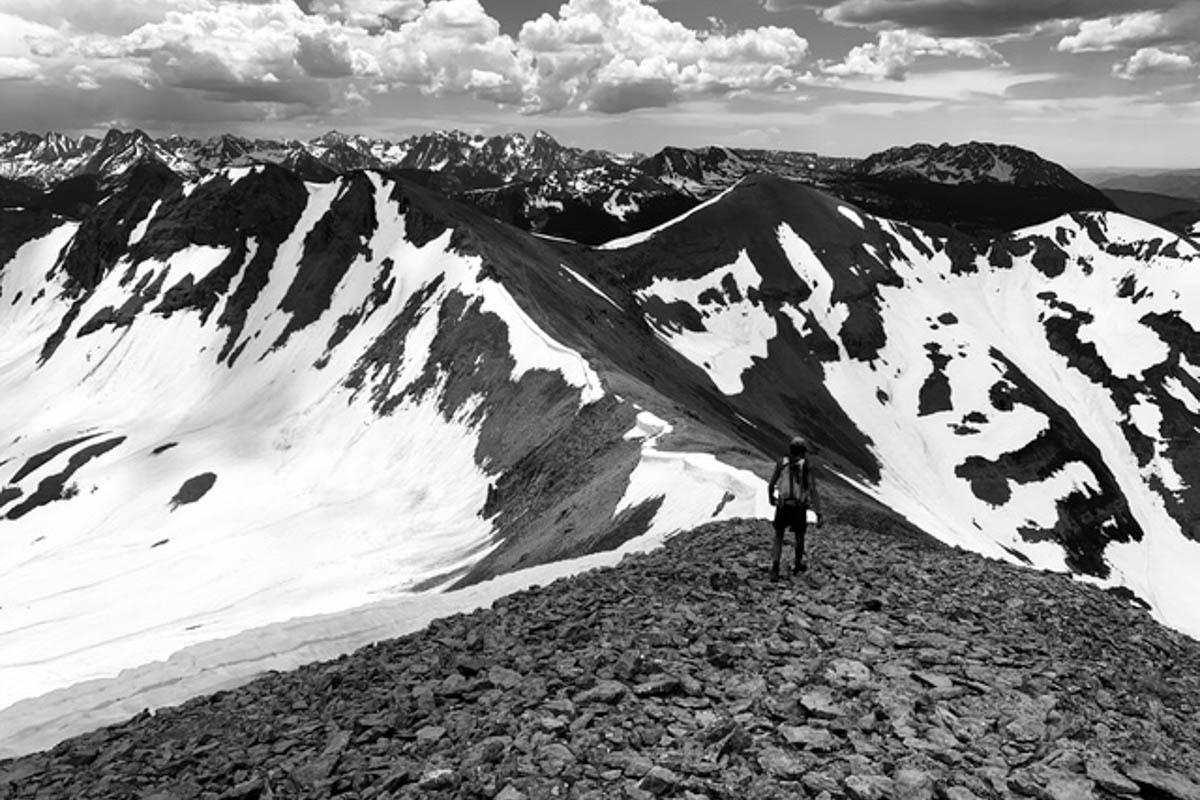
Versteeg on ridgeline in the San Juans of Colorado. Photo: Hannah Green
You’ve won everything from the Cocodona 250 Mile to the Alaska Wilderness Classic, gravitating to the long missions across landscapes. Why?
I think this makes sense. I don’t believe there’s much worthwhile experience gained from running a 50k as fast as you can. I am more attracted to the long-form projects, the multi-day treks. Maybe I am just more of a backpacker than a runner. While the things you mentioned are great, I personally don’t get a lot out of winning or doing things the fastest. I actually think doing things as fast as you can is possibly the worst way that you can experience something. Obviously, I have tried to do this, but I think it satisfies other pursuits, other characteristics of my personality.
“Slowest known times” are way more interesting than fastest known times (FKT). I would love to see this become a thing.
I think some of the most transformative experiences are those done solo, without fanfare. There is a lot of ego involved in racing and FKTs. Things done without an audience are purer and more genuine, in my opinion. Unfortunately, there is real pressure today to share everything, to always perform, to always deliver. I think as a sponsored athlete, this is obviously a struggle for me, as evidenced by the races and FKTs that I pursue. It’s good for me to remind myself, though, that these things are just a small part in the overall experience, and that balancing my pursuits with more thoughtful and genuine days is not just important but a necessity.
Any projects or races in your future?
Of course. Projects in the mountains with friends. Projects with family. A new album this fall/winter under the “Susurrus” banner. Tearing down my shop and building a new recording studio. Exploring land in Colorado I want to build a cabin on. Life never stops.
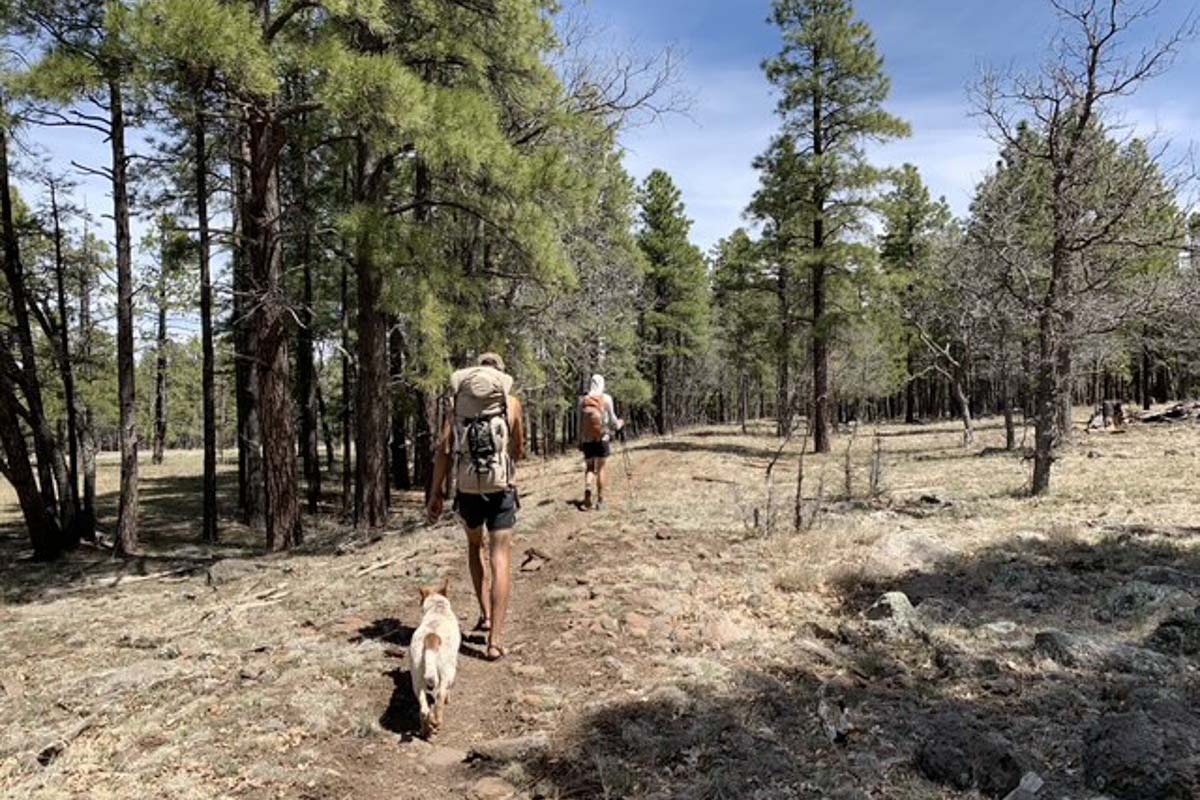
Versteeg being more of a backpacker than a runner. Photo: Hannah Green
Are there places people can hear you play music?
We recorded a live album at the Georgetown Steam Plant in Seattle, Washington, this winter. We will likely release the album with a show there this winter. Shows come and go, and I don’t take them lightly. They are performance art for me, and the rolling out of the same act night after night has never been appealing to me. One or two shows a year, doing something interesting, is good.
You started the Saddles 100 Mile. Why did you start your own race?
Saddles is an honest attempt at exploring new ways of being artistic in an uninspiring world of brands and races. I think Satisfy is the perfect sponsor for this. Love or hate them, they, at the very least, try new things and explore ways of being creative in an industry driven by “rinse, cycle, repeat.”
It’s also so stressful being a race director of what has now become a big, successful race. I don’t know how long I will do it for, but it was worthwhile.
If you could give advice to your kid or your younger self, what would it be?
Not much. Kids need to be kids, and failing is transformative. The same advice for younger generations is also good advice for older ones: Experience life. Love those around you. Say yes to things. Money is corrupt and ruins all good things in this world, etc., etc.
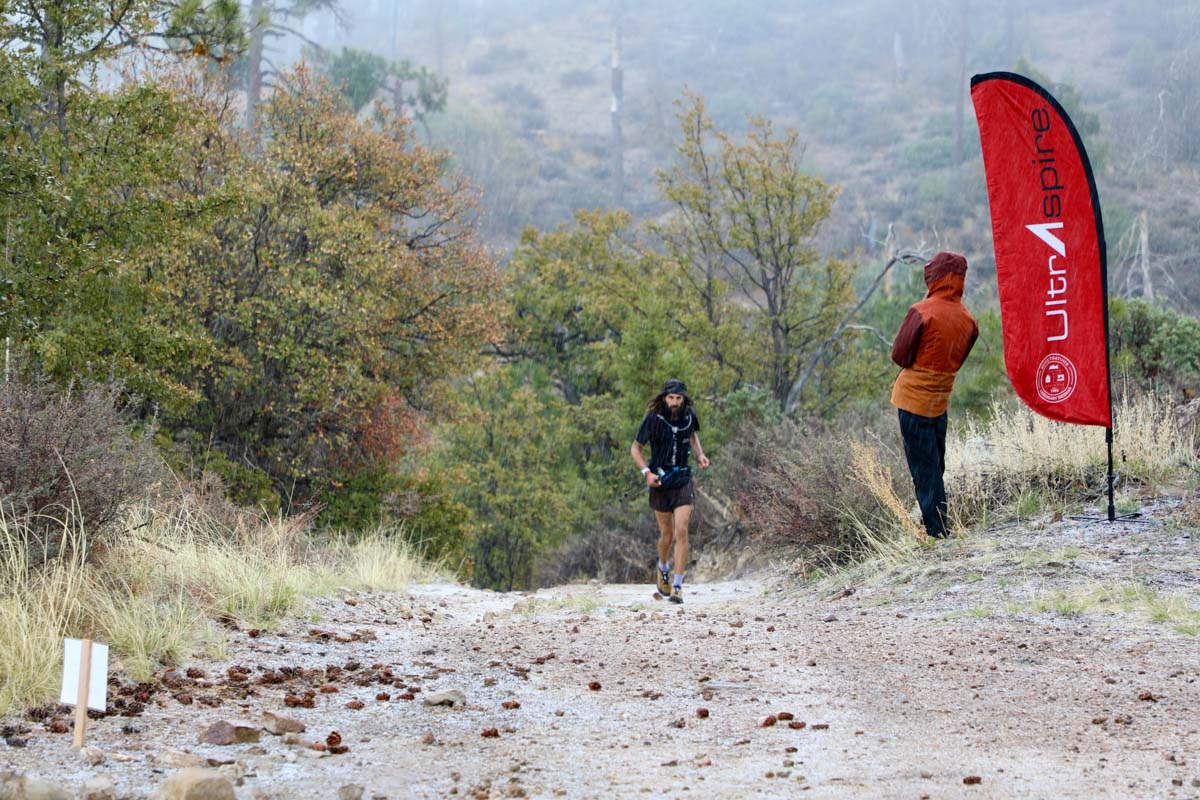
Versteeg runs in the hail toward Lane Mountain aid station during the 2025 Cocodona 250 Mile. Photo: iRunFar/Bryon Powell
If you could be a tree, what kind would you be?
Utah juniper, 100%.
Call for Comments
- What do you think of Versteeg’s approach to running and life?
- Do you have a Versteeg story you can share?