For Harold Bennally, a Navajo ultrarunner and race director for Moccasin Running, completing the 2026 Cocodona 250 Mile was a goal that had been years in the making.
He completed the 250-mile race in May, and when we speak not long after, he understandably has post-Cocodona blues. He’d wanted to do something like it since he was a kid, sitting listening to his grandfather’s stories of long-distance running as a medicine man in the Navajo tribe. Running was how his grandfather traveled for work, to visit different communities, and to get supplies for the family. Traveling over great distances on foot captured Bennally’s imagination.
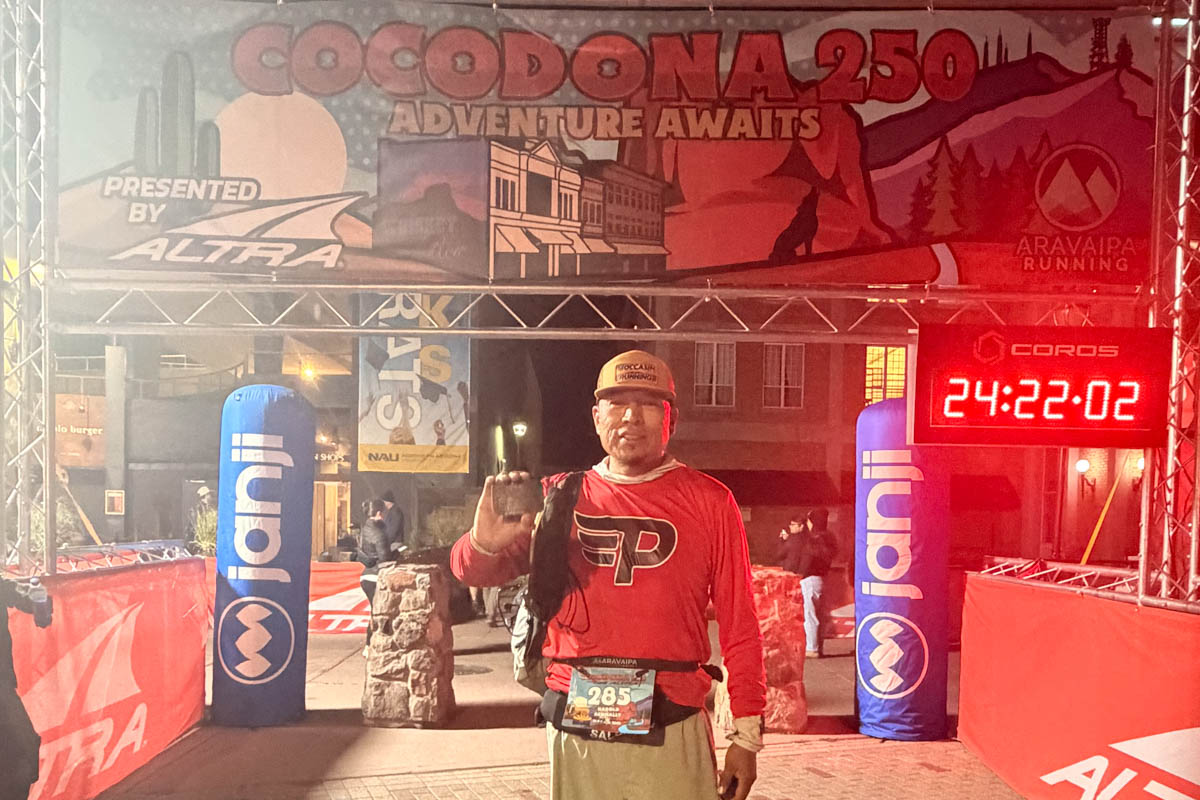
Harold Bennally at the finish of the 2026 Cocodona 250 Mile. All photos courtesy of Harold Bennally.
The depths of Bennally’s connection to the Cocodona 250 Mile course, to the act of traveling a long distance on foot, are more unique than most. The race course passes through land that has been historically stewarded by the Navajo people, and traveling such a distance on foot brings to mind the Long Walk, when, between 1864 and 1866, the U.S. government forced thousands of Navajo from their homes in northeastern Arizona and northwestern New Mexico to an internment camp at Bosque Redondo in eastern New Mexico. They walked a distance of around 300 miles, and many died en route.
In 1868, after signing the U.S.-Navajo Treaty, the Navajo people walked back to their homeland, now only a fraction of its original size. “So they did that trip twice,” Bennally says. “And just, all the lives that they lost, and the elders, the kids, the babies, you know, all those people…” He reflects on the privilege of being able to run Cocodona through choice. “If they can do those things, and I’m here today, I can do this.”
Bennally got a place in Cocodona via a program powered by Rising Hearts, an Indigenous-led organization, and the brand Kahtoola, which joined forces to award scholarships to athletes who might not otherwise be able to participate in events due to financial barriers. Bennally was actually offered a place in 2021, the inaugural year of the race, but he says he passed on the opportunity because he didn’t feel ready from a training standpoint.
Over the following years, Bennally trained for 100-mile races, he crewed other Native runners at Cocodona, and completed the Sedona 125 Mile, which covers the last sections of the 250-mile Cocodona course. When he felt ready to take on the full 250-mile race, he applied for the scholarship, and by January 2026, he had a place.
Running Origins and Navajo Roots
Bennally didn’t get into ultrarunning until around 2012. He says he ran a marathon on his way to training for an ultra, after being convinced by a childhood friend to do the 2013 Elephant Mountain 50k in Phoenix, Arizona. The heat was a bit of a shock to Bennally after living and training in Page, Arizona, and he says he became dehydrated faster than he was expecting, so the last 10 miles were a bit of a struggle. But he finished, and was keen to do more. Bennally had always been familiar with the Western States 100 and Hardrock 100, and began entering qualifying races to see what he could accomplish.
But after his father passed away in 2015, his relationship to training and racing changed. “I kind of lost the motivation to actually race a race,” says Bennally. He was running to finish, running to simply enjoy it, and he focused his energies on race directing. The birth of Moccasin Running was inspired by his father, and more on that later, but it was also a chance to reconnect to the culture he grew up in.
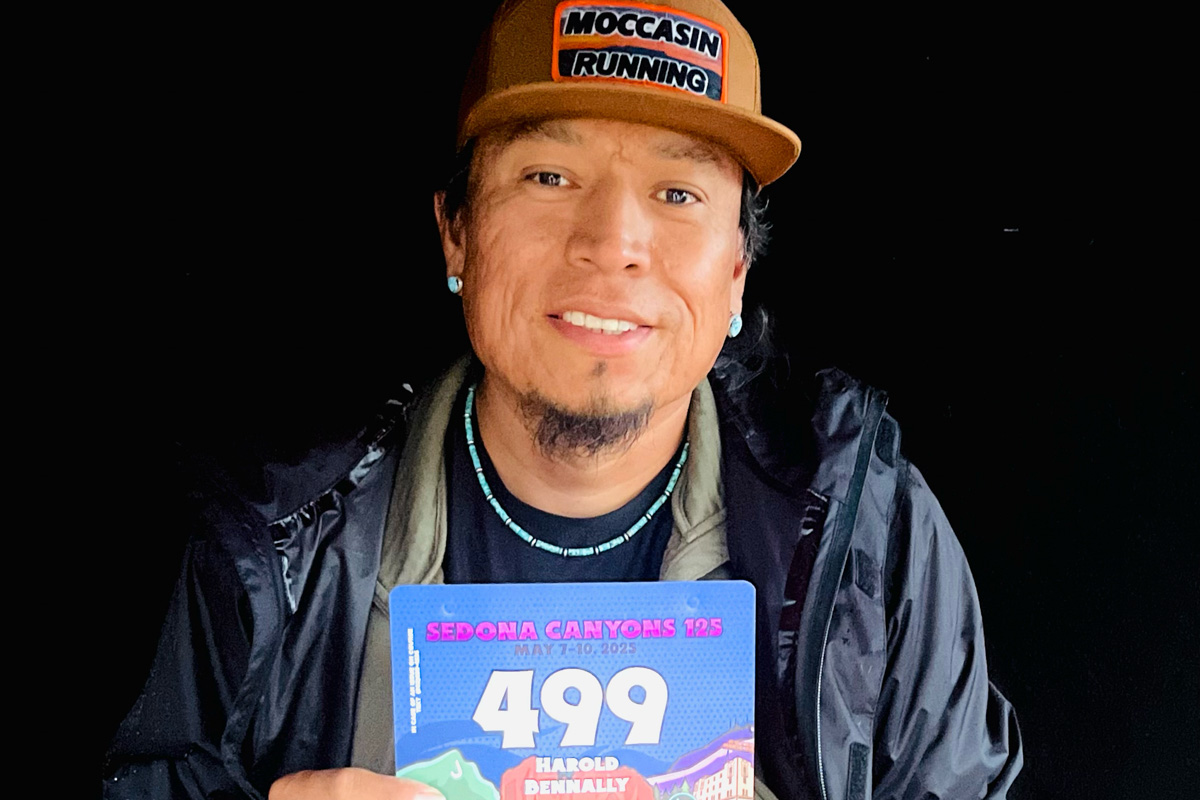
Bennally before the start of the 2025 Sedona Canyons 125 Mile.
Bennally grew up in Page after his family moved there for his father’s work, but his younger years were spent with his paternal grandfather in a hogan, a traditional Navajo home. “At that time, there was no running water, no electricity,” recalls Bennally, “so we did everything by kerosene and used to haul water into our place by 50-gallon barrels, and that was our water for a week or two.” There was also a ranch with cattle, horses, sheep, and goats, and Bennally learned to help take care of them. He went to elementary school in Page, but spent every summer back on the ranch with his cousins, following the sheep or learning to drive a stick shift car. “That’s where I learned to drive,” laughs Bennally. How old was he at this point? “My cousin and I were like, I don’t know, seven, nine years old.” They learned to drive on the dirt roads because it seemed easier than walking to follow the sheep.
Bennally’s relationship with his grandfather was formative. He traveled together with his father to attend ceremonies his grandfather was performing, helping families throughout the Navajo Nation. They went to Utah, Colorado, New Mexico, and even Washington, and Bennally came to understand a lot of the Navajo teachings through ceremony and directly through the Navajo language.
What happens during the ceremonies, I ask. “It depends on what the patient is there for, so it’s not all the same,” says Bennally. “There are different situations that people go through, and either someone’s just had a passing, or someone’s getting married … or maybe a baby has just been born, or a female is just entering her womanhood, her first time getting her period, or when a guy is ready to come of age.”
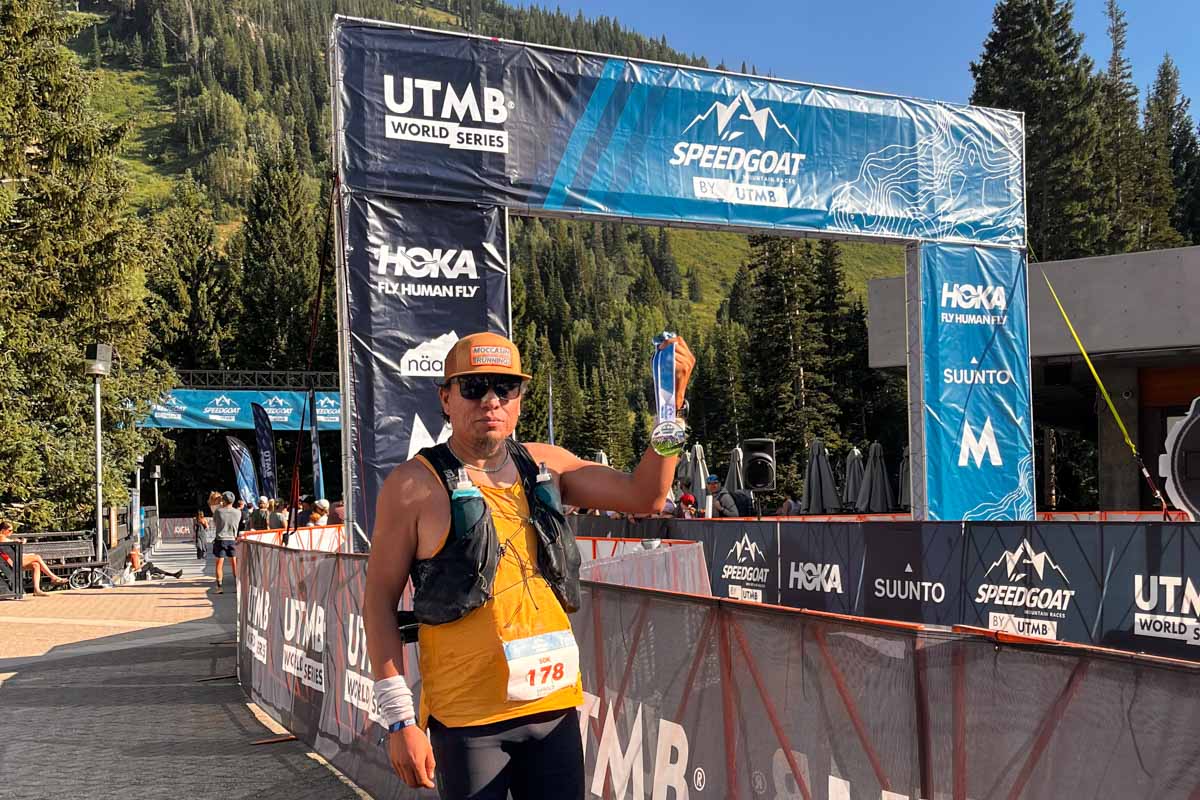
Bennally at the finish of the 2025 Speedgoat 50k.
Running is a big part of Navajo culture, Bennally tells me. It is part of morning prayers, involving a run to the east toward the rising sun before dawn. Bennally says that, as he understands it, you run to greet the sun, then, when the sun comes up, you stop and do your prayer with white corn or corn pollen, then turn around and run home again in the light of the day.
Bennally sought deeper meaning in the ritual, and for him, running in the dark and being greeted by the light is a metaphor for life. “You don’t know which direction you have to go through work, whatever it is, through what life is,” says Bennally. “You don’t know which way to go until that light comes up, and you see the light, and you now know which direction you’re going. So as the sun comes up every day, you know the direction you’re going in life: You’re going to the birth of the new day.” Nature is telling you which way to go. “There’s always going to be a light out of any kind of darkness,”
Bennally says, and that light gives clarity to decisions and to seeing which way is good or bad.
Sadly, Bennally says, the number of people able to perform ceremonies and pass on Navajo practices and traditions is diminishing. People are moving away from the communities, moving to the cities, and pursuing formal education. People of his own age have stayed in the communities to take care of the land, the animals, and their grandparents, and they are still carrying on the ceremonies. “I don’t know how much longer these practices and teachings will be continued to be passed on,” says Bennally.
Moccasin Running
Bennally now lives in Phoenix near South Mountain and says he was transferred there by the company he worked for in Page, and that his father worked for, too. “I live in that spot just specifically to train for hills,” smiles Bennally, and he has a close and personal relationship with the South Mountain trails after training there every day ahead of Cocodona. His days are long. In addition to a full-time job and his training, he is the race director for Moccasin Running. Sufficed to say, sleep is minimal, but he says that being a race director is something he has always wanted to do, and that he wants to be able to do it full-time.
Bennally was inspired by his coaches in junior high and college to pursue a lifestyle and career similar to theirs. “My coaches paved that path for me,” he says. “I wanted to be that kind of person.” He was fascinated by their work as event coordinators during hometown meets and other events, and he wanted to learn how to do it for himself. But it wasn’t until his father passed away in 2015 that he realized he needed to chase his dream. “After realizing how short life can be,” says Bennally, “I was just like, ‘Ok, well, I can’t just keep sitting around dreaming about something, I just might as well go out and do it.’”
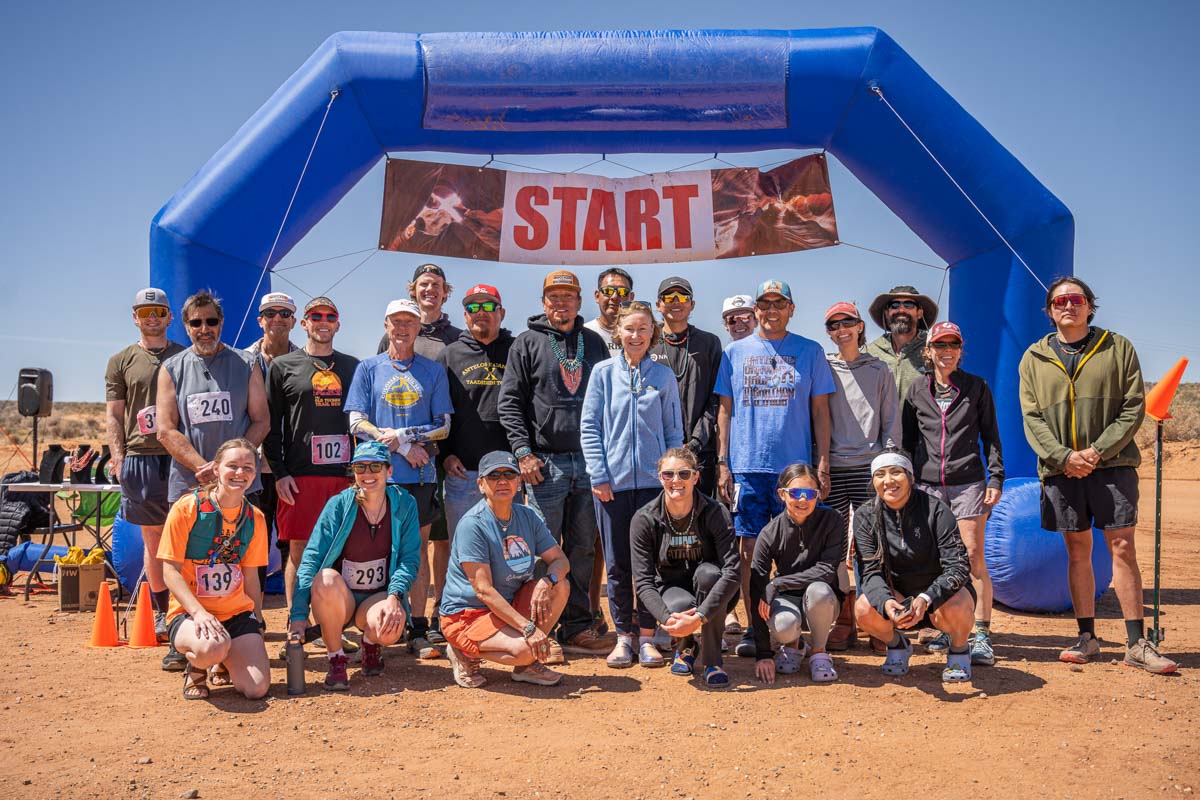
The Moccasins Running crew.
Over a weekend in April in Arizona, Moccasin Running hosts the Mountain Sheep Canyon Run 10-mile and 5-kilometer races, and Antelope Canyon half marathon and 8-mile races. Navajo culture is strongly tied to the races, and they are open to anyone looking to feel more grounded in nature and to learn more about the culture. Morning prayers are performed before the race starts, and entrants receive traditional jewelry handmade by Bennally himself, as well as t-shirts printed with his own design. “Pretty much everything just comes from the table in my home to the race,” says Bennally, “and everybody gets to take it home, so it’s a big challenge.” Jewelry has historically been used for trade in Navajo culture, and here, runners receive as a trade for their entry fee and participation.
The spirit of trade continues: Bennally helps with a running program for Native youth in Page to give back to the community. There’s a program for middle- and high-school students, and they’ve recently started a cross-country program for elementary school students. “It’s a new door that I wish I had when I was growing up,” says Bennally, explaining that when he was growing up, there were many Navajos in the area who were really talented runners, but financial issues were a barrier to joining the cross-country or track team. “I think it would have been a great opportunity for them, for their life, to continue to get more educated, and maybe they would have had a different life now,” reflects Bennally.
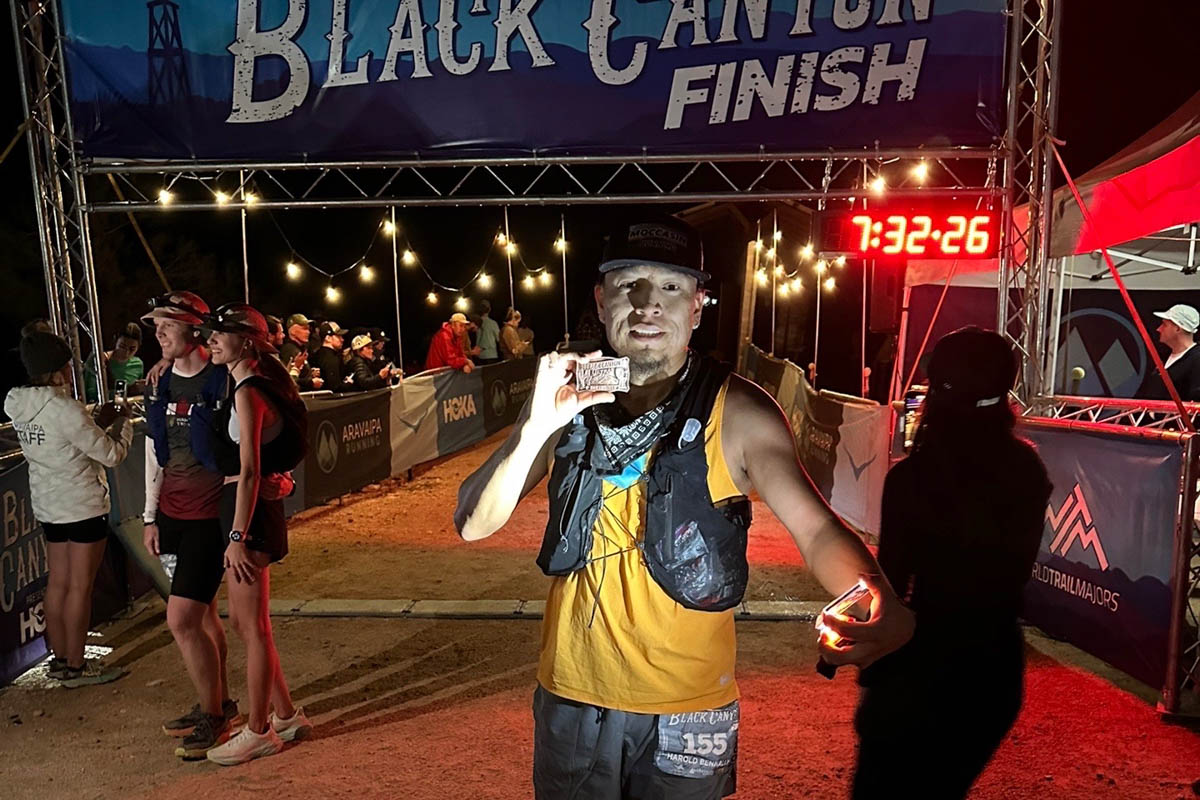
Bennally at the finish of the Black Canyon 100k.
The program Bennally is helping with provides young people with an opportunity to be part of the team and community without worrying about the resources needed to participate. Bennally highlights that sometimes there are kids on sports teams who can afford to be there but don’t have the drive to want to run. Meanwhile, there are kids who are really talented and want to be there, but can’t afford to. “It’s really night-and-day between them. So now that we do all this stuff, we’re able to help them, keep them inspired to work and to be part of the team.” The program is proving to be a success. Just this year, four members of the graduating cross-country team have earned college scholarships. “So I’m very proud and happy that they got to do those things,” smiles Bennally.
The Future of a Community Spirit
In terms of Bennally’s own running, he’s continuing to chase Western States 100 and Hardrock 100 qualifiers but is also looking at qualifying for the Boston Marathon again after running it in 2015, 2016, and 2019. Bennally has enjoyed running races just to finish, but he’s beginning to want to be competitive again. “It feels good, I miss being in front,” he says. His brother has been instrumental here, urging him to go for Boston because he wants to watch him race there again. The first time Bennally ran Boston was soon after their father died, so this feels like a poignant wish from a sibling.
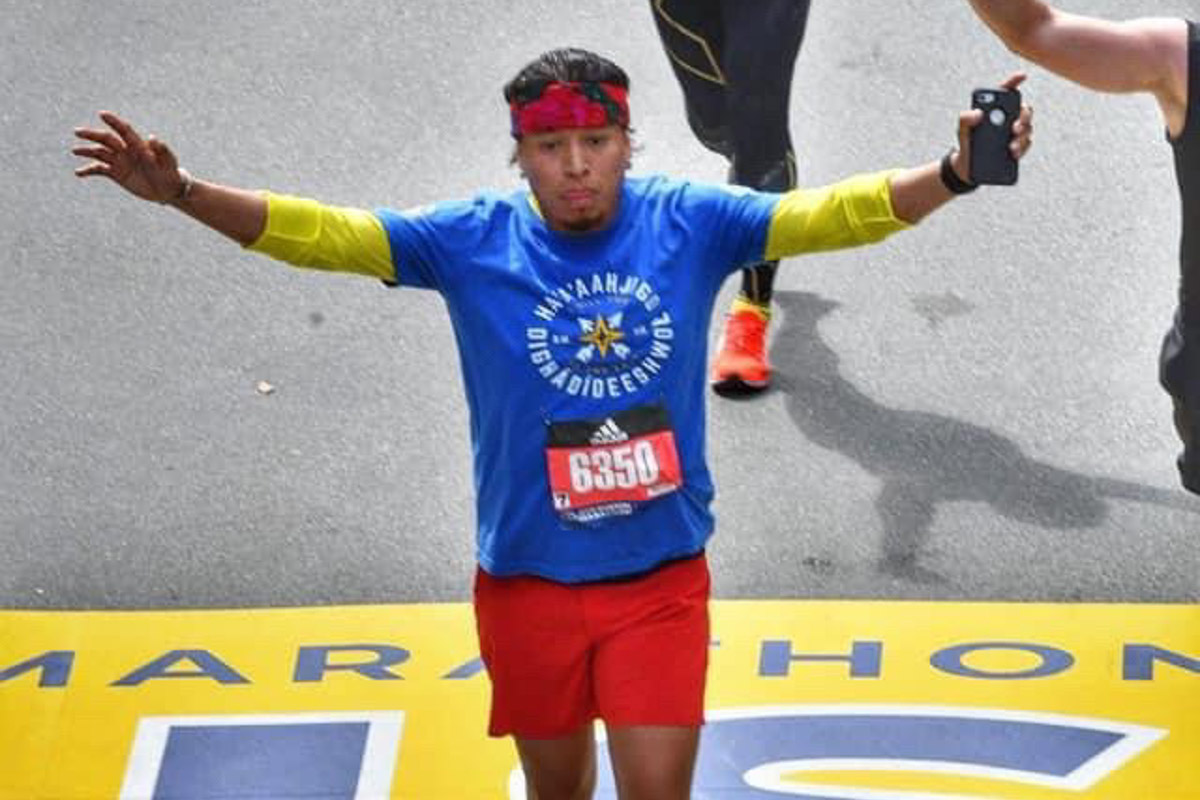
Bennally finishing the Boston Marathon.
For Moccasin Running, Bennally wants to put on an ultramarathon next year but is also currently balancing the rising costs of event production. Permit prices have gone up, as have the costs of the stones for his handmade jewelry. But it seems that these challenges are just obstacles to endure in Bennally’s dream, and to staying true to the core values of Moccasin Running. “I try to make things really worth it to have the experience of Navajo running.”
There is a calm, compelling air to Bennally, but it’s clear that none of what he’s achieving is coming easily. Although he received a scholarship to race Cocodona, he still needed to buy new gear. Resourcefully, he took pre-orders for necklaces that people could buy to support him, which he would make after the race. When we speak, he has just sent out the last batch of necklaces.
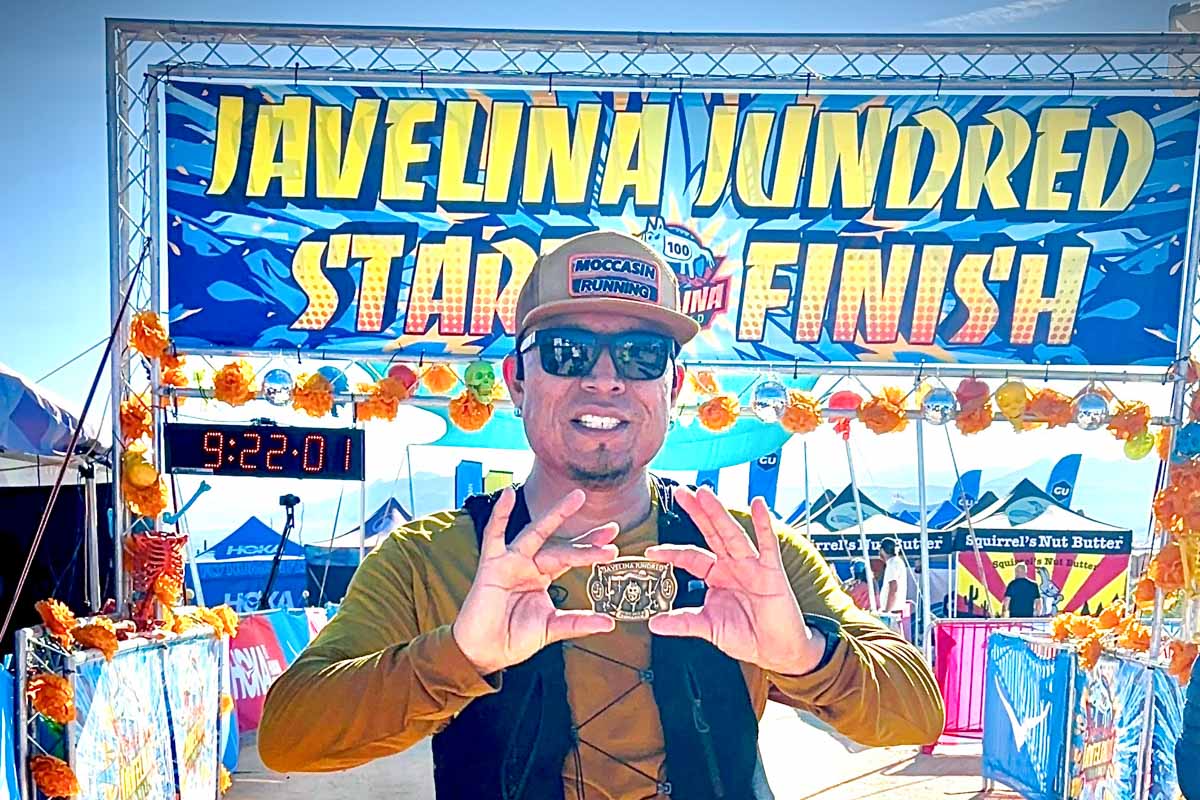
Bennally at the finish of the Javelina 100 Mile.
Even with the difficulties, Bennally exudes gratitude. It is a common theme in our conversation: He is grateful to people who have helped him get to Cocodona, to those who help him put on his races, and to those who make the youth program possible. He is grateful to his parents, grandparents, and ancestors. The spirit of community is palpable in him, with running as its cornerstone and celebration.
Call for Comments
- Have you participated in any Moccasin Running events? How were they?
- Do you have a Harold Bennally story you could share?