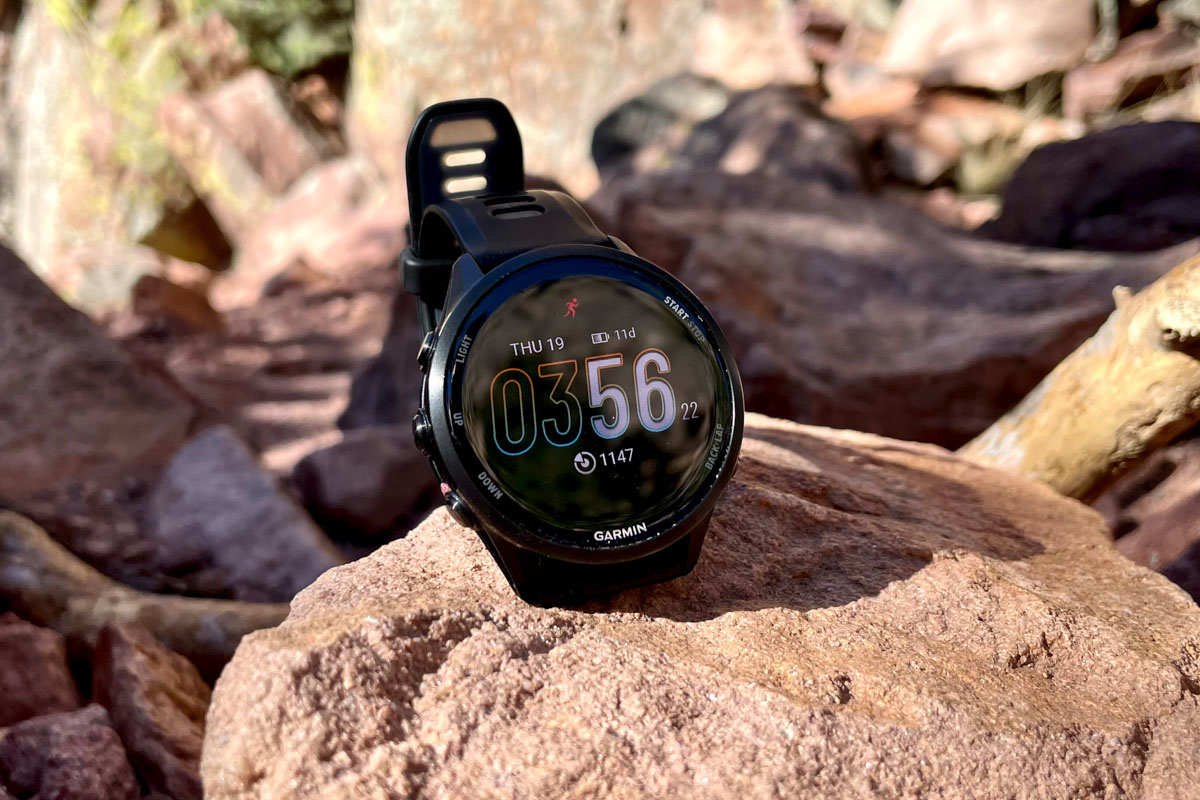
The Garmin Forerunner 970. All photos: iRunFar/Craig Randall
After testing the Garmin Forerunner 970 ($750) over the past four months, I can confidently say it’s the most complete GPS running watch Garmin has ever made — and right now, the best overall option available.
I was a longtime Garmin Fēnix and Garmin Enduro snob, but in aging and expanding my interests in running — hello, track! — the Garmin Forerunner 970 has slotted itself into my multifaceted trail runner life. It offers plenty of battery life for everyday use and doesn’t sacrifice durability, but adds daily wearability at a reduced cost, and it still captures Garmin’s class-leading user interface and ever evolving free features.
Stalwarts in the GPS watch space, like Coros, Suunto, and Polar, continue to refine their strengths, and Huawei and Amazfit are improving quickly, and as a result, the gap in raw hardware — GPS accuracy, build quality, even battery life — has narrowed considerably. But the Garmin Forerunner 970 is so sophisticated, accurate, and easy to use — albeit after an initial learning curve — that it has separated itself from the other watches I’ve tested.
The Forerunner 970 isn’t just a collection of features, it is the most integrated system I’ve found from any watch. Training metrics, recovery insights, mapping, daily health tracking, and device performance all work together in a way that feels cohesive and intuitive.
The multiband GPS system is extremely accurate and fast to find a signal. Additionally, I’ve all but tossed every last heart rate strap in the garbage since the Elevate Gen 5 heart rate sensor is so good. This sensor has ECG capabilities, improved accuracy during high intensity training, and skin temperature tracking. Add in a mature app ecosystem and consistent software support, and Garmin continues to set the benchmark for what a GPS running watch should be.
There are many reasons the Garmin Forerunner 970 tops the list in our Best GPS Running Watches guide, even as other options continue to improve in their performance.
Shop the Garmin Forerunner 970Garmin Forerunner 970 Look and Feel
The Garmin Forerunner 970 is not as stylish as the Suunto Race (review) or as slick as the Apple Watch Ultra (review), but it’s also not as bulky as many other options. It won’t turn heads, but it won’t preoccupy your wrist with weight or heft. It’s very light, sleek, and unobtrusive, and I could run with it and then wear it through the rest of my non-athletic life. It’s barely noticeable on the wrist, yet its functionality is as sophisticated as any GPS watch I’ve tested.
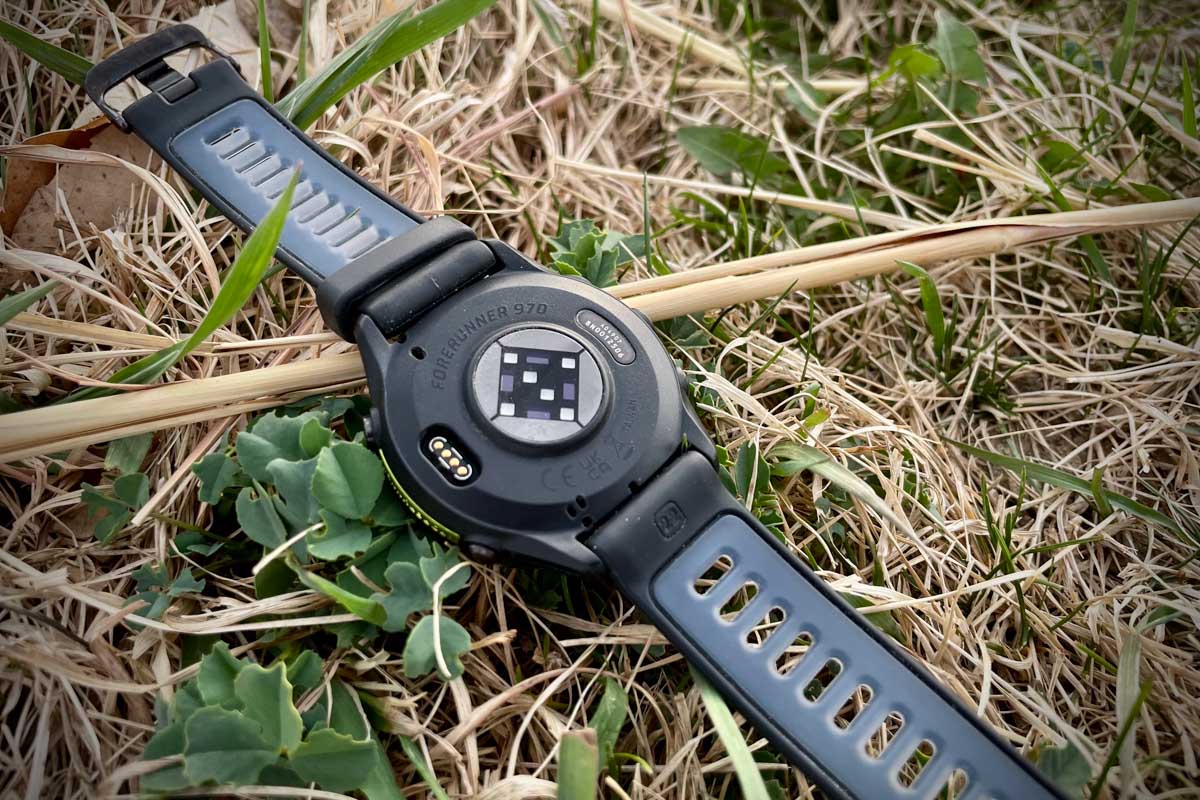
The sensors on the Garmin Forerunner 970 offer heart rate sensing and skin temperature tracking.
With an actual weight of just 57 grams, the weight savings are significant compared to watches like the 87-gram Coros Vertix 2S (review), 74-gram Suunto Vertical 2 (review), or the 68-gram Amazfit T-Rex 3. The AMOLED display, while technically tied for the smallest of that group at 1.4 inches — matching the Vertix 2S — punches well above its weight in readability and gives the watch a low-profile feel on the wrist.
Garmin uses a fiber-reinforced polymer case to keep weight down, then adds premium materials where they actually matter. The titanium bezel provides structure and protection, and a sapphire crystal lens has long-term scratch resistance. It’s the same high-end pairing you’ll find on watches like the Garmin Fēnix 7 and Garmin Enduro 2, just executed in a much lighter, more wearable package.
In practice, that combination has held up. The display hasn’t failed me once despite dings, drops, and the occasional slam into the ground or furniture — collateral damage from parenting two kids under four. The Forerunner 970 doesn’t feel indestructible in the way bulkier adventure watches do. Instead, it’s durable enough for real-world abuse while remaining comfortable enough to forget you’re wearing it.
The AMOLED display is a big part of why the Forerunner 970 feels so refined for day-to-day use. The 1.4-inch screen reads larger than it seems it should because it’s so bright, sharp, and high contrast. Data fields are easy to parse at a glance — whether you’re checking pace mid-interval or scrolling through metrics post-run. The screen is one of those upgrades that’s hard to quantify but immediately obvious the moment you use it.
There are still firmly two camps when it comes to display types: those of us who are MIPS (memory in pixel) people, who don’t need our watches to light up on their own, and AMOLED (active-matrix organic light-emitting diode) people who want the same display we’re accustomed to on our phones.
Since 2024, the running watch industry has made a massive pivot to AMOLED displays, so much so that it’s a rare occurrence that major brands will utilize MIPS for their most recent releases. That said, Coros notably bucked this trend with its latest Coros Nomad and Coros Apex 4 watches. AMOLED is a battery hog, but there is a lot you can do with the Forerunner 970 to make the battery last as long as possible. In exchange for the faster battery drain, the watch offers notifications, widgets, and maps that feel closer to a modern smartwatch experience than a traditional running watch. The AMOLED screen is simply more engaging and easier to live with throughout the day.
There are tradeoffs, of course. AMOLED will never match the always-on efficiency of MIP for multi-week battery life, but Garmin has struck a balance here. They provide a display that’s genuinely enjoyable to look at alongside battery performance that still comfortably supports daily training.
The look and feel of the Forerunner 970 is ultimately what pushed me to name it the best overall GPS watch in our Best GPS Watches for Running guide. It delivers nearly all the high-end capability of Garmin’s more rugged models — minus the battery life — but in a package that feels just as at home on the trail as it does on the road, track, or under your sleeve at work.
Garmin Forerunner 970 Battery Life
Battery life is where the Garmin Forerunner 970 shows its positioning. It’s very good, but not class leading in the world of big, expedition-style watches with batteries that last for weeks. And for me these days, that’s part of its appeal. I used to lean on the side of “bigger is better” when it came to a sports watch, but despite the 200-miler world we’re living in, my tastes are trending toward more wearability and subtlety, even if that means abbreviated battery capacity. The sacrifice is certainly there, but it’s not so extreme that it feels like a decisive disadvantage in most scenarios.
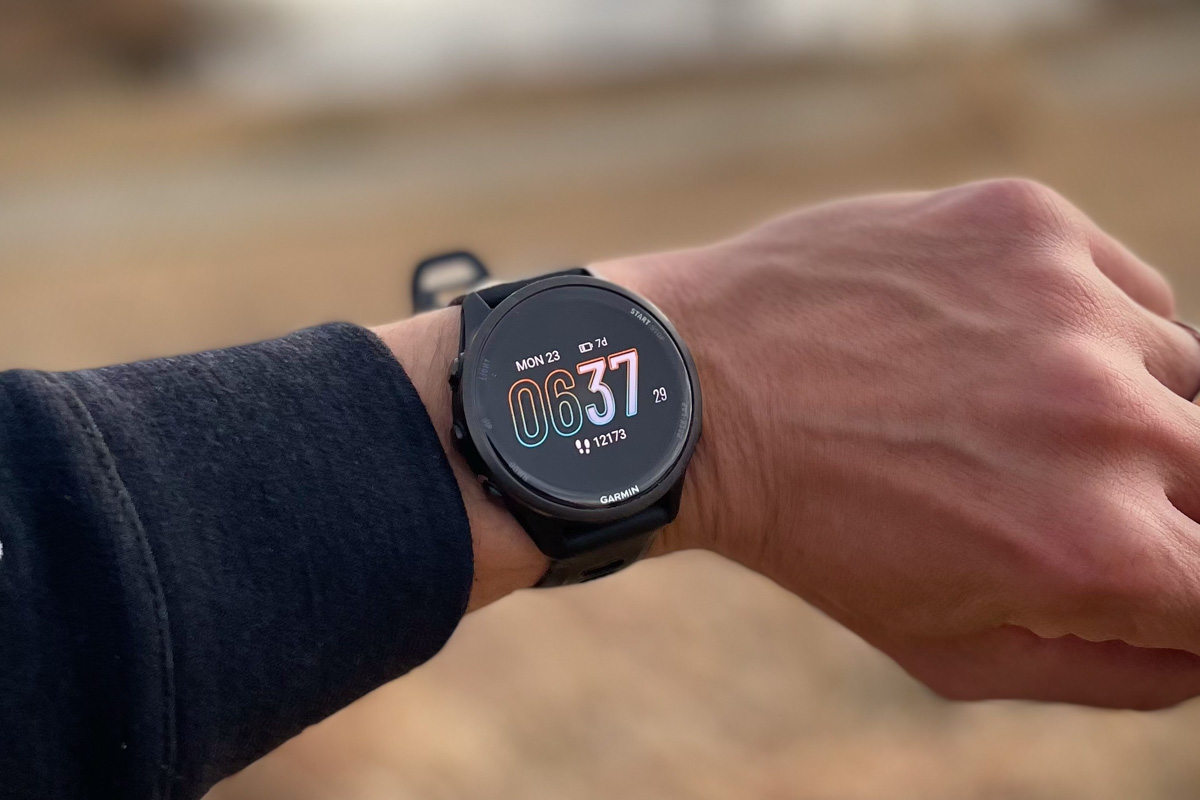
The smaller Garmin Forerunner 970 battery allows for a sleek, low-profile look.
In standard GPS mode, the Forerunner 970 offers roughly 26 hours of tracking. For most trail runners, that comfortably covers daily training and most races, obviously depending on pace. During my testing, the Forerunner 970 was reliable, predictable, and got through long days in the mountains. People joke about losing their Coros charging cable because it gets used so infrequently, and that isn’t the case here. During average running months, I’m charging the Forerunner 970 about every eight to nine days, usually from about 15% battery remaining. The charging is fairly quick, and it will be back at full charge in about 50 minutes.
Compared to the watches designed to get through any length ultra, the Forerunner 970 is in a different — and lesser — battery category. In the ultra-watch category, the Coros Vertix 2S pushes into 100-plus hours of GPS tracking, while the Suunto Vertical 2 can stretch to 65 hours in high-accuracy modes and far beyond in lower-power settings. Even something like the Amazfit T-Rex 3 can get more than 40 hours of precision GPS tracking.
This delta between the Forerunner 970 and the most extreme ultra-distance watches is real, and it matters especially during huge, multiday runs.
While it can’t go for weeks without a charge, the Forerunner 970 still lasts long enough for the majority of trail runners without compromise. For its battery life, it provides an AMOLED display, full mapping, offline music streaming with Spotify, and a much more refined software experience than most of the watches that will go seemingly forever.
In other words, if your priority is maximum time between charges, the Coros Vertix 2S or Suunto Vertical 2 are simply in another league, but if your priority is daily training with more occasional long efforts, the Forerunner 970 is plenty.
For me, the watch lands in that sweet spot. It’ll run long enough to trust on big days, and has a level of usability and polish that makes me actually want to wear it when I’m not training. It is also less expensive and more adaptable to different types of running and sports than many of the bigger-battery watches, making the Forerunner 970 an alternative and not a sacrifice.
Garmin Forerunner 970 Trail-Specific Features
While it may appear primarily geared toward road runners and triathletes, the Garmin Forerunner 970 includes meaningful trail-specific tools. One standout feature is Trail Run Auto Climb, which automatically switches to a climb-focused data screen during ascents so you can monitor vertical metrics and pacing without manually toggling screens.
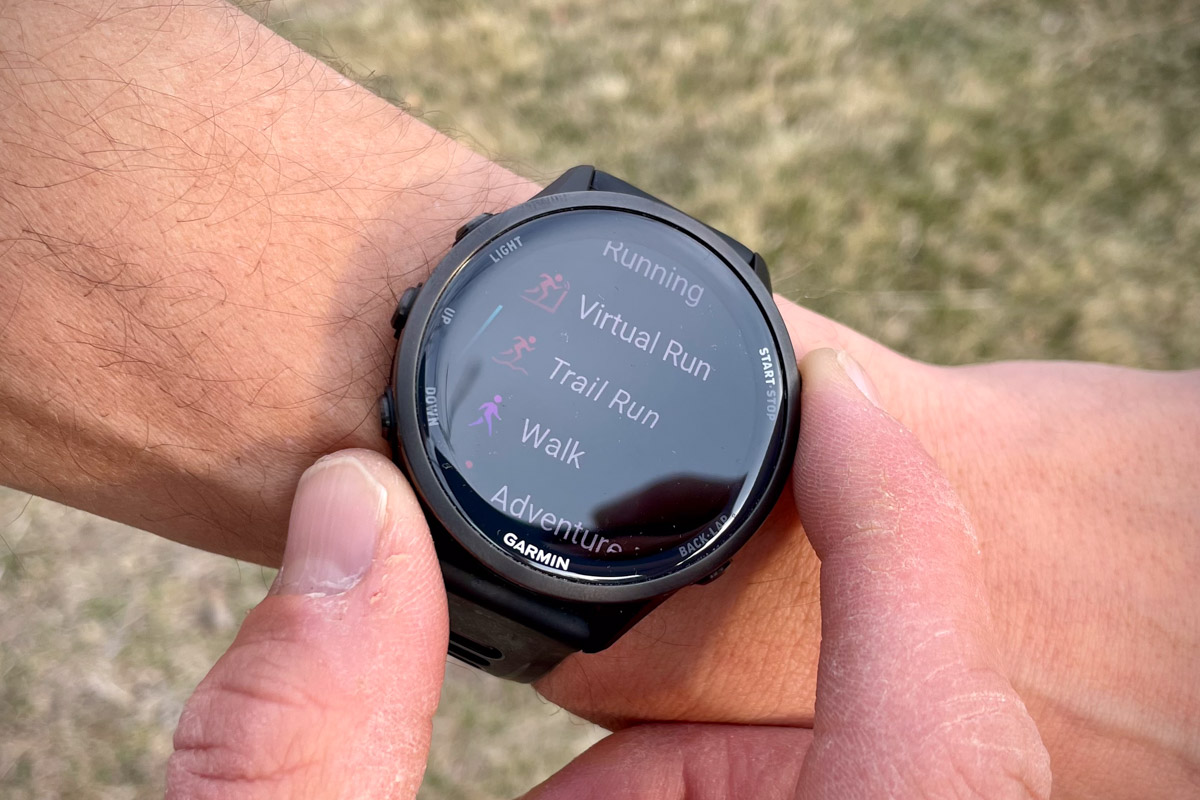
The Garmin Forerunner 970 has trail-specific features.
The watch also calculates grade-adjusted pace (GAP), which translates uphill speed into equivalent flat-ground pace. This removes guesswork from hill pacing and makes performance comparisons across terrain far more meaningful than simply reviewing split pace after the workout. Seeing GAP used to require post-run analysis in Strava, but now it’s available in real time.
Another powerful addition is Hill Score, which evaluates your climbing ability based on recent runs. Instead of relying solely on VO2max, the Hill Score specifically tracks improvements in metrics on vertical terrain — a valuable tool for athletes who race on rolling or mountainous courses.
The Forerunner 970 offers brilliant navigation. It includes offline maps, GPX route support, turn-by-turn guidance, round-trip route generation, and off-course alerts. It’s a capable navigation device that allows for new terrain exploration without relying on a phone.
The built-in flashlight is more than just a gimmicky inclusion. It has four brightness modes and a red-light mode — which is sneakily useful for bathroom breaks in the middle of the night. The blinking strobe is good for visibility during night runs.
Forerunner 970 Lifestyle and Gear Tracking
Not long before writing this review, Garmin — as it is wont to do — released a major software update for the Garmin Forerunner 970. I look forward to these like my kids look forward to holidays (all of them, any of them!).
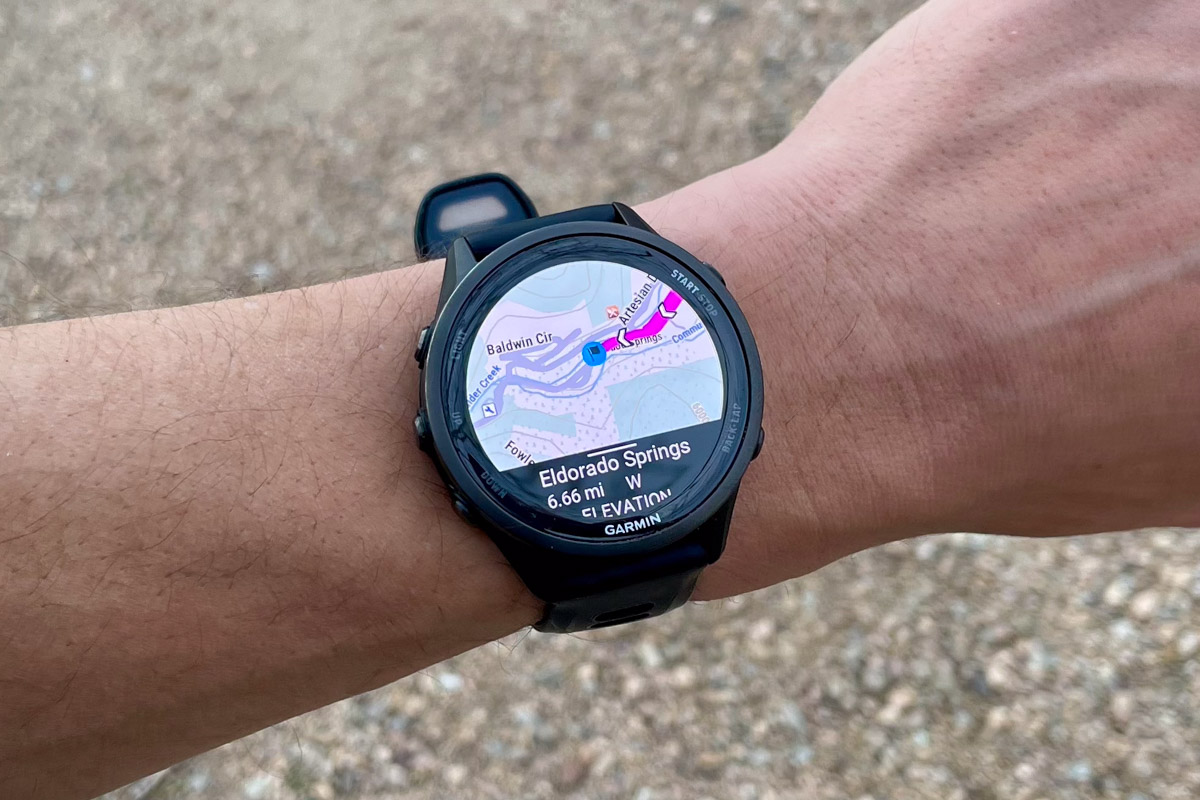
The Garmin Forerunner 970 navigation system now includes race-preparation features.
This update added a host of features that expand the watch’s training and lifestyle functionality. Runners can now assign gear — whether running shoes or other equipment — to specific activities and track usage, distance, and hours directly on the watch or in Garmin Connect. As a gear tester, I’ve long relied on Strava’s gear tracking, but now I can do it directly on this watch, and I appreciate being able to save a step.
Another major update is a suite of race-preparation features. This includes course planning that can add in cut-off times, checkpoints, aid stations, and other notes to help a runner stay on pace and organized during long efforts.
The update also enhances sleep tracking and recovery insights, including the addition of sleep alignment metrics that show how rest patterns sync with natural circadian rhythm. The Garmin Fitness Coach, which uses artificial intelligence to provide personalized workouts that adjust to fitness history, heart rate trends, and training goals, has been improved.
These regular updates illustrate Garmin’s commitment to keeping the Forerunner 970 not just a GPS running watch, but a versatile, evolving platform that supports both serious training and everyday life. Users benefit from a device that grows smarter over time, adding new tools — for free — that integrate into existing routines.
Garmin Forerunner 970 Overall Impressions
If you want elite GPS accuracy, powerful training analytics, strong navigation tools, and a watch that’s comfortable enough to wear daily, the Garmin Forerunner 970 currently delivers the best overall balance in the category.
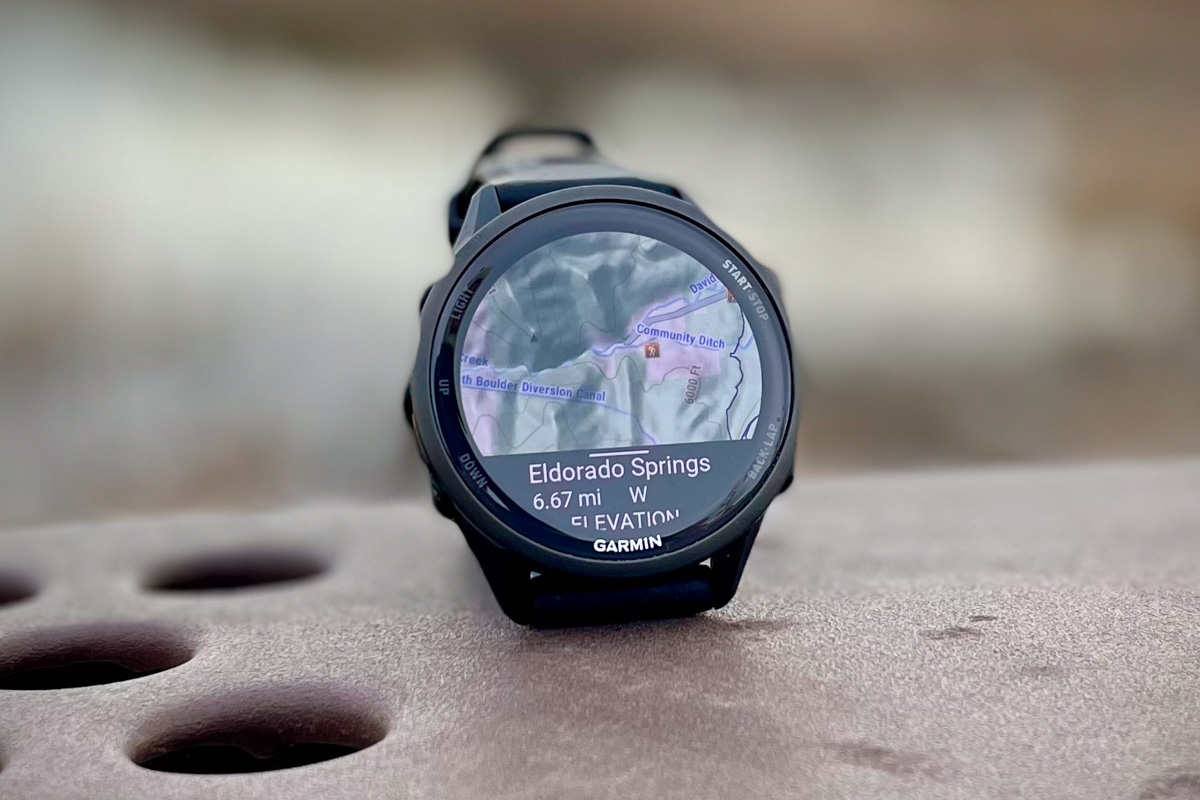
From maps to GPS accuracy to health metrics trakcing, the Garmin Forerunner 970 can do it all.
The watch is expensive and the learning curve is real, but for runners who want exquisite performance without the bulk of a more adventure-oriented watch, the Garmin Forerunner 970 is the leader in the field. While there are plenty of other watches with bigger batteries, larger screens, and additional features, none fit on the wrist as comfortably or provide as much performance for the size and weight.
To see how the Garmin Forerunner 970 ranks compared to some of the other top watches on the market, check out our Best GPS Running Watches guide.
Shop the Garmin Forerunner 970Call for Comments
- Have you used the Garmin Forerunner 970? What do you think of it?
- Do you prefer a bigger battery or a more streamlined look for your GPS watch?