Brian Morrison was within sight of the 2006 Western States 100 finish line — while leading the race — when he collapsed on the Placer High School track. He was a rookie about to taste glory, being paced by seven-time Western States 100 winner Scott Jurek, and unknowingly suffering from a dangerous case of hyponatremia resulting from overhydration. The sodium concentration in his blood was so low that he’d lost control of his body.
It took him long minutes to get around the track, and his crew helped him up repeatedly, assisting him over the finish line as the clock ticked over to 18 hours, 5 minutes, and 13 seconds. The clip of him crossing the line still lives on YouTube. A few hours later, the Western States Board agreed that he failed to complete the course under his own power. He was marked a DNF, and Graham Cooper from the U.K. was awarded the win.
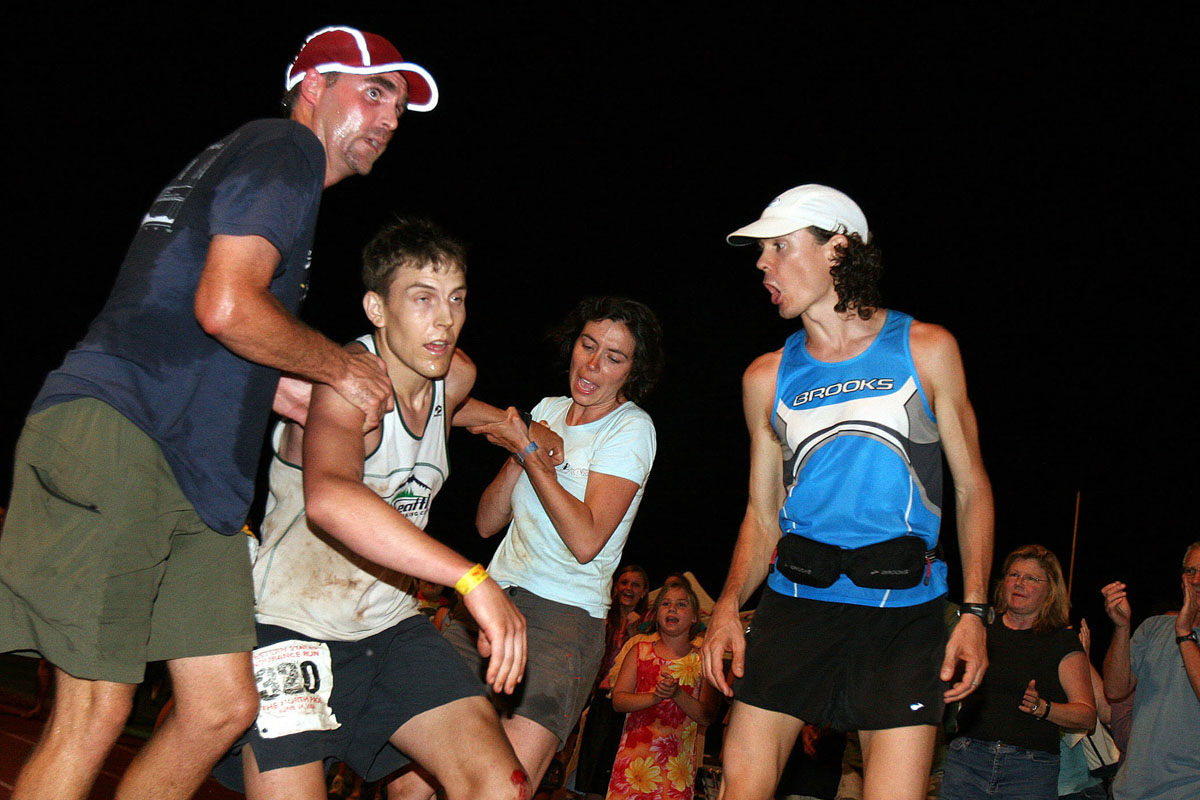
Brian Morrison being helped by his crew, including Scott Jurek (right) to the 2006 Western States 100 finish line. Photo courtesy of Brian Morrison.
It was a defining moment for Morrison, who says he never felt he had won that race. “I was so disappointed with myself for blowing it so close to victory,” he says, “I always understood the decision, like, I didn’t win.” Twenty years later, he still firmly asserts that Cooper should feel like he won it.
“I didn’t get across that line under my own power,” says Morrison.
This spirit of good sportsmanship is admirable, particularly as over the following few years, in 2007, 2008, and 2009, Morrison attempted but couldn’t complete the race. He says 2008 was the hardest, when he felt like he was the fittest he’d ever been, was ready to execute a decent race, and it was canceled because of wildfires. “If 2006 felt heartbreaking, 2008 was actually the worst,” says Morrison. He had put so much into it, and didn’t even get to use his training, and says that in the aftermath, he was given to non-stop bouts of crying.
In 2009, he just couldn’t keep food down, and the mental toll of the obsession and disappointments of the race was impacting him and his family. “I just recognized then that I need to take a break from this race,” Morrison says, “or it’s going to just ruin running for me.”
Morrison took a hiatus from Western States and rediscovered the joy of running. He started a family and began thinking about devising his own 100-mile race in Teanaway, Washington, in the Cascade Mountains. Still, the spirit of Western States never left him, and he realized he needed to finish the race to gain some closure. He quotes Gordy Ainsleigh, the originator of the Western States: “Don’t let this race beat you, or it’ll haunt you forever.”
In 2016, 10 years after he collapsed on the track, Morrison returned to Western States and finished in 27:26:00, in 117th place. After the 2016 finish, Ethan Newberry, otherwise known as the Ginger Runner, made a brilliant film about his story, “A Decade On – Brian Morrison and The Western States 100” and now, 10 years after the finish and 20 years after his first attempt at the race, Morrison has self-published a book, “Given to Fly,” about the experience.
Given to Fly
It’s quite a story, and its happy ending is inspiring. Morrison’s idea to write a book about his experience came quite soon after finishing the 2016 race, but then work and life got in the way. He was an operating partner for the Seattle Fleet Feet stores, working 60 hours a week, saying, “It was really rewarding, but it was also totally consuming.” In September 2024, he left for a “punch-in, punch-out job” that gave him time to work on his book. He self-published “Given to Fly” in April of 2026.
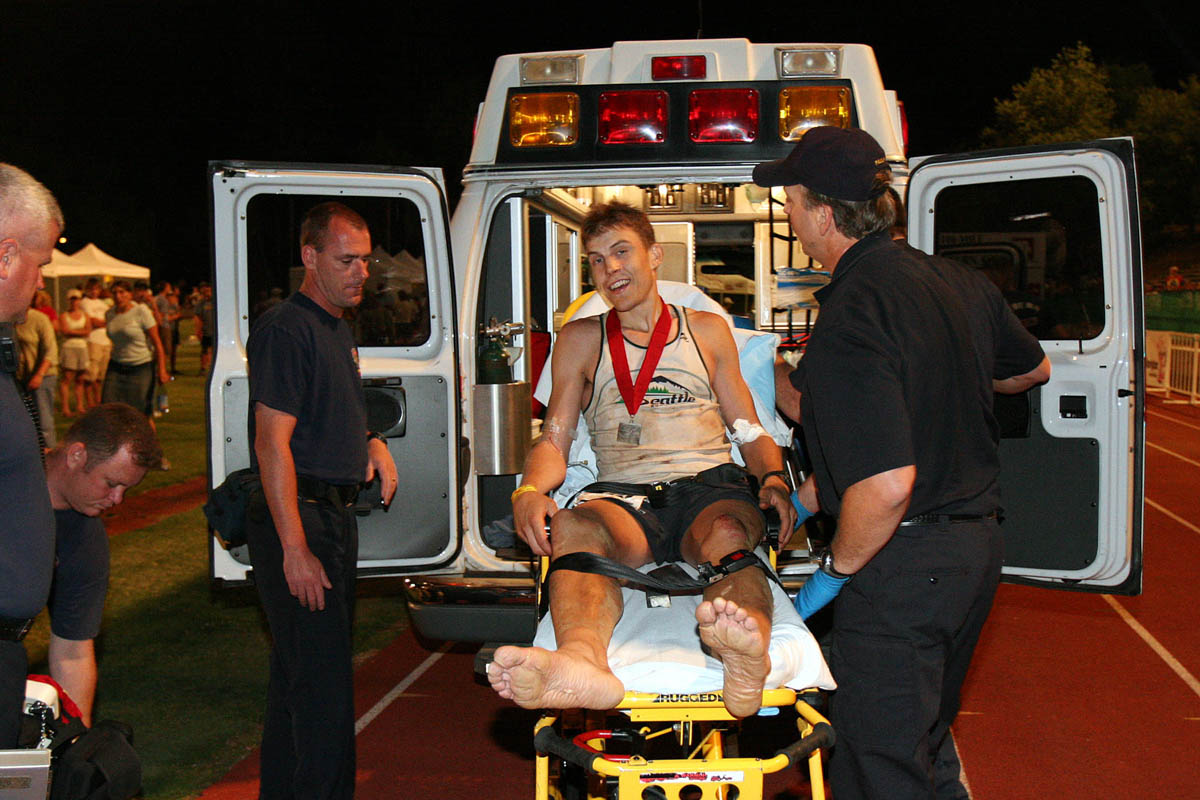
Morrison being loaded into an ambulance at the 2006 Western States 100 finish line. Photo courtesy of Brian Morrison.
“I guess in the 20 years since the race,” reflects Morrison, “I’ve realized just how thankful I actually am for the fact that it turned out the way that it did.” By coming back to finish the race in 2016, he got to run around the track with his kids, who weren’t even born before his first attempt. Of course, Morrison would have liked to have a bronze cougar — the prize awarded to the race winners — and admits he still thinks about how close he was to having his name engraved on the Wendell Robie Cup alongside the race winners, but the stories and memories he has instead are precious.
He reflects that had he won the race in 2006, “I certainly wouldn’t have written a book, or if I did, it would have been a totally different book.” Time puts everything in perspective, and he says, “With 20 years of hindsight, I feel really fortunate that it turned out the way that it did.”
Finding Trail Running
Morrison says he grew up “pretty unathletic,” but always had aspirations to be more so. “I played soccer and baseball, and a little bit of football, and was mediocre at best at all of them,” he says. “Snowboarding was the sport that I cared the most about, but I was never good enough to do anything there.”
But in 2000, his uncle invited him to climb Mount Rainier with him, and on his uncle’s advice, he started running to train for it. “Running didn’t come naturally right off the bat,” admits Morrison, but whereas running had always been associated with punishment in other sports — if you fumbled a ball, you were made to run laps — running alone with the goal of climbing Rainier proved enjoyable. Eight months after the idea was first presented, Morrison and his uncle summited Rainier together. “It was awesome, and it was hard, but it wasn’t impossible,” says Morrison.
The training he’d done opened up his mind to other endurance possibilities, and the natural next step seemed to be a marathon. He entered the Seattle Marathon shortly after. “That was a terrible, terrible experience,” remembers Morrison. “I didn’t train enough, and it was way harder than climbing Rainier, and I thought, Well, I’m never ever doing that again.”
Morrison was living in Bellingham, Washington, when he saw a flyer at the Fairhaven Runners store for a Wednesday night group trail run. It took him a while to build up the courage to finally show up at one of the runs, but when he did, the experience was transformative. While road running had only ever been a way to stay in shape, the trail “was the first time that running ever felt fun to me,” says Morrison.
Someone from the group invited Morrison to race the Chuckanut 50k and took him for a 20-mile training run on the course. “It was awesome,” Morrison says, and despite his reservations after running that very painful marathon, he entered the race. It wasn’t easy, but Morrison says, “Everything about it was better.” Morrison was hooked. He moved to Seattle, started running with the Seattle Running Company, and then started working at the store in 2004. His investment in the sport took off.
The Road to Western States
The Seattle Running Company was the epicenter for the relatively small running community in the area in the early 2000s. The shop organized Sunday trail runs from the store on Capitol Hill, meeting at 7 a.m. to share rides out to Cougar Mountain or Tiger Mountain, and sometimes further afield. Morrison started to go regularly, and sometimes Jurek would be there too. What’s more, Jurek had his physical therapy and coaching office on the third floor of the building that housed the Seattle Running Company, so he was around the store pretty regularly. He and Morrison became friends.
When Morrison talks about those days at the run store, it is with glitter and warmth. Although the store mainly sold road shoes to local fitness joggers, it was known as a hub for ultrarunners. The list of legends who had worked at the store is extensive, including Jurek himself when he first moved to Seattle. Scott McCoubrey, who started the Seattle Running Company in 1999, was formerly a sales rep for Montrail when it was just a start-up shoe company, so naturally, the walls were full of Montrail shoes. He’d helped Jurek join the Montrail Ultrarunning Team in 1998, and when Jurek moved shoe sponsors to Brooks in 2004 and helped develop the Cascadia, the shop started carrying those, too.

Morrison (left) and his pacer Morgan Henderson rolling into the 2015 Cascade Crest 100 Mile finish line. Photo: Glenn Tachiyama Photography
Morrison says the store totally changed his running trajectory. “I went from kind of a hobby trail runner to, ‘Ok, I’m working at Seattle Running Company,’” and the association seemed to legitimize his potential and his dreams. “The fact that they believed in me enough to invite me into that world was incredible,” Jurek told Morrison that he believed he could win Western States, and Morrison bought in. “I thought, Geez, if the guy who’s won it seven years in a row thinks that I can do it, then I guess I can do it.”
Western States have appealed to Morrison for many of the same reasons it’s caught the imagination of others: its prestige, mystique, level of competition, and history. Morrison loved that it was the first 100-mile foot race in America. He loved that it evolved from the Tevis Cup. But to keep returning to a race year on year, to be invested in it so viscerally, there has to be something deeper.
“I remember setting foot on the course for the first time with Scott [Jurek],” says Morrison. He was helping at Jurek’s trail running camp and says, “I’d read all about it, and I’d seen the photos and stuff, but I’d never actually set foot on the course … and the first time I followed Scott down into El Dorado Canyon, it was really heavy. I’m not a religious person, or all that spiritual, but there was just something about being on that trail … I could feel the history of it all.” Morrison says he’s never had that feeling again, but it’s one we might all recognize, when a place seems to resonate with you. “It felt meaningful,” remembers Morrison.
Creating the Teanaway Country 100 Mile
After Morrison took a break from Western States in 2009, he began looking at maps to create his own 100-mile race in Teanaway in the Cascade Mountains. This was part of his fascination with 100-mile races, but it also seemed like the perfect place to hold an event. “It’s on the east slope of the Cascades,” says Morrison, “so it tends to be a little sunnier, a little drier, and melts out sooner after the winter. It’s just south of the Enchantments, and it’s all national forest lands with no Wilderness restrictions.”
He put his plans on hold after his son was born in August 2010, but after finishing the 2016 Western States, Morrison got serious about planning again. He started the permitting process for the Teanaway Country 100 Mile in 2017 and started the race in 2018. He was the race director until 2024, when he handed the event over to Rainshadow Running, a local race-management company.
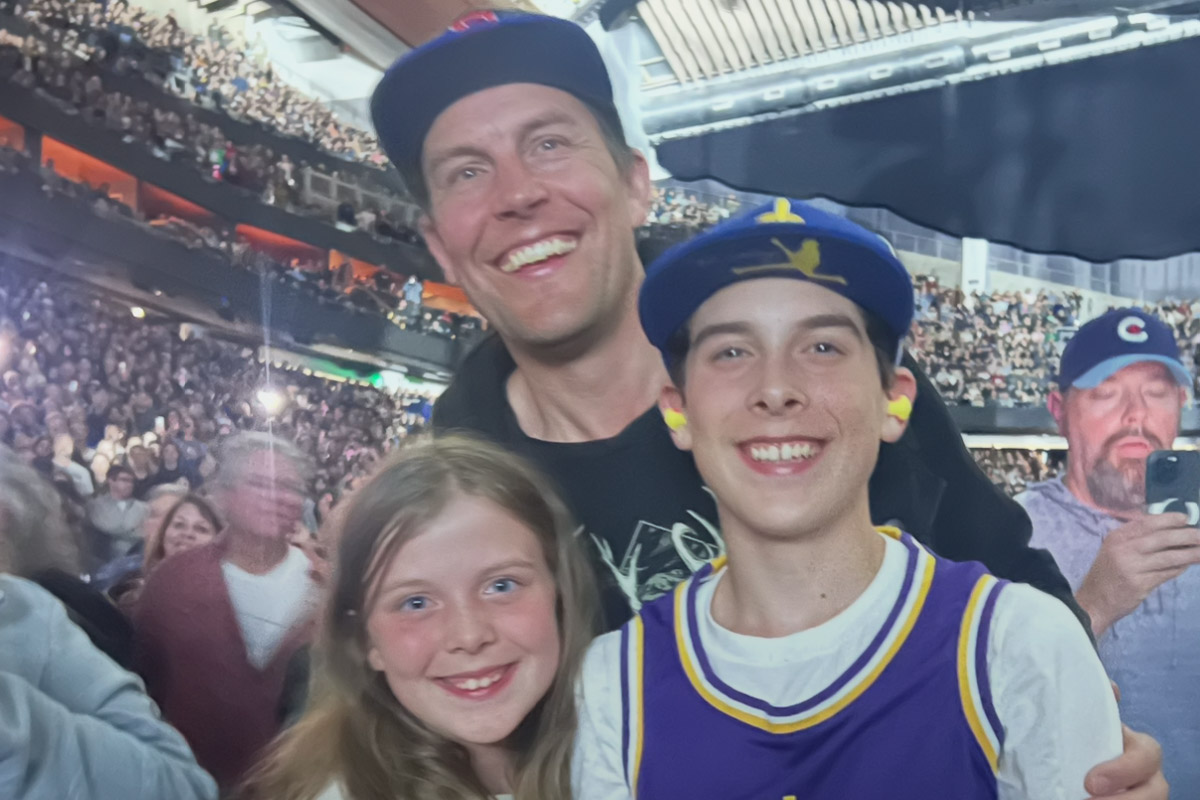
Morrison now prioritizes spending time with his kids over racing. Photo courtesy of Brian Morrison.
Morrison loved directing the race and sending runners out on a course he had created himself, but he says the stress and pressure of runner safety was just too much for him. “I feel like it took years off my life,” he semi-jokes, “The worry that I had, because it’s a 100-mile race, which in any scenario is a big undertaking for people, but the Teanaway is especially rugged as Washington trail races go.”
But what he really misses is the trail work in the lead-up to the race. “Once the snow would melt out, we’d start taking our hand saws out with us on trail runs and doing trail work, and those were just the best days ever.” Again, it was the community aspect that most resonated with Morrison: “Those were eight-hour days, but it was a run/hike mix. He reminisces, “That’s the part of the race that I really miss. Just the prep leading up to it, and the time with friends on the trail.”
The Future of the Sport
Nowadays, Morrison has a more casual relationship with running. He says he runs as consistently as he ever did, but there’s family life to enjoy, and he just doesn’t have a strong desire to race. “That said,” Morrison pauses, “I still think there’s something really special about the 100-mile distance.” He loves the inevitable ups and downs, figuring out the highs and lows — saying that “working through those is really pretty magical” — and experiencing life in a day.
“I hope there’s a point where I get the fire back to want to run a hundred, or maybe more than that,” says Morrison. After the toll that Western States took on his physical and mental well-being between 2006 and 2009, it seems like he has a much better relationship with the sport now. “That pursuit of Western States became pretty unhealthy for me, I think,” says Morrison. “Just trying so hard to prove that [2006] wasn’t a fluke. But it probably was a fluke, in all honesty, but I just didn’t want the sport to perceive it that way.”
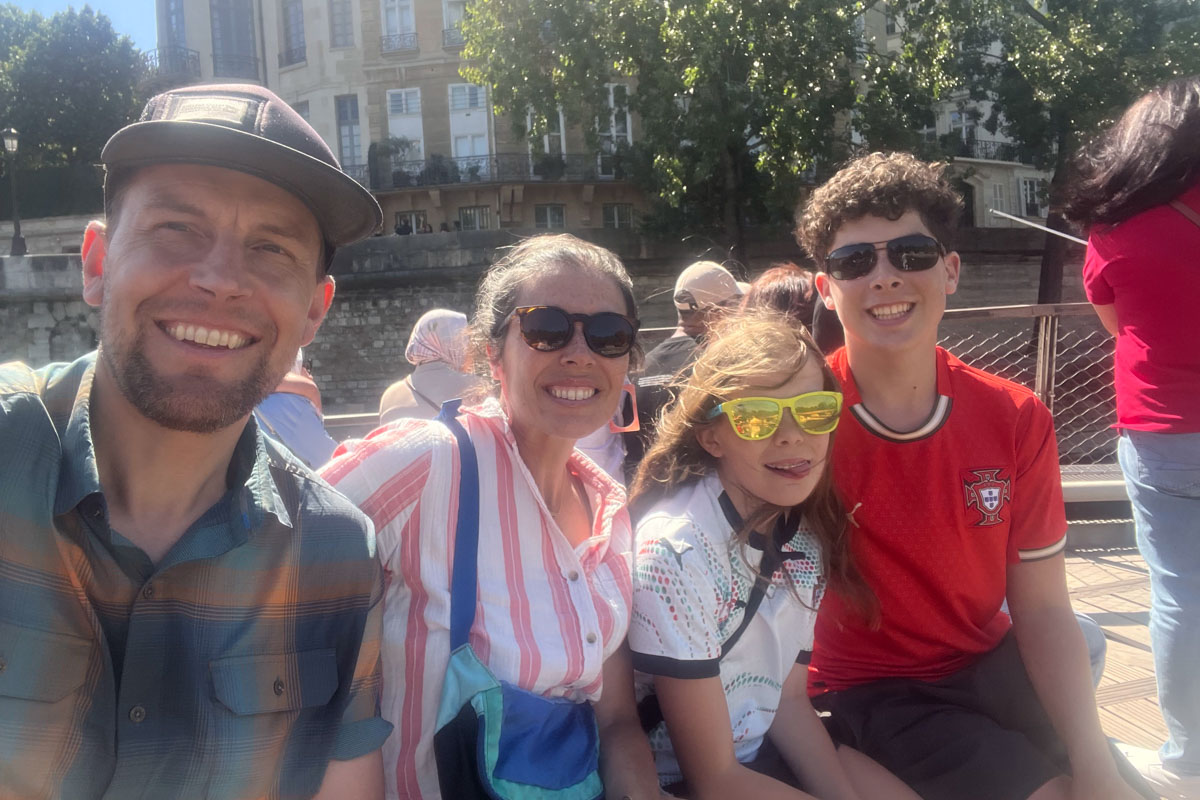
Morrison with his family. Photo courtesy of Brian Morrison.
The sport has changed a lot since the days Morrison worked at the Seattle Running Company, selling Montrail shoes and getting race info from printed fliers. Morrison thinks it has changed for the better. “I’m sure some people would disagree, and maybe the trails have become too crowded, or whatever, but generally, I think that the growth of the sport has been so exciting to see.” He’s glad he got into it when he did, and says those days were fun, but he believes that the professionalization of the sport — athletes receiving salaries that they can live on — is a positive evolution.
Morrison is going to Western States this year, but only as a casual observer. He says he can’t wait to see the fierce competition on this year’s startlist firsthand. He’s also going to TrailCon, the trail running industry conference in Olympic Valley held in the week leading up to Western States. He’ll be there with “Given to Fly,” a tale of a different era of the race. His excitement for the sport and for this race is palpable, but he says, “The idea of going down there with no pressure of racing sounds really nice as well.”
Call for Comments
- Have you read “Given to Fly,” and if so, what did you think?
- Do you have a Brian Morrison story you can share?
- Have you ever become so obsessed with a race that it became a detriment to your life? Were you able to walk away from it?