There is a gap between having a disability and finding a community that truly understands your experience that can make it feel isolating. There is a gap between sustaining a life-changing injury, receiving healthcare, and returning to everyday life that can make recovery really hard. It’s societal: a lack of infrastructure, a lack of funding, a lack of thought. It’s in these gaps that organizations like Achilles International and people like Brandon Stapanowich step forward.
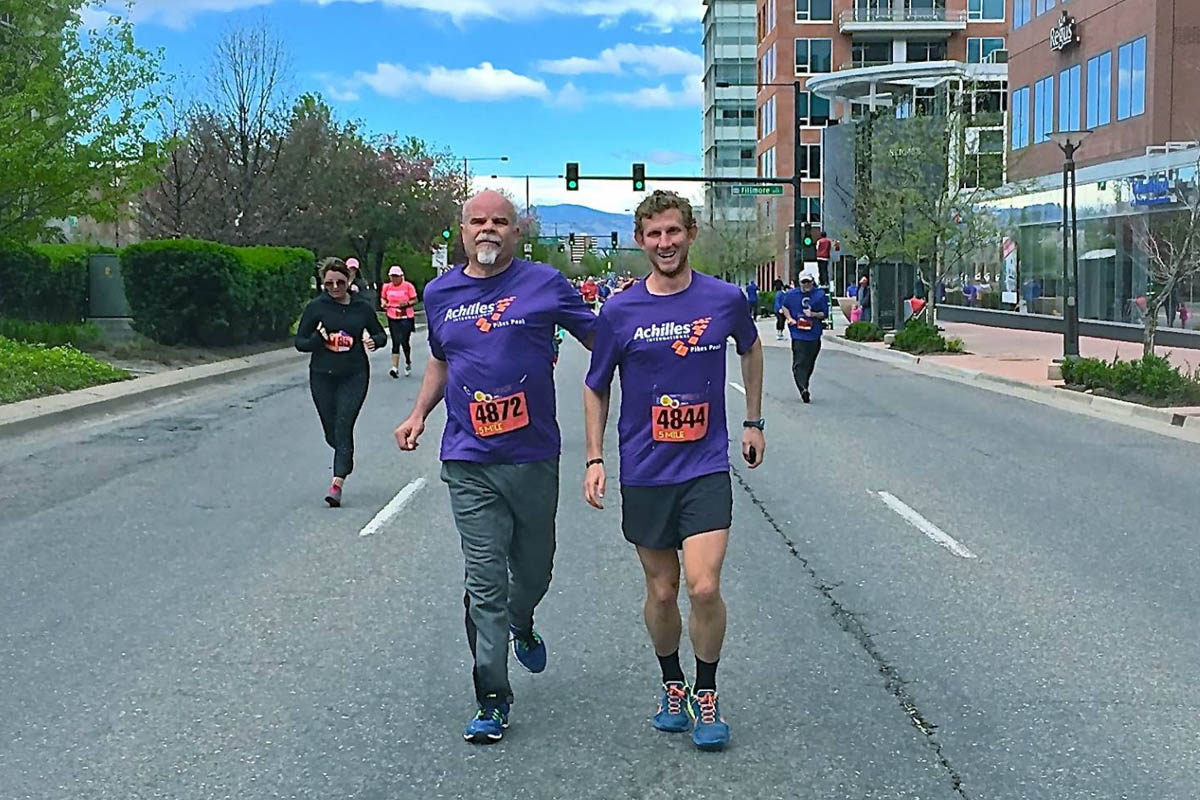
Brandon Stapanowich (right) guiding a visually impaired athlete at the 2016 Cherry Creek Sneak 5k in Denver, Colorado. Photo: Achilles Pikes Peak
When I chat with Stapanowich on a Monday morning, I think our conversation will mainly center on his work with the Pikes Peak chapter of Achilles International. The organization helps people with disabilities participate in athletic programs and create social connections, and Stapanowich started the Colorado Springs-based chapter in 2014. Stapanowich organizes weekly running sessions and more for the community.
But he opens our conversation by telling me he’s got a day off from working at a school as a physical therapist, where he provides individualized assistance to students with significant motor impairments. In other side notes, he tells me he coaches his son’s soccer team and has been a running guide for a few of his friends who are visually impaired during their projects and races. He’s looking forward to summer vacation, but the mild winter in Colorado has him really worried about climate change. Stapanowich’s capacity to care is instantly evident. Ultimately, it is life-affirming and inspiring.
Achilles Pikes Peak
When Stapanowich finished the 2013 Desert RATS 50 Mile in third place, he was narrowly out-kicked by Michael Oliva, with whom he later became friends on Facebook. When his competitor posted photos from his work helping to set up the Achilles chapter in Denver, Stapanowich — who has a deaf brother — was intrigued. The ethos of promoting running for everybody aligned with what he did professionally, so he asked Oliva how he could start a chapter that hosted group runs himself. Stapanowich remembers, “Michael told me, ‘You know, you just pick a time, pick a place, and show up and be consistent, and people will come.’” Of course, in the beginning, there were weeks when Stapanowich would turn up and be the only person there. But over time, the group grew, and now around 20 people turn up to run regularly.
“You get people from such broad experiences in life,” says Stapanowich, “and running is that unifying thing.” Stapanowich explains that some people join each week just to get a little bit of exercise for the day, some want to be healthy for their grandkids, and others purely seek the social interaction. Some people have been with the group for over 10 years, maintaining consistency from middle school, high school, and through to adulthood. They start off wanting to be able to just run three miles without having to take a walking break, and develop toward completing races. “It’s rewarding to see that development in people,” Stapanowich says.
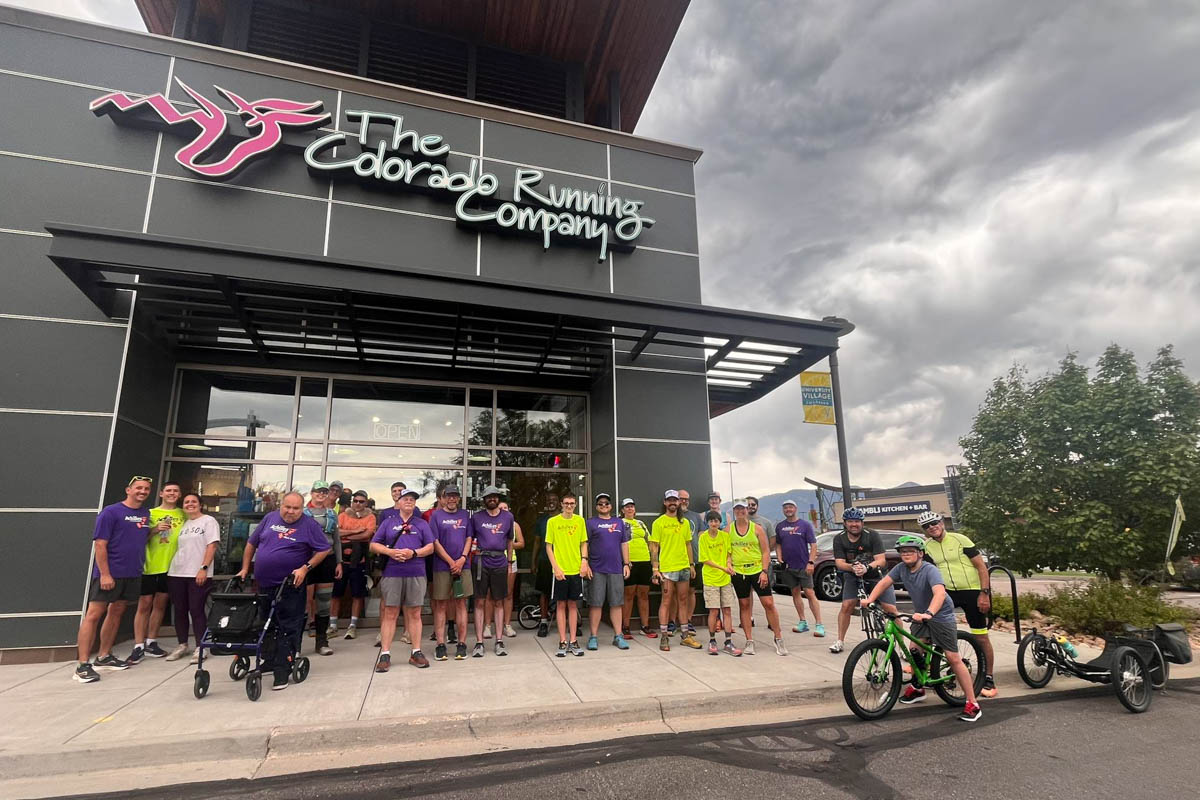
The Achilles Pikes Peak group before a workout in 2025. The Colorado Running Company has hosted the chapter since the beginning. Photo: Brandon Stapanowich
Achilles International has 29 chapters in the U.S. and a similar number worldwide, spanning Oceania, South America, Europe, South Africa, and Scandinavia. But, says Stapanowich, “I think for whatever reason, different chapters have kind of a different profile.” The Pikes Peak chapter is open to people of all ages and backgrounds, and Stapanowich says that it’s not unusual for the socialization after the run to be longer than the run itself. He says, “The store’s closed, it’s dark, it’s a parking lot, but people are just still hanging out and talking. And I think that’s just as important — if not more important — than the physical benefits.”
Stapanowich has been leading this group for 12 years, with others taking over at different times, and he is confident that with or without him, the group will remain a cornerstone of the community in the area. Watching this group grow into its own self-sustaining entity has been rewarding. Seeing the need for a group like this in the community was the driving factor at the beginning, but now that Stapanowich has two children of his own, he’s finding motivation in wanting to set a good example for them. “I think parenting is such an interesting challenge,” says Stapanowich. “How do you teach your kids how to be a good citizen in the world? I think there’s a lot more power in demonstration, rather than just telling them. So hopefully they see this, and they get some perspective on the variety of experiences that humans have.”
When I fumble for a more articulate way to simply ask, “Why are you so helpful?” Stapanowich relates it back to being a good role model. In his early life, his own parents set an example as caregivers to his maternal grandfather, and they instilled the lesson that helping others is important. He sees that growing up — especially with a deaf brother — he simply learned that people have differences, but that shouldn’t set them apart. It’s something that he and his wife, Melissa Stapanowich, have been reflecting on more recently since she started a running program in a juvenile detention center. “You know, we’re just people at the end of the day,” says Stapanowich, “and it’s about just coming together and recognizing that we’re more similar than different.”
Early Years
Stapanowich grew up in Charlotte, North Carolina, with his brother and parents before the family moved to Asheville, North Carolina, to be closer to his grandfather. The exposure to the mountains and wild places of North Carolina had a big impact on him, but the grip of running hadn’t yet taken hold. Stapanowich grew up playing soccer and remembers being a relatively strong player until his first year of college, when he recalls spending more time on the bench. Whether he got burned out by collegiate soccer, humbled by it, or it simply felt like more of a job than a choice, the sport lost its appeal. He transferred to a different school — one further in the mountains — and he started running.
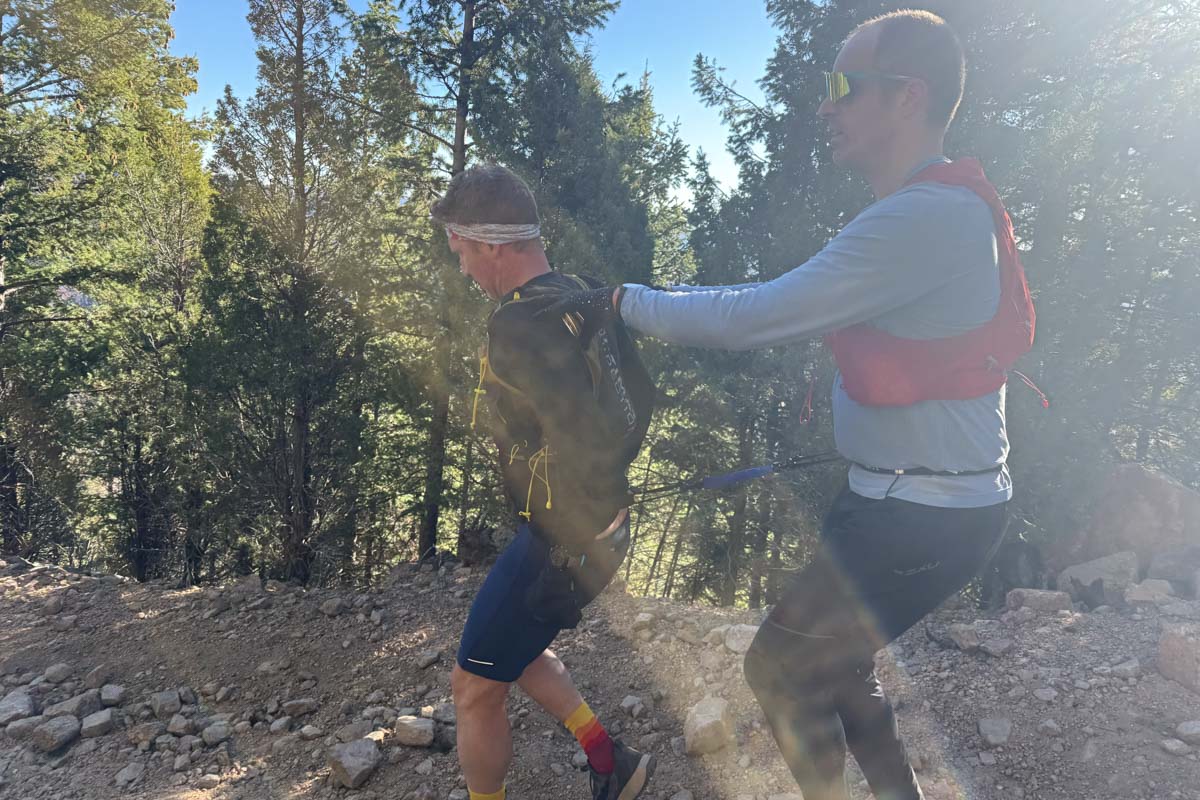
Brandon Stapanowich guiding Kyle Coon on a trail outside of Manitou Springs, Colorado, as he prepares for the Leadville 100 Mile this year. Photo: Dreama Walton
In terms of his career path, though, he didn’t know what he wanted to do, nor what to study at college. He considered pursuing audiology, inspired by his brother, but ultimately opted for exercise science. He says that many people with that degree end up becoming physician’s assistants or physical therapists, but being able to offer physical interventions appealed to him more than a pathway in medicine. “Once I started physical therapy school,” says Stapanowich, “the sports injury side of the field wasn’t as engaging to me.” Once he realized he could work with kids as a physical therapist, the pathway was clear: “You know, a lot of times kids aren’t going to just do three sets of 10. You have to make it fun. You have to make it engaging. And so that’s been a great career for me.” He started his work in a clinic and now enjoys engaging with kids in their everyday environments: on playgrounds, in hallways, and during physical education classes.
Relationship with Running
Providing this care in a way that is engaging and enjoyable, rather than the rudimentary practice usually associated with physical therapy, is key to understanding Stapanowich’s approach to sport as a whole, and perhaps even his general outlook. It seems that for Stapanowich, everything is filled with childlike wonder. “I think that’s another thing running gives us,” he says. “You can run to compete, but I think the majority of us aren’t competing for podiums. We’re competing because, on some level, it is fun.” He goes on to say, “If you can distance yourself from the watches and the results, and just run for the sake of being out there and get back to that exploration and that joy, I think it is the best thing I’ve found for play as an adult.”
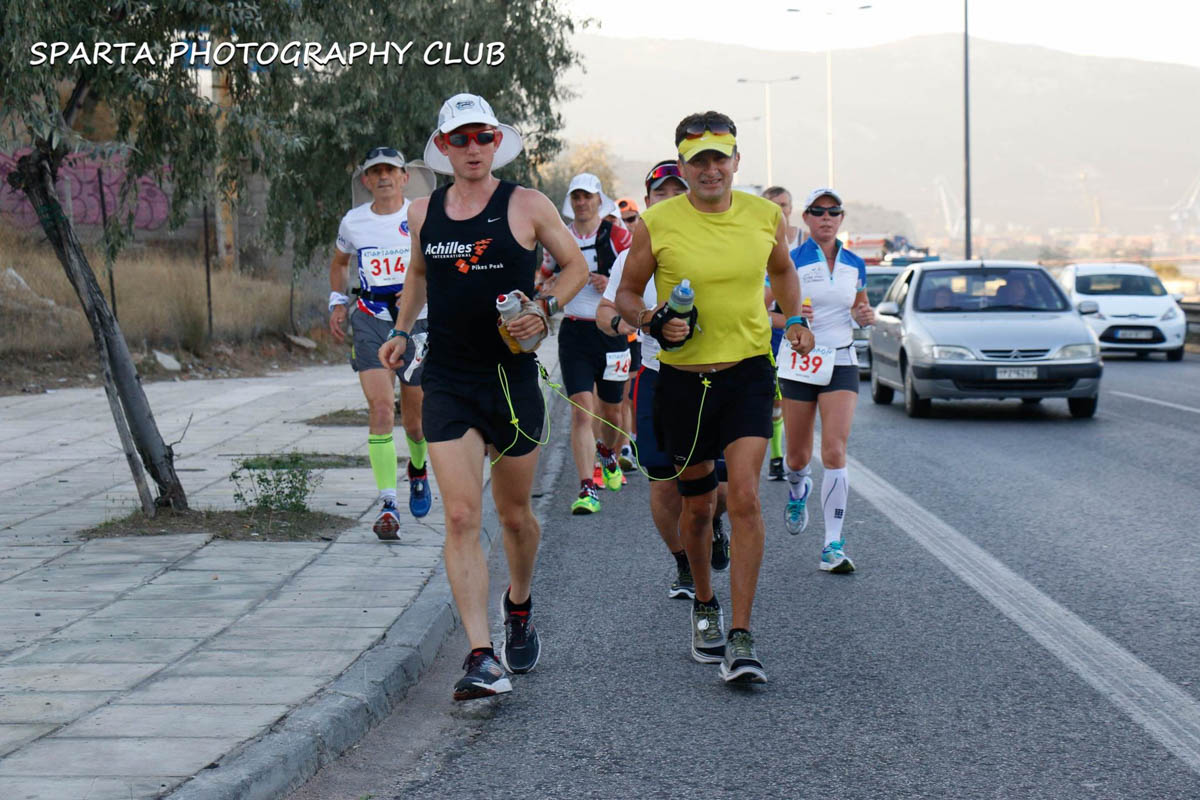
Stapanowich (left) guiding Jason Romero at the 2016 Spartathlon. Photo: Sparta Photography Club
When Stapanowich first got into trail running, he enjoyed that it felt like counterculture. “I hadn’t heard of 100-mile races until I moved to Colorado,” Stapanowich says, “and then I met up with some local groups, and there are these guys in their 40s, 50s, and they look just like regular people, but they’re doing these incredible, super-human endeavors and running hundreds of miles. And I think there was a part of that which appealed to me, that it seemed so niche, and that it still does.” Stapanowich explains other reasons why the sport appeals to him now: “I think there’s a special challenge that you can get from spending long days in the mountains. I think they’re relatively safe challenges. We’re not moving at high speeds. It doesn’t feel like an adrenaline-seeking sport, but you still have that struggle and that accomplishment. And that is a fulfilling experience.” It’s not just the physical benefits that Stapanowich enjoys, and says, “Just to have the time out there, to think, to not think, to be removed from the modern distractions, I think that’s harder and harder to come by. And that’s definitely something that still draws me to it. There’s a lot of peace out there.”
A lot of peace. It’s funny that something so good for our mental and physical health could be considered counterculture. Stapanowich muses, “I wonder if the world would be better if we focused more on this stuff than the other things that kind of get in the way, and are more associated with being an adult?” This is where he draws so much reward from his work. While he values being able to do things with his body — challenging it and seeing growth — he also loves being able to help a child explore their environment and expand their opportunities in this way, too. The same goes for having access to wild spaces. As a parent, Stapanowich has been reflecting anew on childhood. His son is involved in youth sports, but he also has free playtime, during which he can decide how and where he wants to play. “You know, safely,” asserts Stapanowich, “but without always having close supervision, or having structured rules around it — giving that freedom for exploration.”
A Family FKT
Stapanowich is an accomplished trail runner himself, with podium performances at the 2020 HURT 100 Mile and 2023 High Lonesome 100 Mile, and he’s running the High Five 100 Mile this year. But perhaps his biggest ultrarunning endeavor was setting a supported fastest known time on the 1,175-mile Mountains-To-Sea Trail in 2022. The route crosses North Carolina, and he completed it in 23 days, 13 hours, and 28 minutes. He was supported by his wife and then 11-month-old son, Felix. They met him every 10 to 20 miles for resupplies, with Melissa managing food, laundry, and the day-to-day logistics. The FKT is a remarkable achievement, of course, but a huge amount of acknowledgment must go to Melissa for caring for both their infant son and her ultrarunning husband for more than three weeks. Stapanowich says that when they reflected on it together, she saw it as a special adventure for all of them. “She really cherished that bonding time with [Felix], spending all day with him every day and exposing him to a variety of things, different travel, different foods.”
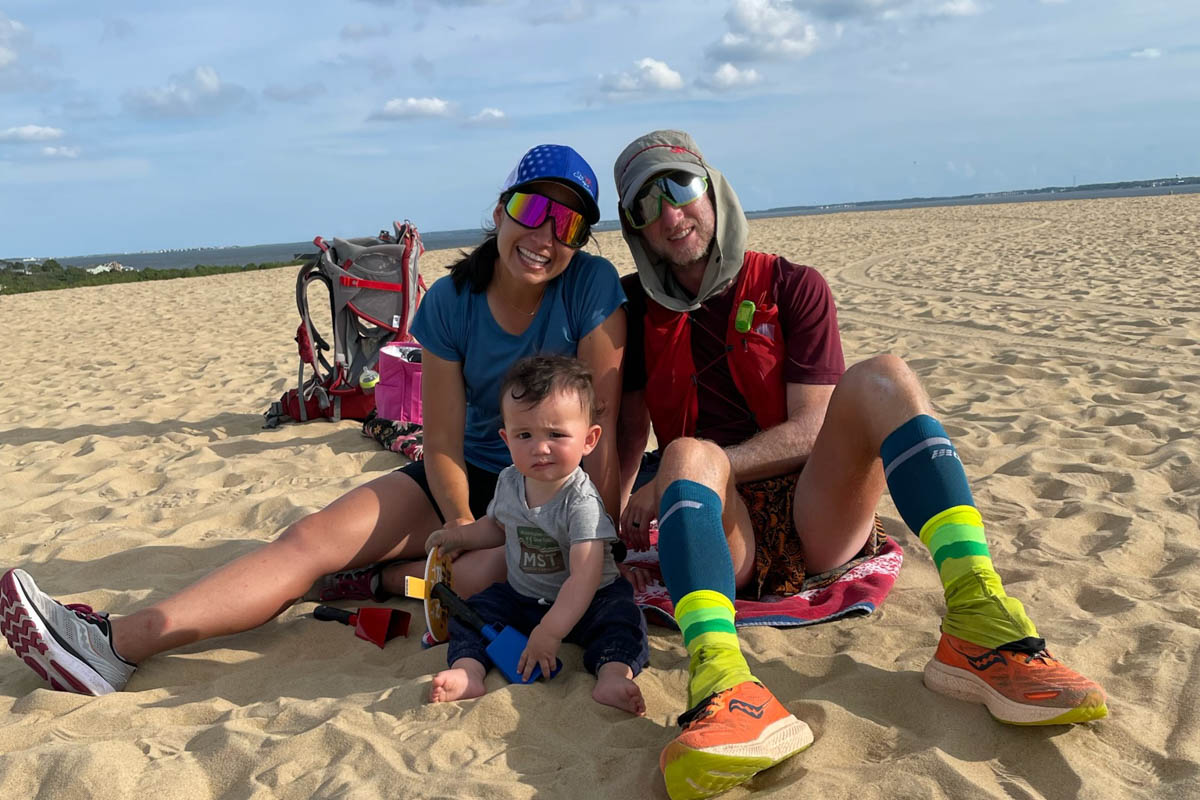
Stapanowich with his wife and son after setting an FKT on the Mountains-to-Sea Trail in 2022. Photo: Brandon Stapanowich
It was very much a family endeavor, as is evident in the film they made about the achievement, “From the Mountains to the Sea: A Family FKT.” In the film, what really strikes me is Stapanowich’s propensity for positivity. When he begins to tell the audience about how the weather has changed, and it’s really rainy, one might believe he’ll go on to say how challenging the day is becoming. Instead, he tells us how many animals and insects have come out because of the rainfall, and how green everything is. His justification for this admirable outlook is that the U.S. East Coast is so different weather-wise from Colorado, and all the humidity, bugs, and itchy plants were part of the experience. With the rainfall came lush greenery and bright orange newts. It’s about perspective: “There’s not good or bad, there’s just different,” says Stapanowich.
The Future
It’s clear that Stapanowich is on a trajectory aimed at helping others: He will continue to endeavor to be a good role model to his young children; he will continue to help children through his physical therapy work; and he will continue to help the Pikes Peak chapter of Achilles International thrive. On a personal level, he is looking forward to getting back to having some ultramarathon adventures of his own, but he highlights the spiritual experience as the main draw nowadays. “Of course, you’re going to be out there and trying hard and doing the best you can,” he says, “but at the end of the day, it’s not about how quickly you finish it, just finishing it will be an accomplishment.”
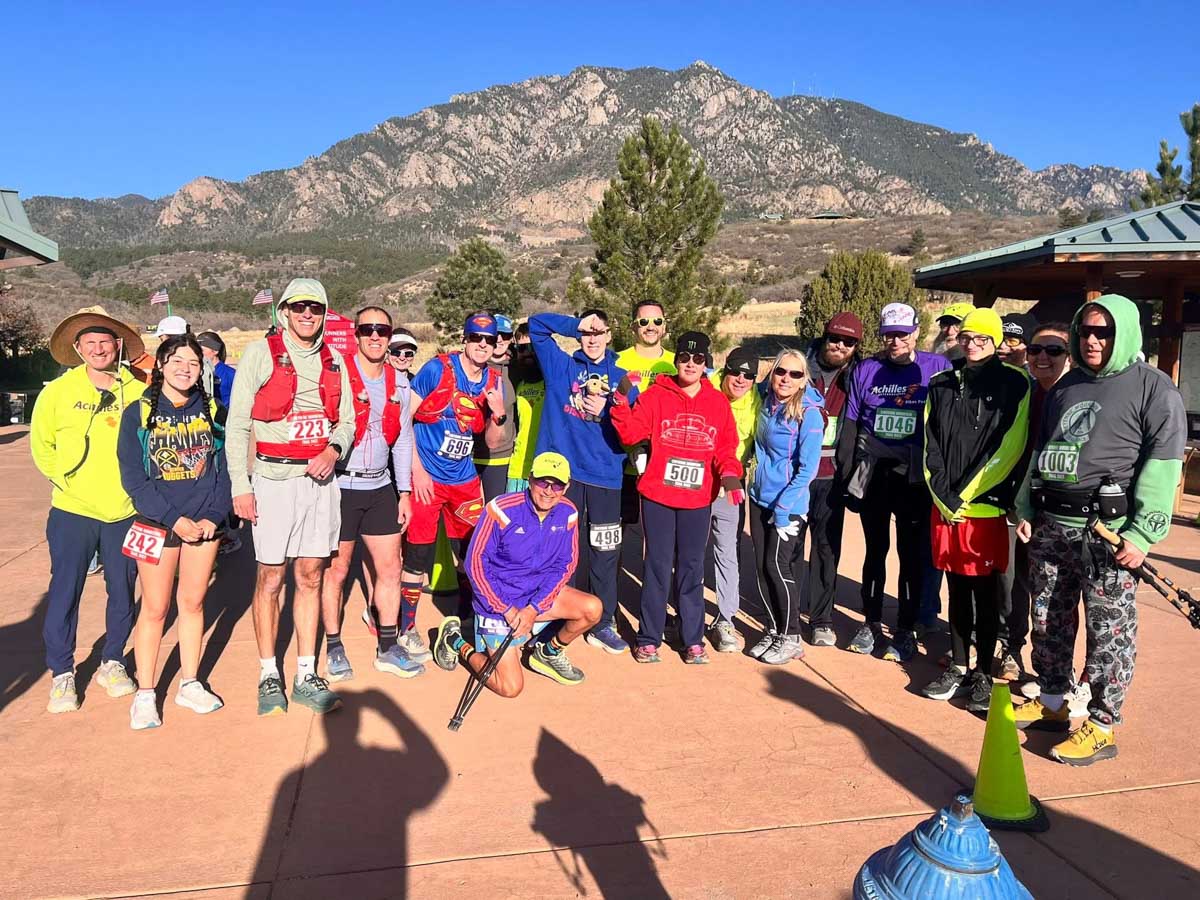
The Achilles Pikes Peak and Achilles Denver chapters before the 2026 Cheyenne Mountain Trail Race. Photo: Brandon Stapanowich
What does the future hold for Stapanowich as a person? He says he’s looking forward to “just being embracing of the mystery of things. I think as adults, it’s tempting to think that we know everything, and we’re experts in this field or that field, but I feel more comfortable saying, ‘I really know very little about the world, and I’m just here to learn and explore and enjoy the journey.'” It sounds like a marvelous way to approach an ultramarathon, a gorgeous way to approach parenthood, and a lovely way to exist in a community: with childlike wonder.
Call for Comments
- Do you have a Brandon Stapanowich story you can share?
- Have you been involved in Achilles International or a similar program?