In a giant leap for humanoid kind, a robot named Lightning outran all its human and robot competitors at the 2026 Beijing E-Town Half Marathon, on April 19, finishing in 50:26, faster than any human — or humanoid — has before.
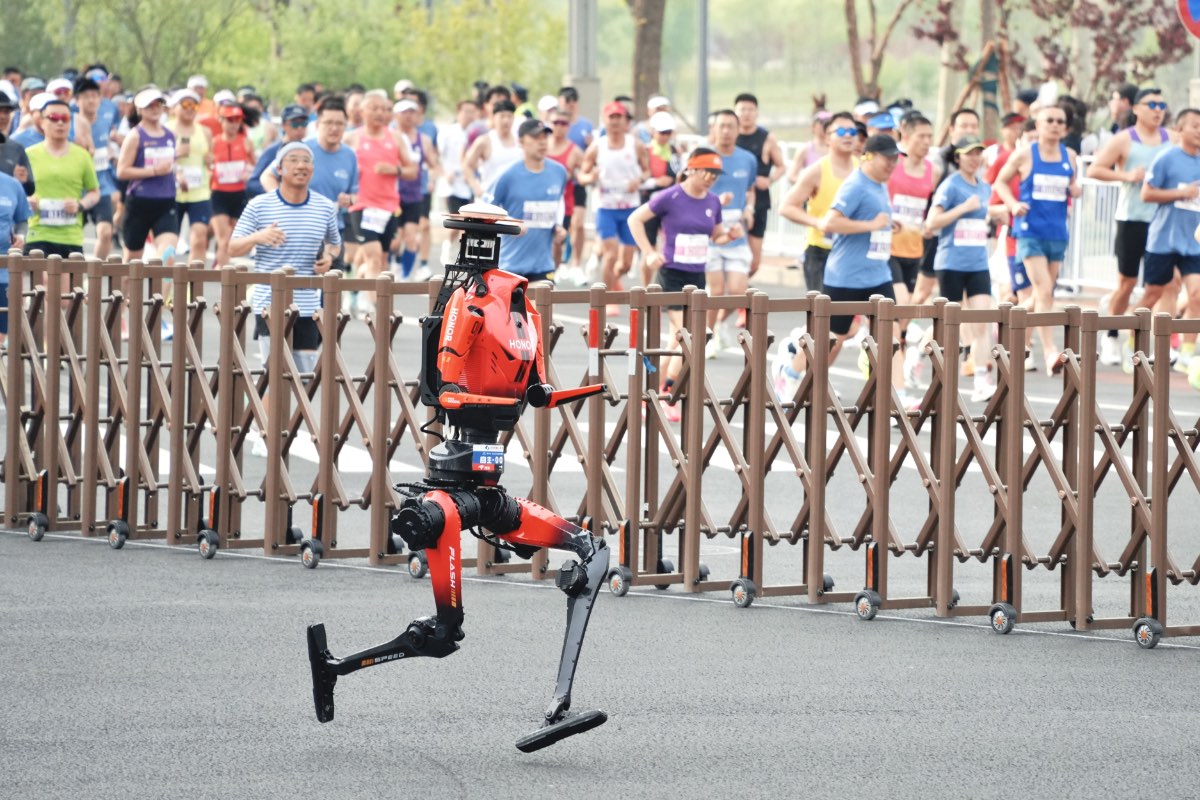
The humanoid robot Lightning won the 2026 Beijing E-Town Half Marathon in 50:26, well faster than the human half-marathon world record. Lightning operated autonomously and was among the more than 300 robots and 12,000 runners participating in the event. Photo: Wang Liangyuan/VCG via AP
Lightning and the other two robot podium finishers were built by the Chinese smartphone and consumer electronics maker Honor, whose representative said in a press conference after the race that the company has been making humanoid robots for only a year and that its work has focused on adapting technologies from other electronics industries into robotics.
This year was the second edition of the Beijing E-Town Half Marathon, and it reportedly hosted more than 12,000 humans and 300 humanoid robots — on parallel but equal courses. For the humans, Zhao Hai-Jie of China won the men’s race in 1:07:47, while Wang Qiao-Zia, also of China, won for the women in 1:18:06.
If last year’s robotic entrants won hearts and minds in the match-up of humans versus humanoid robots, this year’s competitors took that sentiment and ran away with it. Crowds of astounded and inspired onlookers gaped, their smartphones recording, as the mechanical athlete blazed by at an average pace of 3:50 minutes per mile. To put that in perspective, Jacob Kiplimo (Uganda) and Letesenbet Gidey (Ethiopia), the men’s and women’s half-marathon world record holders, ran 57:20 and 1:02:52, with mere average paces of 4:22 and 4:47 minutes per mile.
Given the performances — or lack thereof — of the humanoid robots in the 2025 event, which had a fair amount of excitement leading up to it, the jump in robotics technology is astounding. Lightning was 100 minutes faster than the 2025 winner, the barrier-breaking, remote-controlled electric athlete Tiangong Ultra, a startling margin of improvement. Last year, Tiangong Ultra was the only robot to make it to the finish line under the 3:10 cutoff — finishing in 2:40 — and only six of the robotic entries made it to the finish line at all. This year, Lightning was among the 40% of robot entrants operating autonomously. The race also had a category for remote-controlled robots.
So how did the humanoid robot become such a fantastically fast competitor? Your author’s gut feeling is that this amazing performance likely has nothing to do with high-carbohydrate fueling strategies, as spilling Coca-Cola on my previous laptop did nothing to speed up processing times or increase performance. What was eye-catching was that this humanoid robot basically had no eyes, head, or hands. This suggests that if humans are going to take competing against robots more seriously, we will have to come to terms with more extreme weight-saving strategies that may or may not require a visit to a surgeon.
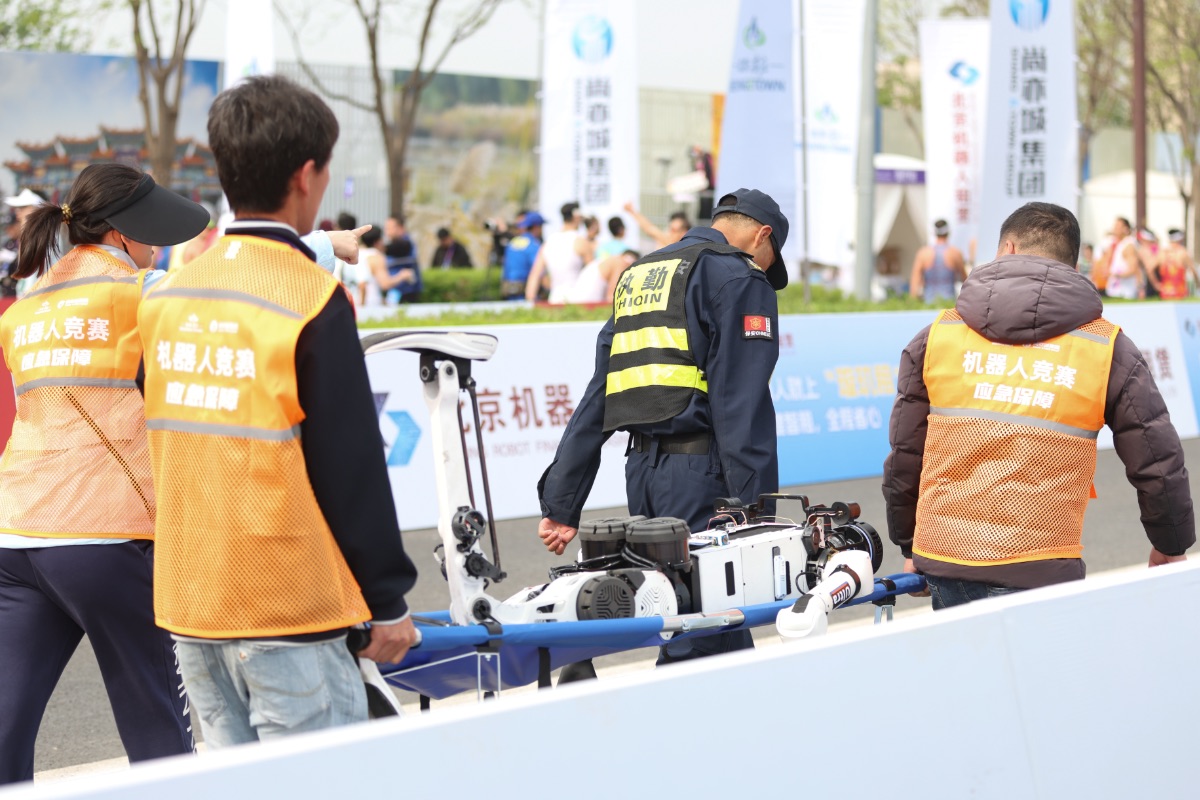
Not all of the 300-plus robots reached the finish line at the 2026 Beijing E-Town Half Marathon, but this year’s robot performances represented an incredible leap forward in robotics technology compared to the 2025 event. Photo: Yang Yuran/China News Service/VCG via AP
In reality, post-race discussion on the robots’ performance improvements has focused on the fact that Honor and the other top-performing companies implemented autonomous and navigation technologies from other electronics industries in their robots, whereas last year, the robots were remotely controlled by nearby humans. Lightning, for example, appears to have a LiDAR (Light Detection and Ranging) device instead of a head, the same technology currently used in the autonomous automobile industry to create continuously updating scans of the conditions surrounding a car.
It is worth noting, however, that so far, the records of our coveted trail races and ultramarathons appear safe from our voltaic counterparts, as their success has been limited to pavement races and they have not been tested on rugged, mountainous trails. But make no mistake, their vast road running improvements in just a year indicate that the robots are coming for our records, which means we need to find ways to quickly evolve and adapt.
Perhaps we need to borrow a page from the playbook of the bicycle world, which in recent years has leaned heavily into advancing electric bikes — or e-bikes. Where are e-running shoes with battery-powered carbon plates that send us flying uphill with galvanic strides? Perhaps Nike knows what humankind is up against with their eye-catching Project Amplify battery-powered footwear system. Or Hypershell with its exoskeleton development. Our UTMB records might still be safe for a little while, but who can predict what humanoid-robot-running advancements there will be in 2027 and beyond?
You can learn more by watching the event’s livestream:
[Editor’s Note: Click here to watch the film on YouTube.]

