[Editor’s Note: Filippo Caon is an Italian author and host of “Pionieri,” an Italian podcast promoted by La Sportiva, on the history of trail running in Italy, which features the voices of many of skyrunning’s early protagonists. This piece was translated from Italian by Ulla Pers.]
It’s August 1994. For a week now, the Grand Hotel Aspen in Aspen, Colorado, has been overrun by a noisy group of Italians who are kind of like the Icelanders at the Great Northern Hotel in the television series, “Twin Peaks.” They’ve brought with them entire wheels of Grana Padano Parmesan cheese.
But unlike the fictional Icelander businessmen and their raucous celebrations, these guys are athletes. Leading the group is Marino Giacometti, a mountaineer and founder of the organized sport of skyrunning as well as the first skyrunning circuit, the Fila Skyrunner Trophy. The Italians are there to partake in the inaugural Aspen–Castle Peak SkyMarathon, the American stop of the quickly growing series. While the circuit was born in Europe two years earlier, it was American Matt Carpenter who would win the race up the 4,352-meter (14,278 feet) Castle Peak that year, and the race became a meeting of two distinct mountain cultures.
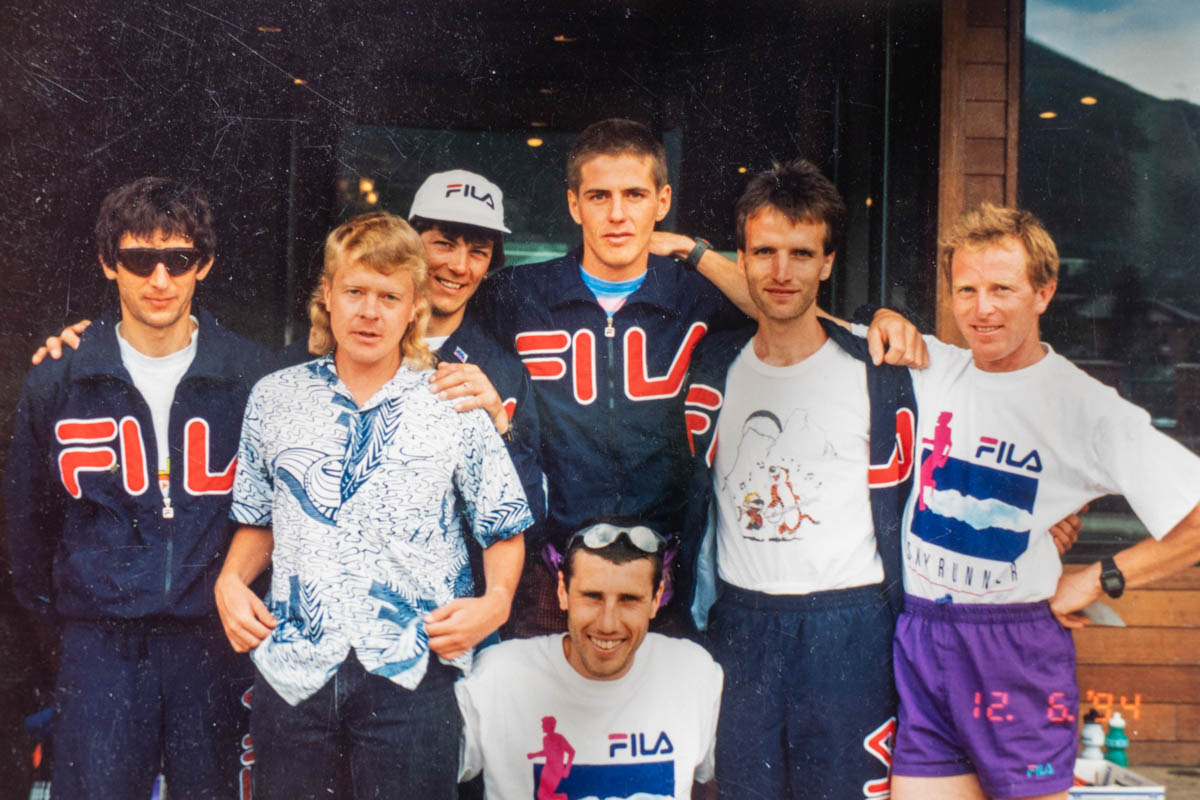
The 1994 Fila Skyrunning Team (left to right): Adriano Greco (Italy), Jay Johnson (U.S.), Fabio Meraldi (Italy) (front), Matteo Pellin (Italy), Silvano Fedel (Italy), Matt Carpenter (U.S.), Ettore Champretavy (Italy). Photo courtesy of Filippo Caon.
Although skyrunning has continued to flourish in Europe on highly technical courses that remain close to Giacometti’s original vision in the intervening three-plus decades, the sport has seen far less growth in the U.S., where skyrunning events lean far more toward mountain running than true skyrunning. But at that start line in 1994, when American skyrunners lined up against their European counterparts, there was only anticipation of what the fusion of the two styles of skyrunning, which had developed independently up until then, would produce on the day.
Giacometti’s Skyrunning Vision
Giacometti’s original idea for skyrunning was simple: to ascend and descend the 4,000-meter peaks of the Alps as fast as possible, using the most direct, doable route. Or, put more poetically, to travel where the earth meets the sky.
To appreciate the weight of his intuition, we should remember that at the time, what came to be known as fast-and-light mountaineering in the Alps was barely spoken about. Back then, mountaineering had a traditional feel. It’s also important to remember that the 4,000-meter peaks in the Alps, although roughly as high as the 14ers — U.S. mountains higher than 14,000 feet (4,267 meters) — are characterized by a completely different environment than most of their American counterparts. They are almost always covered by glaciers, crevasses, and seracs, which require much more technical skill. Running on glacier-covered 2,165-meter (15,203 feet) Monte Rosa on the Italian-Swiss border is not at all like running on Colorado’s non-technical 4,401-meter (14,439 feet) Mount Elbert.
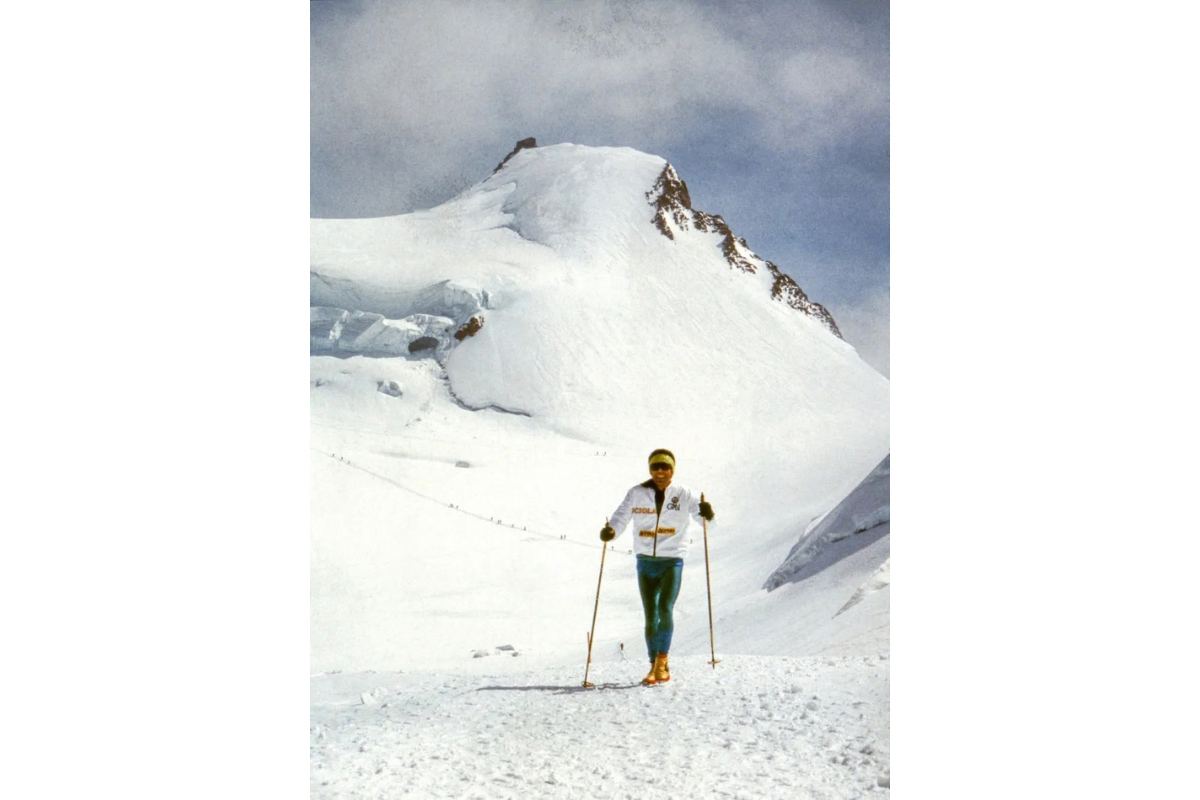
Marino Giacometti during his Monte Rosa fastest known time in 1989. Photo courtesy of Filippo Caon.
The origins of a global skyrunning race series date back to 1988, when Giacometti was at Pumori, a mountain in Nepal’s Khumbu Valley, during a scientific expedition investigating adaptations to hypoxia. Giacometti was ascending and descending from Everest Base Camp almost daily, and on one of these trips, he ran into Enrico Frachey, who had recently become CEO of Fila Sport, a well-known Italian running shoe company in decline. They began fantasizing about organizing running races in the Himalayas. Giacometti was interested in studying the physiological aspects of high-altitude performance, while Frachey sought to sponsor a race circuit to reinvigorate the company.
Incredibly, within a few years, they succeeded in making their combined fantasy a reality — not in the Himalayas, but in the European Alps.
Start of the Skyrunning Series
In the summer of 1992, after setting a series of individual speed records on the Gran Paradiso, Matterhorn, and Mont Blanc, some of the iconic 4,000-plus-meter peaks lining the Aosta Valley in the northwest Italian Alps, Giacometti put together the first real outline of a skyrunning race circuit composed of three races in Italy: on Monte Adamello, Monte Rosa, and Mont Blanc. The year before, he had organized an invite-only event up Mont Blanc, starting in Courmayeur, Italy, which was won by countryman Adriano Greco in 8:48:25.
The initial participants of the 1992 series were a haggard group of alpine guides, ski mountaineers, and a few actual runners, the latter being the very same folks who would show up at the Grand Hotel Aspen in 1994 with those Parmesan cheese wheels. It was a motley group of athletes, some of whom were sponsored by Fila Sport, and all of them competing in a sport that, for all intents and purposes, didn’t yet exist.
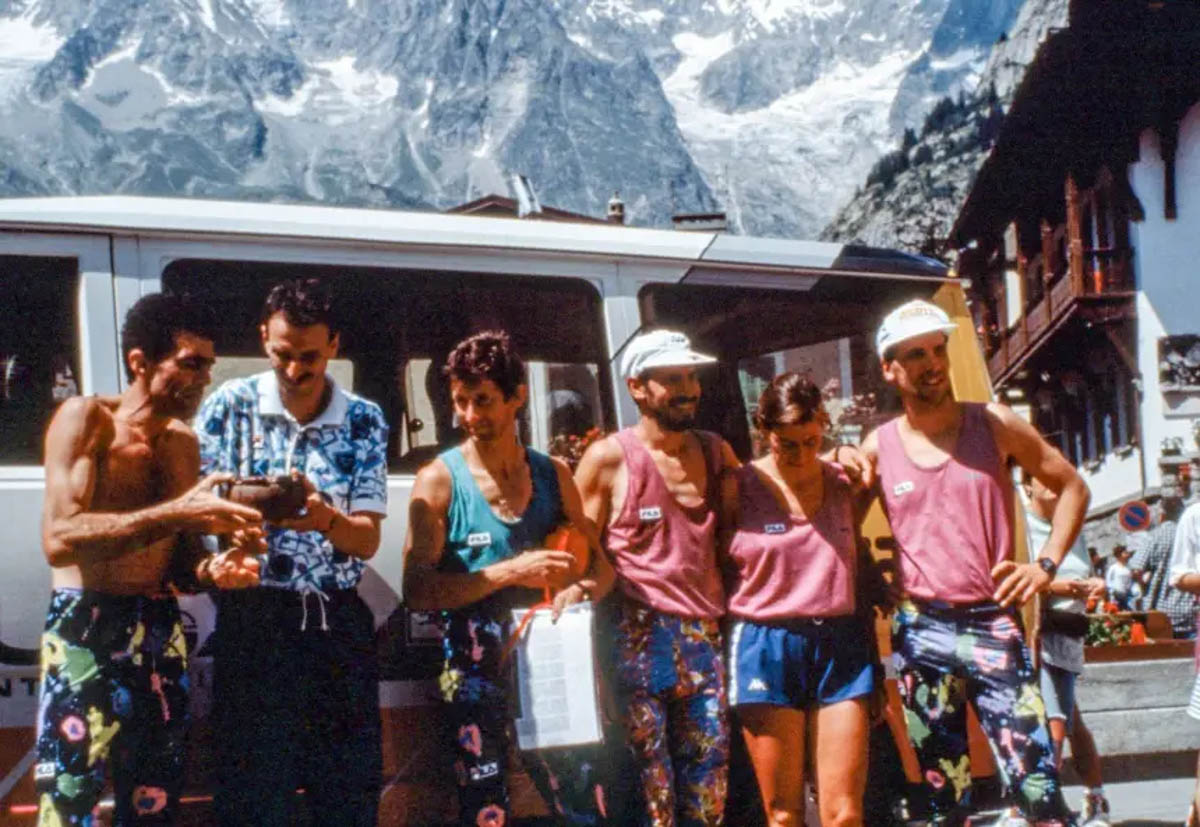
Giacometti’s first event on Mont Blanc in 1991 (left to right): Marino Giacometti, Sergio Rozzi, Adriano Greco, Angelo Todisco, Lucia Castelli, Paolo Fornoni. Photo courtesy of Filippo Caon.
In setting all this up, Giacometti met the athlete already on his way to becoming iconic at every distance: American Matt Carpenter, who was already winning everything from 10k road races to hill climbs. In 1993, he’d set a new record at the Pikes Peak Marathon of 3:16:39, as well as the fastest ascent of the 4,302-meter (14,115 feet) mountain in 2:01:06. Later that year, the Fila skyrunning series invited him to race the Everest SkyMarathon in Tibet — which he also won. In 1994, the Fila Skyrunner Trophy brought the racing to Carpenter’s home state of Colorado.
The Aspen-Castle Peak SkyMarathon
For the 1994 Aspen-Castle Peak SkyMarathon, in addition to organizing the race itself, Giacometti also organized for the Italian athletes who’d been racing in Europe to come to America to compete. The Italians expected to arrive at a grand Hollywood star-studded resort and greet the same 10 or 15 faces they had competed against in the Alps. Instead, they found, very unexpectedly, at least 100 people at the starting line. What the Italians didn’t entirely know was that, by 1994, people had already been running at the top of the Colorado Rockies for decades.
Giacometti, who invented the organized form of the sport — with races, a circuit, and eventually a federation — could shape skyrunning how he wanted. He arrived in America with the will to export an experiment that was having an extraordinary impact on mountain culture in the European Alps. In America, however, both geographically and because of the sport’s history there, it wasn’t considered that far removed from more traditional mountain running. So, the Castle Peak race ended up being primarily a mountain running race, unlike the other races on the circuit.
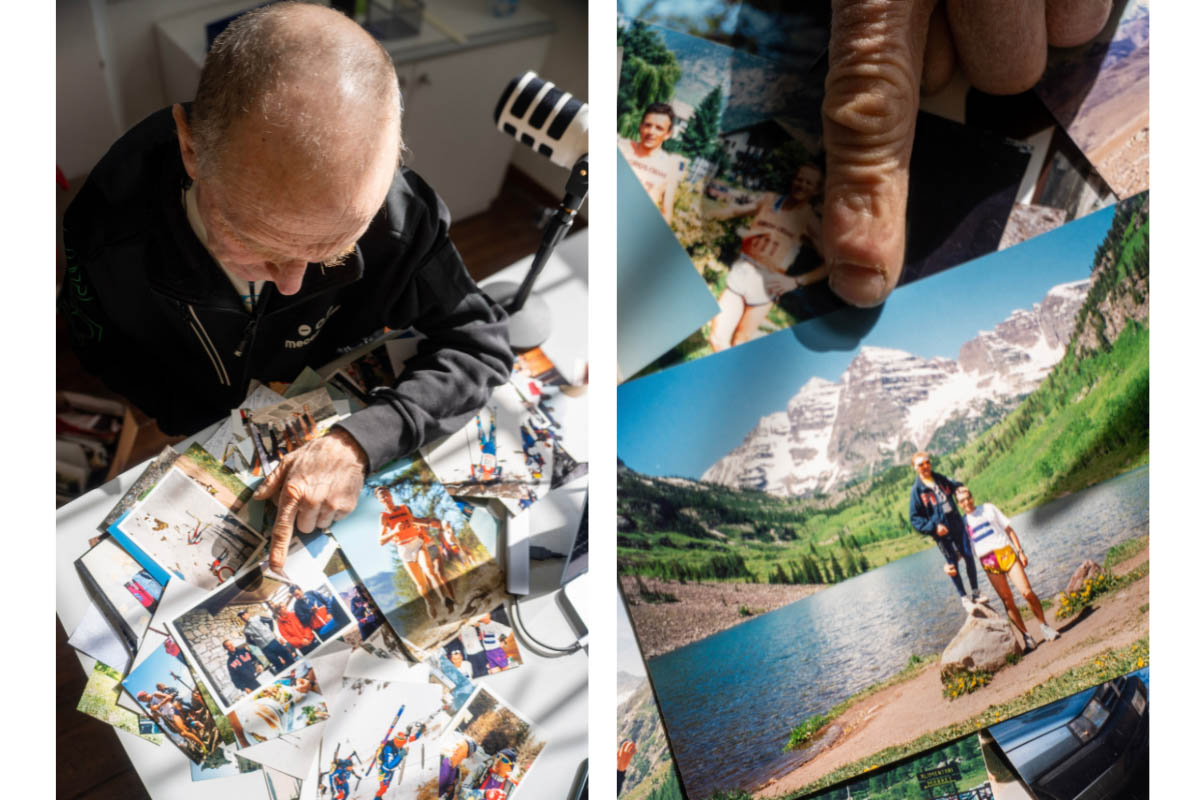
Ettore Champretavy (Italy), who was third at the 1994 Aspen-Castle Peak SkyMarathon, looks at photos of the early skyrunners at the Colorado event. Photo courtesy of Filippo Caon.
On Castle Peak that day, Carpenter beat out Fabio Meraldi for the win by nearly 3.5 minutes with a time of 3:08:27 on the 26.2-mile course. Ettore Champretavy of Italy was third. For the women, Bruna Fanetti of Italy won in 3:56:47, and Americans Melanie McHugh and Ellen Miller placed second and third with times of 4:02:32 and 4:28:41. The top three men and women split $8,000 in prize money and earned trips to Monte Rosa in the Alps and Mount Everest in Tibet for the remaining two races in the Fila Skyrunner Trophy.
Missed Connections
In the end, the Aspen-Castle Peak SkyMarathon only ran through 1998. It seems that due to structural aspects of the world at the time, whereby it was almost impossible to sit in Italy and keep up with what was going on in America, and vice versa, skyrunning remained largely European and Alpine, and the Americans stuck mostly with their mountain running — at least for a while.
In 2004, the modern Skyrunner World Series was launched. Currently, the Skyrunner World Series hosts 19 races, and several national series also take place. In the U.S, a national series is back for 2026, the second restart of an organized national skyrunning series. In some locations, races take place on Alpine and Alpine-esque terrain. In others, races unfold on a country’s highest, wildest terrain, whatever that may be.
Although the 1994 meeting of skyrunning lineages didn’t spark growth in Alpine-style skyrunning in America — perhaps mostly due to a lack of similar terrain — we understand now that it wasn’t without the eventual consequence of the sport evolving into an international phenomenon. And today, though skyrunning has adapted to the diverse mountain terrain around the world, its idea remains pure: Run where the earth meets the sky.
Call for Comments
- Would you like to see skyrunning return to its roots on the big, technical mountains of Europe, the U.S., and the Himalayas?
- Have you participated in the Skyrunner World Series or any of skyrunning’s national series? What were the races like?