• Home
  • Blogroll
  • Book
    • RFP Home
    • RFP Resources
    • Buy RFP
    • Spread the Word
    • RFP Samples
      • Table of Contents (pdf)
      • Chapter 1 (pdf)
      • Chapter 2 - partial (pdf)
    • Reviews and Interviews
    • Media Kit
  • Support iRunFar
  • Archive
  • About
    • iRunFar.com
    • Bryon Powell
    • Contributors

ultramarthon training

  • Store
  • Reviews
    • Shoes
    • Apparel
    • Other Gear
  • News
    • Races
    • Interviews
  • Columns
    • AJW's Taproom
    • Chick's Corner
    • Dakota Jones
    • Geoff Roes
    • Stay the Course
  • Trail Guides
  • Resources
You are here: Home / Columns / Stay the Course / What If Your Heel Pain Isn’t Plantar Fasciitis and What to Do About It

What If Your Heel Pain Isn’t Plantar Fasciitis and What to Do About It

October 9, 2012 by Joe Uhan · 98 Comments 

Stay the CourseTo be known only by your initials means you’ve reached The Big Time: JC, FDR, JFK…AJW. And so it goes with injuries: if it is known only by its initials, you know its impact is widespread and deeply-rooted.

PF – Every long-term runner knows it. Each fears it.

Nothing ruins a perfectly good runner like plantar fasciitis, the dreaded snake bite of the heel and arch of the foot; in essence, nasty foot pain that prevents us from running. Once it sets in, is one of the most menacing and stubborn conditions.

Ultrarunners seem particularly prone to heel and arch pain. Both up and downhill running stresses the foot: the ups stressing the soft tissues of the plantar arch, and the downhills providing ample pounding for the joints.

It’s okay to call your foot and heel pain plantar fasciitis – just like that Coke at the aid station that might be Pepsi or RC Cola. But be sure that you – and your doctor, PT, chiropractor, LMT or other healthcare helpers – are aware of all of the different sources of foot pain. Awareness is the first step in comprehensive treatment and fast recovery from the dreaded “PF” and its brethren.

Plantar Fasciitis, Defined

The plantar fascia is the thick connective tissue that runs from the base of the heel, to the bones of the forefoot. Collectively, with intrinsic foot and ankle muscles, it supports the arch of the foot and helps transfer energy from the forefoot to the rearfoot and ankle, and up the leg.

By definition, in a truly literal sense, fasciitis is an active inflammation of that tissue.

But is foot and heel pain always plantar fasciitis? In a clinical sense, one can only have fasciitis if an active inflammatory event is occurring. Since inflammation only lasts twenty days, indeed, not everyone with persistent foot pain truly has fasciitis.

Not all tissue paper is Kleenex. Not all lip balm is Chapstick. And so it goes, not all heel and arch pain is plantar fasciitis. But as Shakespeare once said, “Is foot pain by any other name, any less excruciating?”

However, to label all foot pain as plantar fasciitis possibly limits one’s ability to quickly and effectively recover from it. Below are some other, equally common causes of foot pain.

Foot Pain: Differential Diagnosis

There are a many possible sources of persistent heel and arch pain. Here are the most common I see, clinically:

Soft tissue sprains and strains. There are several major muscles, tendons and ligaments that span from the heel and ankle to the toes. Besides the plantar fascia, there are several flexor tendons – of muscles originating on the lower leg – that course their way into the foot. Any number of these tissues can become strained under the load of road and trail running. A review of the Rules of Tissue Loading explains how a plantar surface tissue can become irritated.

However, since soft tissue tends to heal quickly given proper treatment, these causes tend to heal rapidly. Those with persistent heel and arch pain – who see me and other medical folks after weeks, months, and even years of pain – tend to have a pain generator of different origins:

Joint Pain. There are over two dozen joints in the foot and ankle complex. With the extreme stress of ultra trail running, these joints could become stiff, irritated, or both.

Joints – articulating surfaces of two bones – require but two things to be happy:

  • Full range of motion
  • Symmetrical, equal loading of surfaces

Seems simple, but running hard and long on uneven surfaces can strip a joint of those two things.

Range of motion loss. Joints get the bulk of their nutrition from range of motion. The vast majority of joints in the body are synovial: two bones surrounded by a leathery capsule filled with fluid. The cartilage surfaces receive very little blood flow. In order to receive nutrition, the joint must “lubricate” itself with the fluid of the joint, absorbing nutrients from the fluid along its surface – via regular, full range of motion.

When joints stop moving through their full range, elements of cartilage do not get this nutrition. The cartilage dries up. And it is replaced with bone. This, by definition is osteoarthritis. Preceding that, is pain.

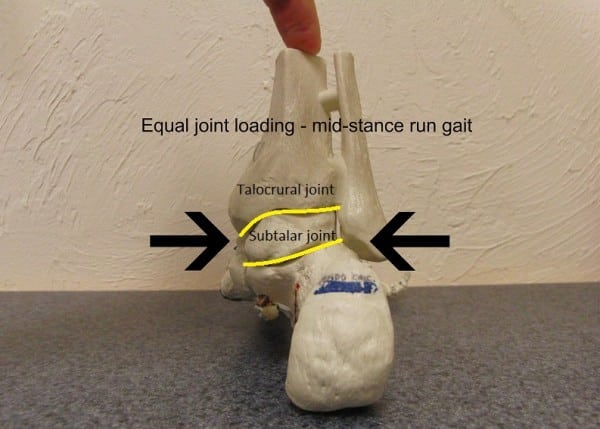
Asymmetrical loading. Joints have the ability to move – sometimes small amounts in one plane; sometimes substantial amounts in many directions. But when running, joint surfaces are designed to be loaded so that the entire surface of one bone impacts flush against the other. This promotes maximum stability; it also ensures that cartilage receives a steady dose of hydration and nutrients.

Asymmetrical loading occurs as the result of abnormal running surfaces – uneven, rocky trails, or a cambered/slanted road – or with inefficient running mechanics.

And when a joint becomes unhappy, it causes pain. Typically, a painful joint will hurt at its precise point of irritation. But joints of the ankle and foot will frequently refer pain to adjacent areas, out the sides or beneath the point of irritation, at times mimicking soft tissue pain.

How can you tell if you have a soft tissue or joint issue? Below are some comparisons:

Soft Tissue Pain Characteristics

  • Succinct, reproducible, palpable tissue pain. Can you find the one spot that is tender?
  • Pain with active use: when you do a toe curl or use the muscle (absent weightbearing), does it hurt?
  • Pain with passive stretch: is pain produced when you bend back your foot and toes? (again, without weighbearing)
  • Pain with resisted testing: when flexing your foot and toes, is there pain?

Joint Pain Characteristics

  • Dull, diffuse pain: no discernible “tender spot”. Rather, it hops around and you can’t put your finger on it.
  • Pain with weightbearing through the joint.
  • Pain is worst in the morning, after prolonged weightbearing, and/or after resting, then bearing weight through the joint.
  • Non-weightbearing testing – actively flexing and passively stretching the foot – is pain-free.

If your symptoms align with the joint pain characteristics – and if your foot pain fails to respond to soft tissue plantar fascial treatment approaches – you likely have joint pain.

The three usual joint suspects – the talocrural, the subtalar and the talonavicular – can all become painful and mimic plantar fascial pain. Each joint lies on the medial plantar surface of the foot, and each is prone to stiffness and asymmetrical loading during running.
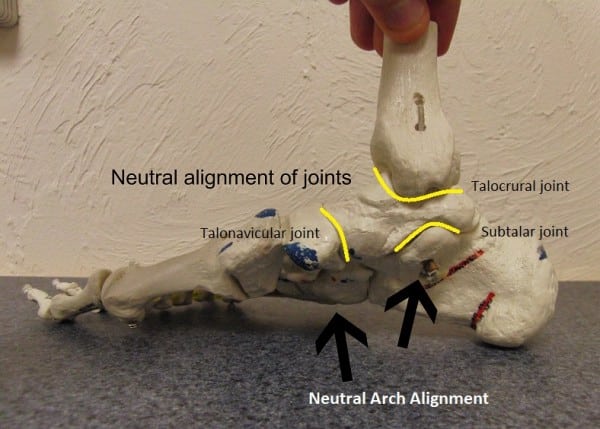
Neutral foot - side view

Medial view of a foot and ankle model, identifying three common problems joints for runners.

Above shows a medial view of the foot, showing three main joints of the foot. The talus plays a role in all three: it is the go-between from the foot and leg bones.

From above, it forms the talocrural joint. The main motion for this joint is “up and down” – it allows the toe up/toe down action that occurs in the run stride.

This joint is prime to get stiff, especially with repetitive downhill running: rather than smoothly sliding and gliding, hard downhill trail running can cause jamming forces of the talus into the tib-fib. And when this joint gets stiff, it can refer pain in any direction around the talus – front or back of the ankle (mimicking both anterior tib tendonitis and Achilles tendonitis, respectively), or it can spit pain out the side – namely the medial ankle and arch.

Between the talus and the calcaneus – or heel bone – is the subtalar joint. It is designed to move in several axes, but its primary axis of motion is medial to lateral. This joint is of little consequence to the healthy, normal runner: minor motions occur depending on the gait cycle. However, deviations or inefficiencies – namely in the foot strike pattern – can cause significant pain emanating from the subtalar joint. Excessive lateral foot strike can cause stressful joint compression to the medial aspect of the joint – mimicking plantar fascial pain!

Neutral foot - rear view

Lastly is the talonavicular joint. This joint is the primary conduit from the fore and midfoot to the ankle and leg. The navicular bone is the “keystone” of the arch. Stiffness or irritation here can also cause significant arch pain.

The following are some illustrations of how mechanical forces can cause joint and soft tissue pain:
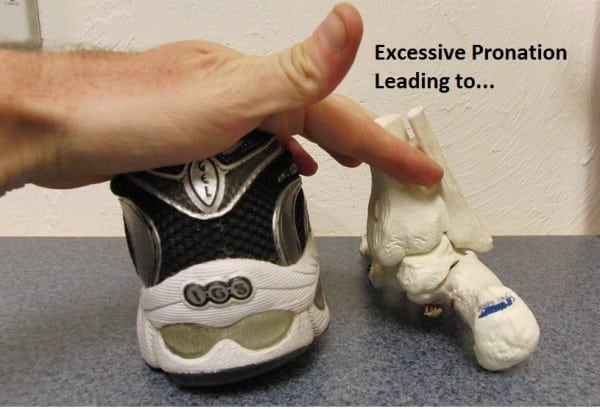
Foot and shoe position during pronation

Over-pronation, as shown with shoe and joint model.
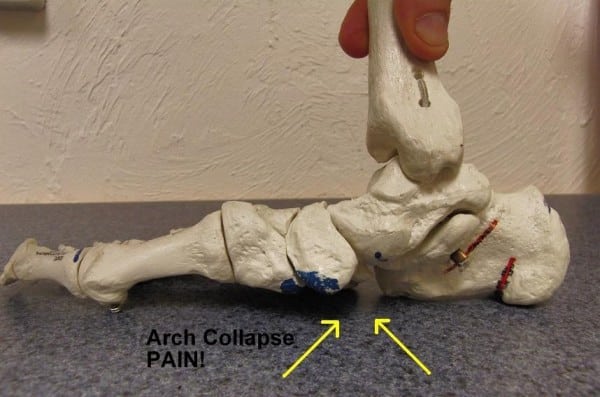
Pronation + arch collapse - side

Medial view of a collapsed arch.

Excessive medial foot landing leads to over-stressing of the medial arch, or “arch collapse.” This stresses all tissues of the plantar surface and is the primary etiology of true plantar fascial pain.

Equally common, especially for faster trail runners, is excessive lateral foot strike:
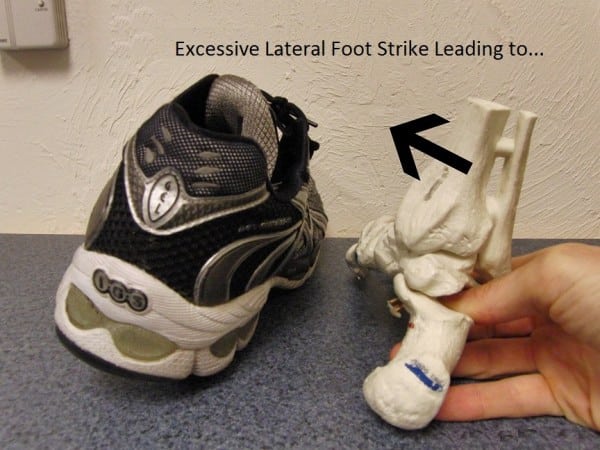
Supination - shoe a foot - rear view

Excessive lateral foot strike/supination, as shown with a shoe and joint model.
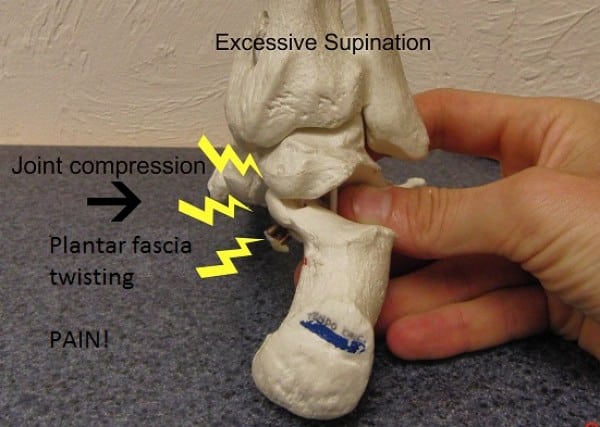
Foot supination - rear view

Excessive lateral striking significantly compresses the medial joint surface of the subtalar joint. This compression accounts for a large percentage of non-plantar fascial foot pain cases. It refers pain at its site, but also farther down into the arch and along the heel bone.

Too much lateral strike can also cause plantar fascial torqueing: the heel rotating to the right (in the above picture), but the forefoot rotates to the left as it contacts the ground – adding a twisting force to the fascia.

Nerve pain. Perhaps the most unrecognized and overlooked factor in heel and foot pain is nerve pain. The peripheral nerves of the ankle and foot originate in the brain, course through the spine, exit the low back and pelvis, and must course – fluidly – through the soft tissues of the entire leg.

Repetitive impact forces from running – often combined with compromised spine posture from running all day (or, in our normal lives, sitting) – can cause these nerves to develop “hitches.” This is a concept called nerve tension.

Nerve tension accumulates in the spine and legs with age, injury history, and running volume. When nerves lose mobility, they begin to create pain – often very similar to soft tissue or joint pain, including plantar foot pain.

And because the same repetitive or excessive impact forces that create joint and soft tissue pain also create nerve tension, it is very common for a runner to present with both joint/soft tissue and nerve pain overlay at the same time.

Almost every runner (and most other folks) has some degree of nerve tension. Here’s a test:

Sit with your back against a chair, head and shoulders upright. Extend your knees straight, with toes up. Note the degree of “stretch” in the back of your legs. Then, slump your head and shoulders. Any increase in stretch sensation is nerve tension from tensing the nerve at the head and neck.

Nerve Pain Characteristics

  • Pain at rest – the hallmark sign of nerve pain overlay: do you have any symptoms in your foot when at rest, namely sitting (specifically, with prolonged sitting, long after you’ve stood on it)?
  • Symptoms described as burning, buzzing, or dull aching.
  • Other symptoms higher up the leg, specifically: lumbar, buttock, posterior thigh, calf or shin pain.

Very often, a runner who applies soft tissue or joint treatment concepts will get partially better, but fail to fully recover because they fail to address the nerve tension component.

Runners and clinicians, alike, need to recognize the existence of nerve tension and treat it concurrent with any soft tissue or joint irritation.

Treatment Approaches

Please discuss any of the following treatment approaches with your doctor, physical therapist, or chiropractor before performing.

Soft tissue

These are straightforward because everyone who [thinks they have] PF does them:

  • Rest, ice, soft tissue mobilization, stretch, strengthen.

Real, actual soft tissue plantar pain will heal rapidly, given correct doses of the treatments above. Those who do not respond to that approach likely have a joint or nerve issue.

Joint pain

The two treatment approaches to joint pain in the foot include full restoration of joint range of motion and symmetrical loading.

Range of motion restoration

Ankle dorsiflexion. Normal ankle dorsiflexion is about 20-30 degrees beyond a 90-degree bend at the ankle. If you cannot stretch this far – or if you have symptoms in front, or anywhere around the ankle joint – your symptoms might be due to stiffness there. To mobilize a stiff talocrural joint, try the following:

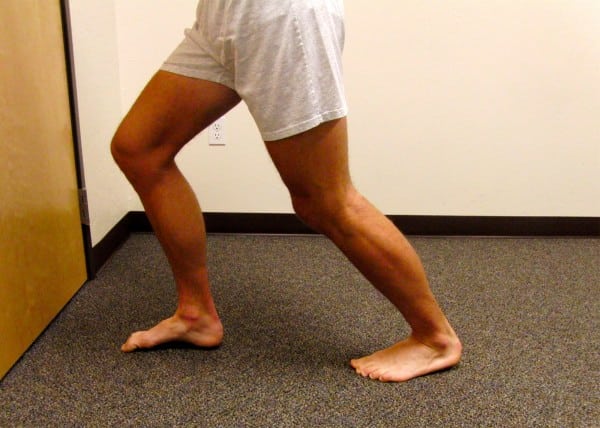
Perform a standard calf stretch, with a few minor adjustments: be sure your stretch foot is perfectly straight ahead. Keep the foot flat, lean forward with a straight knee until full tension. Then, slowly bend the knee as much as possible without allowing the heel to rise. Slowly oscillate between bent and straight knee. This mobilizes the tibia and fibula over the talus, restoring motion to this joint.
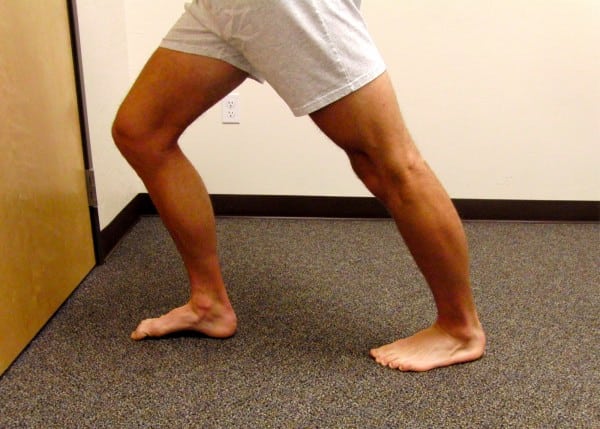
wall stretch ankle straight

Wall ankle stretch – straight knee.

wall stretch - ankle bent

Wall ankle stretch: bent knee. Keep the heel as flat as possible.

Subtalar inversion and eversion. A normal heel bone should be able to “wiggle” about 10-20 degrees side to side. To self-test, cross your ankle over opposite knee. Grasping hold of your ankle with one hand, drive firmly downward with your opposite hand on the inside of your heel bone. Can you move it, at all? If not – and you have heel and arch pain on the bottom/medial side of your foot, your symptoms may be coming from stiff subtalar joint.

To self-mobilize, perform the maneuver described above with firm, slow, on and off downward pressure. The degree of motion will be slight, but the potential for pain relief is substantial when motion is restored here.
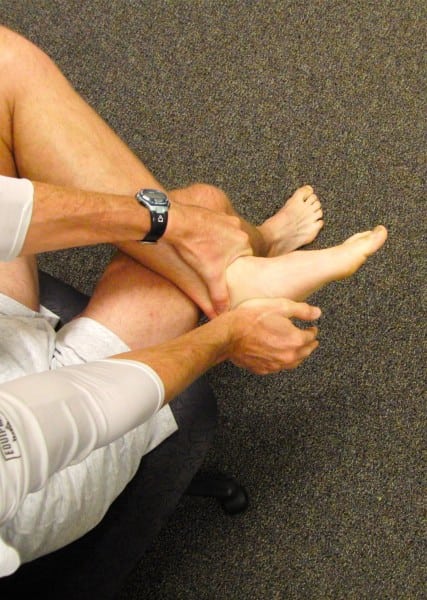
subtalar mobility

The author applying a straight-downward pressure to the heel bone, stabilizing at the ankle. A normal heel will “wiggle” a few millimeters in both up and down directions.

Midfoot arch. A normal midfoot will have some degree of give – both to the hands, and when standing on it. In standing, a normally mobile foot should “sink” a few millimeters to the floor.

Shoe orthotics are intended for those who are hypermobile in their arch: their arch joints are excessively flexible, and the arch “collapses” (typically defined as one centimeter or more) in weightbearing.

However, far more often than not, runners have hypomobile arches – they simply don’t move enough. These folks typically respond poorly to orthotics (often with no improvement, and sometimes they worsen pain).

A hypomobile, stiff arch will benefit from self-mobilization. If you have symptoms that originate farther down the foot, near the apex of the arch – and your foot lacks any give in standing – try the following mobilization:

Stand with stiff foot down. Place your opposite heel directly on top of the stiffest area – typically the navicular bone, which lies directly in front of the tib-fib complex. Gently, then progressive bear down with substantial weight onto the navicular. This may seem scary – test it first. A stiff navicular will give very little, even with full pressure. Pain usually comes from skin compression. “Stomp” on and off 10-20 times. Perform before and after running, and/or in the morning, when stiff joints tend to be stiffest.
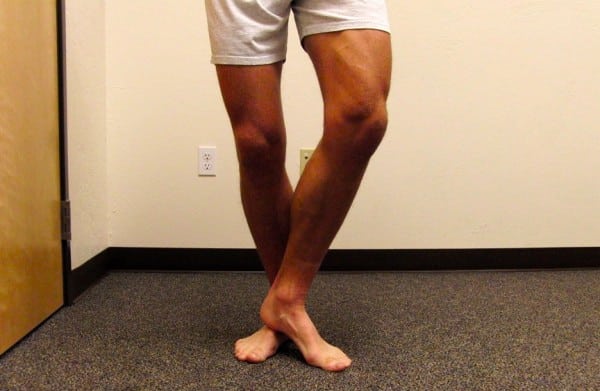
midfoot mobility

The author, performing a mid-foot self-mobilization in standing. Try with soft-heeled shoes on, if too sore with direct skin contact.

Joint Loading Factors

Loading the joint equally is vital to joint happiness. Orthotics can be helpful for those with hypermobile feet, as they can prevent arch collapse. They are also helpful for slower runners with shorter stride lengths. A short stride tends to include excessive vertical forces (up and down motion). This vertical loading bears down on the medial arch – beyond the capability of muscles, tendons, and the plantar fascia to support it. An orthotic can aid in sustaining the arch. But ultimately, an efficient stride that emphasizes normal hip mobility with greater forward momentum is most important in preventing arch collapse.

Other important factors for symmetrical, low-stress loading include the position and angle of foot strike. The foot should always land as close to directly beneath one’s center of mass as possible. A foot that strikes in front, tends to strike:

  • On the heel
  • On the outside edge of the foot (heel or midfoot)
  • On the mid or forefoot, laterally-biased.

A heel strike creates considerable stiffness through the talocrural and subtalar joints. A lateral strike might cause asymmetrical loading of the subtalar joint, and/or a twisting, torqueing force through the midfoot and plantar fascia (see photo above). A midfoot or forefoot strike – significantly ahead of the body – will stress out those joints or strain the plantar fascia.

The most simple, sustainable and important way to correct a foot strike issue is addressing it proximally:

  • Proper forward trunk engagement
  • Moving the hips such that the foot is “pulled” beneath the body

After ensuring proper foot placement beneath the trunk, shoot for a whole-foot strike, where all elements of the foot are absorbing and sharing impact forces.

Nerve pain

To treat nerve tension, refer to the test above, except make one slight adjustment:

Sit in a chair, slumped forward. Slowly extend the affected leg with toes up. As the foot and lower leg rise, slowly extend your head at the same speed. The degree of stretch should be significantly less – but still present. Hold one second, then slowly lower. This is referred to as a “nerve floss” exercise: the head gives the nerve slack that is taken by the foot, and vice versa. Repeat ten to twenty times, and perform three to four times a day, especially before and after running. Here is a video link for the exercise.

Related articles:

  1. Plantar Fasciitis Dakota Jones has plantar fasciitis. Find out what he's trying in order to cure it....
  2. Shin Splints? Quit Pulling My Leg! How to treat and recover from shin splints caused by running....
  3. How to Recover from Plantar Fasciitis Tips for how to recovery from plantar fasciitis....

Filed under Stay the Course · Tagged with Injury, plantar fasciitis

Joe Uhan is a physical therapist, coach and ultra runner in Eugene, OR. He is a Minnesota native and has been a competitive runner for over 17 years. He has a Master's Degree in Kinesiology, a Doctorate in Physical Therapy, and is a USATF Level I and II Certified Coach. Joe ran his first ultra at Autumn Leaves 50/50 in October 2010 and was the bronze medalist at the 2012 USATF 100K Trail Championships. Joe works at Eugene Physical Therapy, and also offers online coaching and gait analysis at joeuhan.blogspot.com.
All posts by Joe Uhan

Comments

98 Responses to “What If Your Heel Pain Isn’t Plantar Fasciitis and What to Do About It”
  1. Coach Weber says:
    October 9, 2012 at 7:48 am

    Awesome!

    Reply
  2. Mic says:
    October 9, 2012 at 8:19 am

    This is very useful information.

    I notice that badly cut single track trails can lead to overpronation or oversupination. Imagine “fisherman” trails near a lake or fireroad trails that come down a mountain at a slant and for miles. I find that running on these type of trails leads to some pain in my feet. These type of trails are utility trails, just used for a purpose and for a “short” time, i.e. access to a fire/stop the fire or to go fishing for a few hours.

    I think mountain bike trails are some of the best out there. They are mostly constructed using a McLoad Tool. Trail runners are great with removing blow downs with chainsaws and maybe we can incorporate trail work days that include McLoed Tools.

    Reply
  3. OOJ says:
    October 9, 2012 at 8:32 am

    Mic-

    Thanks for the comment. I agree 100% – narrow trails + a slower “trail pace” can definitely create a “compenstatory lateral strike” due to having a narrow stride WIDTH, plus the difficultly of opening up the stride!

    Reply
  4. Ron says:
    October 9, 2012 at 8:43 am

    I agree that soft tissue injuries can be very hard to diagnose. I went to Physical Therapy for weeks with no improvement for my “PF”. Turns out the diagnosis was incorrect and after an MRI, it was determined to be a plantar fibroma. Had cryosurgery done on it last week and the pain seems to be dissipating.

    Reply
  5. Brett Rivers says:
    October 9, 2012 at 9:42 am

    These “Stay the Course” articles continue to be super informative. The photos and captions also really help, thanks for spending the time to add those!

    Reply
  6. MJackson says:
    October 9, 2012 at 9:54 am

    Great material here, OOJ. “PF” is something that has nagged me on and off for several years. I really like the details in your explanations. It is helpful to see how various parts of our anatomy can have similar affects. Good to see the whole picture!

    Reply
  7. Jason says:
    October 9, 2012 at 10:48 am

    GREAT article. I’ve been suffering for years. I feel terrible after sleep and coming down the stairs in the morning. Crippling foot pain. It gradually subsides until I feel mostly fine, although walking around barefoot on our slipery hardwood floor feels not so great. Really never affected my running too much, only occasionaly do I even feel it. Rest doesn’t seem to help, infact, it almost seems worse after time off (perhaps a year off would help, but I’m talking about a week in this case). Sitting in a chair causes pain upon standing (office job sucks).

    Footwear seems to make a difference. Obviously barefoot would be the way we were designed to move, but that option is out if you really want to move fast over rough terrain for hours.

    Hoka’s are nice for the plush ride, and seem to help in that regard, but the wide platform causes excessive pronation (for me) on narrow trails, and the soft foam exaggerates that as it’s easier to compress the inside edge of the sole. That pronation causes pain, and seems to bother a touchy knee (knee cap not tracking right?).
    I like the Montrail Badrocks for stability and toe box room, but notice the decreased cushion. Knee and ankle feel better, heel hurts more!

    Dumb question: Is there a good way to select a health care professional? Most seem to have two answers: Orthotics, or stop running (‘running is hard on your joints’). NO! I need a therapist who IS a runner! It would be nice if there was a good sounding board for runners in various areas to ask/recommend therapists. Right now it seems to be totally trial and error, and I think most people just blow it off and run.

    Reply
    • Joe Uhan says:
      October 9, 2012 at 11:22 am

      Jason-

      Thanks for the comment – sorry to hear of your ails!

      Feet: chronic foot pain could involve elements of all three issues: soft tissues (ROM, strength), joint mobility, and perhaps some nerve overlay (possibly). But it sounds like this is a foot strike issue. I would say the wide platform of the Hokas might not cause the pronation – it only brings the pronation issue to your attention.

      Selecting HC folks: GOOD question. Here are some recommendations:

      - Word of mouth. Who is everyone else seeing? And more importantly, what do they do? Do they take a big picture approach? Are their interventions grounded in either research or solid clinical reasoning (e.g. no snake-oil salesmen)? More importantly, can they look at your running? MOST importantly: can they help you effectively change it (without making you mental)?

      - Professional affiliations. For PTs, who typically are most experienced in movement, and have the time to devote to you, I favor two different professional affiliations in physical therapy: the North American Institute of Orthopedic Manual Therapists (NAIOMT), and the Certified Functional Manual Therapists of the Institute of Physical Art (CFMT).

      These groups offer credentialed certifications involving years of training in hands-on techniques – not only to “move stuff” but also to retrain. If you’re devoid of any recommendations, seeking out one of these folks in your area is a safe bet.

      NAIOMT: http://www.naiomt.com/pages2/findcertpts.html
      CFMT/IPA: http://www.instituteofphysicalart.com/ipa/referral/list

      Good luck!

      Reply
      • Jason says:
        October 9, 2012 at 3:09 pm

        Thanks for the reply Joe! That’s some great info, and should help at least direct the search.

        Reply
  8. olga says:
    October 9, 2012 at 10:55 am

    Joe, thanks so much, your articles are the best addition to iRunfar, even if don’t generate much comments. Most useful for us all.

    Reply
    • Joe Uhan says:
      October 9, 2012 at 11:36 am

      Thanks for the feedback and kind words, Olga! Maybe I’ll see you in Bandera in a few months? -OOJ

      Reply
      • olga says:
        October 9, 2012 at 12:48 pm

        Totally, I am working start/middle/finish AS, you’ll hear lots of screaming in the morning too! But, speaking of the issue at hand, had it backwards: stress fracture and early running on it lead to PF, not tending to it lead to Plantar Tear! Then misplaced cuboid, nerves bundled into scar tissues – and a year and half later I am still often in pain on that foot. So, from personal (bad) experience I highly recommend to everyone to treat the injury – and the underlining issue – ASAP and fully!

        Reply
  9. Scott F. Handley says:
    October 9, 2012 at 11:31 am

    Then there’s also bursa issues. My arches are ok, just have heel (right), pain on sides & back of heel. With overuse it sometimes transcends up the lwr. achillies a few inches.

    Reply
    • Runnerjen says:
      October 10, 2012 at 3:00 pm

      Yes, I have the same thing. Taking a break right now and hoping the heel bursitis (both heels) will calm down. I’d love to have treatment plan for this! I also get that “buzzing” in the side of my right achilles when resting. Weird.

      Reply
    • OOJ says:
      October 10, 2012 at 3:28 pm

      The heel bursa, like any other bursa, is a passive structure. The question is, what is irritating the bursa? The tendon/muscle that runs over it? The joint it sits beside? Or the impact forces around the adjacent bone?

      Runnerjen – “buzzing at rest” is not an orthopedic tissue sign. Refer to the section on nerve symptom origin.

      Reply
  10. Elena Makovskaya says:
    October 9, 2012 at 11:46 am

    Great article! Not only i had this problen myself back in spring (hope it never comes back!) but I also sent this ling to my non-running co-worker who is also suffering from PF. Question: what do you think of cortizone shots to treat PF and other soft tissue problems? I had one and it seemed to help, but I heard all sorts of opioons on that topic.. Thank you!

    Reply
    • Joe Uhan says:
      October 9, 2012 at 11:51 am

      Elena-

      Thanks for the comment.

      Cortizone injections: GREAT “fire extinguishers”: they put out the inflammatory fire (if there is one). But as my saying goes, “A Joint Problem* needs a Joint Solution”.

      (*…or nerve)

      A cortizone injection will not mobilize a joint. It also won’t properly align the joint or change your running stride. The most important job of the runner + healthcare helper, then, is to be sure that, once the “fire is out”, that it does not re-ignite”.

      Reply
      • Joe Uhan says:
        October 9, 2012 at 11:57 am

        …if it IS soft tissue, the shot will help, but only temporarily unless the conditions that caused the irritation are changed (training factors, stride, etc).

        If it is joint, it will help, but be less effective unless inflammation is present. If it is nerve – it is less likely to help at all.

        Reply
        • Elena Makovskaya says:
          October 9, 2012 at 12:14 pm

          Thank you so much for your response!!! The shot helped me – in less than a week the pain was gone completely. I am lucky and my doctor is a competitive marathon runner himself and he immediately told me what the problem was: too many miles on roads at too hard of a pace.. And the shoes that I didn’t change in 2 years.. So, now I am trying to do exactly what you say here – change the conditions that originally lead to the problem: fewer road races, more quality in training and better shoes.. So far so good.. Hope it stays that way. Thank you again!! Hopefully see you in Bandera in Jan.

          Reply
  11. AJW says:
    October 9, 2012 at 12:00 pm

    Dayum! Wish I had this column a year ago:) Timing is everything…

    Reply
    • Joe Uhan says:
      October 9, 2012 at 12:06 pm

      This IS dedicated to AJW! As I posted on FB, I began to write this in the fall/winter of last year, but by then you’d moved up the ladder from foot to knee issues! Here’s for next time. :)

      Reply
  12. Trail Clown says:
    October 9, 2012 at 12:20 pm

    I was surprised when Iron Mike (Wardian) came down with mild PF this year, and then of course he got the stress fracture. I thought the man was invincible. But it just shows…if you stress the body and “go for it”, noone is safe. I am not even half the runner Mike is, but when I trained for my first 100 miler, PF was the result. Too much pounding, too many hills, not enough rest. It was a real painful lesson. Thanks for another great article Olive Oil J…

    Reply
  13. Elena Makovskaya says:
    October 9, 2012 at 12:27 pm

    btw.. my own PF experience lead to a stress fracture as well. I kept running through it for about a month and was compensating with my other foot ==> stress fracture in the other foot. Lesson for sure! :(

    Reply
  14. Lucy says:
    October 9, 2012 at 12:52 pm

    Joe, your articles are always so wonderful and helpful, I hope you put them all together in a book some time soon, please! :)

    Reply
    • Joe Uhan says:
      October 9, 2012 at 5:24 pm

      Thanks, Lucy! Maybe I’ll co-write with accomplished author/publisher, Bryon Powell! :)

      Reply
  15. Erin says:
    October 9, 2012 at 1:59 pm

    Great info, and the pictures are super helpful, but……as a yoga instructor (who also runs), I think it’s important to include information about PREVENTION of things like PF, not just the typical American response of “what to do AFTER you get ailment X”. Yoga practices often include foot exercises that can help PREVENT PF-type problems, and I would always recommend a yoga practice to supplement runners’ regular mileage. (Heated Power Vinyasa, in particular, is uniquely suited to runners and their needs.)

    Reply
    • Joe Uhan says:
      October 9, 2012 at 5:20 pm

      Excellent point, Erin. I’m a huge proponent of Yoga for many reasons. Other comprehensive prevention things could include small amounts of barefoot jogging (even on the order of 1-2 minutes after a run, twice a week), or simply wearing different shoes. Because of my high volume of training, I will frequently roll my feet with a tennis ball in the morning, in addition to performing the ROM exercises listed above.

      Reply
  16. eric hodge says:
    October 9, 2012 at 2:24 pm

    i often get problems in my knee that are more pronounced than the “other” problems i feel. these “other” problems, however, are consistently there and are most likely the issues that cause me to change my gait. these issues seem to relate to nerves, as it’s slight pain that moves around (could be joint stuff too, i guess, based on what you wrote) and weakness in parts of my foot, with sensations that run into the ankle and up the calf. so it would seem my gait is off to begin with. can one run through these types of problems and solve them with better biomechanics? i’ll certainly try. wish i knew what it was about my foot strike (etc) that was causing it though.

    regardless, great article (once again). very informative, through and clear.

    Reply
    • Joe Uhan says:
      October 9, 2012 at 5:23 pm

      For a runner with multi-joint issues and symptoms, I would look proximally to what is going on at the trunk/pelvis: are you strong and efficient in this area? If not, the rest of the leg might be lacking strength and stability, causing a myriad of issues that you describe.

      A thorough examination that includes gait analysis and strength/ROM through the trunk and pelvis would be helpful!

      Reply
  17. MonkeyBoy says:
    October 9, 2012 at 4:31 pm

    Liquid Gold, OOJ.

    I wanted to say, having decreased range of motion/mobility in the ankle led to the only stress fracture I have ever had. The decrease in ROM, coupled with running on off camber trails with poor flexibility in my calves and hamstrings, led to a severe stress reaction/fracture in my heel. The pain felt like severe PF, without the arch tightness or locked up midfoot. I had the signs/symptoms for a couple of years leading up to this in the form of recurring achilles tendonitis.

    I do the wall stretch daily to work on my dorsiflexion and I struggle to keep it above 20 degrees. I also do a lot of work on keeping my posterior tibs healthy, as a tight joint puts additional stress upon them. My lesson? Don’t let it get this bad before you address this issues. Great article!

    MB

    Reply
  18. Nick A says:
    October 9, 2012 at 11:41 pm

    Great article, really enjoyable. I seem to be succumbing to PF, have a similar problem to one mentioned above where getting out of bed hurts like hell, but once I move around a bit it gets better. Strangely my knees are now causing me problems, I wonder if this could be linked to running style issues (think: the bells, the bells) caused by the sore feet?. I’ve started a routine of stretching, cross training and strength training in addition to running, hoping that will help? Cheers, Nick

    Reply
    • OOJ says:
      October 10, 2012 at 8:19 am

      Nick-

      Stretch, x-train and strength can help bolster your tissue tolerance and increase the margin of error IF there are any gait issues. Stay tuned for next month when we go over some simple form drills that might help both your knees and feet.

      Reply
  19. Derrick Kanashiro says:
    October 10, 2012 at 12:20 am

    You didn’t write about tendonitis in the ankle, like posterial tibial tendonitis or Achilles tendonitis. Any suggestions on causes and treatment for them?

    Reply
    • OOJ says:
      October 10, 2012 at 8:21 am

      Derrick-

      I did write about anterior tib tendonitis in May (http://www.irunfar.com/2012/05/shin-splints-quit-pulling-my-leg.html). Some of the cause and treatment concepts are similar. Foot strike – namely if it’s out front of your center of mass/your trunk – plays an enormous role in chronic post tib/shin pain…

      Reply
  20. Mic says:
    October 10, 2012 at 5:12 am

    Since the trunk and pelvis were mentioned, it reminds me of ab or core work. I recall a cross country friend in college, Div. 1A, always on the floor doing ab work. If you went to visit her – she’d slowly and casually make her way to the floor and socialize while doing crunches. It almost went unnoticed along with the fact that she always carried around a bag of food. She is diabetic and likely needed the food but also needed it for the calories, of course (@ 70 miles a week).

    I mention ab work because – although it may go without saying – among this crowd, ab work seems to free up my lower body to do as it pleases. I recall times of feeling heavy on my feet when I began ultras. My feet were having to run and balance all the while controlling my upper body. After much ab work, I find that my feet are sort of liberated to have fun and maneuver.

    There are definitely yoga poses for the abdominals – leg lifts and resting on forearms, etcs.

    Reply
    • OOJ says:
      October 10, 2012 at 8:22 am

      Excellent point. Next month’s column will be “Part II” on gait mechanics, where I’ll be doing a compare/contrast of two major “schools” of gait training – Chi Running and the Pose Method – along with my clinical training. All three elements strongly emphasis proximal (core/trunk/pelvis) initiation and control in running.

      Reply
  21. Ran Pergamin says:
    October 10, 2012 at 7:31 am

    Hi John,

    Your article came just in time !
    I have been dealing with a stubborn heel pain for several weeks now.
    It actually started as metatarsal & arch pain, that slowly settled in the heal..

    I caught it early, so its volume is not super high (though annoying when flared..) , but I stopped running, to get rid of it as fast as I can.

    Immediately, I suspected Plantar Fasciitis. The heel pain. Reading all the material online about it.
    I want to 4 different therapist, heard 4 different theories, and no relief. None really with expertise in dealing with something that is not of classic symptoms.

    I became skeptical & in “trust no one, but what works” mode

    I did the ice, stretching, roller, deep tissue massage, PT & complete rest from running, but the pain would not go away.

    Your article came just in time, cause, something along the way didn’t match PF classic symptoms:

    1. I don’t suffer morning first steps aches
    2. My pain is actually stronger while sitting/driving/rest, no during activity.
    3. Even during a period of 1 month when I wasn’t running the pain would stay.
    4. The pain awakes also from long period of standing

    3 weeks ago I noticed that when I wear my Birkenstock sandals, it dramatically reduces the pain to a degree where it kind of disappears. (Still no running)

    I gradually started running again, 10-15min (barefoot or minimal) at a time, no one day after the other.
    The runs feel amazingly well (I never had the heel pain during activity).

    After each run, 2-3hrs after a 10-15min run the pain would come back. I would do the roller, ice , stretch & the next morning usually my feet would actually be better with little ache, if at all (again still walking Birkenstock).

    The last PT I went to claimed that the pain comes from my back (weak core muscles), and that I have no real PF.. Which I wanted to believe, but have been to skeptical about theories.. I started working on those core muscles but that will obviously take a while..

    Than I read your article, about the nerve tension.. Any my symptoms kind of jumped out… WOW, could it be that my pain is indeed not really PF, but actually something different ?

    My problems is the lack of Professional Therapist to point me in the right healing direction, and guidance on running/not running thingy.

    I have decided now to stop running again, cause I don’t want to take two steps back on the healing process with further inflammation, however, I am still feeling in the dark, as to whereas what healing process I should follow, when to come back running & how, and what is actually the source of my pain..

    Should my pain be neural tension, how fast , doing the excersie, would I feel a difference ?
    Are these symptoms “easier” than PF to treat / heal ?
    Any other therapy you would recommend for the symptoms I mentioned ?

    Any guidance / thoughts is highly appreciated.

    Regards,
    Ran

    Reply
    • Ran Pergamin says:
      October 10, 2012 at 7:32 am

      Joe that is, not John :-)

      Reply
      • OOJ says:
        October 10, 2012 at 8:26 am

        Ran-

        Sorry to hear about your struggles – but a familiar tale for many folks.

        A nerve origin of your pain is possible, especially with the pain at rest and/or with prolonged weight-bearing.

        For all exercises – and the nerve stretching *especially* – I recommend you run them by a professional first. But with initiation of nerve “mobility”, your symptoms can rapidly diminish.

        BUT: the real question is, how do you keep them from coming back? What are you doing (running, not running) to accumulate nerve tension? Ultimately that question must be addressed.

        Refer to my post above about choosing a healthcare person. Anyone from either the NAIOMT or CFMT lists will be very knowledgeable about these concepts.

        Good luck!

        Reply
        • Ran says:
          October 10, 2012 at 9:07 am

          Thanks Joe.

          Sadly, I am based out of Israel, and the amount of “real” running proffesionals therapist is to be counted on less than one hand, and even I not sure I can point who they are…

          So right now I am struggling with whatever makes me better.
          I 100% agree with you, I want the root cause, not put down the fire only.. That’s the hard one to nail.

          I am actually considering to take advanteage of a business trip to UK or USA, and go to a good running clinic to get my walking/running/standing gate sorted..

          I hope to have good news in the near future…

          BTW a though, do you think remote video thearapy / analysis is something that could work.. I know as a therapist when you cannot touch the patient, it takes siginficant % of the treatment. My thought is whether you (or therapist like you), could analyze a runner / person (myself ?) diags via remote video / voice session or something in that area.. I that was doable, I think it would open the door for so many poor people suffering like me to get proper advise… Think about it, and if you have experimental thoughts, I am open to experiment :-)

          Cheers
          Ran

          Reply
          • Ron says:
            October 10, 2012 at 10:20 am

            You should get an MRI which is the only way to accurately diagnose what you have. Otherwise you may spend months on therapies that will not help. I had an MRI done and once the problem was pinpointed (plantar fibroma), I was then able to take quick and precise actions to mitigate the pain. Good luck and I hope you can work it out.

            Reply
            • OOJ says:
              October 10, 2012 at 10:32 am

              Ron-

              MRIs and other diagnostics can be helpful as part of a comprehensive clinical examination. In your case, finding a tissue anomoly was important. But in sports medicine, this sort of finding is *extraordinarly rare*.

              The truth is, MRIs are extremely over-used and, more often than not, lead people down paths that result in excessive medical procedures. And doctors, themselves, are beginning to see this:

              http://www.nytimes.com/2011/10/29/health/mris-often-overused-often-mislead-doctors-warn.html?pagewanted=all

              Some other interesting research with MRIs:

              - 50% of all people over the age of 30 will have a positive finding (disc bulge) with a lumbar MRI. Asymptomatic..

              - 50% of all people over the age of 50 will have a positive finding for a rotator cuff tear in the shoulder. Asymptomatic.

              For sports medicine issues, only when a comprehensive clinical exam *including* a thorough motor control/gait assessment**, is an MRI indicated.

              (**OR the presence of “red flag findings”: http://www.bboyscience.com/medical-red-flags/)

          • OOJ says:
            October 10, 2012 at 10:46 am

            Ran-

            Remote gait analysis is possible, but because of your background (with possible nerve/lumbar contributor), you would be best served to see a healthcare professional who will do a comprehensive exam — the whole leg, the pelvis and back, as well as gait.

            To *only* look at gait might be missing a vital part of your issue.

            Keep searching for a quality, versatile sports med professional – I’m sure there are many in Israel! Ask around, do some homework! And definitely, if your symptoms worsen, seek out an MD to be sure there might not be a more serious back is going on.

            Reply
            • Ran Pergamin says:
              October 10, 2012 at 11:38 am

              Thanks Joe.

              I am still on the hunt, but this search is expensive.
              I have not met yet a true proffesional, who as you well written, will look at the big picture, look at my running, walking, standing, examine my body posture & identify the problems..

              Every PT I went to were way too confident that they “know” the source of the problem from a 5-15min check.. So you understand how pro, that can be..

  22. OOJ says:
    October 10, 2012 at 10:34 am

    Clarify: only when a comprehensive clinical exam is PERFORMED (including movement/gait assessment) and NO improvement is made, is further diagnostic testing indicated – unless there is a presence of a medical red flag.

    Reply
  23. monica ochs says:
    October 10, 2012 at 2:47 pm

    Great article! I had self diagnosed PF and learned about a month later it was a calcaneus fracture. These injuries require different care so lesson here is to have it looked at by someone other than self!

    Reply
  24. Laura says:
    October 11, 2012 at 9:30 am

    This is a great article!! and so thorough! Thank you!

    Reply
  25. Dave says:
    October 11, 2012 at 9:48 pm

    Interesting… I had surgery for a bone spur on the back of my right heel in April (with a follow up for a post-surgical infection in May). I’ve never had plantar fascitis nor knee pain in 30+ years of running. Yet… this really sidelined me. Turns out the bone spur was right at the insertion point of the Achilles tendon – so the tendon needed to be detached as well. With the infection after, I had 10 weeks of total immobility.

    Anyway… I’m on the road to recovery – but I did want to say to those who indicate “the best way to find out is via an MRI”. I disagree that that is the case for all. For me, the x-ray diagnosed the bone spur. A “diagnostic ultrasound” on the Achilles showed the corresponding tendon damage. Never had an MRI – but clearly needed the surgery and (despite the infection) ended up successful.

    I think it great that Joe doesn’t assume all issues are PF – and talks about other issues. I overpronate – don’t know if the injury was chicken or egg – but recognize that accurate individual diagnosis is critical.

    Reply
  26. Anonymous says:
    October 12, 2012 at 12:45 am

    Question: Say you’re sure you’re dealing with soft tissue damage in the arch. You decide to stop running completely. You’re article states soft tissue will heal rapidly. How rapidly? Most are familiar with how quickly muscle can heal, but fascia does not have the same blood flow. Also, daily, routine walking around I suspect can slow the healing process.

    For a runner with moderate case of PF, who completely stops running, walks around during the day, x-trains, stretches, ices and massages, what is a ballpark estimate for how long before one can be sure the tissue has significantly healed? I realize it depends on the individual case, but I’m just looking for a rough estimate.

    Thanks and AWESOME article.

    Reply
    • OOJ says:
      October 12, 2012 at 10:52 am

      “Rapid” is relative. An acute strain of tendon tissue will heal in 3-4 weeks, but “rapidly improve” within days. Muscle is much faster.

      However, the scenario you describe – “only soft tissue damage” – is extremely rare. Injuries are typically “conspiracies” of several factors – joint, soft tissue, motor control – such that you have to address them all.

      But when you do address them all, an otherwise young[er] (<40yo), healthy runner with a mild/moderate plantar strain that I see in clinic will typically be able to return to running 100% in a month.

      Reply
  27. TCJ says:
    October 18, 2012 at 8:52 pm

    I’ve had many right ankle inversion sprains from my days as a soccer player. The ligaments are very loose now. When I run, this foot noticeably over-supinates. I keep getting plantar fasciitis only in this foot – I let it heal, but it comes back when I start training hard. I think it could be the torquing of the plantar, as shown in your picture. It’s also difficult to do stretching/range of motion exercises with this ankle because something pinches in the front of the ankle when I stretch. The ankle feels stiff.
    If I was to come see you as a patient, what would you recommend? I’m thinking of going to see a PT, but I don’t have much money to spend…
    Thank you.

    Reply
    • Madi says:
      October 21, 2012 at 5:48 am

      Interested to hear your view on this one, suffering similar problem of left foot noticeably over-supinating, ankle stifness with pinch felt inner/front upon stretching (has improved with ankle mobility exercises) and chronic heel pain (7-8 months now). History of ankle sprains on this side. Had nerve pain on this side (calcaneous & up inside of ankle) which has improved 90% so far with nerve “stretches” as described in the article. Heel pain still present but not just in morning or after periods of rest – pain also when foot is up.
      Look forward to hearing your comments as sounds similar to above complaints.
      Cheers

      Reply
      • OOJ says:
        October 24, 2012 at 8:22 am

        Madi-

        You *could* have the same issue, but there could be a lot of other things going on as well (with respect to where your foot is landing – how far out front vs beneath you).

        Unfortunately, pain of any chronicity (with a history going back even farther) isn’t easy to fix – and likely won’t remedy 100% without a thorough evaluation and several treatments. However, I’m glad to hear you’re 90% better!

        Reply
    • OOJ says:
      October 24, 2012 at 8:19 am

      TCJ-

      Thanks for the post – sorry for the delayed response.

      Chronic lateral striking might actually be an issue up high. Folks who don’t push off with their hips well tend to have a “narrow stride”: When we push off, the hip extends and abducts (think ice skating, rollerblading, or skate skiing), which ensures that the “landing foot” in front lands slightly “wide”.

      A deficient push off can result in a narrow width, which results in a compensatory lateral foot strike and the torquing you alluded to. A good PT or gait analyst will be able to determine if this is the case, based both on a “table exam” and a running assessment.

      Reply
  28. Aaron Gustafson says:
    November 2, 2012 at 1:25 pm

    Thanks for your article!

    I missed any mention of fasciosis. Are you aware of the work of Dr. Lamont and Dr. McClanahan?: http://youtu.be/7rin6PzWQCs . What are your thoughts on occlusion as caused by deforming footwear creating a state of perpetual necrosis?

    Reply
    • OOJ says:
      November 2, 2012 at 1:54 pm

      Aaron-

      Thanks for the comment. The term fasciosis is dervied from “fascia” + “osis” — or a state of being diseased or disordered.

      This term is gaining traction because, as mentioed in the “Defined” section above, “-itis” means inflammation, which can technically only last 20 days. Indeed tissue biopsies performed on chronic “PF” patients revealed the complete absence of any inflammatory compounds.

      So they called it “-osis”…simply because it wasn’t “-itis”. In essence it replaced an incorrect designation with a wider, non-specific designation of -osis.

      Perpetual tissue “-osis” may easily occur with perpetual mal-loading. Is it the shoes? Maybe (as many folks are placed into aggressive orthoses or motion-controlled shoes, which creates increased mal-loading of the rear/midfoot joints). Or it could simply be perpetual mal-loading of the joints and tissue.

      Is it really a blood flow issue causing tissue death? Could be (but testing this theory would be very difficult: are tissue biopsies showing dead, decayed tissue in these patient?). A more plausible explanation is asymmetrical loading and chronic tissue strain (AND joint irritation, referred) as theorized above.

      Reply
  29. Dave Kelly says:
    November 27, 2012 at 8:33 am

    Joe – great article, I’ve been experiencing an ache in my right heel for a little while which would just come and go. It’s worsened as of late and I suspect that running in a pair of neutral Brooks that had probably done more than their recommended mileage may have contributed (who knows?). I estimate that I was running in the Brooks for approx 7-8 months and reckon I probably did 600 miles. I’ve changed running shoes now, as it was high time. I’m hoping that the increase in support will help. What support should I use when I’m not in running shoes. I’m easing off training slightly, I find that first thing in the morning the ache is directly from calcaneous – I don’t feel any discomfort in my arches. After a few steps the ache lessens and during a run it lessens too. I don’t impact much on my heel when I run as I sort of run as more of a forefoot or mid foot runner. I mostly run on paths or asphalt. My mileage is currently 25-30 miles per week. Not entirely sure if this is is PF or not – I suspect it is, I’m hoping it has been caught early enough. What else can I do? For the record I have a history of tight calves, I assume this could be a contributory factor.

    Reply
    • OOJ says:
      November 27, 2012 at 11:46 am

      Dave-

      Thanks for the post.

      Without seeing you in person, it’s difficult to make recommendations with any merit. BUT:

      - Posterior heel pain
      - Tight calves
      - Pain in the morning that goes away

      I suspect this is either true PF or the joint issue (as discussed above). AND, based on that collective of symptoms, I suspect you’re a “braker”: landing with the foot in front of the center of mass. This COULD explain the heel pain plus the tight calves (which COULD be over-used to help with braking).

      That said, shoe selection means relatively little: a foot landing in front of the body = stress.

      Try this drill (video 1): http://runningwellct.wordpress.com/drills-videos/

      The emphasis should be on a straight up-and-down leg action + the forward lean demonstrated.

      The results will be gradual – improved foot strike should result in gradually less heel pain. IF that is the issue.

      Reply
      • Dave Kelly says:
        November 28, 2012 at 5:19 am

        Thanks OOJ

        and thank you for the comments and drills. Sounds like I possibly need to alter my gait then, that could take a while. I’m going to see a sports PT later today for deep tissue massage (calves) and mobility work. I was interested in what you said about ‘braking’. I’m supposed to be doing a half marathon in about ten days, is it wise to run with PF. Yesterday during a run my foot felt a little sore initially but felt ok as the run progressed. I only ran 5 miles but it was at Tempo Run pace. I felt like I could have carried on but then a couple of hours later my heel started to ache and then it was pretty sore first thing this morning. I’m looking on the web for some good PF stretches and will do those daily.

        Reply
        • OOJ says:
          November 28, 2012 at 10:29 am

          Dave-

          Glad to be of help.

          The #1 job of physical therapists (in my opinion) is to be “pain managers” – help progress your recovery – in the same way a coach would progress your training. Speak with your PT about what he/she thinks about your half-marathon, and how it would affect your condition.

          Good luck!

          Reply
  30. twenty_over says:
    January 5, 2013 at 7:48 pm

    Interesting article and comments, I had a release done to my right foot on Dec. 13 and was just browsing the web for info. It is now 23 days later and I still have heel pain, I’m just hoping that it’s still too early to tell if surgery will help or not.

    After about two years of heel pain the podiatrist suggested I get another opinion so I went to an orthopedic surgeon. The surgeon gave me x-rays, a bone scan, and then an MRI; he concluded that pain was due to pf. The heel of the bone scan was illuminated quite a bit, right where the pain is.

    I’ve worked in an auto factory for the last 25 years and do a lot of walking on concrete floors so maybe that’s the cause. Last summer I could not even cut my grass and it kept me from doing the activities I like to do so I opted for the surgery.

    Thanks for letting me vent…

    Good luck to all with such a problem…

    I enclosed a link to a picture, hope it works and that no one minds.

    http://i1325.photobucket.com/albums/u638/twenty_over/Miscellaneous/heelstitchessmallpic_zpsc4046eb3.jpg

    Reply
  31. diane says:
    February 14, 2013 at 8:47 pm

    thanks for this info. i started having heel pain after a 10 miler in the snow with my yaks on. that was 3 weeks ago, and my heel is still hurting even after not running (I am cross training). its 2 days until race day and I’m almost dreading it. ugg! by the way, I really liked the diagrams!

    Reply
  32. Monica says:
    February 16, 2013 at 5:27 pm

    I have had lowered leg and foot pain for. 6 months now. . Have had emg… Tested for blood clots and veins ok . Had a mylegram and praying I get a answer. Before this horrible pain… I worked out three times a wk. in so much pain I can’t do anything

    Reply
    • OOJ says:
      February 16, 2013 at 9:09 pm

      Monica-

      Thanks for the comment, and sorry for your troubles!

      Be sure your doctor/”medical team” look at the following, and answer the following questions:

      - Lumbar spine (any low back pain?)
      - Lower leg arterial flow/atherosclerosis (e.g. narrowing of leg arteries) – do your symptoms come on, or worsen, at a very specific time during running/activity?

      Good luck!

      Reply
  33. Monica says:
    February 17, 2013 at 7:48 am

    Ihad back surgery 10 years ago… My orthopedic surgeon ordered MRI with dye. He said leg and foot pain wasn’t coming from my back . Had Doppler artery test and testing on veins.. All normal. Emg was normal! I do have more pain when being active. My feet and ankles hurt ( they did ex rays of legs.. No shin splints). When this first started about two years ago , it felt like I was walking on rocks. Bought the pads for shoes and it would be ok for several months then pain again and would change pads and ok again ( I thought it was just from bouncing. Around on boards at exercise class. Both feet hurt, but the left is worse ( I do have plantar fibroma in both feet… The one under left foot is fairly large.. I hurt in heel area and lower legs. Lower back hurts at times ( because lack of exercise ). I’ve gained 13lbs because I can’t exercise with this pain My left buttocks hurts terribly ( have to put a pillow under it) my legs and butt hurts worse when I sit . I saw a podiatrist in the very beginning and he said that the plantar fibroma wouldn’t be causing my lower legs to hurt…. But with all my research I found out that is not true . I will get results of my mylegram Tuesday and pray its nothing serious , but at the same time hoping I get an answer . I have tried remain possitive, but I’m so tired !! Very tired !! Thanks for listening

    Reply
  34. Sara says:
    February 23, 2013 at 10:40 pm

    Joe I just have to say THANK YOU! This is exactly the type of information I needed about the foot issues I have been having! Thank you so much! Now I understand what is going on. Knowing is half the battle!

    Reply
    • OOJ says:
      February 24, 2013 at 12:53 pm

      You’re welcome, good luck! :)

      Reply
  35. Dustin says:
    March 8, 2013 at 10:39 am

    Hi Joe,

    Well, I find your explanations very helpful, especially in seeing the photos of the foot in a planting motion. I have been running about 25-30 miles per week and have been recently experiencing stiffness/dull pain in my left foot arch when I plant it during my stride. I thought because I have ramped up my speed work over the last month or so that may explain it. Typically after warming up for 15-20 mins the pain will subside. I do not pronate and I figured maybe I should stop after 15 minutes to stretch the foot out, any other recommends for mid workout therapy?
    Thanks!
    Dustin.

    Reply
    • OOJ says:
      March 8, 2013 at 1:05 pm

      Dustin-

      If you do not pronate much, as you claim and your arch is stiff, try the midfoot “stomp” mobilization as shown above. Gently perform before and mid run. Good luck!

      Reply
  36. Judy says:
    March 11, 2013 at 12:16 pm

    I would love to find a physical therapist in my area of St. Louis, MO that had as much knowledge and insight into the whole foot/heel pain issues! I have suffered for months and seems like there are about four things going on in my foot. I am thinking it isn’t plantar fascitis and hurts all around the heel area then I got a stress fracture from walking out of synch on that foot and am so frustrated. I am a walker and could scream because this won’t go away! Do you have a listing of therapists or other professionals who could help like you do? Thanks.

    Reply
    • OOJ says:
      March 12, 2013 at 10:01 am

      Judy-

      Sorry to hear about your foot!

      I don’t have any specific references. My preference is for Certified Functional Manual Therapists – trained in both hands-on techniques and motor control. Here’s a listing of those certified, nationwide:

      http://www.instituteofphysicalart.com/ipa/referral/list

      Unfortunately, I don’t see any in the StL area. But ask around – find someone with good hands-on ability who works with runner/walker gait mechanics! Good luck!

      Reply
  37. Paul Banbery says:
    March 11, 2013 at 3:50 pm

    Hi joe…really good forum and good to know that someone knows what theyre talking about.
    I had pain at the back of my heel and achiles for a year or so. Stretched it off for a while and seemed to dissappear. I then when I got up in the morning could hardly walk due to extreme stiffness on the underside of the heel which would subside after 20 mins of walking. 8 months ago when playing football (soccer – im English) I felt a pop under the heel. Actually thought the gel sack had popped in my trainer. Could hardly stand and was then on crutches for a couple of weeks at least. I was told I had possibly ruptured PF but that I should try to put some weight on it as soon as possible.
    8 months on im still not running / playing football as there is heel pain there – but not painful as such – just a knowledge that it is still injured. Mainly I am getting discomfort from the centre (slightly left) of the PF BUT mainly I get a discomfort up the outer / underside of my foot from by the ankle up to to little toe ball of my foot. Any idea – becuse im all out of them TBH.. hot and colding every night ang generally staying off my feet.
    Does this sound like plantar facaitis or somethiing else??

    Reply
    • OOJ says:
      March 13, 2013 at 4:25 pm

      Paul-

      Thanks for the message – sorry to hear about your foot!

      It’s not possible to diagnose what is going on, but a “pop” followed by severe pain indicates that something might’ve sprained.

      8 months later is sufficient time for even that tissue to heal, if allowed. Check out my Pain #2 article on Inflammatory vs Ischemic pain. You might have dysfunctional tissue pain at this point that simply needs progressive stretching, strength, and impact. But without a thorough exam, it’s impossible to say.

      Have a physio (English!) or osteopath thorougly examine your foot and heal, and see how the joint and tissue mobility is.

      Good luck!

      Reply
  38. Nick says:
    March 14, 2013 at 7:17 am

    Hey joe, I am 21 and i have had a severe issue with my feet for about 3 years now. I cant stand for any prolonged period of time with extreme pain developing if i do. I cannot run, walk or do anything at all without feeling some form of the pain. When i wake in the morning my feet are stiff and all throughout the day depending on what i do, some form of the pain exists. I cannot wear shoes at it superheats my feet and it feels like they are drastically inflamed and after i do exercise they are obviously worsened. It all starts at the back of my heel ( well thats where i think it starts , I feel the pain under the base of calcaneous when standing still, closer to the inside of my feet but basically at the back of the heel. ( dont know technical terms ). If i stood for 20 minutes it would radiate from that area to underneathe my feet, feel extremely painfull, hot, itchy and in general uncomfortable. It would also cause pain on either side of my heel connecting to the achilles ( or bursa sacs?)On both exterior and interior sides but more pain on the inside a cm or two away from the achilles i guess. I always here a cracking ( release of fluid or air or whatever it is ) when i stretch or move them, if i have not done so in a while and it can get so bad if i am mobile in the day that i feel it throbbing. If i move in general ( ie: walk, run it wont be as bad but will eventually come to hit me ). In summary, bilateral, symmetrical heel pain with ANY FORM of weightbearing upon the heel.

    I do not take any regural medications, have no other forms of injuries other than an episode of achilles tendonitus around 5-6 years ago with 2 years freedom before the onset of this issue. No family history of the problem, although my mother has athritus, still common however in 60 yr olds. I have had blood tests for for inflammation related illnesses. I have seen 3 podiatrists and tried short and long hard and soft orthotics to no avail, each for extended trials. Treated for plantar fasciitis, possible severs disease when first onset, issues with the flat footed nature of my feet and what not. I have seen a back speacilist with no problems and no connection to the issues with my feet. I have had steroidal injections based off an mri into possible development of soft tissue thickening around the medial side of both feet, with only a week of minor pain relief. I have seen a neurologist and several physios all with no real affect. I have also take anti-inflammatories for a month long period and it had little affect. My thoughts are now simple after this 3 yr long journey, maybe it is a combination of things. Im thinking that it may be as simple as inflamed bursa sacs and a prolonged exposure to this linked with possible bouts of haglunds deformity, although no real calcitic lump is evident ( only a small one ). Maybe it is issues with my achilles and the bursa and that pain radiating away from the area?? after prolonged exposure to this and incorrect localisation of pain and misconstrued diagnosis it could be possible that scar tissue has developed alongside the tissue any time it gets worn and torn. Similar to me waking up every morning like the day before i did a marathon when i did not….Icing certainly helps but only for short periods of time following….

    Any response to this, any help at all would be greatly appreciated and if you have thoughts on what it is, let me know i will be forever in your debt. Reading this article brought me to the idea of possible joint issues?? i do feel dull constant pain but sometimes its sharp, especially if im standng for any time.

    Thankyou for listening.
    Kind Regards
    Nicholas Brunning.

    Reply
  39. OOJ says:
    March 14, 2013 at 4:21 pm

    Nicholas-

    Thanks for the post. Please send me an email.

    Reply
    • OOJ says:
      March 14, 2013 at 4:22 pm

      = joseph(dot)m(dot)uhan(at)gmail.com.

      Reply
  40. ginger says:
    March 15, 2013 at 11:44 am

    Dear Joe,

    Thank you for this great article. Though I am a natural therapist myself, I can not help myself. I have been running intensively (mostly trails), but do Yoga at the same time. Yet, this January, I felt that something was not right. Incruciating pain on the right outside heelbone of my right foot. I stretch, I have stopped running, tried again and it comes back again. Thus, it is not PF after your great explanation. I am a fore-foot runner, however, do run with supporting running shoes from Salomon. Yet, I had been running in the same old shoes for 5 years which was probably not the best idea.

    Anyway, it turns out to become chronic now, I love running especially with spring approaching.

    I would really appreciate your advise.

    Best regards

    Ellen

    Reply
    • OOJ says:
      March 16, 2013 at 7:28 pm

      Ellen-

      Your symptoms (lateral heel) plus your run style (forefoot) makes me *think* (read: shot in the dark) that you might be over-stressing your lateral foot/peroneal muscles. It’s very common for forefoot strikers to overstride, and when they do, it’s usually a lateral foot strike.

      Beyond that, it’s difficult to for me to provide any other insights.

      My general recommendations (as they apply to everyone):

      1.) make sure your foot is landing beneath your body (http://www.irunfar.com/2012/09/give-it-a-brake-form-fundamentals-for-healthy-efficient-running.html)

      2.) make sure you’re not landing/pushing off too narrowly, which also stresses the lateral foot/leg tissues (http://www.irunfar.com/2013/03/going-wide-the-role-of-stride-width-in-running-injury-and-economy.html)

      Good luck!

      Reply
  41. TCJ says:
    March 17, 2013 at 2:24 pm

    Hi Joe,

    I was wondering your thoughts on the relationship between plantar fasciitis and chronic ankle instability. My idea is without the ATFL and CFL for support, over the course of a long run, the peroneals are asked to do too much work and start to fatigue/give out. This leads to an over-supinated footstrike described by a couple previous writers. The muscles and ligaments on the medial side subsequently tighten, which leads to plantar fasciitis.

    Does this sound reasonable to you?

    Thanks very much!

    Reply
    • OOJ says:
      March 17, 2013 at 6:28 pm

      TCJ-

      That’s plausible, but I’m partial to flipping that on its head:

      - The ankle has instability (e.g. ligamentous laxity) AND plantar fascial pain as a result of an excessive lateral foot strike, which: A.) chronically overstretches those ligaments, and B.) causes over-pronation “slapping” (lateral edge –> flat), which over-stresses the plantar surface of the foot.

      So again, worth looking into are overstriding (http://www.irunfar.com/2012/09/give-it-a-brake-form-fundamentals-for-healthy-efficient-running.html) AND/OR a narrow stride (http://www.irunfar.com/2013/03/going-wide-the-role-of-stride-width-in-running-injury-and-economy.html), both of which result in excessive lateral foot strike.

      Reply
      • TCJ says:
        March 17, 2013 at 10:50 pm

        Fantastic response. Unfortunately my MRI does show chronic ankle ligament damage. But your response give me hope to get through my issues with strength and conditioning and not a scalpel! Thank you.

        Reply
  42. BallyT says:
    March 18, 2013 at 7:48 pm

    Thanks so much for the article I will be re-reading till it all makes sense and watching some of the video’s.
    My starting point, I had a left ankle re-construction about 20 years ago after rupturing the lateral and medial tendons and almost shredding the third.
    I was fat, unfit and suffered PF about 2 years ago. I had walked for a month, 6km 3 times a week for a month and then started interval walk / jog. within a couple of weeks I was diagnosed with PF and it took a couple of years to recover.
    I started walking again about 6 months ago and interval walk/run for the last 2 months and have just completed my first 6km fun run (without stopping). During my training I started suffering heal pain but more interestingly in the week leading up my left calf and Quad felt tight as a drum and didn’t seem to recover from my runs (right leg perfect). I was afraid it was PF again and saw the physio. I did also after the leg issue suffer a blow to the left foot in jumping out of a boat and that’s important.
    Physio has said my core strength is terrible (I agree) which I’m working on and my foot roles laterally. However the second physio I saw (after a week of no running) said she believed I had bruised the fat pad on the heel (likely from the blow). This made sense for a lot of the pain but I had already had the issue with my left calf / quad being unusually tight. My masseur even commented she could draw a line from the ankle to inside of leg (calf) up the inside of quad into groin but also wrapping around to lower back.
    So whilst I believe the bruised heel has been an issue, I’m not sure if I also have a bit of PF, circulation issues or nerve problems. I do know I’m not right yet and I think there are other issues. My right leg feels great after every run, my left leg, heavy, brick like and I just know it’s not right.
    I’m currently rolling the foot on ice. I purchased a tens machine to assist in what I believe to be possibly circulation issues and I’m also trying to make sure I get my core exercises happening. Am I doing all I can do or do you think I should be looking for something else?
    I have another small run this week but have 5 weeks to build up to double distance. I don’t think I can afford another 2 weeks of no running. I’ve never been a runner but this is making me feel much better about my self and has really helped me on my journey to be a fitter and better me. I need to run, for me and for my kids and any help or direction would be fantastic.

    Thanks

    Reply
    • OOJ says:
      March 19, 2013 at 8:58 am

      BallyT-

      Your left ankle injury is traumatic – by definition, and how it affects your future motor performance (e.g. how you do EVERYTHING: stand, walk, jump, run). The brain changes in response to even mild injuries; on top of that, if there was a fracture and you were <20 years old, you might have a difference in leg length on top of it.

      THEN, on top of that, you had PF "for a couple years" – another major "brain change"! (http://www.irunfar.com/2013/01/navigating-the-pain-trail-concepts-of-pain-physiology-in-running-injuries.html)

      The bottom line is, this is a running mechanics issue: you're doing something weird with your left leg. No amount of core strength (unless integrated into run mechanics drills), soft tissue or joint mobilization, or modality (TENS, ultrasound, etc) will change how your brain uses your left leg.

      The key to happy running is sustainability. The key to sustainability is efficiency and symmetry. My recommendations:

      1.) Find a physio that is extremely experienced in gait mechanics (very often, these folks aren't "sports med" – they frequently work in neurological rehab settings!) to watch you run. And walk. For you, this is an *absolute must* if you want to continue running in the future, as well as avoid chronic pain in your left leg, as you age.

      2.) Progressively load. Your body is telling you that the current stress level (given your motor control AND tissue tolerance) is TOO much. Supplement heavily with biking and swimming/shallow water "real" running. Build fitness without tearing down muscle, joints, etc.

      Good luck!

      Reply
  43. Tash says:
    March 19, 2013 at 10:43 pm

    I have suffered PF in my right foot a few years back whilst trying to move up from a marathon runner to ultra runner (increased mileage too quick). I took a month off, it went away. Then late last year I got a dull pain in the left foot. I ignored it and kept running. I assumed it was PF. All the symptoms were text book but the thing is – it always started to hurt about 15km into a run. I got a second opinion from a podiatrist who sent me for an ultrasound and Xrays and his opinion was that I had done some damage to the PF in the past and had small nodules on the PF as a result. Every time I ran over 15km, I got a bit sloppy with my form and started to roll my foot into my shoe therefore causing the pain. I was dubious about that explanation – ignored him – kept training and ended up with a stress fracture.
    Since returning to the sport, I now have steady base of 50-70 miles per week. I do a marathon or ultra most months. The last three months I’ve been doing a lot more hill work and bam! The pain has come back in the left foot.
    My osteopath thought it was PF and so did I except same as last time – I get pain about 15km into my run. This is making it really hard to do any long runs.
    I really can’t afford rest as I have a couple of big races coming up.

    Do you think it could still be PF even though I’m getting pain DURING activity?

    Reply
    • BallyT says:
      May 6, 2013 at 12:39 pm

      Thank you so much for your reply. I wanted to give you an update on my progress.
      I took inboard what you said, did some cutting back and variation of my activities and variation of where I was doing my activities.
      I completed a second run I had already entered that was only 5.5km the week after my post to u. The night before I got some ITB pain predominately in my right leg. Fortunately a friend who is a very good runner helped me and we went and got a foam roller and sorted that out very quickly. But again as I hadn’t run that week it continued to point out to me just how wrong everything was going.
      We have a store here about an hour and a half from where I live called Active feet where the sales assistance are either qualified or final year podiatrist and they video u to see gate etc and then recommend shoes.
      When they watched me bare foot yes I roll laterally but not so bad, get me into a jog it just gets worse and worse. interestingly it was my right ankle that appeared most unstable. 3 style of shoes later we achieved stability. Add In gel heel I had been wearing in my shoes just to cushion impact and they felt great. In comparison to my previous fitted shoes by a specialist they had easily 3x the lateral support.
      Wore the shoes for the rest of the day and where I had started with ITP pain, I had non.
      Went for a jog later in the week felt better again, left calf not so tight.
      I couldn’t tell u every response in the weeks following, but I can tell u I’ve only put my old runners (which were new) on for one walk since then.
      Because i was stubborn and as part of my weight loss journey i needed to complete it, I progressed up and did do my 10km run. Legs pretty good after no need for a massage which is so different to back in March but I did suffer a fair amount of heel pain after I cooled down. I went and saw my Dr and said I need help I don’t want to stop running but needed more help and we weren’t getting to a resolution. I asked if I could get an X-ray, as I thought that previous blow a few months back may have caused a fracture. Ps I had X-ray 2 years ago at start of first PF issue which showed nothing.
      This time the X-ray showed a big heel spur. The doctor put me on an anti inflammatory immediately and has booked me for a cortisone injection in a few weeks. He said we will give that a go and if that’s not working he recommends surgery as from our history discussed I have already progressively worked my way threw the other management options which haven’t worked.
      Well after just 6 days on the tablets the heel pain has dramatically reduced. I had my final pre booked run on two days ago which was 13km which again mentally I needed to get over and do and despite having been in bed all week with a cold (so not even walking in the lead up) I got up and did. It took me 1:42 which was only 2 minutes behind my goal time. More amazingly though I feel great. I just got out of bed bare foot 1 day later which would normally hurt even without running and my foot feels great. I have a bit of thigh pain but it was a long run with hills it’s expected, but calf fine, ITP fine, heel never better.
      When the dr gave me the action plan I was skeptical that the injection would do anything, but given the tablets have done so much already I am hopeful.
      My next planned run is in a month and its 10km. I won’t do much running between now and then as I know mentally and physically I can do it and will be doing the majority of my work on an exercise bike and gym equipment giving my entire body a workout.
      Hopefully that will give my foot recovery time and the injection a chance to work. I am more hopeful than I have been that a plan is coming together to help me manage and resolve into the future.
      Certainly the new runners after having my gait reviewed has made a huge difference to my leg issues and feet and now the Dr’s plan seems to also be working.
      I am young, after being thin all my life and putting on to much weight over the last 5 years I have lost 14kg and have at least another 10 to go but if non of this works to keep me running I do know that I want to have this resolved for my future mobility.
      I wanted to say thank you for your advise it made me think everything through and whilst I took a lot of your advise I also knew in these couple of months I needed to modify what I did do I could still achieve my short term goals that were mentally so important for me in achieving my long term weight loss.
      My husband who has been overweight since being a teenager has become inspired by me and has now lost almost 10kg himself. He said he has never been able to run, but after coming out on his bike one day when I went for a run, he realised just how far I had come and how far behind he was. He started running on the treadmill and has worked his way up to a regular 5km with a weekly 10km and is going to do his first run with me next month. He has got the bug and as a family and attending my last 2 runs is seeing what I have got from the experience and our goal is to do 1 run a month to help keep us motivated and active, the kids are also itching to do their first run at some point.
      So fingers crossed everything comes together for me and my foot and we get to achieve our monthly goal.

      Reply
  44. Elizabeth Clarke says:
    March 23, 2013 at 2:46 pm

    Dear Joe,

    Great web page!

    I have been suffering from heel pain on weight bearing, for a couple of years, and have been treated for PF.

    I have had Orthotics, Physio, exercises, & cortizone injections. The first injection worked for three months and the pain came back worse that ever, the second one last November did not work.

    In January last I had a MRI scan, result in brief – “6mm osteochondral lesion within the posterior aspect of tibiotalar joint, with minimal oedema, likely chronic. Trace ankle effusion. Plantar Fascia appears normal”

    I met with an orthopaedic specialist who felt that the MRI result was not significant enough to be causing the discomfort. But is to consult with Neurophysiology Department and get back to me.

    At the moment I feel I am getting nowhere.

    I am 51 years old and I am not an athlete

    I can send you a copy of the scan if required or the radiological report.

    I would appreciate your comments.

    Kindest regards
    Elizabeth Clarke

    Reply
    • OOJ says:
      March 25, 2013 at 10:32 am

      Elizabeth-

      Thanks for the post! Though I definitely CANNOT diagnose or treat anything in this forum, your “defect” is suggestive of a gait (walking and/or running) issue where you’re loading asymmetrically – in other words, how you’re landing on that foot is not “equal”, thus causing that defect.

      Is the defect causing pain? No one can say (just as 50% of all people with ZERO back pain will have a bulging disc on MRI). But, you do have pain.

      Find someone to take a good, hard, comprehensive look at how you walk and/or run. Make it equal, then slowly/progressively load!

      Good luck!
      -J

      Reply
  45. Will T. says:
    April 2, 2013 at 10:17 am

    Such a great article for self evaluation. I’ve come back to this article multiple times since it’s publication. Thank you!

    Reply
  46. laura says:
    April 10, 2013 at 9:41 am

    hi! thank you for this great article!
    i battled pf for awhile over a year ago, and now have a new heel pain that hurts on the back/sides of my heel… like if you were to pinch the sides of my heel and squeeze, it hurts! this is *not* plantar fasciitis is it? i can’t find what it might be from your article and don’t really know where else to look as everything seems to call heel pain plantar fasciitis. i think it’s due to a new shoe. didn’t hurt during my last run in them (of 8 miles, after several shorter runs in the same shoe, 25 total shoe miles), but hurt to walk that night and the next day (which was yesterday) and i still can’t walk normally now! i supinate if that helps.
    i too will bookmark this article! : ) thanks for your work!

    Reply
    • OOJ says:
      May 6, 2013 at 10:46 am

      Laura-

      Thanks for the post!

      I would have a PT, chiropractor or osteopath look at the mobility of your rear foot (ankle, heelbone, etc). Make sure it’s moving the way it should. The area where you describe symptoms is a prime area of referral for a stiff heel bone. But be sure to have it looked at, as it could be a muscle, tendon or even nerve issue, as well! Good luck.

      Reply
  47. Henry says:
    May 2, 2013 at 9:30 am

    Hi,

    Great article. I found it searching for “heel pain from running”. My experience is a little different. 3 years ago I had a subtalar implant in both feet (in the sinus tarsi cavity) to correct flat feet. Things have been great (except for an occasional twinge in my left foot if I’m on an uneven surface) However I’ve started a very slow “Couch to 5K” running program. The first day I ran a total of 8 minutes in a 30 minute program. The next day there was significant pain in my right foot when I put weight on it. It doesn’t hurt any other time. I can’t replicate the pain when pressing only when walking.

    THe doctor who did the surgery doesn’t know why as his other patients who run haven’t had the same issues. He’s also in LA and I now live in London so it’s not like I can just pop in for him to check!!! I’m thinking it has “something” to do with the implant although I would expect the other foot to hurt as well.

    Any advice? I’ve been taking NSAIDS just in case it’s inflammation.

    Thanks :)

    Reply
    • OOJ says:
      May 6, 2013 at 10:44 am

      Henry-

      Thanks for the post.

      With a procedure like a subtalar implant, the playbook goes out the window – you have new (and sensitive) anatomy! With a change like that, it’s doubly important to have excellent strength/range of motion AND efficient run mechanics.

      My advice is to see a professional with a lot of experience in running gait – make sure you’re efficient as can be, then be very patient!

      Reply
  48. Burns says:
    May 6, 2013 at 9:03 am

    Joe

    Thanks for the in-depth article! My 10 year old son who is very active (soccer, 3days a week, Roller hockey, tennis, etc.etc) is currently and has had in the past very tender spots on the inside and outside of his heal bone. There is no acute pain on the arch or base of the heel strictly on the sides on a very small area. His soccer cleats and shoes all have good support. We have replaced the soccer insole with Super Feet and have bought more expensive running shoes for daily use and support. Wondering if you have any treatment suggestions and perhaps a diagnosis.

    Thank you for your time!

    Reply
    • OOJ says:
      May 6, 2013 at 10:35 am

      Mr Burns:

      A wonderful little nugget of sport medicine is, “When you FEEL symptoms is not necessarily what CAUSES the symptoms.”

      With all athletes, I always look at how they WALK. Is your son a stiff walker? Does he take long/big steps in front of him? Does he bang down hard on his heel when walking?

      Even if a kid plays soccer 3 hours a day, he’s walking around 8 hours a day. Be certain that all activities outside soccer are “normal”.

      Reply
  49. A.L says:
    May 6, 2013 at 6:57 pm

    I was told that I have PF but I am really beginning to question this since nothing seems to be helping the stiffness and pain seems to be getting worse i can pinpoint a tender spot it is on the inside edge of my heel just as it starts to curve around by the arch but i am finding that all around the back of the heel is becoming painful and very stiff running up the cord at the back of my foot / ankle cannot weight bear when i first get up and extremely painful after sitting for a short period i am not a runner but I am on my feet 10 hrs a day in steel toe work boots got orthodics but still cant seem to get them correct so we are working on that still this pain has been going on for 7 months and is only getting worse not better i am doing heat cold stretches have tried anti- inflammatories nothing is working

    Reply
  50. Derek says:
    May 10, 2013 at 10:50 pm

    Hi there. I have read your article and was going through the comments, and I have a similar problem as Nicholas who posted here recently. Please I don’t know what to do, I have experienced pain in the arch of my left foot only for the last year. The more I am on my feet the more it hurts. The pain is hardly noticeable or not there at all when my foot is resting for long periods of time. It feels stiff in the morning when I wake up and I usually stretch my foot and leg for about 10 minutes before I get out of bed. The pain gets worse as the day goes on, significantly worse if I am walking a lot at work and such. The pain begins just in front of the bottom of my heel where the arch begins and radiates to the rest of the arch. Running is hardly even an option for me as the pain becomes too unbearable. I usually ice the painful area at night or sometimes before work and then stretch my foot afterwards. This gives me short term relief but I haven’t gone a day without some form of pain in the last year.

    I have had pain in my feet before a few years ago. I visited a podiatrist and was given orthotics but they did not help. The problem went away by itself but it came back two years later and has lasted longer than ever now. I am on my feet much more now than I was back then.

    When I stretch my feet I can feel a ‘clicking’ in my left foot around the middle but not in my right. Could this be the talonavicular joint? I think my feet have some over pronation as well but like I said only my left foot experiences pain. My right foot is perfectly fine. I am going to see a professional this summer when I can but honestly I dont have high hopes. This is seriously ruining my life. I am a 23 year old male, quite tall (6’4) and about 215 lbs. Please share any advice you might have for me. Thank you.

    Reply
Newer Comments »

Speak Your Mind

Tell us what you're thinking...
Click here to cancel reply.

  • The iRunFar Store

  • Advertisement

  • An iRunFar Featured Video

  • Join the iRunFar Community

    Subscribe to iRunFar via RSS
    Subscribe to iRunFar via Email
    Become a Fan of iRF on Facebook
    Follow iRunFar on Twitter
  • Please Support iRunFar!

    Make any purchase from Amazon via the link below to help fund iRunFar.com. It costs you nothing and helps us big time!
    Support iRunFar.com!
    In one of these countries? use the appropriate link to support us! UK, Canada, France, Germany and Austria, Spain, Italy!
  • The Latest from TrailPorn.com

    Crossing the Razorback in Australia’s Victorian Alps.

Photo: John Power
    TrailPorn.com
  • Advertisements

  • Ultra & Trail Resources

    • Ultramarathon Training
    • Finding Trails
    • International Resources
    • Energy Gels Comparison
    • Ultramarathon Coaches
    • Ultramarathon Clubs
    • Trail Running Camps
    • Choosing an Ultra
    • Heat Acclimation
    • Improve Running Economy
  • Top Gear Reviews

    • Suunto Ambit
    • New Balance MT1010
    • Merrell Trail Glove
    • Brooks Cascadia 7
    • Salomon Sense
    • New Balance MT110
    • NB Minimus Trail/Road Zero
    • Salomon Speedcross 3
    • Brooks Pure Grit
    • New Balance Minimus Trail
    • Other Shoes
    • Apparel
    • Packs and Other Gear
Home · Privacy · Advertise on iRunFar · Contact

© 2013 iRunFar, LCC